
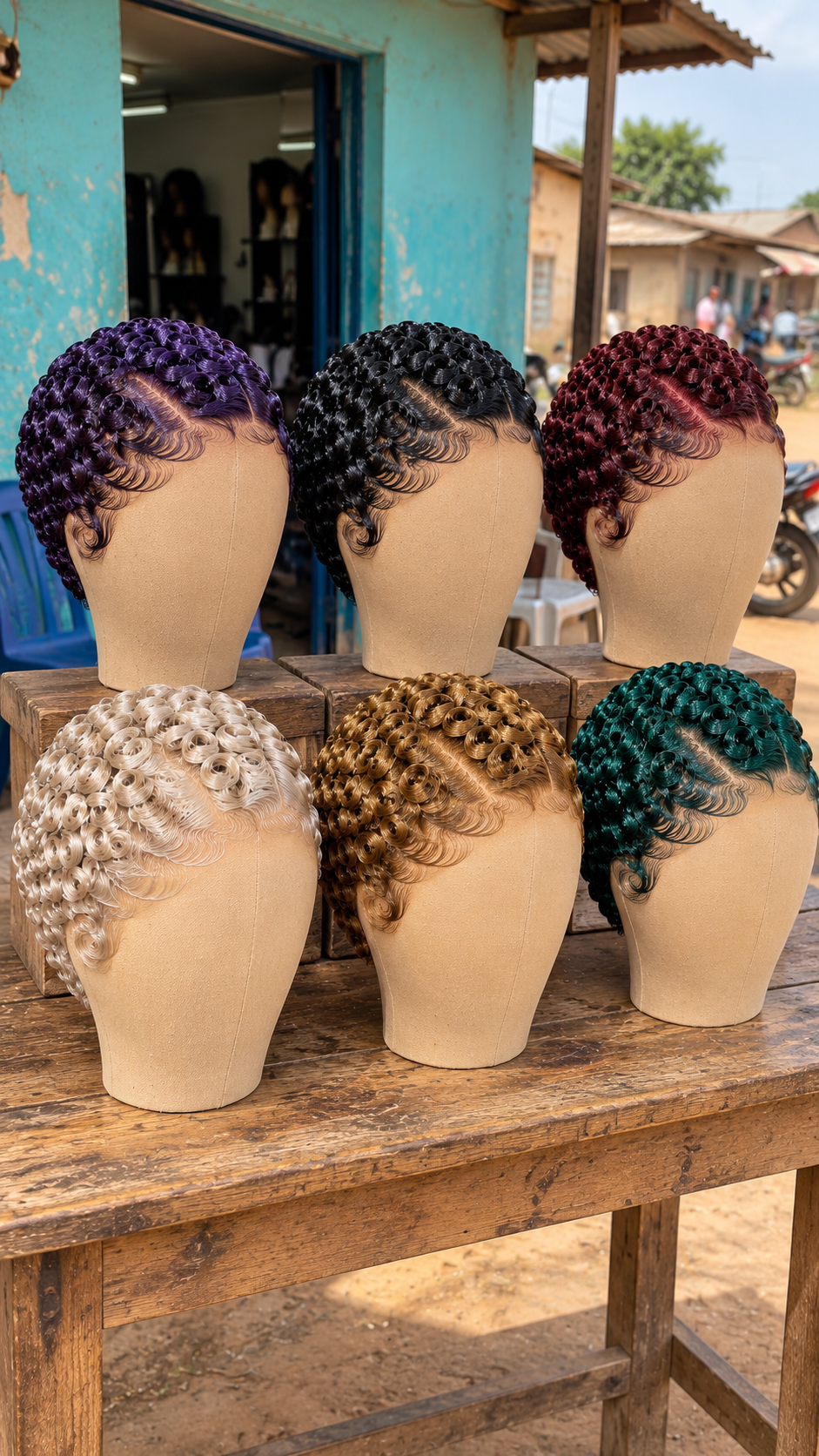
A wig does not need long hair, elaborate accessories, or an expensive showroom presentation to attract attention. Sometimes a collection of carefully arranged curls displayed on simple mannequin heads can communicate a hairstyle more effectively than an elaborate promotional photograph. This image presents six compact spiral pixie wigs arranged in two rows on a weathered wooden table outside a neighborhood beauty shop. Their colors range from deep purple, black, and burgundy to platinum blonde, golden honey, and emerald green.
Each wig combines tightly arranged circular curls with a prominent diagonal side part and decorative finger waves around the front hairline. The curls resemble small rounded rosettes, with visible openings and overlapping strands that create a dense upper silhouette. The front sections lie closer to the head and follow carefully curved paths, producing a recognizable contrast between the raised coils and the flatter hairline styling.
Unlike mannequin displays featuring painted eyes, makeup, and jewelry, this collection uses plain beige display heads without facial details. That difference makes the hairstyle itself the principal attraction. Buyers can compare the upper curl arrangement, the color distribution, and the visible front styling without accessories obscuring the hair.


The setting also reflects a practical way wigs are marketed in local beauty shops. The display sits outside a modest storefront, with wooden supports beneath the mannequin heads. Although the presentation is informal, the photograph provides enough visible styling information to compare the six options. What it does not provide is confirmation of the hair fibers, cap construction, lace materials, or actual selling prices.
The Collection at a Glance
The six wigs are displayed in two rows of three. The upper row contains a deep purple wig on the left, a glossy black wig in the middle, and a dark burgundy wig on the right. The lower row contains a pale platinum-blonde wig, a warm golden honey-brown wig, and a rich emerald-green wig.
All six share a compact pixie silhouette with dense curls across the crown. However, their coil arrangements are not completely identical. Some contain smaller, tightly grouped spirals, while others display slightly larger circular openings around the front and upper side.
Each hairstyle also includes a diagonal parting that creates a visible separation between the raised curls and the sculpted finger waves near the forehead. The direction of this parting is similar across the collection, though its apparent width and angle vary slightly.
The absence of long hanging curls is important. These wigs rely on compact, rounded upper sections rather than shoulder-length hair or a tall, loosely curled crown.
For customers who want a distinctive hairstyle without considerable length, the collection offers several useful references. The best choice depends on the preferred color, curl size, hairline styling, and intended installation method.
Deep Purple Gives the First Wig a Rich Jewel-Toned Appearance
The upper-left wig displays a deep violet-purple shade with bright reflections across the circular curls. The color appears darker between neighboring coils, while the outward-facing strands have a more noticeable purple sheen.
The upper hairstyle contains numerous compact rosettes, including several larger loops around the front. These curls are arranged closely together, creating a rounded crown without excessive height.
A pronounced diagonal parting travels across the visible front-side area. Below it, fine purple strands follow broad finger-wave curves toward the temple.
One particularly noticeable wave bends downward before curling back toward the side, creating a decorative transition between the upper coils and the lower hairline.
This version may appeal to women who enjoy bold hair colors but prefer a relatively compact haircut. The shade is more violet than burgundy, making it visually distinct from the red-toned wig beside it.
For a custom purchase, the buyer should specify whether the desired color is deep purple, violet, or plum. These descriptions can represent different shades depending on the supplier.
The Black Wig Emphasizes Circular Curl Precision
The upper-center wig has a predominantly black appearance, with glossy reflections across the tightly arranged coils.
Its circular curls are particularly noticeable around the upper front, where several openings face outward. Smaller spirals occupy the surrounding sections and continue toward the visible rear.
The dark color creates strong contrast between the reflective curl surfaces and the shadowed spaces inside them.
The diagonal side parting is clearly visible, separating the upper curls from the flatter front hair. Beneath it, the strands form carefully curved finger waves that travel toward the temple.
Because the hair is dark, the shape of the finger waves becomes especially apparent where light catches the individual strands.
For buyers who prefer a single-color hairstyle, this black version provides an example of how intricate curl placement can create visual interest without additional coloring.
The photograph does not show identifiable colored highlights. The lighter areas appear consistent with reflections rather than confirmed gray or silver strands.
Burgundy Offers a Deeper Red Alternative
The upper-right mannequin displays a dark burgundy wig with wine-red circular curls.
The color appears particularly rich across the upper hairstyle, with brighter reddish reflections along the outer surfaces of the coils.
Several compact rosettes form visible circular openings near the front, while smaller curls continue toward the crown and rearward sections.
A diagonal parting creates a pale separation beneath the curls. The front hair follows a sculpted finger-wave pattern, with strands curving toward the temple.
Compared with the purple version, the burgundy wig has a stronger red-brown character. It does not appear as bright as conventional copper or scarlet shades.
This makes it a useful option for women who want a noticeable warm color while retaining darker depth.
Before ordering, request photographs under neutral daylight. Burgundy can appear more purple, red, or brown depending on lighting conditions and the specific fibers used.
Platinum Blonde Reveals the Smallest Curl Details
The lower-left wig stands out because of its pale cream-blonde appearance. Its upper curls contain numerous small circular formations, some with clearly visible openings and others arranged into tightly overlapping spirals.
The light color makes the individual curl shapes particularly easy to distinguish. Fine strands can be followed around the rounded loops, especially near the front and upper side.
A diagonal parting separates the curls from the flatter front section. Beneath the parting, pale strands form delicate finger-wave curves across the forehead area.
The hairstyle remains compact despite the intricate curl arrangement. The upper coils provide fullness without extending into long hanging spirals.
The shade appears closer to creamy platinum or pale champagne blonde than a strongly yellow golden blonde.
For buyers considering this color, it is important to confirm the actual shade with the supplier. Pale blonde wigs may appear considerably different under warm indoor lighting and natural daylight.
The photograph does not establish whether the hair is human or synthetic, or whether the pale color was achieved through processing after manufacture.
Golden Honey Brown Creates a Warmer Look
The lower-center wig has a warm golden honey-brown appearance, with rich amber reflections across the circular curls.
The upper hairstyle contains a combination of small and medium rosettes. Several larger openings are visible near the front, while tighter coils fill the crown.
The diagonal parting follows the front-side area, creating a distinct separation between the raised curls and the finger-wave styling.
Near the forehead, the hair forms broad curved sections that follow the direction of the parting.
Compared with the platinum-blonde wig, this version has a considerably warmer and deeper color. Its golden-brown tones create a more pronounced contrast between the illuminated outer strands and the darker spaces inside the curls.
This option may appeal to customers who prefer warm hair colors without choosing copper-red or burgundy.
For a custom order, ask the supplier whether the shade is closer to honey blonde, golden brown, or caramel. Color names can vary substantially between manufacturers.
Emerald Green Adds a Distinctive Dark Color
The lower-right wig displays a deep emerald-green shade with cooler teal reflections across the curls.
The upper hairstyle is densely arranged, with several prominent circular openings near the front and smaller coils continuing toward the rear.
The dark green shade provides noticeable contrast against the beige mannequin head, making the diagonal parting and finger-wave sections easy to examine.
The front hair follows broad, sweeping curves toward the temple. Several smaller curls sit close to the side, connecting the upper crown with the lower hairline.
The green appears rich and dark rather than pale or fluorescent.
For buyers interested in this color, the difference between emerald green, teal, and forest green should be discussed before placing an order.
The photograph does not establish the coloring method or whether the wig can be safely recolored later.
Why the Diagonal Side Parting Matters
Across all six wigs, the diagonal parting is one of the most recognizable structural elements.
The exposed channel separates the raised circular curls from the flatter finger-wave section near the forehead.
Its direction creates a deliberate asymmetry, giving the hairstyle more movement than a conventional center-part pixie.
The parting also influences how much space remains for the upper curls on either side.
Moving it toward the center could change the entire appearance. Positioning it too close to the temple might reduce the area available for the decorative front waves.
For custom production, the parting should be established before the surrounding curls are arranged.
The photograph does not confirm whether these channels were created through a specific lace construction, deliberate parting, or another styling method.
Finger Waves Create a Decorative Front Hairline
The wigs feature carefully arranged front strands that form broad curves along the hairline.
These finger-wave sections lie relatively close to the mannequin head, contrasting with the raised circular curls above them.
The waves travel across the forehead and bend toward the visible temple, creating a flowing transition between the upper hairstyle and the lower side.
Some versions contain broader waves, while others have slightly finer curved sections.
These differences should be considered when choosing a reference for a custom order.
A buyer who prefers subtle front styling may select a different version from someone who wants a more pronounced finger-wave appearance.
The waves also require careful maintenance because their appearance depends on the hair remaining arranged in a specific direction.
How Curl Diameter Changes the Pixie Silhouette
The circular curls across the collection vary slightly in size.
Some wigs contain numerous small coils packed closely together. Others have several larger rosettes that are immediately noticeable around the front.
Smaller curls create a densely detailed upper surface, while larger loops produce more prominent circular openings.
Neither approach is automatically better. The preferred curl size depends on the desired hairstyle and the proportions of the wearer’s head.
For a custom wig, curl diameter should be discussed alongside crown height and density.
Adding too much hair may conceal the circular openings, while reducing density excessively can create gaps between the curls.
The goal should be a compact upper silhouette in which individual curls remain recognizable.
What the Plain Mannequin Heads Can and Cannot Show
The beige mannequin heads make the hairstyle easy to inspect because they do not contain painted eyes, elaborate makeup, or accessories that might distract from the hair.
The photograph provides useful information about visible colors, curl arrangements, parting positions, and finger-wave styling.
However, the wigs remain mounted on the display heads, concealing their undersides.
The image cannot confirm whether the wigs contain human hair, synthetic fibers, or blended materials.
It also cannot establish cap construction, lace coverage, attachment hardware, or exact sizing.
The fact that the front hairline appears carefully arranged does not establish that the wigs use HD lace or another particular construction.
Before purchasing, request an underside photograph of the selected wig along with written product specifications.
Finding Similar Wigs in Local Beauty Shops
Neighborhood wig shops and hair supply stores can be practical places to compare compact pixie hairstyles in person.
When visiting a local seller, examine the curl arrangement from the front, side, and above. Ask whether the displayed wig is the exact unit available for purchase.
If the seller allows inspection, request a view of the underside to evaluate the cap and attachment components.
For online shopping, useful search descriptions include spiral rosette pixie wig, sculpted finger-wave wig, compact circular curl hairpiece, and colored side-part pixie wig.
Specialized custom wig makers may also be able to reproduce a preferred color and curl arrangement from a reference photograph.
However, a generic curly pixie may not match the circular rosettes or diagonal parting shown in this collection.
How to Order a Specific Wig From This Collection
Start by selecting one mannequin as the primary reference. Identify the preferred color, curl diameter, and finger-wave arrangement.
Send the supplier a clear photograph of that particular wig rather than relying only on the complete six-wig display.
Explain that the upper curls should remain compact, with visible circular openings and a rounded silhouette.
Identify the diagonal parting and the direction of the front waves.
Ask the maker to avoid adding unrelated decorative side lines or increasing the crown height unnecessarily.
Finally, confirm the hair material, cap measurements, lace specifications if applicable, and intended installation method.
If possible, request a progress photograph before final styling is completed. This may help identify important differences while adjustments remain feasible.
Ready-Made Versus Custom Pixie Wigs
A ready-made wig may be suitable when the desired color, curl arrangement, and cap size are already available.
It may also provide faster delivery and a lower initial cost than a fully customized unit.
However, generic curly pixie wigs may use different curl sizes, parting directions, or hairline arrangements.
Custom production offers greater control over these details, although it may require additional labor and expense.
Before choosing either route, decide which characteristics are essential and which minor variations would be acceptable.
For this collection, the circular rosettes, diagonal parting, compact silhouette, and decorative finger waves are the most important common elements.
Illustrative Pricing for Sculpted Spiral Pixie Wigs
The cost of a comparable wig may depend on hair material, cap construction, curl-setting labor, color selection, and the extent of customization.
The photograph does not provide verified selling prices or confirm the material used in any of the six displayed wigs.
The following figures are illustrative planning ranges in US dollars rather than live product quotations.
| Wig Category | Illustrative USD Range | Potential Purchase Scope |
|---|---|---|
| Premium Custom | $315–$760+ | Individual cap sizing, detailed circular curl placement, custom color selection, and specialist finger-wave styling. |
| Standard Custom | $165–$395 | Selected adjustments to curl diameter, parting direction, cap sizing, and front styling. |
| Basic Human Hair | $95–$260 | A human-hair base unit that may require additional professional curl setting or coloring. |
| Premium Synthetic | $65–$190 | A higher-grade synthetic option with potentially prearranged rosettes and prepared finger-wave sections. |
| Basic Synthetic | $25–$100 | A budget alternative where exact curl placement, color accuracy, and styling flexibility may vary. |
These categories describe possible purchasing approaches and do not identify the material or value of the photographed wigs.
Installation, shipping, lace preparation, color customization, and future curl restoration may be charged separately.
Ask for an itemized quotation before paying, especially when commissioning a specific color and curl arrangement.
Booking a Stylist for Installation
After receiving the selected wig, inspect the curls, hairline, parting, and cap before making adjustments.
When booking a salon appointment, explain that the hairstyle contains circular rosette curls and carefully arranged finger waves.
Ask whether the stylist has experience fitting compact sculpted pixie wigs without disturbing their upper curls.
If lace is present, the cap should be positioned and checked for comfort before any trimming.
The diagonal parting should align appropriately with the forehead, and the finger waves should follow the intended direction.
Any cutting near the hairline or side should be approached cautiously because supporting cap material may lie directly beneath the strands.
Maintaining Circular Curls and Color
The upper rosettes depend on retaining their rounded shape and visible openings.
Aggressive brushing may separate the strands, while unnecessary pressure can flatten carefully arranged curls.
Before washing or restyling, confirm the material and ask the manufacturer which methods are appropriate.
For synthetic wigs, heat should only be applied within manufacturer-confirmed limits.
For human-hair wigs, restyling may be possible, but the appropriate method depends on previous processing and the original setting technique.
Color maintenance may also vary. Pale blonde hair can reveal product residue more readily, while color-treated human hair may experience tonal changes after repeated washing or excessive heat exposure.
Violet, burgundy, golden brown, and green shades may have different maintenance requirements depending on how the hair was colored.
The front finger waves should be handled carefully because their decorative appearance depends on the strands remaining arranged in the intended direction.
Choosing a Color for Everyday Wear or Special Occasions
The six wigs offer a broad range of color choices within one hairstyle family.
Black provides a classic dark appearance that emphasizes the curl structure.
Burgundy introduces a deep red tone, while purple creates a more pronounced jewel-colored appearance.
Platinum blonde offers the lightest option, making the individual circular curls particularly noticeable.
Golden honey brown provides warmth without the intensity of burgundy or purple.
Emerald green creates a distinctive dark green appearance with cooler reflections.
The best color depends on personal preference, the intended use, and the amount of color maintenance the buyer is comfortable performing.
Before purchasing, compare individual photographs under consistent lighting rather than relying entirely on the group display.
Why This Neighborhood Display Is Useful for Buyers
This collection demonstrates that sophisticated-looking curl arrangements do not require elaborate retail staging. Six wigs displayed on plain beige heads outside a local beauty shop provide a clear comparison of color, curl size, and front hairline styling.
The purple, black, burgundy, platinum blonde, golden honey, and emerald-green options share a recognizable compact pixie structure while offering different visual impressions.
The photograph is useful for hairstyle selection but does not establish fiber quality, cap construction, or installation suitability.
For buyers seeking a comparable wig, the most reliable approach is to identify the preferred color and curl arrangement, request additional product photographs, verify the specifications, and choose a stylist experienced in sculpted curls.
By considering color, coil diameter, parting direction, and cap fit together, customers can make a more informed decision without relying on unsupported product claims.
Search Terms
Six color spiral pixie wig display · Purple rosette curl finger wave wig · Black compact circular coil pixie · Burgundy diagonal parting wig · Platinum blonde sculpted spiral hairpiece · Golden honey brown rosette wig · Emerald green finger wave pixie · Beige mannequin curly wig collection