
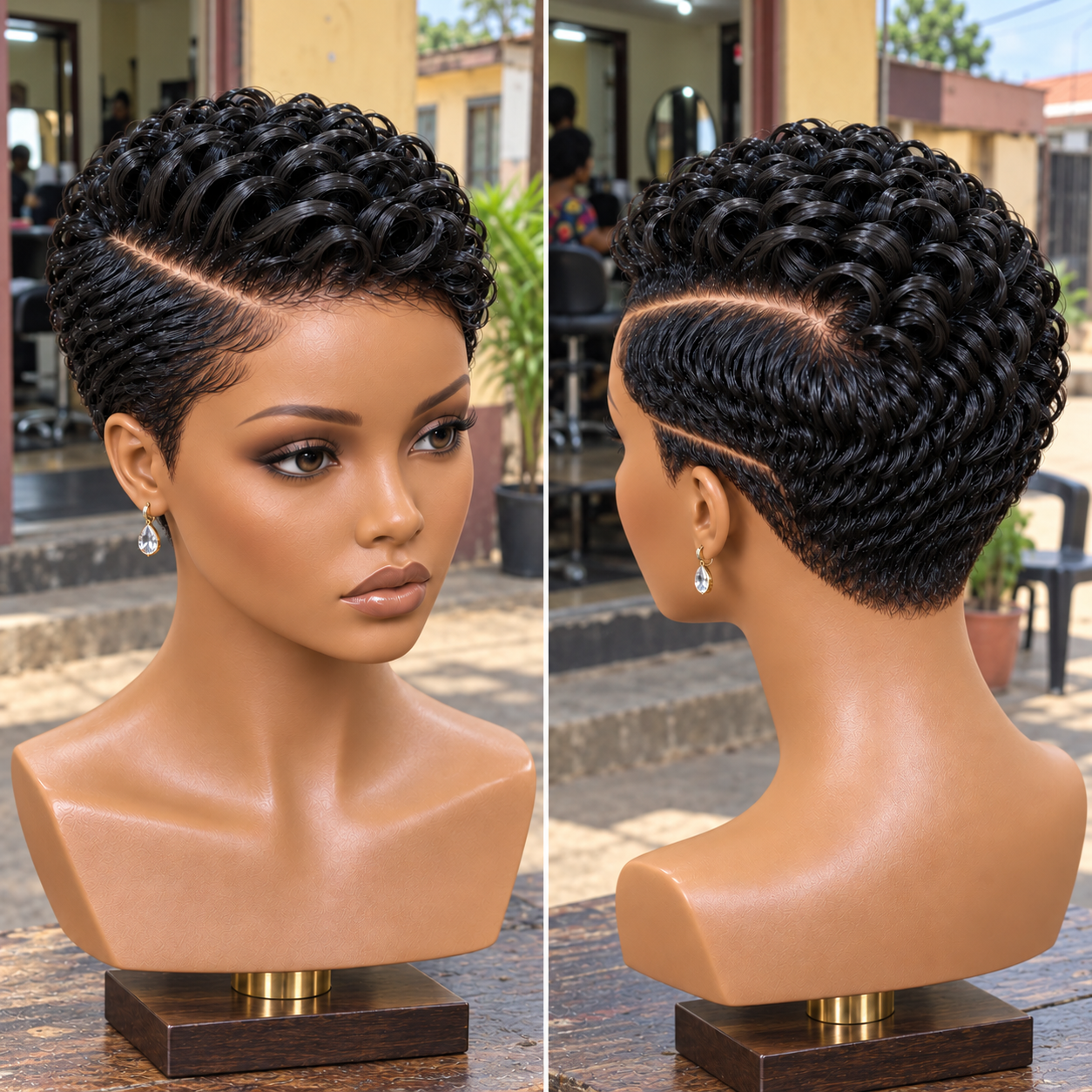
A short black hairstyle can look striking without dramatic color combinations, exaggerated height, or complicated accessories. The two-angle salon display pictured here shows how carefully arranged loop curls, a sharp side part, and a compact tapered nape can work together to create an attractive pixie silhouette. The design relies on the direction of the hair, the separation between the crown and side, and the balanced distribution of curls rather than additional decorative elements.
The first photograph presents the hairstyle from a front three-quarter angle on a female mannequin. Glossy black loops sit across the upper crown, while the side is combed into a sweeping pattern that follows the head toward the temple. A visible diagonal part separates these sections. The second photograph reveals the opposite viewing perspective, showing the rounded curl coverage, a narrow secondary side line above the ear, and the gradual reduction in hair length toward the nape.
Both photographs are particularly useful because they show the relationship between the prominent upper curls and the closely arranged lower hair. The crown has enough volume to create a sculpted appearance, yet the sides remain compact and the rear follows a short tapered shape. The visible hairstyle appears to be displayed on a mannequin, so its precise wig construction, hair fiber, cap type, and attachment system cannot be established from the photographs alone.


Two Viewing Angles Reveal the Complete Styling Concept
The first image emphasizes the front, crown, and hairline. The black loop curls create a rounded upper section, while the diagonal part separates them from the directional strands along the side.
The second image provides an additional view of the side and back. It makes the lower section easier to examine and shows how the curls continue toward the rear without creating excessive bulk.
For buyers, these two perspectives are more informative than a single frontal photograph. They demonstrate that the hairstyle depends on consistent shaping across the head, not merely an attractive front arrangement.
A custom wig maker should use both views when planning the crown height, side density, and tapered nape.
The Crown Uses Open Loop Curls Rather Than Loose Ringlets
The upper hair contains numerous loop-shaped curls with visible curved openings. Several sections form broad arches, while others fold into tighter circular shapes.
These curls remain positioned close to the crown instead of hanging downward in long spirals.
The result is a compact but visibly full upper hairstyle. The loops create depth by allowing darker strands to remain visible beneath their reflective outer surfaces.
A custom maker should preserve the rolled shape and direction of the curls rather than replacing them with ordinary loose curls.
The Forward Curls Create a Rounded Upper Silhouette
Near the forehead, several black curls rise above the foundation and bend backward. Their curved surfaces catch the light, making the individual loops recognizable.
The upper hairstyle maintains a rounded shape rather than forming an exaggerated upright crest.
Some loops appear larger near the front, while smaller curls continue toward the back and sides.
This change in scale helps the hairstyle follow the head’s natural proportions.
Glossy Black Hair Emphasizes the Curl Construction
The color appears consistently deep black, with charcoal reflections created by light falling across the curved strands.
No clearly separate blonde, burgundy, copper, or other colored highlights are visible.
This monochromatic appearance makes the arrangement of the hair particularly important. The upper loops reflect light along their outer surfaces, while the recessed sections remain darker.
For customers who want the same result, a rich jet-black or natural-black shade should be selected without adding unnecessary contrasting color.
The Diagonal Part Gives the Hairstyle Its Character
A clear scalp-toned division runs diagonally beneath the crown curls. Its placement creates a strong separation between the raised upper hair and the flatter side.
The part does not follow a perfectly straight horizontal route. Instead, it travels at an angle that complements the rounded upper section.
This separation is important because it determines how much hair belongs to the crown and how much remains available for the side styling.
A custom stylist should establish the part before arranging the final curls.
The Front Side Uses Closely Directed Finger-Wave Strands
Beneath the diagonal part, the hair is combed backward in closely aligned sections. These strands create a broad sweeping movement toward the temple.
The side styling is flatter than the upper loop curls, producing a deliberate contrast in volume.
Several fine strands follow gentle curves near the front, connecting the crown to the lower hairline.
For custom production, the maker should preserve this directional movement rather than adding extra curls throughout the side.
A Secondary Parting Adds Detail Above the Ear
The second photograph reveals a narrow exposed line above the ear. This line separates the upper side hair from a smaller lower section.
Unlike extensive barber artwork, the marking is restrained and follows the direction of the hairstyle.
The dark hair surrounding the line provides the contrast that makes it visible.
A custom maker should reproduce the existing side detail without adding unrelated geometric patterns.
The Lower Side Remains Compact
The hair beneath the main crown becomes shorter in appearance and follows the head closely. This creates a tapered silhouette without exposing large areas of the foundation.
The compact side allows the upper curls to remain the main visual feature.
Too much volume near the ear could obscure the visible parting and alter the hairstyle’s balance.
A professional should preserve the closely arranged lower section rather than extending large curls across the entire side.
The Nape Gradually Narrows Toward the Neck
The rear three-quarter photograph shows the hair becoming more compact toward the lower back. Small curls continue above the nape, while the bottom follows a tapered shape.
This gradual reduction in volume gives the hairstyle a finished appearance from behind.
The nape should not be made equally bulky as the crown, since that would change the compact pixie silhouette.
For a custom reproduction, the rear view should be used to establish the intended density and length.
The Rear Curl Coverage Is an Important Quality Detail
Short wigs can sometimes appear full from the front but uneven from the back. The second photograph helps show how the circular curls continue across the rear crown.
Several small and medium loops remain visible toward the back, creating continuity with the front.
The distribution should remain balanced without making every curl identical.
When ordering a custom unit, request a direct rear photograph to confirm complete coverage and the intended nape shape.
The Hairstyle Does Not Require Excessive Height
The crown has noticeable volume, but the overall silhouette remains compact.
This proportion is important because the shorter sides and tapered nape are essential parts of the design.
Increasing the upper curls excessively could make the hairstyle appear top-heavy.
A custom maker should preserve the existing height and rounded shape rather than treating additional volume as an automatic improvement.
The Mannequin Presentation Does Not Verify Wig Materials
The hairstyle is displayed on a mannequin, concealing the underlying construction.
The photographs do not confirm whether the unit uses human hair, synthetic fiber, or a blend.
They also do not reveal the complete cap, lace material, or fastening components.
Buyers should request verified product specifications rather than assuming a particular construction from the finished appearance.
Cap Size Determines the Parting Position
For a wig version of this hairstyle, the diagonal part and side detailing would be fixed to the foundation.
If the cap sits too far forward or backward, the parting and side line may fall in different positions relative to the wearer’s face.
Correct sizing therefore matters for both comfort and appearance.
For made-to-order wigs, follow the manufacturer’s measurement guide. Circumference, front-to-nape, and ear-to-ear measurements may be required depending on construction.
Choosing a Human Hair or Synthetic Version
Human-hair wigs may offer greater flexibility for professional curl restoration and adjustments, depending on the quality and condition of the strands.
Some synthetic wigs can retain pre-set loop curls with comparatively little daily styling.
However, synthetic fibers vary in heat tolerance and future modification options.
Buyers should choose the material based on their intended maintenance routine, budget, and preference for restyling.
Where to Find Similar Short Black Loop Curl Wigs
Custom lace-wig studios, specialist wig makers, beauty supply retailers, and salons experienced with sculpted pixie hairstyles are practical places to begin.
A ready-made black curly pixie wig may be suitable when its crown and side arrangement closely match the reference.
Custom production may be necessary when the diagonal part and rear taper must be reproduced more precisely.
Before purchasing, confirm whether the seller provides a completed styled unit or a foundation that requires additional professional work.
Get the Details on This Wig Style
When contacting a supplier, provide both photographs and explain that the desired hairstyle uses compact black loop curls rather than long loose ringlets.
Specify the diagonal crown part, backward-directed side hair, narrow line above the ear, and tapered nape.
Ask for confirmation of the hair material, cap size, lace options if applicable, and installation method.
If the product is made to order, request photographs of the completed unit before final shipment.
Finding the Right Stylist for This Pixie Shape
The hairstyle combines several techniques that require careful coordination.
The upper crown uses sculpted loop curls, while the side relies on closely arranged directional strands.
The nape requires compact shaping, and the exposed partings should remain clearly visible.
A professional experienced with short sculpted wigs or detailed pixie styling is more appropriate than someone whose portfolio contains only long loose-curly hairstyles.
Preparing a Custom Production Brief
The crown should contain glossy black open loop curls arranged into a rounded compact silhouette.
A visible diagonal part should separate the upper curls from the flatter side.
The side should contain backward-directed black strands and a narrow secondary part above the ear.
The rear should maintain consistent curl coverage while tapering toward the nape.
No contrasting highlights or unrelated geometric side designs should be added.
Cap dimensions, material, and attachment preferences should be confirmed before production.
Approval Photographs Should Match Both Reference Angles
A front three-quarter photograph should reveal the diagonal part, crown curls, and hairline.
A rear three-quarter view should show the side line, compact rear curls, and tapered nape.
An elevated crown photograph can help confirm curl distribution and volume.
For a wig, an underside photograph should also establish the actual cap construction.
Understanding the Cost of Sculpted Black Pixie Wigs
The hairstyle has a short length and a single black color, but individual loop setting and precise shaping can still require professional labor.
Material selection, cap construction, lace preparation, and fitting services may influence the final price.
Estimated Pricing for Sculpted Loop Curl Pixie Wigs
| Category | Illustrative Price Range | Potential Scope |
|---|---|---|
| Premium Custom | $310–$580+ | Higher-grade hair, personalized cap sizing, individually arranged black loop curls, precise parting, detailed side styling, and professional finishing. |
| Standard Custom | $190–$345 | Prepared black curl crown, shaped side part, tapered nape, and standard cap options. |
| Basic Human Hair | $110–$210 | A human-hair foundation requiring curl setting, side shaping, and professional fitting. |
| Premium Synthetic | $75–$150 | A quality pre-set alternative that may maintain the compact curl structure with limited routine styling. |
| Basic Synthetic | $35–$90 | A budget interpretation with potentially simpler curl placement, side definition, and cap construction. |
These figures are illustrative budgeting estimates rather than verified prices for the pictured hairstyle. Actual costs depend on material, supplier, location, customization work, shipping, and installation.
Buyers should compare completed-unit prices rather than assuming every basic curly pixie wig includes professional sculpted styling.
Human Hair May Allow Professional Curl Restoration
A human-hair version may allow individual loops to be reset when they lose their shape, depending on hair quality and condition.
Professional restoration can focus on displaced curls rather than rebuilding the entire crown.
Heat should be selected according to the actual condition and processing history of the hair.
Synthetic Curls May Retain Their Original Pattern
A quality synthetic version may preserve its pre-set loop curls with relatively limited daily manipulation.
However, heat tolerance varies by fiber, and conventional permanent coloring should not be assumed suitable.
Follow the supplier’s care instructions before applying styling products or heated tools.
Washing Without Disturbing the Loop Curls
Before washing, photograph the crown from above to record the original curl placement.
Avoid aggressive rubbing that could intertwine neighboring loops and obscure their individual shapes.
Use cleansing methods appropriate for the confirmed material.
After drying, restore any displaced sections individually.
Maintain the Side Part Separately
The dark side should remain closely arranged and directional rather than becoming as curly as the crown.
If the strands shift across the parting, carefully reposition them along the original direction.
Unnecessary cutting could widen the division or permanently change the shape of the side.
Protect the Tapered Nape
The lower rear should retain its compact shape. Aggressive cutting could make the nape appear sharper or shorter than intended.
If small curls become displaced, targeted maintenance may be sufficient.
A professional should use the rear reference photograph when making significant adjustments.
Avoid Excessive Product Buildup
The glossy black curls already reflect light strongly. Heavy styling products may cause neighboring loops to stick together and lose their separation.
Use products appropriate for the confirmed fiber and apply them conservatively.
Suitable cleansing may restore the curl definition more effectively than applying additional shine products.
Installation Should Preserve the Side Alignment
When a wig version arrives, inspect the crown, diagonal part, side line, nape, and cap before permanent alterations.
The installer should establish the final wearing position and check where the decorative parting falls relative to the temple and ear.
Only after the fit is correct should optional lace trimming or styling adjustments be considered.
Storing the Wig Without Flattening Its Curls
A suitable wig stand or mannequin head can help preserve the rounded crown.
Avoid stacking the unit beneath other hairpieces or placing heavy objects against its curls.
The lower side should also remain free from pressure that could disturb the directional styling.
Make sure the hair and cap are completely dry before storage.
Why This Short Black Hairstyle Stands Out
The design combines a rounded crown of glossy loop curls with a prominent diagonal part, closely arranged side hair, and a compact tapered nape. Its visual appeal depends on careful hair direction and proportional shaping rather than contrasting color or excessive volume.
For buyers, the most important quality checks are curl diameter, crown density, parting placement, side-line accuracy, rear coverage, nape shape, and verified wig construction.
For wig businesses, front and rear three-quarter photographs provide useful evidence of how a hairstyle looks from different angles. Additional product specifications help customers understand what they are purchasing.
A faithful custom recreation should preserve the original loop-curl structure and compact silhouette without adding highlights, unnecessary side carving, or excessive crown height. The strongest result is one that looks balanced from both the front and rear.
Search Terms
jet black loop curl pixie wig · diagonal side part black pixie · sculpted short black curls · tapered nape curly wig · glossy black crown loops · compact side part wig · front and back pixie hairstyle · black loop curl hairpiece