
The Details That Make This Style Recognizable
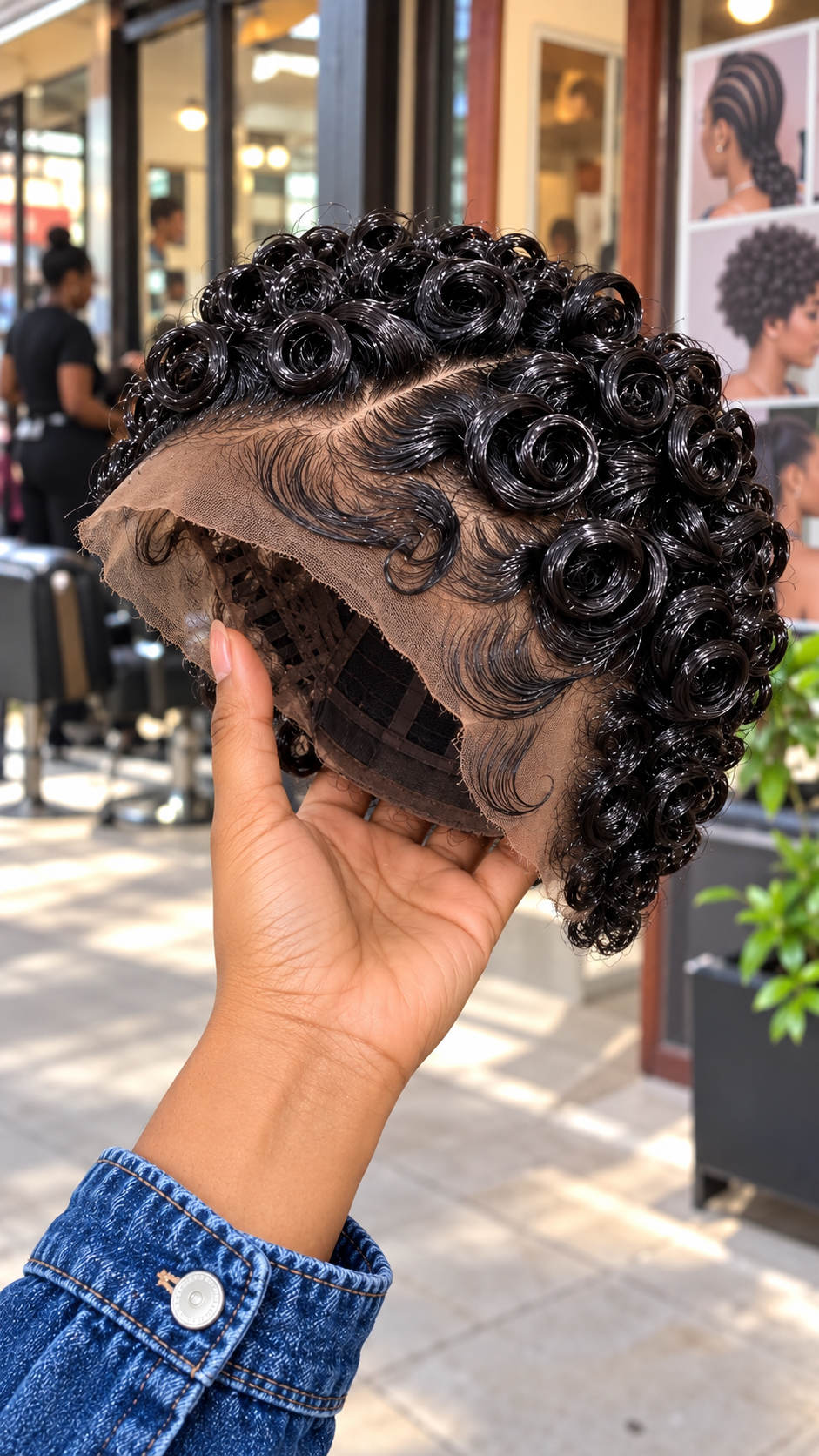
The most distinctive feature is the open center inside many of the curls. Each loop resembles a small rolled ribbon, with strands following a circular direction around it. That structure creates the rosette effect visible throughout the wig. A seller might describe similar work as sculpted pin curls, molded curls, or a rosette curl pixie. Those descriptions can help with searching, but photographs remain essential. Two products carrying the same name may have very different curl sizes, crown heights, and front arrangements, so the reference image should be part of any serious order discussion.
The side part gives the style a clear direction. Hair moves away from the exposed line into fuller curls above it, while the section below the part follows flatter waves before joining the side curls. This contrast prevents the entire wig from looking like one uniform cluster. When requesting a recreation, ask the stylist to preserve the relationship between the part, the rolled crown, and the lower front waves. Increasing the curl size everywhere or lifting the front too high would change the character of the style, even if the color and overall length stayed similar.


The color appears black throughout, with bright reflections emphasizing the paths of individual strands. Those reflections should not be mistaken for a second color. The photograph also shows a strongly styled surface, but it cannot establish which products created that appearance or whether the fiber is human hair, synthetic hair, or a blend. Likewise, visible front lace does not establish its grade. A useful buying decision separates what the photograph demonstrates from what the seller still needs to confirm in writing.
Choose the Finished Shape Before Choosing Extra Density
For this particular look, a balanced outline matters more than a dramatic density label. The curls already add dimension because they stand away from the cap in small loops. Adding substantially more hair may make the crown wider, crowd the side part, or leave the front difficult to arrange. Instead of asking automatically for the highest density available, show the seller the silhouette you want. Request a short unit with enough coverage between the curls, moderate crown height, and sides that follow the head without creating an oversized rounded shape.
The underside view in the photograph is helpful, although it does not show every part of the cap. Ask for additional pictures of the back, both sides, and the wig resting on an appropriately sized stand. A close photograph of beautiful curls cannot tell you whether the nape is bulky or whether the back sits too flat. A short wig needs a coherent outline from every direction. The back should support the crown and taper into the lower edge in a way that looks intentional when the wearer turns around.
Length descriptions also need context. On a sculpted wig, the length of a strand when extended may be quite different from the height of its finished curl. An advertised measurement therefore cannot replace photographs of the styled unit. Ask whether the listed length refers to stretched hair, the original base wig, or the final cut. If your priority is this compact appearance, make that clear before purchase. Otherwise, a seller may send a longer curly unit and assume that a local stylist will complete the shaping.
Where To Buy This Wig
Start with wig boutiques, independent wig makers, and salons that regularly offer short sculpted curl wigs. The reference is especially useful when contacting businesses whose portfolios already include pin curl pixies, finger-wave fronts, or short occasion wigs. A stylist experienced with long loose curls may still be talented, but their usual work might not demonstrate the setting technique needed here. Look for examples that show circular curls with visible centers, a controlled front section, and a finished shape photographed from more than one angle.
When browsing an online marketplace, search beyond the first product title. Useful phrases include “black rosette curl wig,” “short pin curl lace wig,” and “side part sculpted curl pixie.” Read the description to determine whether the item arrives styled or whether the listing shows an optional salon finish. Some photographs represent a custom styling service applied to a separate wig base. Before paying, ask whether the advertised amount includes the hair unit, the cut, the curl setting, lace preparation, and any fitting adjustments.
A direct message can be specific without becoming complicated: “I would like a short black wig with these open rosette curls, this side-part placement, and the flatter waves at the front. Can you show a similar unit you have made, including the back and inside cap? Please confirm the fiber, cap size, lace area, final price, and whether it arrives fully styled.” This gives the seller concrete points to answer. It also helps you compare offers on the actual product being supplied instead of comparing attractive photographs with incomplete descriptions.
Request a short video of the exact unit when possible, particularly for a ready-made purchase. The seller can rotate it slowly in ordinary light and show the front, crown, sides, back, and interior. For a custom order, ask to see comparable previous work and agree on which details will be checked before dispatch. Save the written specification and read the seller’s return or alteration terms. A custom-cut wig may be handled differently from an unworn stock item, so those conditions should be understood before the work begins.
Human Hair, Synthetic Fiber, and the Styling Question
The right fiber depends partly on whether you want to preserve this exact arrangement or change the wig regularly. Some synthetic units are manufactured with a persistent curl pattern, but additional salon styling may behave differently from the original factory texture. Human hair can offer more restyling options, yet a sculpted set will still require appropriate maintenance. Neither category guarantees the photographed result on its own. Ask how the loops were formed, what happens after washing, and whether the supplier provides a resetting service.
Do not assume that every synthetic wig accepts heat. If the seller identifies the unit as heat-friendly, request the manufacturer’s temperature instructions and care directions for that specific fiber. For human hair, ask whether it has been colored or otherwise processed and how the stylist recommends maintaining the set. The useful comparison is the total ownership experience: purchase cost, cleaning needs, professional resetting, and the amount of styling you are comfortable doing. A lower initial price may suit occasional wear, while another option may better suit someone who wants regular changes.
The glossy finish deserves a separate conversation. The image shows clear reflections across the black loops, but a purchase should not depend on shine alone. Ask to see the wig in daylight without a filter and, if possible, without freshly applied shine spray. You want to assess curl structure, coverage, and fiber appearance as well as surface reflection. Tell the stylist whether you prefer this highly polished presentation or a less reflective version. Both requests can retain the same basic curl arrangement, provided the finishing products are chosen accordingly.
Fit Comes Before Lace Trimming
A carefully arranged short wig can still sit poorly if its cap is the wrong size. Measure according to the seller’s instructions and check the available size options before ordering. Circumference is useful, but some suppliers also request front-to-nape and ear-to-ear measurements. Those details can matter when positioning the side sections and keeping the nape close to the head. If you are between sizes, ask how much adjustment the cap allows instead of assuming that a tighter strap will solve every fit problem.
The front lace in the photograph extends beyond the styled hairline and has not been cut to a wearer’s individual outline. That is a preparation stage rather than the final fitted appearance. Try the wig on and establish its placement before trimming. The side part, front waves, and temple areas should all be assessed together. If you are unfamiliar with lace cutting, a wig stylist can help preserve a workable edge. Cutting too far into the hair-bearing area can remove useful material and make later fitting more difficult.
Ask what lace shade is available and how it looks against your skin in ordinary light. The warm mesh visible here is not enough to establish an exact shade match for another wearer. Also confirm how far the lace extends and whether the side part can be moved. A unit may have lace at the front while offering limited parting space farther back. If you want to reproduce the pictured part precisely, the seller should verify that the construction supports that location rather than promising unlimited styling freedom.
Deciding Between Glueless Wear and an Installed Finish
A glueless option can be convenient for someone who prefers to remove the wig regularly, but the word should describe the complete fit system. Ask whether the unit includes an adjustable band, straps, or other securing features, and have the seller explain how it stays in place. Front lace alone does not confirm that a wig is ready for secure glueless wear. The short cut may make handling easier, but stability still depends on cap design, sizing, and how the front sits on the individual wearer.
If you prefer an installed finish, discuss it with a stylist who works with short lace wigs and sculpted fronts. Explain that you want the circular curls and side waves preserved during fitting. The stylist should be able to position the lace without flattening the crown or pulling the front arrangement out of alignment. Ask which services are included in the appointment: fitting, lace customization, securing, touch-up styling, and removal guidance may be priced separately. Knowing the scope helps you arrive with the right expectations and enough appointment time.
You can also request a less elaborate front while keeping the main curl pattern. The photograph includes several pronounced swoops extending over the lace. Some wearers enjoy that detail; others prefer shorter, subtler front pieces. Decide this before the stylist completes the setting. Changing those pieces after they have been heavily arranged may require part of the front to be reset. A clear preference about the hairline allows the finished wig to reflect your taste without sacrificing the rosette curls that attracted you to the reference.
A Practical Five-Tier Budget
The table below is an illustrative budgeting framework in US dollars, not a current price list or a quote for the pictured wig. It shows how you might divide a budget across different purchasing routes. Actual offers can fall outside these bands, and the bands do not prove fiber quality, lace quality, or workmanship. Compare written specifications and completed examples before deciding what represents value. Delivery, taxes, installation, customization, and later resetting may be additional costs.
| Budget Tier | Illustrative Allocation | Purchase Route to Explore | Questions to Resolve |
|---|---|---|---|
| Entry Budget | Under $75 | A stock short curled unit or a basic wig intended for further styling | Does it already have rosette curls, and what fiber and front construction are supplied? |
| Everyday Budget | $75–$150 | A ready-styled unit with more clearly documented cap and care details | Are the pictured cut, curl setting, and any lace preparation included? |
| Styling Budget | $150–$300 | A selected wig base combined with a dedicated cutting and setting service | What portion pays for the unit, and what portion covers the stylist’s work? |
| Custom Budget | $300–$500 | A more individualized order with agreed fit, front placement, and curl arrangement | Which measurements, review stages, and alterations are included in writing? |
| Extended Service Budget | Above $500 | A bespoke project or a package combining the wig with additional salon services | What specific materials, workmanship, appointments, and aftercare justify the total? |
For a fair comparison, ask each supplier for the total needed to reach a wearable result. One quote might include a finished wig and fitting, while another covers only an unstyled base. A third may include shipping but exclude lace preparation. List those differences before comparing the totals. If your budget is limited, prioritize a suitable cap, convincing curl work, and a balanced cut. Optional accessories and elaborate packaging will not correct a poorly placed part or a bulky nape.
Booking the Right Stylist
When arranging an appointment, ask for someone who handles short wig shaping, molded waves, or pin curl setting. Send the reference in advance and explain whether you are bringing your own unit or purchasing one through the salon. If you already own a wig, provide its fiber information and current condition. A stylist needs to know whether the hair can support the intended technique before accepting a restyling request. An existing short curly wig may need adjustments, and some bases may not reproduce this arrangement closely.
Agree on the priorities in plain language: a black color, visible circular curl centers, a side part, moderate height, and controlled sides. Then discuss the details that can be personalized, such as front swoops and nape length. Ask whether you can inspect the fit before the final setting is completed. This is especially useful with a short cut, where small changes around the ears or forehead affect the overall appearance. Bring any glasses you wear regularly so their arms can be considered during fitting.
Keeping the Curl Arrangement Intact
Routine care should protect the shape instead of treating the wig like loose curls. Avoid running a brush through the finished rosettes or pulling your fingers repeatedly through their centers. Those actions can separate the arranged sections and undo the circular form. Handle the wig by supporting the cap and lower edge whenever possible. If one curl moves out of position, follow the stylist’s touch-up instructions rather than brushing the surrounding area. A small correction may be enough when the rest of the set remains intact.
Before washing, find out whether the rosettes are a lasting fiber pattern, a temporary set, or a combination of both. That determines what the wig may look like afterward. Use care products and water temperatures appropriate to the verified fiber, and follow the supplier’s method. Do not assume that a shampoo will preserve a salon-arranged style unchanged. If the set needs professional renewal after cleaning, plan for that service. Knowing this beforehand is more useful than discovering after washing that the loops need to be rebuilt.
Product use should be purposeful. A wig that already has a firm, glossy set may not benefit from additional gel, oil, or spray before every outing. Repeated layering can leave residue and change how the strands sit together. Ask the stylist to identify the products already used and explain which, if any, are suitable for maintenance. When touching up the front, work with the smallest amount needed for the approved method. Keep products away from areas where buildup would interfere with the chosen securing system.
Store the wig on a suitable stand in a clean place where its curls will not be pressed against other objects. Avoid stretching a small cap over an oversized head form. For travel, use a container that supports the unit and leaves space above the crown. A tightly packed bag can compress the loops even when the hair itself remains untangled. If the wig is damp after cleaning, follow the fiber-specific drying directions and allow it to dry fully before enclosed storage.
Check the Finished Unit Before Wearing It Out
A final inspection should include more than the attractive front angle. Look at the wig in a mirror from both sides and check the back with a second mirror or a phone photograph. The part should sit where you intended, the crown should look proportionate, and the lower sections should follow the head comfortably. Check that the front waves have not been distorted during fitting. If the wig shifts when you turn your head, revisit the fit before adding more styling product.
For a ready-made order, inspect the unit before making alterations that could affect the seller’s return terms. Compare it with the agreed specification, including color, curl placement, cap size, and included components. Photograph any concern clearly and contact the supplier promptly. For a salon service, raise fit or shape concerns while you are still at the appointment. A minor adjustment is easier to discuss when the stylist can see the wig on your head and understand exactly which section needs attention.
This style works best when its strongest details remain easy to read: circular black curls, a clear side part, and a front that flows into the sides. Buying it successfully means finding a supplier who can reproduce those elements and explain the construction beneath them. With a suitable fit and a realistic care plan, the wig can retain the compact, carefully arranged character shown in the photograph. Let the curl workmanship guide the purchase, then use customization to make the finished unit comfortable and appropriate for your own routine.
Search Terms
black rosette curl wig · short pin curl wig · side part lace front wig · sculpted black curls · short curled pixie wig · finger wave front wig · rolled curl wig · black wig with uncut lace