
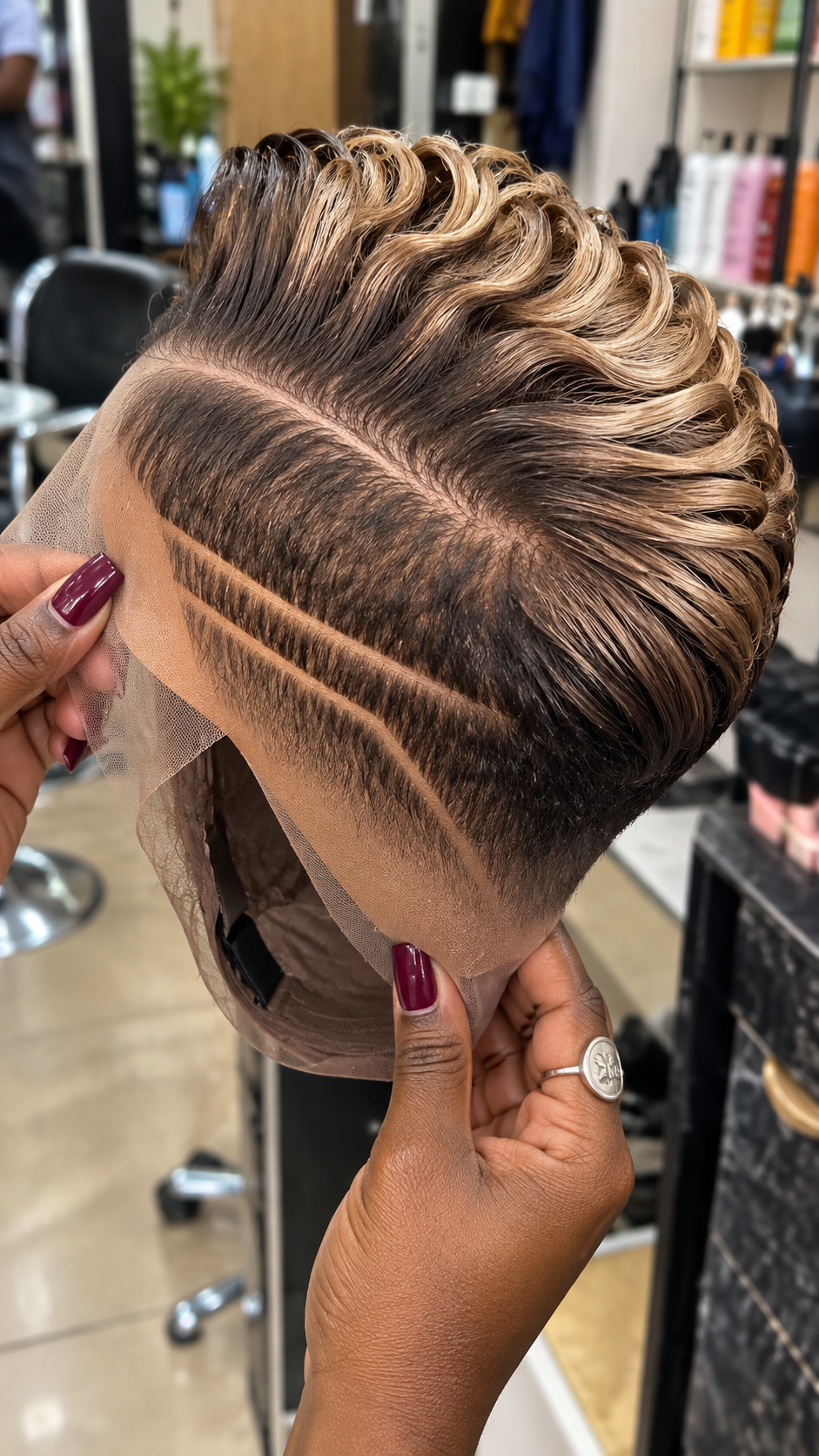
A hairstyle can be compact without looking simple, and this honey blonde pixie wig demonstrates how carefully directed hair can create a striking appearance without relying on excessive length or oversized curls. The design combines a dark brown foundation with sweeping honey-blonde sections, a pronounced diagonal parting, and two curved separation channels across the visible lower side. Its most distinctive characteristic is the movement of the upper hair, which rises from darker roots before folding backward into broad, sculpted waves.
The photograph captures the wig before installation, held with two hands inside a working hair salon. Rather than displaying the hairstyle on a mannequin or a model, this perspective reveals how the upper waves relate to the lower side panels. The beige lace remains untrimmed, and part of the brown interior cap is visible beneath the hairpiece.
Unlike a traditional curly pixie covered with small circular ringlets, the upper section contains wide, elongated waves that bend into rolled formations. The lighter strands appear concentrated across the top and upper rearward area, while the lower hair remains predominantly espresso brown. This distribution gives the wig a noticeable two-tone appearance without creating a sharp, uniform color boundary.


For women looking for a honey blonde pixie lace wig, a dark-rooted sculpted hairstyle, or a compact side-part wig with directional waves, understanding these details is essential. The correct purchasing decision depends not only on the color but also on the position of the parting, the proportions of the side panels, and the quality of the finished cap.
Why the Swept Upper Waves Deserve Attention First
The upper hairstyle is built around a sequence of broad hair sections that rise near the front and travel backward. Each section follows a curved path, forming elevated waves rather than independent hanging curls.
Near the front, the dark-rooted hair stands relatively upright before bending toward the crown. Farther back, the honey-blonde sections create more pronounced wave ridges. Several strands fold into loose rolled shapes, adding depth without forming the hollow circular loops seen in spiral-coil pixie wigs.
The waves appear carefully grouped. Individual strands travel in the same direction within each section, creating glossy ribbons that reflect the salon lighting.
The shape is not entirely uniform. Some upper waves are broader and more elevated, while others sit closer to the surrounding hair. This variation produces a natural-looking progression across the hairstyle.
The visible silhouette remains compact. The upper hair has noticeable height, but the wig does not resemble a tall pompadour or a loose, voluminous curly crown.
When commissioning a reproduction, the buyer should emphasize the backward direction and broad wave formation. Asking only for a blonde curly pixie could result in a completely different hairstyle.
The Difference Between Rolled Waves and Spiral Curls
A spiral curl generally travels around a continuous curved axis and may form an obvious circular opening. The waves in this hairstyle behave differently. They extend across a greater distance before bending, producing elongated ridges and folded sections.
Some of the upper ends curl inward, but the overall pattern is dominated by directional movement rather than numerous separate ringlets.
This distinction influences both manufacturing and maintenance. A tightly coiled pixie may require individual curl restoration, while a broad wave arrangement depends more heavily on preserving the direction and grouping of longer strands.
The photograph does not establish the exact styling method or products used. A professional wig maker should explain how comparable waves can be achieved with the proposed material and whether the hairstyle will require resetting after washing.
A Honey Blonde Color Arrangement With Espresso Depth
The upper hair displays warm honey blonde, beige blonde, caramel, and deeper brown tones. The brightest blonde areas appear across the raised wave sections, particularly where the strands bend backward and catch the light.
Near the roots, the hair is considerably darker. The visible foundation ranges from medium brown to deep espresso brown, creating a gradual visual transition into the lighter upper lengths.
The color does not appear uniformly blonde from root to tip. Instead, the darker foundation remains prominent through the front, parting area, and lower side.
This contrast is important because it emphasizes the movement of the upper waves. The lighter strands trace their curved direction while the darker sections provide depth beneath them.
Some blonde sections appear almost champagne-colored under the salon lighting. Others are warmer and closer to caramel. These differences may reflect intentional color placement, lighting, or a combination of both.
Before ordering, buyers should request photographs under indirect natural daylight to confirm the actual shade distribution.
How to Communicate the Color Without Ordering the Wrong Blonde
Honey blonde is a broad commercial description. One supplier may use it for a golden-yellow shade, while another may offer a muted beige blonde under the same name.
For this design, the more useful instruction is to request a dark brown foundation with warm honey and beige-blonde upper sections.
The darker roots should remain visible, and the lighter hair should follow the direction of the raised waves rather than appear as random bright patches.
A uniformly pale blonde wig would change the appearance considerably. So would a black wig with only a few thin blonde streaks.
If the proposed material is human hair, ask whether it has previously been processed and whether additional lightening is appropriate. If synthetic hair is selected, confirm the available manufactured colors rather than assuming conventional hair dye can be applied.
The photograph cannot establish the fiber composition, so any coloring recommendation must remain conditional on verified product information.
The Diagonal Parting Creates a Clear Styling Boundary
A prominent pale parting runs diagonally across the visible upper-side area. It begins close to the front and continues backward beneath the raised waves.
The channel separates two sections with distinctly different hair directions.
Above it, the hair rises toward the blonde upper hairstyle. Below it, dark brown strands lie closer to the cap and follow a flatter diagonal path.
This contrast gives the haircut its layered character without requiring a large difference in overall hair length.
The parting appears relatively broad near the front, where the surrounding hair has been directed away from the exposed channel. Its width and visibility change slightly along its length.
The image does not establish whether the parting was produced through a specific ventilation technique, hair separation, cutting, or another process.
For an accurate custom reproduction, the maker should preserve the position and direction of the visible channel before arranging the upper waves.
Two Curved Side Channels Add Detail Without Excessive Decoration
Below the main diagonal separation, the visible side contains additional narrow curved divisions. Two particularly noticeable channels run through the closely arranged dark hair, creating layered sections beneath the upper hairstyle.
The broader lower-side separation follows a sweeping diagonal direction, while another narrower channel traces a related curve closer to the lower edge.
Their paths are not perfectly straight or mechanically parallel. They follow the contour of the hairstyle and narrow as they approach the rearward portion of the visible side.
Dark hair remains between these channels, creating a series of compact panels.
This arrangement differs from a conventional clipper fade with bare skin showing across the entire side. The photograph clearly displays hair coverage throughout the lower section.
It is also important not to claim that the visible separations were necessarily made using a razor. Their appearance is established, but their production method is not.
When ordering, describe the curved channels and their spacing rather than simply requesting shaved lines.
Why Side-Panel Density Matters
The middle panel beneath the upper parting is relatively broad. The hair appears closely arranged, with individual strands following the diagonal direction of the surrounding channels.
Lower down, the panels become narrower and taper toward the lower edge.
If a maker removes too much hair from these areas, the cap or lace beneath may become more visible than intended. If too much hair is retained, the pale channels may disappear beneath the strands.
The correct balance depends on the construction of the wig and the amount of hair available for styling.
For this reason, detailed side photographs should be requested before a custom unit is approved.
The Lower Side Has a Compact Tapered Appearance
The visible lower section is predominantly dark brown, with strands arranged close to the supporting structure.
Its profile narrows toward the lower edge, creating a tapered-looking silhouette beneath the fuller upper waves.
The transition is relatively gradual. The hair does not appear completely removed, and the photograph does not establish a skin fade.
Near the lower front, fine strands extend toward the lace and blend into the surrounding directional styling.
This compact side balances the raised blonde upper section. Without the lower contrast, the hairstyle might appear considerably bulkier.
For women who enjoy sculpted pixie wigs but prefer some hair coverage around the sides, this arrangement provides a useful reference.
The Front Hairline Before Installation
The wig is shown before its lace has been trimmed, leaving a broad beige mesh margin around the front and visible temple.
Fine dark strands are visible near the beginning of the upper hairstyle. They transition toward the side parting and the closely arranged lower hair.
Unlike wigs with elaborate circular baby hair patterns across the forehead, this design appears to rely more heavily on the direction of the main hairstyle than on extensive decorative edge styling.
The final hairline appearance cannot be established while the wig is held away from a head.
The position of the cap, the wearer’s forehead shape, and any additional customization will influence how the lace and front strands look after fitting.
A professional stylist should evaluate the hairline before altering the existing wave direction.
The Brown Interior Cap and Visible Attachment Detail
The photograph exposes part of the underside, including a brown fabric cap and dark securing material near the lower opening.
The visible construction appears to include stitched sections and a dark attachment component, although the full interior is not shown.
These details provide evidence of the physical cap beneath the hairstyle, but they are not sufficient to confirm the complete attachment system.
The photograph does not establish the total number of combs, the complete strap configuration, or the cap’s exact adjustment range.
It also does not prove that the wig can be worn securely without adhesive.
Buyers should request a complete inside-out photograph before purchasing, especially if they have specific requirements regarding comb placement or adjustable hardware.
Measurements That Should Be Confirmed
Cap circumference is the first measurement to establish, but it should not be the only consideration.
The front-to-back length and ear-to-ear measurements also influence how the wig sits.
A cap that is too small may create pressure and shift the intended styling position. A cap that is too large may move during wear and alter the alignment of the parting and side channels.
If the supplier offers several sizes, compare the manufacturer’s measurement instructions rather than assuming that all brands use identical sizing standards.
For custom construction, provide accurate measurements before production begins.
How To Order This Style
Start by contacting a wig maker or specialized lace wig boutique that has experience with sculpted pixie designs and directional wave styling.
Send the reference photograph and explain that the hairstyle should feature broad honey-blonde waves over darker roots, not numerous tight circular ringlets.
Identify the diagonal upper parting and the two curved lower-side channels as important elements.
Ask the maker to preserve the compact tapered silhouette while keeping the upper hair elevated enough for the blonde waves to remain visible.
Before paying, request confirmation of the hair material, cap measurements, lace specifications, and the amount of styling customization included.
If a supplier offers a ready-made version, ask whether the photograph shows the actual unit available for shipment.
For a custom order, request a progress photograph after the upper waves and side sections have been arranged. This provides an opportunity to identify major differences before final completion.
Ready-Made Wigs Versus Fully Customized Construction
A ready-made wig may be a reasonable choice if the buyer finds a unit with a similar color arrangement, wave direction, and cap size.
However, many wigs advertised as blonde pixie styles use loose curls, conventional side-swept layers, or uniformly colored hair.
Those alternatives may be attractive without reproducing this particular design.
Custom production provides greater control over the blonde placement, wave size, parting direction, and lower-side geometry.
The trade-off is that additional customization may increase the price and require more detailed communication.
Buyers should compare completed examples of the supplier’s work rather than relying solely on marketing descriptions.
An accurate ready-made unit may offer better value than an expensive custom wig that fails to reproduce the intended hairstyle.
Illustrative Pricing for a Honey Blonde Sculpted Pixie Wig
The price of a comparable wig can be influenced by hair material, cap construction, lace coverage, color processing, and the labor required to shape the upper waves and curved side channels.
The photograph does not establish the actual manufacturer, fiber composition, or selling price.
The following US dollar ranges are illustrative planning estimates rather than verified current retail quotations.
| Wig Category | Illustrative USD Range | Potential Cost Considerations |
|---|---|---|
| Premium Custom | $340–$780+ | Personalized cap construction, precise honey-blonde color placement, sculpted wave setting, and detailed side geometry. |
| Standard Custom | $175–$410 | Selected adjustments to wave direction, root color, cap sizing, and side-channel placement. |
| Basic Human Hair | $105–$280 | A human-hair base unit that may require additional color processing and professional sculpted styling. |
| Premium Synthetic | $70–$205 | A higher-grade synthetic option with potentially prearranged waves and blended dark-rooted coloring. |
| Basic Synthetic | $30–$105 | A budget alternative where wave accuracy, color distribution, and styling flexibility may be limited. |
These categories describe possible purchasing routes and do not identify the material of the photographed wig.
Installation, shipping, lace preparation, cap alterations, additional coloring, and future restyling may be charged separately.
A buyer should request an itemized quotation and confirm whether the finished unit will reproduce the agreed wave pattern and color distribution.
Planning Installation Without Disturbing the Waves
Once the wig arrives, inspect the upper waves before attempting to adjust the cap.
Check whether the blonde sections retain their backward direction and whether the parting follows the intended path.
Next, examine the lower-side channels and the density of the dark hair panels.
During the fitting appointment, the stylist should position the cap and check how the hairstyle aligns with the forehead and temple.
Only after confirming the intended placement should excess lace be trimmed where necessary.
Any cutting near the lower channels should be approached carefully because supporting lace or cap material may lie directly beneath the hair.
If the waves require reshaping, the stylist should establish the hair material and appropriate setting method before using heat or styling products.
Protecting the Blonde Waves During Maintenance
The upper hairstyle depends on broad hair sections remaining grouped and directed backward. Aggressive brushing may separate the strands and reduce the visibility of the wave ridges.
Before washing, ask the supplier whether the arrangement is intended to retain its shape or whether professional resetting will be necessary.
If the wig contains synthetic fibers, heat should only be applied within manufacturer-confirmed limits.
If it contains human hair, professional resetting may be possible, but the method should account for previous color processing and the condition of the strands.
The blonde areas may require additional attention because lighter-colored hair can reveal residue or tonal changes more noticeably.
For confirmed color-treated human hair, repeated washing, excessive heat, and sunlight may affect color longevity.
For synthetic wigs, conventional dyeing should not be attempted without specific manufacturer guidance.
The lower-side channels also need careful handling. Repeatedly brushing across the separations may move hair into the exposed areas and alter the intended geometry.
Photographs That Help Confirm an Accurate Reproduction
The reference provides a strong view of the upper waves and one side, but several important areas remain outside the frame.
A direct front photograph would help establish how the raised hair frames the forehead.
An opposite-side view would reveal whether the wave arrangement and decorative channels are repeated or intentionally different.
A rear photograph would show how the blonde sections transition toward the nape.
A complete underside photograph would help confirm the cap construction and securing components.
A short video under neutral lighting would also provide a more reliable impression of the blonde-brown color relationship.
These additional views are particularly useful for remote purchases and custom orders because they allow customers to compare the finished wig with the original reference before accepting delivery.
Who Might Prefer This Blonde and Brown Pixie Design?
This hairstyle may appeal to women who appreciate a compact pixie silhouette but want more movement than a conventional closely cropped wig provides.
The sweeping upper waves offer visible structure without the abundance of small curls found in spiral-coil designs.
The dark brown foundation creates contrast with the honey-blonde sections, while the diagonal parting and lower-side channels add distinctive detail.
Its practical suitability depends on the buyer’s willingness to preserve the existing styling arrangement.
Someone who enjoys brushing and changing the direction of their hair frequently may prefer a simpler wig. A wearer who values a carefully arranged, established hairstyle may appreciate the sculpted waves.
Before purchasing, consider not only the initial appearance but also the availability of local stylists who can maintain or restore the wave pattern.
Why the Color and Wave Direction Must Be Considered Together
The defining achievement of this wig is the way its honey-blonde sections follow the movement of the upper hair.
The lighter strands emphasize each backward curve, while the darker roots and lower side provide contrast and visual depth.
The diagonal parting organizes the hairstyle, and the curved lower channels create additional structure without requiring excessive volume.
The untrimmed lace and partially visible brown cap offer useful information about the pre-installation condition, although they do not establish the complete construction or fiber composition.
For buyers seeking a comparable wig, the most important decisions involve preserving the sweeping wave direction, the blonde-to-brown relationship, and the proportions of the lower side.
A successful reproduction should retain these details without replacing the broad waves with ordinary loose curls or introducing unrelated decorative patterns.
With careful supplier selection, precise order instructions, and professional fitting suited to the confirmed material, this style offers a distinctive approach to the dark-rooted blonde pixie wig.
Search Terms
Honey blonde swept wave pixie wig · Dark brown root blonde lace hairpiece · Espresso side panel blonde pixie · Diagonal part sculpted wave wig · Two curved temple channel hairstyle · Beige untrimmed lace honey blonde wig · Caramel blonde rolled crown waves · Brown cap asymmetrical blonde pixie