
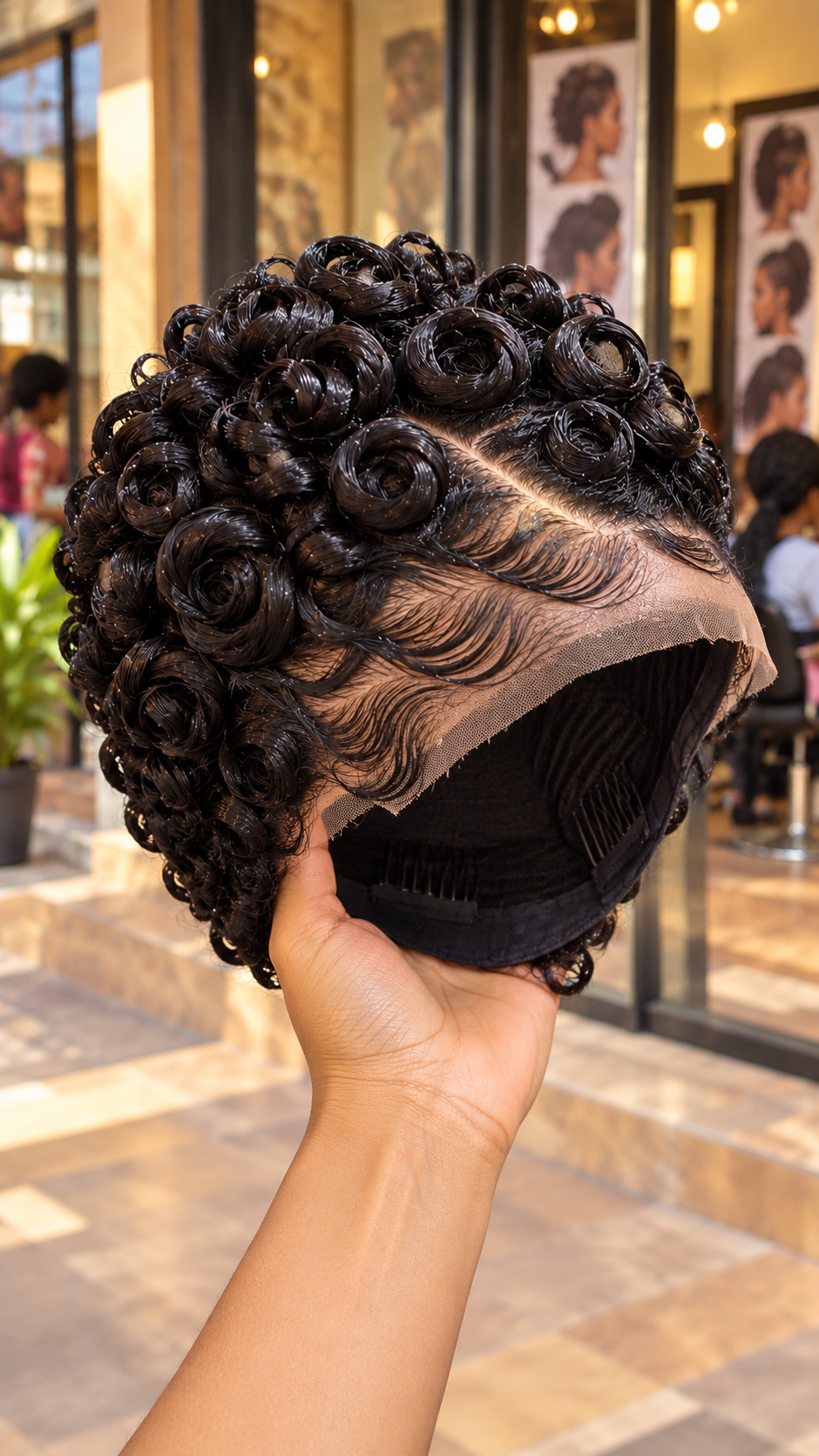
Large black curls arranged like little rosettes give this wig an immediately recognizable beauty. Each curl turns inward around an open center, creating a rounded shape that feels carefully composed without looking like a row of identical rings. Beneath those curls, fine waves sweep across the visible front and temple area. The contrast between the raised rosettes and the closely laid strands is what makes the hairstyle memorable.
This reference is particularly useful for anyone who wants to understand what they are buying before installation. The wig is held with its opening facing the camera, revealing excess brown-toned lace, a dark interior, perimeter banding, and visible comb attachments. Instead of concealing the preparation stage, the photograph shows the relationship between the decorative exterior and the foundation underneath.
For a buyer, the next step is to turn that visual information into a clear order. A general request for a black curly wig would not capture the scale of these curls, the diagonal part, or the sweeping front panel. A suitable supplier should be able to discuss those elements individually, explain the actual construction, and provide a complete quotation that includes any styling or fitting still required.
The Rosette Shape Is the Starting Point
The curls across the upper section are broad enough to reveal their centers. Strands curve around those openings in overlapping layers, giving several curls a flower-like appearance. “Rosette” describes their visual shape here; it does not establish a particular manufacturing technique or prove that the arrangement will remain unchanged after washing.


These curls are noticeably different from tiny finger coils. Their larger openings create a more sculptural surface, with shadows inside each ring and reflected light along the outer bends. Replacing them with miniature coils would produce a busier, more tightly packed appearance and change the identity of the hairstyle.
The arrangement also varies across the visible surface. Some curls face the camera directly, while others turn sideways or overlap neighboring sections. That variation contributes to the rounded silhouette. A recreation made from completely uniform rings could look more repetitive than the reference, even if the color and overall dimensions were similar.
When ordering, identify the curl scale as a priority. Ask the maker to show a close view of the actual upper section and explain whether those openings are created through a temporary set or belong to the supplied curl pattern. This question connects the appearance you want with the maintenance it will need.
A Diagonal Part Gives the Front Its Shape
A pale separation runs diagonally through the visible upper-front area. It divides a group of raised curls from the flatter hair beneath them and directs the eye toward the front edge. This line is an important organizing detail rather than a minor space between random curls.
Below it, fine strands sweep into repeated curved sections. Some form longer arcs across the temple area, while others sit closer to the forehead edge. These are wave-shaped arrangements of hair, not a verified set of shaved stripes. The photograph does not show a skin fade or a carved pattern that should be added during recreation.
The lower wave panel is generous enough to remain visible beneath the curls. If a stylist brings the rosettes too far forward, that panel may disappear. If the panel is made much wider, the top could seem pushed back. The desired result depends on preserving the relationship between these two areas.
Explain how much of that sweeping section you want to see when the wig is worn. The hand-held angle exposes it clearly, but its appearance on a head will depend on fit and placement. A consultation should assess that relationship before any front hair is cut or the lace is trimmed.
Black Color Lets the Curl Openings Stand Out
The visible hair appears black throughout. Warm reflections from the surrounding light give some strands a softer brownish sheen, but the image does not establish deliberate brown highlights or a second color. The strongest evidence supports a black hairstyle with changing reflections across its curved surface.
The dark color makes the pale part especially noticeable. It also emphasizes the spaces inside the rosette curls, where shadows deepen their rounded shape. That interplay contributes to the appearance more than a high-shine product claim would. Shine alone cannot verify the material or quality of the unit.
Before purchasing, request an unfiltered video near a window as well as ordinary indoor footage. Ask the seller to turn the wig slowly so you can see whether the black appears consistently dark from different angles. This is particularly useful if you prefer a softer natural black instead of a very deep black.
If you are commissioning a recreation, avoid adding color simply to make the order feel more elaborate. The reference already has a strong focal point in its curl structure. Highlights would create a different effect, and they should be treated as a separate design choice rather than an assumed improvement.
What the Interior Actually Reveals
The opening exposes a black foundation with fabric or mesh areas and a broad dark perimeter. Two comb attachments are visible in the lower interior view. Their presence is useful information, but the photograph does not reveal every component or establish the complete securing arrangement.
Ask for a full interior photograph with the unit turned so that the front, sides, and nape can be inspected separately. The seller should identify the visible combs and explain whether any additional adjustment components are included. Hardware should be described for the actual product, not inferred from a similar model.
The brown-toned lace extends beyond the styled hairline. Its visible mesh does not confirm a particular lace grade, dimensions, or suitability for a specific skin tone. Ask for the supplier’s written lace description and check its appearance during fitting under ordinary lighting.
The photograph also does not verify adhesive-free wear. Combs may form part of a securing system, but their presence alone does not establish how comfortably or securely the wig will fit a particular wearer. Construction, dimensions, and the intended wearing method need to be considered together.
Human hair and synthetic fiber remain unconfirmed. The curls, color, and reflective surface cannot reliably settle that question. Obtain a material description before discussing heat tools, coloring, or chemical products, because those decisions depend on specifications the photograph cannot supply.
Where To Buy This Wig
Look for specialist wig boutiques and independent makers with experience in cropped curl arrangements. A portfolio showing large pin curls, rosette-like sets, and closely swept front sections is more relevant than one consisting entirely of long straight installations. The seller needs to demonstrate the styling you want, not simply offer many wigs.
A salon that provides wig sales and setting services can be useful if you prefer an in-person consultation. Ask whether it supplies finished pieces, commissions units from another maker, or works only on wigs customers bring in. Those are different services and may involve separate quotations.
For local searches, combine your city with descriptions such as “rosette curl wig styling,” “cropped pin curl wig maker,” or “lace wig wave setting.” Use the results to build a shortlist, then inspect the actual work. Search wording is a route to potential suppliers, not proof that their available product matches this reference.
The storefront in the photograph does not establish a verified shop name, physical address, country, or purchasing link. A salon background cannot confirm where this exact unit is sold. Ask any supplier using the image to provide separate business information and photographs of the product they will actually deliver.
If ordering remotely, confirm the dispatch location, delivery coverage, and aftercare arrangements. If buying in person, verify the appointment address and whether a sample fitting is available. Clear location and service details should be settled before traveling or paying a deposit.
Decide Whether You Need a Finished Unit or a Styling Service
A finished stock wig may be suitable when its measurements, curl arrangement, and color already meet your needs. Request current photographs of the exact unit available. Ask whether the shown rosettes and front waves are included in the purchase or were created only for a promotional photograph.
A custom order is more appropriate when you want specific coverage, a particular curl scale, or close control over the front panel. Select this image as the main reference and list the details that matter most. A short, ranked brief is easier to interpret than a long collection of unrelated examples.
Restyling an existing wig may also be possible, but it requires inspection. A stylist must consider the available length, density, construction, and known material before promising these large circular curls. Hair that has already been cut too closely may not provide enough length for the desired openings.
Have the stylist assess the base before purchasing additional services. If you are considering buying an unstyled unit elsewhere, send its specifications and photographs first. This can help avoid paying for a base that cannot support the reference’s shape.
For any route, establish which work is included. Cutting, setting, lace preparation, fitting, and installation may be separate charges. A clear explanation of the finished state at collection or delivery is more useful than a vague promise that the wig comes ready.
What Goes into the Price of Rosette Curl Styling
The figures below are illustrative USD planning ranges rather than verified current listings. They do not identify the material, construction, or value of the photographed wig. Use the categories to organize quotations and ask what each supplier includes for the actual product being offered.
| Purchase Category | Illustrative USD Range | Details to Compare |
|---|---|---|
| Premium Custom | $510–$1,120+ | Individual sizing, selected foundation, detailed rosette setting, front wave work, fitting support, and revision arrangements. |
| Standard Custom | $280–$570 | Available base options, reference-based shaping, part placement, curl scale, and the styling completed before delivery. |
| Basic Human Hair | $150–$335 | Written material information, processing history, cap specification, and separate charges for cutting and setting. |
| Premium Synthetic | $90–$220 | Fiber instructions, available dimensions, supplied curl arrangement, and permitted options for resetting. |
| Basic Synthetic | $35–$95 | Actual product views, sizing limitations, perimeter appearance, and return eligibility before modification. |
The detailed labor here involves more than curling the ends. The maker must coordinate the larger rings, preserve the diagonal part, and arrange the lower wave panel so it remains visible. A quotation should explain whether that work is included or added to the price of a base wig.
Ask for an itemized total covering the product, haircut, initial set, fitting, delivery, and any installation service. If a separate local stylist will finish the unit, include that appointment in your comparison. Two advertised prices are not directly comparable when one includes the set and the other does not.
Also ask what it costs to restore the hairstyle after cleaning. A detailed set that requires professional resetting creates an ongoing service need. Knowing that before purchase helps you decide whether the unit suits your budget and access to local styling help.
For international orders, clarify which delivery costs are included and whether import-related charges might be collected separately. Compare the complete route to a wearable wig rather than choosing solely from the lowest starting figure.
Use Measurements to Protect the Front Arrangement
The front waves and part need to sit in the intended position on the wearer. If the cap is too loose or too small, the same hairstyle may look different and require repeated adjustment. Follow the chosen maker’s measuring instructions and provide the dimensions requested for that specific product.
Explain any particular temple coverage needs before ordering. The reference shows a substantial swept section, but the hand-held angle does not predict how much coverage it will provide on your head. A maker should discuss the relationship between cap dimensions and the visible hair arrangement.
During fitting, assess the front at eye level and from both profiles. Check whether the diagonal part remains clear, whether the rosettes sit at a comfortable height, and whether the lower wave panel is visible in the way you expected. Consider those elements together rather than evaluating each in isolation.
Do not trim the lace before settling the position. Excess mesh is part of the preparation stage shown in the photograph. Its final treatment should follow the fit assessment and the intended wearing method, with the stylist explaining what will be removed and why.
Request the Views Missing from This Photograph
The image offers an unusually helpful interior view, but it still leaves important areas unseen. The complete back and nape are not presented straight on, and the opposite side cannot be assessed fully. Ask for those views before approving the entire haircut.
A rear photograph should show how the curls progress downward and where the hair ends. A closely cropped back, a rounded lower section, and a longer nape can each create a different silhouette. Do not assume the missing area follows a particular pattern simply because the visible side looks compact.
Request a top view with the wig supported on an appropriate head. This helps show how the rosette groups connect and whether any spaces are created by the temporary hand-held position. It also provides a clearer basis for discussing density.
For the interior, ask the seller to keep hands away from the components being demonstrated. Clear views of the foundation, comb placement, and perimeter are more valuable than additional decorative photographs that repeat the same angle.
Agree on the First Wash Before Approving the Set
The essential maintenance question is what remains after cleaning. Are the rosettes a temporary set, part of a persistent curl pattern, or a styled arrangement built on another underlying pattern? The answer determines how much work is needed to restore the photographed appearance.
Ask the supplier to describe the expected result after washing and drying according to its instructions. A before-and-after example of the same product can be especially useful. Without that information, a buyer may expect the original arrangement to return automatically when professional work is actually required.
For confirmed synthetic fiber, obtain the specific care instructions before using heat or chemical products. For confirmed human hair, ask about processing history and the recommended resetting method. Neither the photo nor a general product category supplies a safe temperature or a universal treatment.
The lower forehead waves may need different attention from the larger rings. Ask the stylist to demonstrate which small corrections you can make yourself and which should be left for a full reset. A practical demonstration using your own unit makes the instructions easier to follow.
Keep the Curl Centers Open Between Appointments
The openings inside the rosettes are central to the appearance. Brushing across the top without a plan could loosen the rings and replace the sculpted surface with separated strands. Follow the maker’s method for handling the set rather than treating it like loose curly hair.
When a single curl moves, assess that section first. A small displacement does not automatically require restyling the entire crown. Ask whether finger placement or another specified method is appropriate for the material and set you purchased.
Avoid gripping the raised curls when applying or removing the unit. Use the handling instructions provided for the cap so that the styled front is not repeatedly pulled. The comb attachments should also be used only as directed for the intended fit.
During storage, support the foundation without stretching it and keep the rosettes away from surfaces that could flatten them. A suitable support should preserve the rounded shape while leaving the front panel undisturbed. Ask the supplier how to protect the unit during travel as well as at home.
Heavy product buildup may reduce the separation between strands and make the pale part less clear. Use only the recommended products and quantities. If the set repeatedly loses shape, discuss the cause with the stylist instead of continually adding more product.
Plan the Appointment Around What Still Needs Doing
Send the reference before booking and state whether you already own the wig. Ask the salon to distinguish a fitting appointment from a detailed setting service. Recreating large rosettes and arranging the forehead panel may need different preparation from installing a unit whose styling is already complete.
If several professionals are involved, agree on the order of work. The base and fit should be assessed before irreversible perimeter changes. Any necessary haircut should support the planned curls, and the final set should follow the decisions about placement and proportions.
Bring the wearing instructions and known product specifications to the appointment. A stylist should not have to guess the fiber, construction, or permitted tools from appearance. If information is missing, obtain it from the seller before expecting extensive alteration work.
Before leaving, ask for a rear photograph and a simple demonstration of application, removal, and minor corrections. Confirm where you can return for resetting and whether the salon offers ongoing care for that specific material. This makes the service useful beyond the first finished photograph.
Inspect the Delivered Wig Before Changing It
For a custom order, request final photographs or a video before dispatch. Compare the curl scale, diagonal part, front wave coverage, and visible silhouette with the written brief. Resolve any difference while the maker still has the unit.
After delivery, inspect the wig before washing, cutting, or applying styling products. Check the actual material description, included components, and order details. Read the return and alteration conditions before making changes that could affect your options.
If transit has flattened a section, document it and ask for targeted instructions. Avoid brushing through the entire hairstyle to solve one compressed ring. The supplier should explain whether minor arrival preparation is expected and how it should be handled.
For an occasion purchase, allow time for this inspection and a fitting appointment. Production, shipping, and preparation are separate stages. A schedule that includes all three gives you a better chance to resolve concerns without rushing permanent changes.
Buy the Shape, Understand the Foundation
The beauty of this wig lies in its contrast: generous black rosettes above, graceful waves beneath, and a diagonal part that gives both sections direction. Its appeal does not depend on added color or an elaborate shaved pattern. The visible arrangement already provides a clear focal point.
A strong purchase decision preserves that appearance while checking the practical details hidden behind it. Confirm the material, foundation, sizing, full price, and care requirements. Choose a seller or stylist who can explain how the curls are created and how the set will be restored after cleaning.
With those answers in place, the photograph becomes more than inspiration. It becomes a clear reference for a black curled wig whose proportions, preparation, and upkeep you understand before the first wear.
Search Terms
black rosette curl wig · large open ringlet lace unit · diagonal part sculpted curls · swept temple wave panel · brown lace black curled wig · visible interior wig combs · rounded black pin curl hairstyle · layered rosette crown wig