
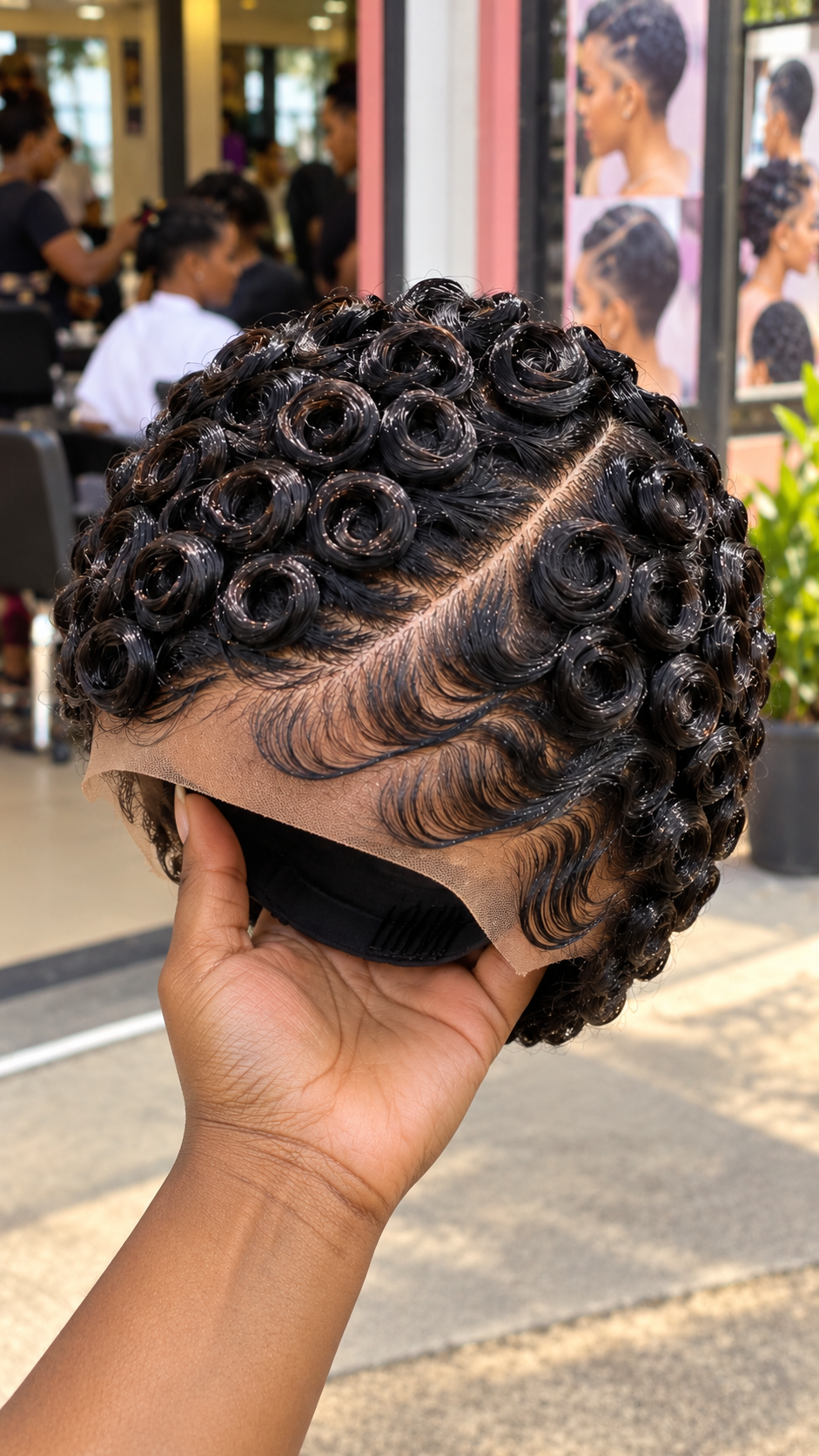
A line of sweeping finger waves gives this black wig its most memorable detail. Beneath a curved side part, the hair follows the forehead in broad, connected movements before turning toward the temple. Above that panel, open-centered curls cover the upper section like small rosettes. The contrast between circular curls and flowing waves creates a vintage-inspired hairstyle with a compact, rounded silhouette.
The photograph captures the wig resting in one hand before fitting. Tan lace extends beyond the front hairline, and a portion of the black interior remains visible underneath. This is more informative than a distant portrait because it shows how the front arrangement relates to the exposed lace. It also makes clear that the final appearance on a wearer will depend on placement, cap fit, and any necessary customization.
For someone looking to buy this style, the key is recognizing that it is more specific than a black curly pixie. The open rings, curved part, and broad wave panel all contribute to the result. A similar color and length will not necessarily produce the same appearance. The most useful purchase starts with those visible details, then adds verified information about construction, material, price, and professional support.
The Wave Panel Is the Detail to Preserve
The most distinctive section sits below the part on the near side. Fine strands move together in wide curves, leaving areas of the tan foundation visible between them. The panel is flatter than the ring-covered upper section, which gives the hairstyle a deliberate change in height. That difference prevents the curls from becoming one uninterrupted mass.


Several waves follow one another toward the temple, with the lowest visible section curling down near the perimeter. Their widths and depths vary. This is not a simple fringe combed across the forehead, nor is it a row of separate curled ends. The strands create connected movements that should remain recognizable after fitting.
When commissioning a reproduction, send a close crop of this area alongside the full image. Explain that the broad waves are essential and should not be replaced by a narrow strip of small curls. A maker may be comfortable producing the upper rings but need a separate discussion about the forehead arrangement.
The final position still has to suit the wearer. A stylist may need to adapt the panel slightly so that it follows the intended hairline without sitting awkwardly around the temple. The aim is to retain the same visual rhythm while making the unit wearable, rather than copying a detached wig’s position without considering the person underneath.
Open Curls Give the Upper Section Its Character
The upper hair is arranged into numerous circular curls with clearly visible centers. Some rings face the camera, while others tilt toward neighboring sections. Their arrangement creates depth without relying on long hanging lengths. The silhouette is rounded, but the surface remains detailed because the individual curl openings are easy to distinguish.
These curls are larger and more open than very tight finger coils. They also differ from loose waves that can be separated casually with the fingers. A suitable shopping description would mention open pin curls or rosette-like curls, supported by the photograph. Product names vary between sellers, so the visual reference should remain the main point of comparison.
The rings continue down the visible outer side, where they sit closer to the perimeter. This continuation helps the hairstyle feel complete rather than decorated only on top. However, the photograph does not show the entire rear or nape. Ask for those angles before assuming the same density and arrangement continue around every section.
The hair appears predominantly black. Warm reflections are visible along some illuminated strands, but they do not establish an intentional brown highlight treatment. If you want a single black shade, specify that in the order and ask for neutral-light footage. Avoid requesting a two-tone version unless you deliberately want to change the reference.
Use the Curved Part as a Placement Reference
A pale-looking channel separates the fuller upper curls from the waved side panel. It travels diagonally backward rather than forming a straight center part. The surrounding strands follow its direction, which makes the part an important structural element in the visible hairstyle.
The channel is not evidence of a shaved design. It separates styled hair sections, but the image does not reveal the exact construction beneath it. Ask whether the part is fixed, whether it can be moved within a specific area, and how its visible base is intended to look after fitting.
If the side orientation matters to you, confirm it in writing with the maker. Phone photographs can be mirrored, and a detached wig is not always easy to interpret. Identify the intended wearer’s side rather than relying only on “the side shown in the picture.” A reversed arrangement may create a different balance around your face.
The position of the part also affects where the upper fullness appears. Before approving a custom order, request a front view that shows the relationship between both sides. The close-up demonstrates the details beautifully, but a more distant photograph is needed to judge the complete proportions.
Where This Wig Comes From
The photograph shows a salon setting, but it does not identify a verified supplier, physical address, or available stock. The surrounding posters and salon activity are background context, not proof that a particular business sells this exact unit. A reliable buying route requires direct confirmation from the seller.
Start with wig boutiques or independent makers who show experience with pin curls and finger-wave fronts. Search using phrases such as “black pin curl lace wig” or “finger wave pixie wig maker,” adding your city when you want local service. Send the image before visiting so the shop can assess whether it has a suitable piece.
A local studio may offer an advantage if you want fitting and styling handled together. Ask whether the business supplies the wig, customizes outside units, or provides only installation services. Those arrangements have different costs and responsibilities, so clarify the scope before booking.
For an online order, establish whether the seller is offering a finished unit or a made-to-order interpretation. A finished item should be available for current footage from several angles. A commission should include material specifications, measurements, production timing, and an approval process. Neither situation should rely solely on the reference photograph.
If the exact style is unavailable, ask whether a suitable base can be customized. A maker should explain what needs to change and whether the cap supports the intended part and wave panel. Buying a generic black curly wig first and hoping it can be transformed later may create avoidable expense.
Ask for Evidence That Matches the Product Claims
The visible lace is tan and extends beyond the front hairline. Its mesh can be seen along the untrimmed edge. This confirms exposed lace in the photograph, but it does not establish a particular lace grade or guarantee an invisible result on a wearer. Ask for the actual specifications rather than inferring them from the image.
A section of black interior material is visible beneath the front. There also appears to be a small toothed attachment near the lower opening, but the partial view is not enough to establish the complete fastening system. Request a clear underside photograph showing all attachment components and how they connect to the cap.
The photograph cannot identify the fiber as human hair, synthetic, or a blend. Shine, curl shape, and fine flyaway strands are not reliable proof of composition. Ask the seller for a written material description and care instructions that correspond to the exact unit being offered.
If adhesive-free wear is advertised, ask what provides the hold and how cap sizing affects it. If a lace customization service is included, ask what that service covers. Specific explanations about construction and fitting are more useful than broad promises that do not describe the product.
Price Expectations for a Styled Lace Pixie
The following USD figures are illustrative planning ranges, not verified current prices for the photographed wig. They compare possible purchase categories for a similar appearance. The image does not confirm the material of this unit, and the final quote should explain the actual cap, fiber, styling, and fitting services included.
| Purchase Category | Illustrative USD Range | What the Price Should Clarify |
|---|---|---|
| Premium Custom | $440–$960+ | Individually specified construction, open-curl arrangement, curved part, broad finger-wave panel, and fitting support. |
| Standard Custom | $220–$470 | An existing base adapted to the reference, with agreed limits on cutting, cap adjustment, and styling revisions. |
| Basic Human Hair | $115–$265 | Verified composition, processing information where available, lace coverage, and whether the finished set is included. |
| Premium Synthetic | $65–$170 | Fiber specifications, preset curl quality, wave-panel construction, cap size, and maintenance restrictions. |
| Basic Synthetic | $25–$75 | Actual item photographs, perimeter coverage, fit information, and how closely the front arrangement follows the reference. |
The styling labor is particularly relevant here. Creating open curls across the upper section is one task; arranging the broad front waves is another. A low advertised price may cover the base without either service. Ask whether the wig arrives in the displayed style or needs a separate salon appointment.
Compare complete quotes rather than starting prices. Delivery, applicable taxes, lace preparation, cap adjustment, and professional fitting may be charged separately. If you are buying remotely and using a local stylist afterward, include both purchases in the same budget before deciding which option offers better value.
Future resetting should also be considered. A unit that requires professional work after washing may have a different long-term cost from one supplied with a maintainable preset arrangement. Ask how the curls and wave panel are restored, who can perform the service, and whether the original maker offers support.
Turn Your Preferences Into a Clear Commission
A useful order brief should identify the black shade, rounded silhouette, open-centered curls, curved side part, and broad finger-wave panel. These are the visible elements that distinguish the reference. Explain which details are essential and which you would allow the maker to adapt for fit.
For example, you may want the same curl size and panel width but slightly less upper fullness. That is a specific request a maker can assess. Asking for the style to be “more natural” is less useful unless you explain whether you mean lower height, a different hairline, reduced shine, or a softer arrangement.
Ask the maker which cap measurements are needed and follow the supplied method. The hand supporting the wig does not provide a dependable measurement reference. Your intended hair preparation underneath should also be discussed because it can affect how the cap sits and how the silhouette appears.
Agree on approval stages before production begins. Request photographs of the overall shape, the front panel, and the completed rear. Clarify which changes remain possible at each stage and whether additional revisions carry a charge. This makes the order concrete and easier to review.
Fit the Lace Without Losing the Front Design
The first fitting should establish where the cap sits comfortably. The waves need to relate to the forehead and temple without forcing the unit into an unsuitable position. A fitter should assess the entire outline rather than moving the wig solely to make one front detail appear closer to the photograph.
Check both sides and the back while the unit is in place. The picture provides a close view of one front-side area, but it cannot demonstrate how the opposite side fits a wearer. Ask whether any unevenness comes from placement, cap size, or styling before deciding that cutting is required.
If lace trimming is necessary, it should follow that assessment. The visible extension is untrimmed, but the amount to remove depends on the actual unit and fitting method. Cutting too early can reduce options for positioning and may interfere with the arrangement of fine strands near the edge.
Ask the stylist to preserve the broad wave panel unless you have agreed on a change. A fitter unfamiliar with the reference might otherwise simplify it into a different front. Keep the photograph available and discuss any proposed alteration before it becomes permanent.
Book the Right Kind of Styling Appointment
When contacting a salon, explain whether you need placement advice, lace customization, cap adjustment, or a full recreation of the curl set. Those are separate services, and not every stylist offers all of them. Send images of the actual wig you own or plan to purchase, not just the desired result.
Look for examples of finger-wave work on wigs with compact curled silhouettes. A stylist who excels at long curls may not have the same experience with this broad forehead arrangement. Ask to see the work from the side, where the relationship between the panel and upper curls is easier to assess.
Provide the confirmed material and care information before authorizing heat or chemical work. If the seller has not supplied those details, obtain them first. The hairstyle’s appearance does not establish which tools or products are suitable, even when it resembles another wig the stylist has handled.
At the end of the appointment, ask for a handling demonstration. Learn where to hold the unit, how to place it without pulling on the front waves, and how to check its position. A beautiful fitting becomes more useful when you can repeat the routine comfortably at home.
Inspect the Delivery Before Restyling Anything
On arrival, compare the wig with the approved photographs while it remains unaltered. Check the shade, curl scale, part placement, panel width, and overall silhouette. Packaging may temporarily disturb the arrangement, so ask the seller how the unit should be settled before judging the final shape.
Inspect the lace and inside construction against the written description. Confirm the promised fastening components and cap size information. If anything differs materially from the order, document it and contact the seller under the stated policy before washing, trimming, or adding products.
Keep the invoice, product specifications, care guidance, and approval images together. This is especially useful with a custom commission, where the agreed details may not appear in a standard listing. A clear record helps distinguish a minor styling correction from a unit that does not match the order.
Care for the Rosettes and Waves Separately
The raised curls and flatter front panel depend on different arrangements. Running a brush through the entire wig could dismantle both. Ask the maker how individual rings should be corrected and whether the front panel should be refreshed differently. A method that restores one section may disturb another.
Support the cap when moving the wig rather than lifting it by the curls. Avoid using the waved front as a grip during placement. If a ring shifts, follow the demonstrated technique instead of pulling neighboring curls into a new arrangement. Small repeated adjustments can gradually change the original set.
Before the first wash, establish whether the style is expected to remain or needs to be recreated. Obtain cleansing and drying instructions specific to the verified fiber. Do not apply hot tools to unidentified material, and do not assume that products used on natural hair will suit the wig.
Additional shine products may be unnecessary. The photograph already shows strong reflections across the rings, but it does not identify which products created that appearance. Ask what was used and what is recommended for maintenance. Heavy application without guidance can change the surface and complicate later cleansing.
Prepare for Storage and Occasional Wear
The rounded upper section needs clearance during storage. Use an arrangement that supports the cap without pressing the curls against a lid or shelf. The front lace and waves should not be repeatedly folded together. Ask the fitter how the customized perimeter should rest after the first appointment.
If you plan to wear the wig mainly for events, test placement before the occasion. Allow time for inspection, fitting, and any agreed correction after delivery. A completed styling appointment should not be scheduled so late that there is no opportunity to address a fit issue.
For travel, request packing instructions for the actual unit. Some arrangements may need resetting after unpacking, while others may retain more of their shape. Knowing the expected preparation in advance is more useful than assuming that a compact wig can be placed in any small container.
Regular wear calls for a realistic maintenance plan. Find out whether a local stylist can reproduce the curls and front panel, particularly if the original maker is far away. A hairstyle is easier to enjoy when its upkeep is accessible and its care requirements fit your routine.
Choose the Complete Hairstyle, Not Just the Curls
The appeal of this reference comes from the way its elements work together. Open rings provide dimension, the curved part separates the sections, and the broad waves frame the front. A proposed alternative should be assessed against that complete relationship rather than accepted solely because it has black curls.
When comparing offers, consider the actual unit footage, verified construction, fitting options, and aftercare support alongside the price. Ask the supplier to explain what will arrive and what still needs to happen before the wig is ready for you to wear. Clear answers make the purchase easier to evaluate.
With the shape, fit, and maintenance agreed, this vintage-inspired style can be approached as a practical purchase rather than an attractive mystery photograph. Keep the distinctive front arrangement at the center of the conversation, and choose a maker or stylist who can preserve it while adapting the unit to you.
Search Terms
vintage black rosette curl wig · broad finger wave lace front · curved side part pin curl wig · open ring curls with waved temple · tan lace black pixie unit · rounded pin curl wig silhouette · sculpted forehead waves on lace · compact black curls with side panel