
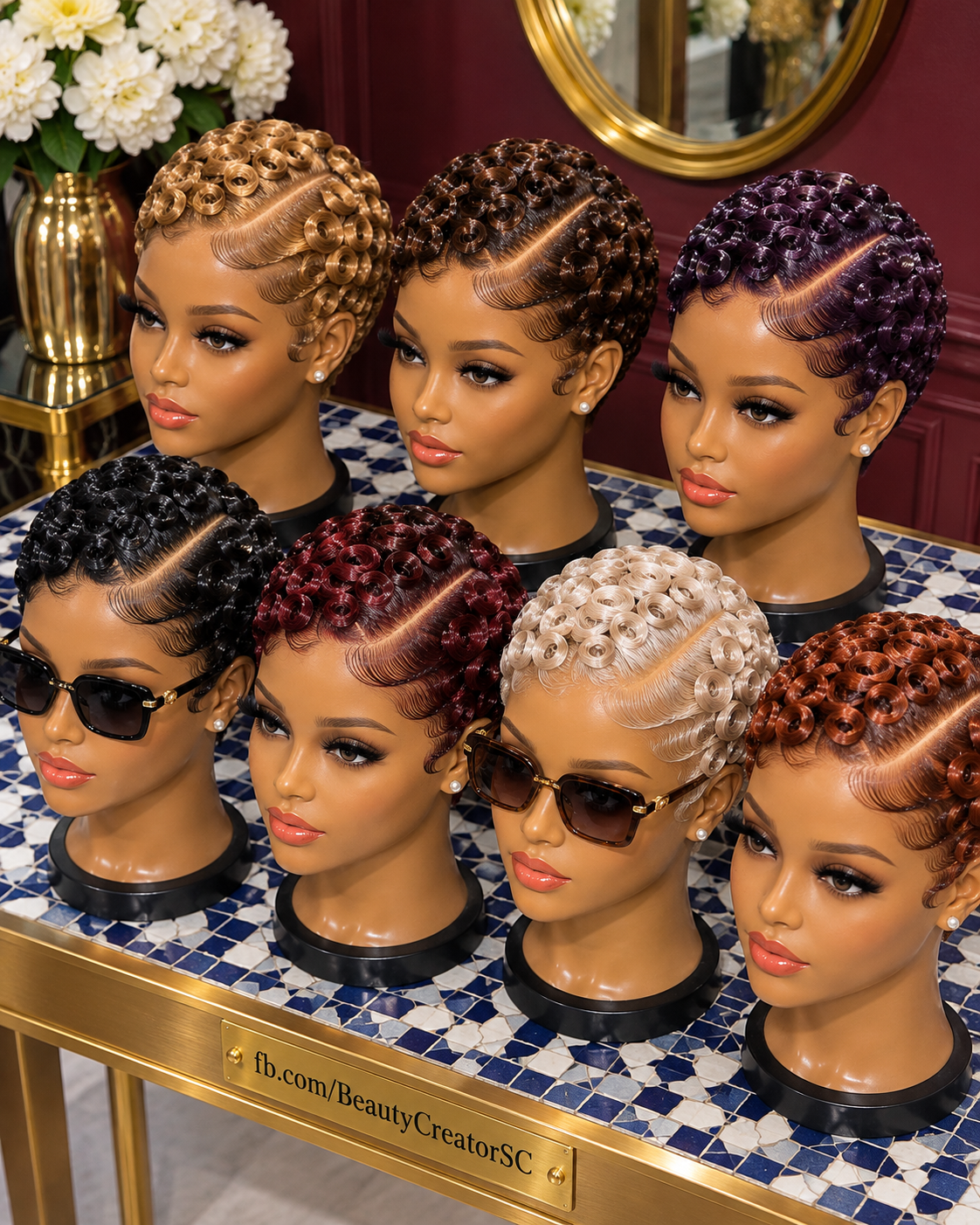
The sweep beside the part is what makes this collection memorable. Each wig combines small, open-centered curls with a broad section of carefully arranged waves, giving the hairstyle a distinctive rhythm from the forehead toward the ear. The curls provide height and detail; the waved panel creates direction. Together, they produce a fitted pixie silhouette that feels decorative without depending on long hair or an oversized crown.
Seven wigs appear in the display, arranged across two staggered rows. Golden honey, warm brown, and deep plum sit behind black, burgundy, pale blonde, and copper. Their shared styling makes the differences between the colors especially easy to appreciate. Black emphasizes the contrast around the visible part, blonde brings attention to the individual strands in the waved section, and the richer reds and plum give the circular curls a jewel-like appearance.
For anyone considering a purchase, this photograph offers more than color inspiration. It shows a specific relationship between curl size, part placement, and side coverage that should be communicated clearly to a seller. The most useful shopping decision begins with identifying which of those details matters most to you, then finding a wig maker or retailer who can provide the appearance, fit, and care information needed to make the style wearable.
The Sweeping Panel Gives the Curls Their Direction
Look beside the exposed part on each mannequin. The hair travels downward in closely aligned strands before curving into waves near the forehead and temple. This section is flatter than the curled upper area, so it creates a visual pause between the rows of circular curls. Without it, the hairstyle would read as a more uniform curled cap.


The part itself follows a diagonal path backward from the front. Its pale appearance contrasts strongly with the darker wigs, particularly the black, burgundy, and plum versions. On the pale blonde wig, the same channel is less conspicuous because the surrounding hair is much lighter. That difference affects the overall impression even when the styling remains broadly similar.
The visible channel should not be described as a shaved line. It separates styled sections, but the photograph does not establish the underlying construction. It could be produced through different wig-making methods, and the image does not reveal whether the part can be relocated. If its position is central to your choice, ask the seller to explain whether it is fixed or adjustable within a particular area.
At the lower edge of the waved panel, small curls and fine curved strands follow the temple. These details help connect the larger upper curls with the exposed ear area. Their placement is worth preserving in a custom order, although a stylist may need to adapt the exact position to suit the wearer’s measurements and preferred forehead coverage.
Compare the Seven Colors as Separate Choices
The golden honey wig at the back left has a warm, amber appearance. Its circular curls catch light along their outer edges, while the flatter panel shows the direction of the individual strands. This is a deeper, warmer blonde than the pale option in front. A buyer who wants honey should not assume that any product labeled blonde will deliver a comparable result.
The middle wig in the back row is warm brown, with lighter-looking reflections across some curls. Those reflections do not establish a separate highlight treatment. Ask for daylight footage if you want to determine whether the unit is one brown shade or intentionally colored in more than one tone. The photograph supports a warm brown description, but not a precise salon color formula.
Deep plum sits at the back right. It appears darkest between the curls and brighter on the illuminated surfaces. This creates a rich purple impression rather than a bright pastel result. If ordering a similar shade, use the photograph alongside the seller’s color reference, because names such as plum, aubergine, and dark purple can represent different products.
Across the front, black offers the strongest dark-to-light contrast around the part. Burgundy has a wine-red character, while copper is brighter and more orange. The pale blonde appears creamy, with slightly deeper shadows between the rings. These are distinct choices, not interchangeable versions of red or blonde. Identify the mannequin by position when requesting a quote.
Lighting also matters. Gold furniture, warm indoor illumination, and the burgundy background contribute to the scene’s overall warmth. Request a second view under neutral daylight before committing to a color-sensitive purchase. Ideally, compare your two preferred shades in the same frame so that exposure and lighting remain consistent.
Choose the Shape Before Choosing the Material
The upper curls are compact, with visible circular openings and relatively consistent scale. They sit close together rather than hanging in loose lengths. The sides remain fitted to the mannequin heads, and the ears are largely exposed. This combination distinguishes the collection from a fuller curly bob or a loosely curled pixie with a lifted fringe.
If this is the appearance you want, begin your order discussion with the silhouette. Specify a close-fitting pixie, open-centered pin curls, a diagonal side part, and a broad waved panel. Material selection can follow once the seller explains which bases are suitable. Starting with a material label alone may lead to a wig that has the desired fiber but a very different shape.
The photograph does not show complete rear views. It reveals portions of the upper back and sides, but not enough to establish every nape line. Ask for a rear photograph taken at head level. A bulky back, a longer perimeter, or a different curl arrangement could alter the result even if the front closely resembles the reference.
There are also small differences between the individual wigs. Curl placement, visible part length, and the way the waved panel approaches the temple are not perfectly identical. Select one primary mannequin as your shape reference. This gives the maker a clearer target than asking for an unspecified combination of all seven.
Where To Buy This Wig
A wig boutique with a styling service is a practical starting point when you want to inspect a similar piece in person. Send the photograph before visiting and ask whether the shop carries pin curl pixie wigs with a side-parted wave panel. That description is more useful than asking only for a curly wig, which could refer to many unrelated shapes.
An independent wig maker may be a better fit when you want the panel and curl arrangement reproduced closely. Look for a portfolio showing fitted pixies, pin curls, and deliberate forehead styling. Ask to see several angles of completed work. A single attractive front photograph does not demonstrate how consistently the maker handles the sides, back, and cap fit.
Online retailers can also provide suitable options, but clarify whether you are buying an existing unit or commissioning one. An existing item should be available for current photographs and a complete product description. A custom commission needs written specifications, a production window, and an agreement about approval photographs and revisions.
The page address visible on the table is not independent proof of a retailer’s identity, physical location, or stock. The photograph alone cannot confirm where these exact wigs are sold. Obtain the seller’s city, country, delivery coverage, and collection arrangements directly. If you want local help, search for a wig boutique or pin curl wig stylist followed by your city.
You can also separate purchasing from customization. A suitable base may come from one supplier, while a local stylist handles fitting and final arrangement. Before taking that route, ask the stylist whether the proposed unit can support the intended look and whether outside wigs are accepted. This prevents buying a base that is unsuitable for the planned service.
Write an Order Brief That Protects the Important Details
Describe your selected mannequin by row and position, then state whether it supplies the color, the shape, or both. For example, you might prefer the back-center brown wig’s arrangement in the front-row burgundy shade. That request is workable only when both references are identified clearly and the maker confirms the proposed combination.
Include the details you want retained: a compact crown, small open curls, the broad waved section, the diagonal part, and visible ear space. Explain whether you prefer the same degree of contrast around the part. Avoid relying on vague requests such as “make it exactly beautiful,” because they do not tell the maker which visual decisions are essential.
Ask which measurements are required for the cap and follow the supplier’s instructions. Measurements should be taken with the intended hair preparation in mind. If your natural hair will be arranged underneath, tell the maker or fitter, since that can affect how the cap sits and how much internal space is needed.
For a commissioned unit, agree on when you will approve the shape and color. Some changes may be straightforward before the final set but difficult after cutting or processing. Written approval stages help you understand when to raise concerns and what the maker can still revise without rebuilding the piece.
A Practical Budget for Pin Curl Customization
The following USD amounts are illustrative budgeting ranges, not verified current offers for the photographed collection. They compare possible purchase categories rather than identify the material of any displayed wig. The actual quote should specify the cap, fiber, styling work, and services included. Categories may overlap depending on the supplier and the amount of customization.
| Purchase Category | Illustrative USD Budget | What to Confirm |
|---|---|---|
| Premium Custom | $460–$980+ | Individually specified construction, detailed pin curl placement, waved-panel styling, color work where applicable, and fitting support. |
| Standard Custom | $210–$460 | An existing base adapted toward the reference, including the agreed cut, part arrangement, and limits on revisions. |
| Basic Human Hair | $115–$270 | Verified fiber composition, processing information where available, cap specifications, and whether the styled set is included. |
| Premium Synthetic | $65–$165 | Fiber care requirements, preset curl quality, cap sizing, part construction, and permitted restyling methods. |
| Basic Synthetic | $25–$75 | Actual item photographs, perimeter coverage, consistency of the wave panel, and return eligibility. |
For this particular hairstyle, styling labor deserves attention. Arranging the circular curls is only part of the work; the broad panel beside the part also needs to sit in proportion to the upper section. A low base price may exclude that service. Ask whether the wig arrives in the advertised set or whether a separate salon appointment is necessary.
Color can change the quote, but the reason should be clear. A supplier may offer a manufactured shade, while a custom maker may propose processing a suitable human-hair base. Those are different services with different limitations. Do not assume that every displayed color is produced by the same method or costs the same amount.
Request a total that includes delivery, applicable taxes, fitting, and any necessary finishing work. Then ask about maintenance costs, particularly a full reset after washing. A purchase that seems affordable at checkout may require more ongoing service than another option. Comparing the complete wearing routine gives a more useful picture than comparing the wig price alone.
Understand the Construction Beneath the Display
Mannequin presentation cannot confirm the inside of a wig. This photograph does not show loose lace, cap interiors, adjustment hardware, combs, or attachment points. It therefore does not establish a particular lace grade, adhesive-free use, or a specific cap technology. Those details need an underside photograph and a written product description.
Ask the seller to identify the fiber composition rather than judging it from shine. Human hair, synthetic fibers, products, and lighting can all influence reflectivity. The circular curls may look highly polished without revealing which material was used. A reliable description should also explain the care restrictions that apply to the actual unit.
The pale channel along the part deserves a close view. Ask how it is constructed, whether its color can be adjusted appropriately during fitting, and whether the part is fixed. If you intend to change the part later, obtain a clear answer about the area available for restyling. The photograph does not demonstrate that flexibility.
If the seller advertises secure wear without adhesive, ask what provides the hold and how that relates to cap sizing. A snug appearance on a mannequin is not a wear test. The explanation should refer to the unit’s actual construction and your measurements, not simply repeat a marketing label.
Use the First Fitting to Set the Proportions
The close silhouette makes placement important. A unit sitting too high can alter the relationship between the waved panel and the ear, while a unit placed too far forward can change the amount of forehead coverage. Establish the position before considering cutting or other permanent adjustments.
At a fitting, check the front, both side profiles, and the back. The diagonal part should sit comfortably with the overall placement rather than forcing the cap into an awkward position. Ask the fitter to assess whether any imbalance comes from placement, cap size, or the arrangement of the hair itself.
Two mannequins wear sunglasses, but that does not prove compatibility with your own frames. If you regularly wear glasses, bring them to the fitting. Check the temple area while the frames are on and make sure ordinary use does not displace the wig or put uncomfortable pressure around the ears.
Any lace trimming, if the purchased unit has lace that needs it, should follow the fit assessment. The display does not establish that trimming is required. Ask the stylist to explain each proposed alteration and how it will affect coverage. Cutting should solve a specific fitting need rather than be treated as an automatic step.
Inspect the Unit Before Changing It
When the wig arrives, compare it with the approved photographs before washing, applying products, or making alterations. Check the selected shade, the position of the part, the curl scale, and the overall height. Packaging can disturb a set, so ask the seller how the unit should be settled after unpacking.
Request instructions before trying to recreate flattened curls. Pulling apart a ring or brushing through the panel may make the arrangement harder to restore. If the piece differs substantially from the order, photograph it as received and contact the seller under the stated policy while it remains unaltered.
Keep the written specifications, approval images, invoice, and care guidance together. This is particularly useful for a custom order, where the agreement may include details that do not appear in a standard listing. A clear record helps both parties distinguish a styling adjustment from a product that does not match the agreed request.
Preserve the Contrast Between Rings and Waves
The curls and waved panel do different jobs, so they may need different handling. The circular upper sections provide dimension, while the flatter side panel depends on its directional arrangement. Treating the entire wig as loose curly hair could dismantle both elements and leave a result that no longer resembles the reference.
Ask the maker to demonstrate how to correct a displaced ring without pulling neighboring curls out of position. For the panel, find out whether it should be left untouched between wears or refreshed with a particular method. Avoid experimenting with additional product simply because a section looks different after storage.
Before the first wash, establish whether the set is expected to remain or needs to be recreated. Obtain instructions specific to the confirmed fiber. Do not apply hot tools to unidentified material, and do not assume that a method suitable for one wig will suit another. Even verified human hair may have a processing history that affects its care.
If professional resetting is recommended, identify a stylist who can reproduce both parts of the hairstyle. Ask for a service estimate and discuss how closely the original arrangement can be restored. Knowing the maintenance route before purchase is especially useful when the nearest suitable salon is some distance away.
Plan for Regular Wear, Occasions, and Travel
Think about how often you expect to wear the wig. A regular wearer may prioritize accessible maintenance, a comfortable cap, and a shade that fits an existing wardrobe. An occasional wearer may be more willing to choose plum or pale blonde, provided the unit can be stored properly and prepared reliably before an event.
For an important occasion, allow time for delivery, inspection, fitting, and any agreed corrections. Ask the supplier to distinguish production time from shipping time. A stated dispatch date does not guarantee arrival by your event, and a newly delivered unit may still need a fitting appointment before its first wear.
Storage should protect the raised curls from pressure while supporting the cap appropriately. Keep the waved side panel clear of tight packaging and avoid leaving sunglasses pressed against the hair between wears. The accessories are part of the display, but they can obstruct inspection and may disturb the arrangement when used as storage props.
For travel, ask how to pack the specific unit and what attention it may need after unpacking. A maker may recommend a different approach for a rigid preset style than for a set intended to be recreated. Follow instructions for the actual product rather than assuming all compact wigs can be packed the same way.
Make the Final Comparison About the Complete Result
When two sellers offer a similar appearance, compare more than their front photographs. Look at the rear outline, cap information, actual shade, approval process, and aftercare support. A detailed explanation of what you are buying is more useful than broad promises about quality that do not identify the construction or services.
Give particular weight to the styling detail that first attracted you. In this collection, the broad curved panel beside the part is as important as the circular curls. If a proposed alternative has attractive curls but a narrow or differently placed panel, it may still be beautiful, yet it will produce a different overall effect.
Choose the shade and mannequin arrangement you want, confirm what the seller can supply, and obtain a complete quote before committing. Then plan fitting and care around the verified product. That sequence helps preserve the beauty of the reference while turning it into a purchase that suits your measurements, budget, and routine.
Search Terms
pin curl wigs with sweeping side waves · golden honey diagonal part pixie · warm brown circular curl wig · deep plum sculpted pixie wig · black pin curls with waved temple · wine red side panel wig · pale blonde open ring curls · copper fitted pixie with side part