
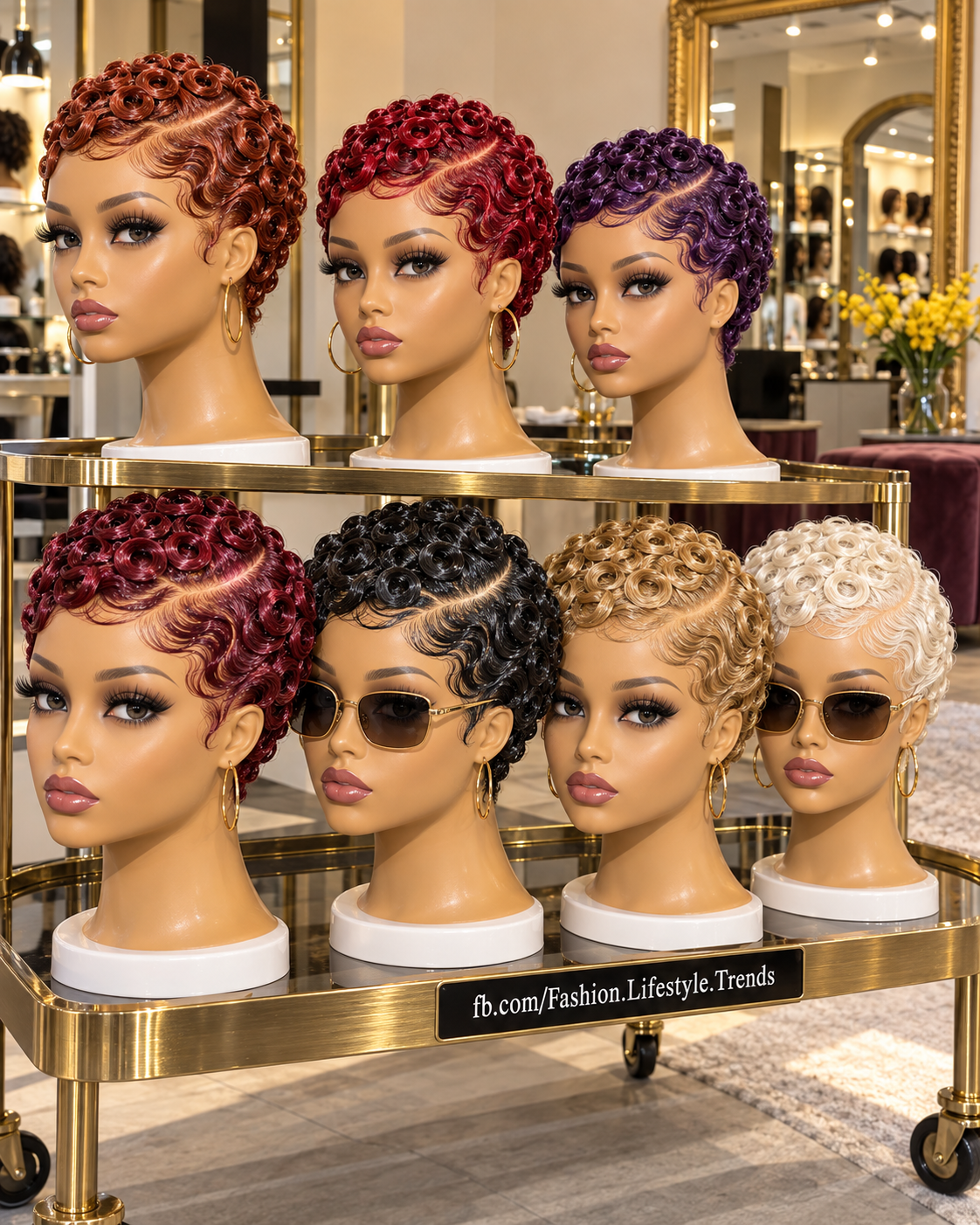
Seven beautiful pixie wigs, seven different color personalities, and one question that many women face when shopping for a new hairstyle: which one is worth buying? This salon collection brings together copper auburn, cherry red, deep purple, burgundy, natural black, golden blonde, and creamy platinum blonde in a coordinated display of closely arranged circular curls. Rather than presenting seven completely different haircuts, the collection demonstrates how color, curl placement, and carefully sculpted hairlines can give a similar pixie silhouette a different character.
The wigs are displayed on seven female mannequin heads arranged across two levels of a gold metal salon trolley. Three mannequins occupy the upper shelf, while four stand on the lower shelf. Each mannequin has a realistic cosmetic appearance, with painted eyebrows, prominent eyelashes, and glossy lips. Several wear gold hoop earrings, while the black and platinum blonde styles are accessorized with sunglasses.
The setting is an elegant beauty salon with large gold-framed mirrors, decorative lighting, and other hair displays visible in the background. Although the surroundings are attractive, the hairstyles themselves provide the most useful information for anyone considering a purchase.


Every wig has a compact, closely curled crown. The curls form small circular rings resembling miniature rosettes, while the front hairlines display carefully arranged finger waves. Several wigs have diagonal partings that create a visible separation between neighboring curl sections. The overall silhouettes remain close to the head, without long hanging strands or excessive height.
What makes this collection particularly interesting is that the colors do not simply cover identical arrangements. The copper and cherry-red versions have slightly different front-wave placements. The purple wig shows a distinctive side curl arrangement, while the black wig has a prominent diagonal parting and darker circular curls. The blonde versions make the individual ringlets more visible because of their lighter coloring.
For customers asking where to buy these wigs, how much similar hairstyles might cost, or whether they can be ordered in a particular color, the first step is understanding exactly what the photograph shows and which details require confirmation from a seller.
Seven Wigs, Two Shelves, and Different Color Personalities
The upper shelf contains three hairstyles. From left to right, the mannequins wear copper auburn, bright cherry red, and deep purple pixie curls.
The lower shelf contains four additional styles. From left to right, the colors are burgundy, glossy black, golden blonde, and pale platinum blonde.
This arrangement provides a useful comparison between warm, dark, and lighter color families. Copper and cherry red introduce stronger warmth, while purple creates a cooler fashion-oriented appearance. Burgundy offers a deeper red alternative, and black provides a familiar dark option.
The two blonde wigs are especially interesting when viewed together. Golden blonde contains warm honey-like reflections, while platinum blonde appears much lighter and creamier.
All seven wigs share the general characteristics of compact circular curls and sculpted front hairlines. However, differences in curl diameter, parting placement, and wave direction mean that each hairstyle should be evaluated separately.
Customers who want an exact reproduction should identify one mannequin as the main reference rather than assuming that any of the seven colors can be exchanged without affecting the overall appearance.
Copper Auburn Curls With Warm Reddish Reflections
The upper-left mannequin wears a copper-auburn pixie with numerous small circular curls arranged across the crown and sides.
The color contains rich reddish-brown and copper reflections, producing a warm appearance without becoming uniformly bright orange.
The curls form compact circular openings, with some slightly larger ringlets positioned near the front. Smaller curls fill the surrounding spaces, creating a rounded upper silhouette.
A diagonal parting separates the upper curls from a carefully arranged front section. The strands beneath the parting follow curved paths toward the forehead and temple.
The side contains several decorative curls that sit close to the face, creating a gradual transition from the fuller crown.
This color may appeal to women who enjoy warm hair shades but prefer something richer than golden blonde.
What to Request When Ordering Copper Auburn
Ask the seller whether the proposed shade contains more orange, red, or brown.
The reference appears predominantly copper auburn, with reddish-brown depth beneath the brighter reflections.
A uniformly orange wig could look substantially different.
Request a daylight photograph of the actual hair and confirm whether the color is consistent throughout the curls.
If ordering a custom wig, also specify the circular curl size and diagonal parting position.
Cherry Red Creates a Brighter Statement
The upper-center mannequin displays a vivid cherry-red pixie with compact circular curls.
The shade is brighter and more saturated than the burgundy wig on the lower shelf. Its red coloring is especially noticeable along the outer surfaces of the curls.
Numerous small ringlets cover the upper head, with several prominent circular openings near the front.
A diagonal parting travels through the upper section, while sculpted finger waves curve across the forehead and toward the temple.
The front waves create a graceful transition between the upper curls and the closely arranged side hair.
Cherry red may appeal to customers who enjoy expressive hair colors and want a compact pixie that attracts attention without requiring long extensions.
Cherry Red Is Not the Same as Burgundy
Although both belong to the red color family, cherry red and burgundy can create very different impressions.
Cherry red generally appears brighter, while burgundy contains deeper wine-red tones.
The photograph demonstrates this distinction by placing both shades within the same display.
Customers should avoid ordering a generic red wig without confirming the intended undertone.
Commercial color names vary between suppliers, so photographs of actual hair samples are more useful than shade names alone.
Deep Purple for a Distinctive Pixie Appearance
The upper-right mannequin wears a deep purple pixie with numerous compact circular curls.
The shade contains rich violet reflections, creating a cooler appearance than the copper and cherry-red wigs beside it.
The curls are closely arranged across the crown, with several prominent ringlets visible near the upper front and side.
A diagonal parting separates neighboring curl groups, while carefully styled strands follow the forehead and temple.
Several small curls sit close to the side hairline, giving the hairstyle a compact appearance.
The purple color is sufficiently deep to retain darker areas between the curls, allowing the circular shapes to remain visible.
This version may appeal to women who want a fashion-oriented hair color without choosing a pale or neon shade.
Choosing Between Violet and Plum
Purple wigs can range from bright violet to dark plum.
The displayed hairstyle appears to belong to a deep violet-purple family, although the exact commercial shade cannot be established from the photograph.
Some purple wigs contain strong red undertones, while others lean toward cooler blue-violet shades.
Customers should request photographs under natural daylight before approving the color.
If the desired appearance is deep purple, specify that the color should remain visibly violet rather than becoming almost black.
Burgundy Offers a Richer Red Alternative
The lower-left mannequin wears a deep burgundy pixie with numerous compact circular curls.
The hair contains wine-red reflections, creating a darker appearance than the cherry-red version above.
The crown is filled with closely positioned curls, including several prominent circular openings near the front.
A diagonal parting travels across the upper section, while sculpted finger waves follow the forehead and temple.
The front arrangement includes broad curved strands that create movement beneath the circular curls.
The hairstyle maintains a rounded silhouette, with the lower side remaining relatively close to the head.
Burgundy may appeal to customers who enjoy red-family colors but prefer a deeper, less luminous appearance than bright cherry red.
Why Burgundy Works Well With Circular Curls
The rounded curls create numerous reflective surfaces.
Wine-red tones become particularly noticeable where light strikes the outer strands, while darker areas inside the curls provide depth.
This contrast allows individual curls to remain recognizable without requiring additional highlights.
The result is a rich color appearance that complements the compact pixie proportions.
Natural Black Keeps the Hair Design in Focus
The lower-center-left mannequin wears a glossy black pixie with compact circular curls.
The hairstyle contains numerous small and medium ringlets, with visible circular openings across the crown.
A prominent diagonal parting separates the upper curls from a carefully arranged front-wave section.
The strands beneath the parting follow broad curved paths toward the temple, creating a decorative hairline.
The black color emphasizes the contrast between reflective strands and darker spaces inside the curls.
This version offers a versatile option for women who prefer dark hair while still enjoying detailed salon styling.
The mannequin wears sunglasses, but the upper curls, parting, and side arrangement remain visible.
Why Black Does Not Need Additional Highlights
Black hair can appear highly dimensional when arranged into circular curls.
The outer strands reflect light, while the curl openings remain darker.
This creates visual contrast without requiring separate color sections.
Customers seeking a faithful reproduction should prioritize curl placement, hairline styling, and overall proportions rather than requesting unnecessary highlights.
Golden Blonde Adds Warmth to the Lower Shelf
The lower-center-right mannequin displays a warm golden blonde pixie with numerous compact circular curls.
The shade contains honey and golden reflections, creating a bright appearance without reaching the pale tone of platinum blonde.
The upper curls are closely arranged, with several prominent circular openings near the front.
A diagonal parting separates neighboring curl groups, while carefully arranged finger waves follow the forehead and temple.
The warm coloring emphasizes the circular shapes, making the individual curls particularly noticeable.
Golden blonde may appeal to women who want a brighter hairstyle while retaining warm undertones.
Golden Blonde Versus Honey Blonde
Golden blonde often emphasizes yellow-gold reflections, while honey blonde may contain deeper amber or caramel undertones.
The displayed wig has a warm golden appearance, although its exact commercial color number cannot be determined from the photograph.
Customers should request actual color samples before ordering, especially when precise shade matching is important.
Platinum Blonde Creates a Bright Contrast
The lower-right mannequin wears a pale platinum blonde pixie with numerous compact circular curls.
The color appears creamy white-blonde, with subtle warm reflections under the salon lighting.
The upper curls are densely arranged, forming a rounded silhouette with several visible circular openings.
A diagonal parting separates neighboring curl sections, while fine finger waves follow the front hairline.
The mannequin wears oversized sunglasses, but the upper hairstyle and temple arrangement remain visible.
Platinum blonde offers a considerably lighter alternative to golden blonde, copper, burgundy, and black.
Platinum Blonde Requires Careful Shade Selection
Platinum can range from creamy white-blonde to cooler icy tones.
The displayed wig appears relatively creamy rather than distinctly silver gray.
Customers should confirm the intended undertone before ordering.
If purchasing a human-hair wig, ask whether the hair has been chemically lightened and how that processing may affect future styling.
If purchasing synthetic hair, confirm the manufacturer’s care instructions before attempting any color alteration.
The Circular Curls Connect All Seven Hairstyles
Despite their different colors, the wigs share a recognizable compact curl structure.
The upper hair contains numerous small circular spirals arranged in overlapping layers.
Some curls have larger openings, while others are more tightly wound.
This variation creates rounded silhouettes without making the hairstyles appear excessively tall.
The individual curl arrangements are not necessarily identical across all seven wigs.
Customers should therefore evaluate the preferred wig separately rather than assuming that changing the color will produce an otherwise identical unit.
Why Curl Diameter Matters
The size of the circular openings influences the hairstyle’s appearance.
If the curls are too small, the crown may resemble a tightly coiled Afro pixie. If they are too large, the compact proportions could be lost.
A custom wig maker should consider curl diameter, placement, and overall density together.
The photograph does not establish the exact technique used to create the curls.
The Diagonal Partings Add Direction
Several wigs display visible diagonal partings that separate neighboring curl sections.
The exposed channels appear lighter than the surrounding strands because the foundation beneath the separation is visible.
The partings vary slightly in angle and length, but they help establish the direction of the upper curls and front waves.
A custom stylist should determine the preferred parting position before arranging the hair.
The customer should also confirm whether the design should appear on the left or right side when worn.
Finger Waves Create Beautiful Hairlines
Each wig includes carefully arranged strands near the front hairline.
These strands form curved finger-wave patterns that follow the forehead and temple.
The waves create a transition between the compact circular curls and the lower hairline.
Their exact shapes vary slightly between the wigs, but the general styling approach remains coordinated.
Some waves form broad curves, while others appear as smaller repeated arcs.
A customer seeking a faithful reproduction should include the front-wave arrangement in the custom-order instructions.
Which Wig Color Is Best for Everyday Wear?
The best color depends on personal preference, styling habits, and the desired overall appearance.
Black may appeal to customers who prefer a familiar dark shade, while golden blonde and copper provide warmer alternatives.
Burgundy offers a rich red-family option, while cherry red and purple create stronger fashion statements.
Platinum blonde can be particularly striking when paired with darker clothing.
However, color should not be the only consideration. Customers should also evaluate the curl arrangement, parting direction, and front hairline styling.
A wig that matches the desired color but has a different curl structure may not provide the intended appearance.
What the Mannequin Display Cannot Confirm
The photograph provides useful information about color, curl arrangement, parting direction, and front hairline styling.
However, the underside of the wigs is not visible.
The mannequin heads do not establish the cap construction, fiber composition, lace grade, or attachment hardware of the displayed units.
Buyers should request photographs of the actual wig removed from its mannequin before purchasing.
A complete underside photograph can help establish the cap design, while a close-up of the hairline may reveal whether lace is present.
No wig in the display should be advertised as HD lace or glueless solely on the basis of the photograph.
Where to Buy Similar Curly Pixie Wigs
Customers can begin with specialist wig salons, independent wig makers, and online businesses offering custom pixie styling.
Look for portfolios containing compact circular curls, diagonal partings, and carefully arranged front waves.
A general curly wig seller may offer similar colors without demonstrating the ability to reproduce the precise curl arrangement.
When contacting a potential maker, send the reference photograph and identify the preferred wig by its color and position.
Ask whether the seller can reproduce the curl size, parting direction, and front-wave styling.
Preparing a Custom Wig Order
Confirm the desired color, crown height, curl density, and parting orientation.
Ask whether the wig will arrive fully styled or require additional salon work after delivery.
Request photographs of the actual unit rather than relying exclusively on a mannequin display.
The seller should also provide information about the hair material, cap construction, measurements, and available installation options.
For online orders, obtain written confirmation of the agreed design, production time, shipping arrangements, and revision policy.
Choosing Between Ready-Made and Custom Wigs
A ready-made curly pixie may provide a similar color and general silhouette at a lower initial cost.
However, many ready-made wigs contain ordinary loose curls rather than the compact circular spirals shown in the reference.
They may also lack the diagonal parting and carefully arranged finger-wave hairline.
Customers who want these details reproduced accurately may prefer a custom wig.
A ready-made base could still be suitable if its hair length, density, and cap construction allow the stylist to create the desired arrangement.
Before purchasing a base unit for later customization, ask the intended stylist whether it can support the required alterations.
Estimated Prices for Seven-Color Pixie Curl Wigs
The potential cost of these hairstyles depends on the selected hair material, cap construction, color processing, circular curl styling, and front hairline customization.
The following USD amounts are illustrative planning estimates only. They are not verified live retail prices or quotations for the displayed wigs.
| Wig Category | Illustrative USD Range | Relevant Cost Considerations |
|---|---|---|
| Premium Custom | $375–$895+ | Individual circular curl placement, personalized color selection, diagonal parting styling, sculpted front waves, and custom cap fitting. |
| Standard Custom | $190–$450 | Customized compact curls and front-wave styling on a suitable prepared wig foundation. |
| Basic Human Hair | $105–$285 | A possible starting unit requiring additional coloring, curl |