
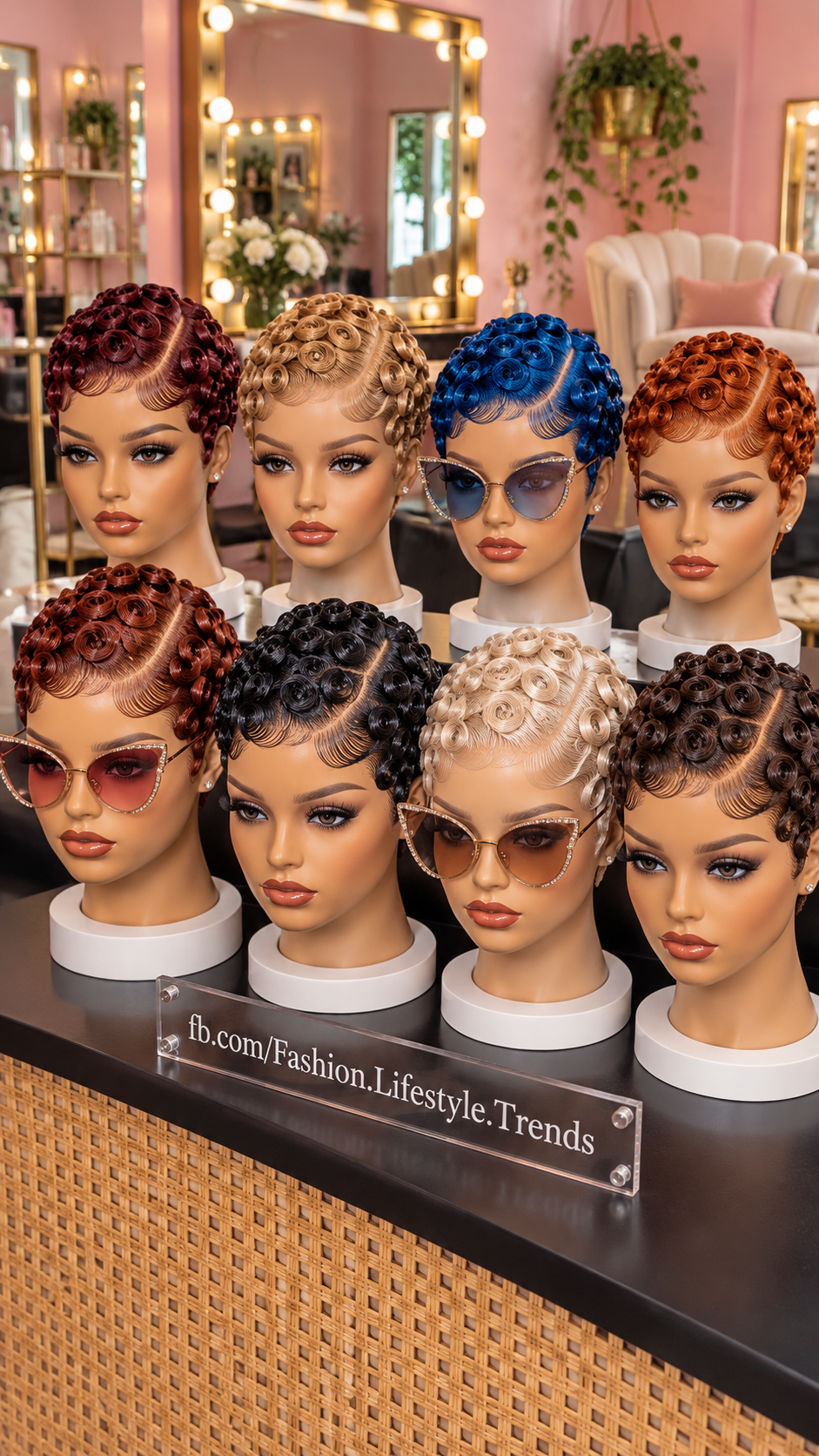
A beautifully arranged pixie wig can make you stop scrolling, but the decision to buy usually comes down to a few practical details. You want to know where to find the style, which color to choose, how much to budget, and whether the wig will look as appealing on your own head as it does on a mannequin. This collection brings those decisions into focus through eight variations of a compact hairstyle built around circular curls, forehead waves, and a sweeping side part.
The display includes burgundy, golden honey, vivid blue, orange-copper, deeper auburn, black, pale creamy blonde, and dark brown. Each piece offers a different color impression while maintaining a closely fitted outline. The styling leaves the mannequin faces open, with curls concentrated across the upper head and smaller waves following the forehead. It is a look that depends on careful arrangement rather than long lengths or oversized volume.
For someone hoping to purchase a similar wig, the photograph works best as a starting reference. It shows the desired appearance, but it does not confirm fiber composition, cap construction, current stock, delivery terms, or a physical shop address. The most useful approach is to connect what you can see with the information a seller or stylist needs to provide. That is how an attractive photograph becomes a realistic, well-specified order.
Decide Which Detail Made You Save the Picture
Before comparing sellers, identify the part of the collection that appeals to you most. It might be the small circular curls, the pronounced side part, the close-fitting sides, or a particular shade. These preferences lead to different purchasing decisions. Someone who mainly wants the burgundy color may accept a slightly different curl arrangement, while someone who loves the exact front pattern may need a custom styling service.


The circular openings across the upper sections are particularly noticeable. These curls sit close together, but their centers remain visible, creating a decorative surface rather than a fluffy mass. Some rings tilt sideways, while others face toward the viewer. Their arrangement changes slightly from one mannequin to another, so the collection should not be treated as eight perfectly identical wigs with different dye colors.
The front sections have a finer rhythm. Narrow waves sweep along the forehead beneath the larger curls, and a pale-looking side channel separates sections of hair. Several parts curve backward across the upper head. This relationship between the larger rings and the flatter waved areas is essential to the appearance. A seller who offers only a generic curled pixie may not be providing the same type of styling.
Choose one mannequin as your primary reference. Then explain whether you want its complete appearance or only selected details. This simple decision can prevent a custom order from becoming a mixture of several different pieces that never quite matches the one you originally preferred.
Read the Color Collection Before Choosing a Shade
Across the back row, the first mannequin wears a deep burgundy shade with wine-colored reflections. Beside it is golden honey, followed by a saturated blue and an orange-copper option. In the front row, the first wig has a deeper reddish auburn appearance, followed by black, pale creamy blonde, and dark brown. The arrangement makes it possible to compare warm, neutral, light, and cool colors within a similar silhouette.
Burgundy and auburn should be requested separately. The burgundy at the back left appears closer to a dark wine tone, while the front-left auburn has more reddish-brown warmth. The copper at the back right is brighter and more orange. Calling all three “red” leaves too much room for interpretation, especially when ordering remotely from a seller who uses different color names.
The two blonde options also need separate descriptions. Golden honey has a deeper, warmer appearance, with amber-looking shadows between curls. The pale blonde in the front row is much lighter and creamier. Warm salon lighting can influence both shades, so request a comparison in neutral daylight if you are deciding between them. A seller’s color label is helpful, but an actual item photograph is more useful.
Black and dark brown create different levels of warmth. The black wig appears deeper and more neutral, while the brown piece shows warmer reflections around the circular curls. Blue is the most conspicuous cool shade in this particular collection. Its brightness changes across illuminated and shadowed sections, so ask for footage that shows the entire unit moving through consistent light rather than one highly illuminated close-up.
Find Out Where To Buy This
A local wig boutique is a practical place to begin if you want to inspect fit, color, and styling in person. Contact the shop before visiting and send the photograph with your preferred mannequin identified. Ask whether it stocks finger wave pixie wigs with circular curls, rather than asking only for a curly wig. A clear description helps the shop determine whether it has a suitable item or would need to arrange additional styling.
A specialist wig maker may be the better choice when you want a particular front arrangement or a less commonly stocked shade. Look for examples showing close-fitting pixie units, carefully arranged forehead waves, and consistent work around the temples. A portfolio consisting mainly of long wigs may not demonstrate the skills needed to reproduce this compact shape.
Online wig stores and independent sellers offer another route, especially when local options are limited. Ask whether the listing represents an existing finished unit or a sample used to advertise made-to-order work. Those are different purchasing situations. An existing unit can be photographed immediately, while a commission requires a written agreement about the intended result and the time needed to produce it.
The page address on the display does not independently establish a seller’s identity, location, or inventory. No verified physical shop address can be determined from this image alone. Before planning a visit or paying for delivery, obtain the seller’s city, country, collection arrangements, and shipping coverage directly. If you need a local service, include your own city in searches such as “finger wave wig maker” or “curly pixie wig boutique.”
Build an Order Request That a Maker Can Follow
A useful order message should explain the desired shade, the selected mannequin position, the curl arrangement, and the intended fit. For example, you might request the front-row dark brown version with its compact ringlets and visible side part. If you want that arrangement in another color, say so explicitly. Do not assume the maker will know which details you consider essential.
Include your preferences about forehead coverage and ear exposure. The mannequins have visible ears and closely styled temple areas, but the same placement will not automatically suit every wearer. A maker may need to account for your measurements, natural hair underneath, and preferred position of the wig. Ask which measurements and photographs are useful before sending personal fitting information.
Discuss the back separately. The image shows the front and portions of the sides, but it does not provide a complete rear view of each piece. Ask for a compact rear outline that is consistent with the selected reference, then request approval footage from behind. This avoids making assumptions about a section that the photograph cannot fully document.
For a custom commission, agree on when you will see progress photographs and what can still be changed at each stage. Color, cap size, cutting, and curl placement may have different revision limits. Written confirmation makes the order easier to review and gives both buyer and maker a clear record of the intended result.
Estimated Costs Across Five Buying Options
The following USD amounts are illustrative planning ranges, not verified current prices for the photographed wigs. They are intended to help organize a budget and compare different types of purchase. The image does not identify the material of any displayed unit. Human hair and synthetic options are listed as possible shopping categories, and the actual quote should come from the seller supplying your chosen piece.
| Purchase Category | Illustrative Price Range | What the Quote Should Explain |
|---|---|---|
| Premium Custom | $480–$1,050+ | Individually specified construction, detailed styling, selected color work, fitting arrangements, and approval stages. |
| Standard Custom | $230–$490 | An existing base customized toward the reference, with clear limits on color changes, cap adjustments, and revisions. |
| Basic Human Hair | $120–$280 | Verified hair composition, processing history where available, base construction, and whether sculpted styling is included. |
| Premium Synthetic | $70–$175 | Fiber specifications, preset curl quality, cap options, care instructions, and permitted restyling methods. |
| Basic Synthetic | $25–$80 | Actual product photographs, coverage around the perimeter, fit information, and the applicable return policy. |
These ranges can overlap because the price reflects more than fiber alone. A carefully arranged synthetic unit may involve more styling labor than a simple human-hair base. Similarly, a human-hair wig advertised at an attractive starting price may arrive without the circular curl set shown here. Ask whether the amount covers a finished hairstyle or only the underlying wig.
Request a complete quote that separates the product from additional services. Cutting, color customization, professional setting, fitting, shipping, and taxes may be charged independently. If a salon appointment is required after delivery, include that service in the overall budget. Comparing only the advertised wig price can make an apparently inexpensive option more costly than expected.
Also ask about the likely cost of resetting the style. These closely arranged curls and forehead waves may require more deliberate maintenance than a loose hairstyle, depending on the material and setting method. A clear answer about future care helps you compare the long-term practicality of a preset unit with a custom piece that needs occasional professional attention.
Check What the Cap Actually Offers
The visible styling should not be used to guess the construction underneath. The photograph does not show the inside of the caps, exposed lace edges, combs, straps, or other attachment details. A neat-looking part does not establish that a wig has a particular lace grade, and the mannequins cannot demonstrate whether the units remain secure during wear.
Request an underside photograph of the actual unit or the proposed base. Ask the seller to identify the cap material, size, adjustment system, and any area intended for adhesive. If the product is described as glueless, ask what provides the hold and how sizing affects it. The term should be supported by a clear explanation of the construction.
The parting deserves its own confirmation. Some wigs are designed around a fixed part, while others allow changes within a specified area. This image cannot establish which applies. If you like the exact side channel in the photograph, a fixed arrangement may suit your needs. If you want styling flexibility, ask what movement is genuinely available before ordering.
Comfort should be considered alongside appearance. Tell the fitter if you wear glasses regularly or have particular sensitivity around the ears. Several mannequins wear sunglasses, but that does not prove the wig will sit comfortably with your own frames. Check that the cap and hair placement allow ordinary use without pushing the unit away from its intended position.
Use Product Footage to Assess the Finish
A short, continuous video can answer questions that several carefully chosen still photographs leave unresolved. Request a front view, both sides, a rear view, and a view from above. The lighting should remain reasonably consistent, and the camera should move slowly enough to show the part and perimeter. For existing stock, the footage should show the exact unit available to purchase.
Pay attention to how the curl arrangement continues around the head. The front may look beautifully organized while the back follows a different shape. That is not automatically a defect, but it should be visible before purchase. If the seller claims the piece matches your selected reference, ask how the unseen areas have been interpreted.
For the mannequins wearing sunglasses, request additional photographs without the accessories. Frames partially cover the upper face and may distract from the area around the temples. An unobstructed view makes it easier to assess forehead coverage, the beginning of the part, and the relationship between the side sections and the ears.
Do not judge fiber quality solely from shine. Lighting, setting products, photography, and material can all influence reflectivity. Instead, request written fiber information and care instructions, then compare those specifications with the intended use. A photograph can establish an appearance, but it cannot replace a reliable product description.
Arrange the First Appointment Around Fit and Placement
If you plan to use a local stylist, contact the salon before purchasing the wig. Explain that the unit may arrive already styled and ask whether the stylist can assess it without unnecessarily dismantling the curls. Provide the seller’s material and construction information. This helps the salon determine whether it can offer fitting, adjustment, or a complete reset if needed.
At the appointment, establish placement before discussing cutting. The forehead waves should sit in a position that suits your face and the cap’s intended fit. Check both ear areas, the side profile, and the rear outline. A mannequin can support a display arrangement, but a wearer needs comfort and stability during ordinary movement.
If lace is present and requires trimming, that step should follow the fitting assessment. The photograph itself does not show a lace perimeter, so trimming should never be assumed necessary simply because the style is a wig. Ask the stylist to explain the proposed alteration and how it affects coverage before proceeding.
A useful appointment ends with a demonstration you can repeat at home. Ask how to put the unit on, remove it, check its position, and make minor adjustments without pulling apart the rings. Taking time to learn the handling method can be more valuable than leaving with a perfect arrangement you cannot maintain after the first wear.
Match the Wig to the Way You Plan to Wear It
Daily wear and occasional wear can lead to different choices. Someone wearing the wig several times a week may prioritize comfortable construction, accessible maintenance, and a shade that works with an existing wardrobe. An occasional wearer may be more willing to choose a conspicuous blue or pale blonde, provided the storage and preparation requirements are manageable.
Consider how much styling assistance you want. A preset arrangement with clear care instructions may suit someone who prefers minimal intervention. A customizable unit may appeal to someone who already visits a wig stylist and wants adjustments over time. Neither option should be selected on material claims alone; the quality of the specific piece and the support available matter.
The compact silhouette also makes proportion important. Ask for a view of the unit on a wearer or a mannequin photographed from a comparable angle, rather than relying only on a close crop. The aim is to understand how the crown height, side coverage, and front waves work together. A larger-looking upper section could create a different result even with similar individual curls.
Protect the Circular Curls During Everyday Handling
The most immediate care priority is preserving the arrangement. Avoid lifting the wig by its curled upper sections or repeatedly pushing fingers through the circular openings. Support the cap when moving the unit. If a curl shifts, follow the maker’s advice for repositioning it rather than pulling adjacent sections in an attempt to restore symmetry.
Ask which products, if any, are appropriate for refreshing the style. Adding heavy products without guidance may alter the surface appearance or create buildup between closely arranged sections. The correct approach depends on the confirmed material and setting method. Do not assume that products used successfully on your natural hair are suitable for this particular wig.
Before washing, find out whether the existing set is expected to remain intact or whether it will need to be recreated. Request instructions for cleansing, drying, and resetting, including any material-specific restrictions. Avoid applying heat to unidentified fibers. If professional maintenance is recommended, identify a suitable stylist before the wig needs its first full service.
Storage should support the cap while keeping pressure off the curls. Choose a stand or storage arrangement appropriate to the unit’s size and construction. Do not force the styled upper section into tight packaging or leave accessories pressing against the forehead waves. For travel, ask the maker how to pack the piece and whether any sections will need attention after unpacking.
Resolve Delivery and Aftercare Before Paying
For a ready-made purchase, confirm the dispatch window and whether the wig will be checked or restyled before shipping. For a commission, distinguish production time from transit time. If you need the piece for a particular occasion, communicate the date at the beginning of the discussion and ask whether the seller can realistically meet it.
Read the policy covering returns, exchanges, and custom alterations. Some sellers treat personalized items differently from standard stock, so clarify the terms that apply to your exact order. Ask what happens if the wrong shade arrives, the cap measurements differ from the agreement, or the item is damaged in transit. Keep the product description, approved photographs, and payment record together.
Aftercare support is another useful comparison point. A seller who can explain the care process, identify the material, and provide reliable maintenance advice gives you more information to work with after delivery. Ask whether replacement photographs, a handling demonstration, or a paid reset service are available. These details are especially relevant for a hairstyle whose appeal depends on deliberate curl placement.
The right purchase begins with a specific visual choice and ends with a clear understanding of the product. Select the mannequin that best represents your preferred color and shape, verify the construction, compare complete quotes, and plan fitting and upkeep. With those details settled, you can shop for this curled pixie style with a realistic budget and a much clearer expectation of what you will receive.
Search Terms
side swept ringlet pixie wigs · wine burgundy waved pixie · golden honey circular pin curls · cobalt blue sculpted curl wig · orange copper finger wave pixie · auburn compact ringlet hairstyle · creamy platinum side part wig · dark brown forehead wave wig