
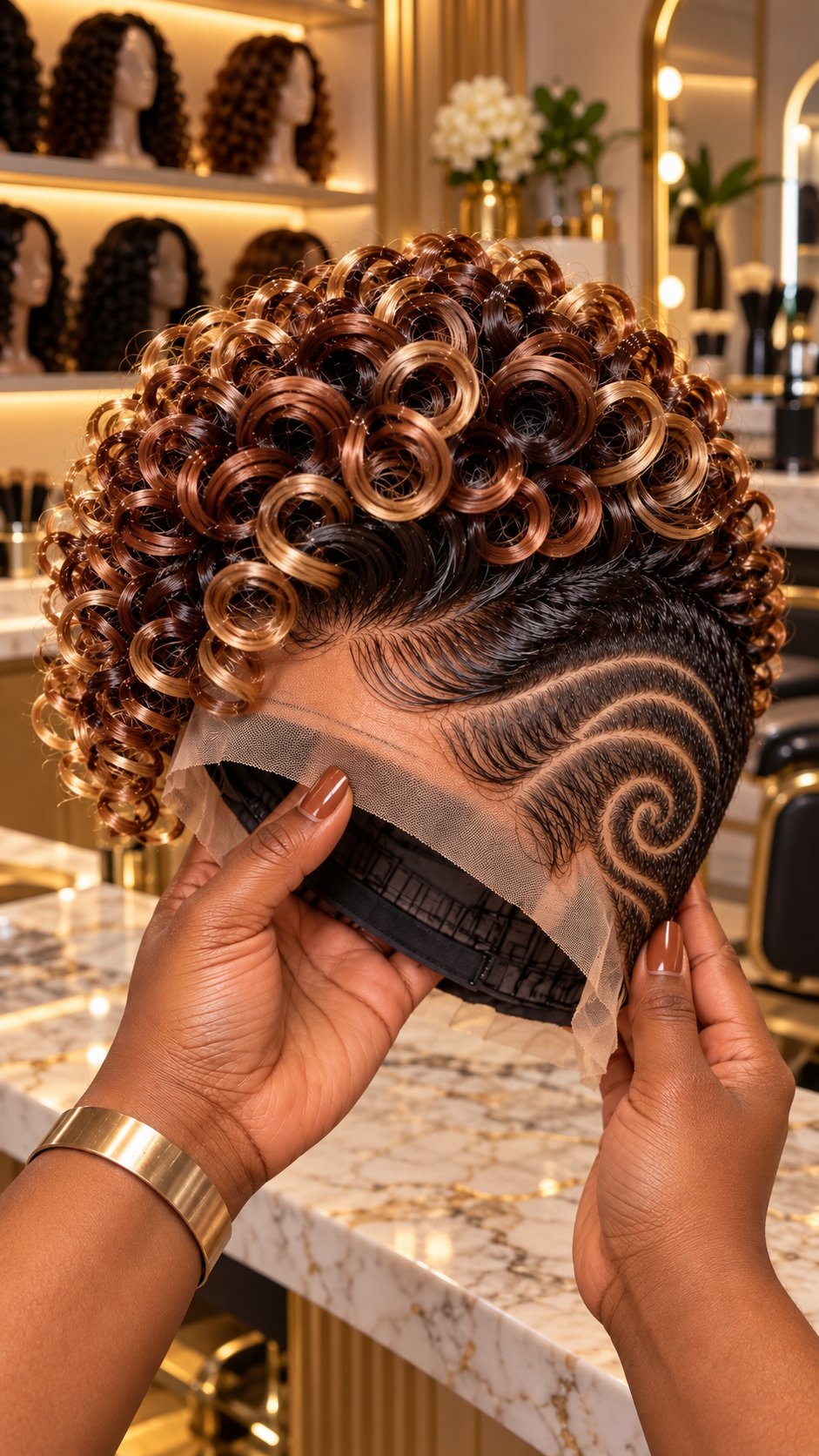
The detail worth saving in this reference is the spiral beside the temple. Its curved channels bring a deliberate pattern into the dark side section, while open caramel and chestnut ringlets create a completely different rhythm above it. That contrast gives this wig its identity: a rounded, colorful arrangement of curls paired with closely laid hair and an intricate side design. Ordering only a “highlighted curly pixie” would leave too much of that identity open to interpretation.
The wig is held in two hands before installation, making several purchasing details visible. Untrimmed lace extends beyond the hairline, and a black interior band appears beneath the front opening. Neither detail confirms the fiber, lace grade, or fastening system. What the photograph does provide is a useful starting point for a precise commission, especially if the curved temple pattern matters as much to you as the curls.
Turn the Temple Pattern into a Clear Order Brief
Look closely at the exposed side and the design becomes more specific than a few parallel lines. A long curved channel travels beneath the upper section, with additional curves bending toward a compact spiral lower down. Dark hair separates these lighter pathways, keeping the pattern readable. The arrangement follows the side of the wig rather than sitting on top like an unrelated decoration.
For a custom order, send the full reference together with a crop of this area. Ask the maker whether the pattern will be created through hair placement, selective trimming, ventilation, or another construction method. The photograph alone cannot establish how it was made. This question matters because a pattern produced during construction may require a different approach to future repairs than one achieved mainly through styling.


Agree on the scale before work begins. A larger spiral could crowd the temple, while overly narrow channels might disappear when the unit is fitted. Request a progress photograph showing the side against a head form with measurements. If you prefer the design on the opposite side, specify that explicitly; reversing the photograph after production will not reverse the actual wig.
The Highlights Follow the Rings
The color arrangement is not a simple blonde layer over a dark base. Near-black and deep brown areas remain visible beneath warm chestnut, copper-brown, and golden caramel sections. Several curls carry lighter lengths around their outer arcs, so the circular shape catches the eye without every ring becoming the same color. Darker intervals give the brighter pieces room to stand apart.
Warm salon lighting adds a golden cast across the image. For that reason, treat “caramel” and “chestnut” as descriptive starting points rather than exact shade guarantees. Ask for a daylight video and, where available, a physical color sample. A unit that appears honey-gold under illuminated mirrors may look more copper or brown beside a window.
The placement also deserves its own instruction. If the maker distributes pale strands evenly throughout the side section, the spiral may lose some contrast. Specify whether you want the visible side to remain predominantly dark, with most lighter color concentrated through the elevated curls. Confirm the root color separately from the highlight shade so the finished result does not become uniformly light.
Open Centers Give the Curls Their Shape
These are open circular ringlets with visible spaces through many of their centers. They sit in overlapping groups, with some facing forward and others turning outward across the top. The curl sizes vary enough to avoid a rigid row-by-row appearance. Along the left edge of the photograph, several rings descend lower than the central front section, giving the visible outline an uneven, rounded edge.
A stylist recreating this arrangement should understand that brushing the curls into a soft mass would change the result substantially. The reference depends on individual rings remaining recognizable. Ask whether the unit arrives fully set and whether its advertised photographs show the actual delivery condition or a separate salon finish. A lower initial price can become less attractive if the complete curl arrangement must be rebuilt immediately.
Although the top looks full, the photograph does not show the entire back or underside. Request a rear view before approving a similar unit. The transition from the elevated curls into the nape should be evaluated independently; a convincing front and side photograph cannot establish whether the back has the proportions you want.
Check the Fit Before Altering the Lace
The visible mesh projects beyond the forehead and temple, indicating that the pictured unit has not received its final edge trim. Fine hairs are arranged along the front and side boundary, including a curved sweep above the patterned area. Their appearance after installation will depend partly on where the wig sits on the wearer.
Ask for the cap circumference, front-to-nape measurement, and ear-to-ear measurement relevant to the maker’s sizing system. With a design this dependent on temple placement, circumference alone may be insufficient. A cap can feel secure while placing the spiral too far forward, too low, or partly over the ear. Have the stylist assess those relationships during a dry fitting.
The black interior section visible at the opening does not establish that the wig is glueless, adjustable, or equipped with particular combs. Obtain clear underside photographs and a written construction description. Discuss your preferred wearing method before purchase, including whether you need removable daily wear. Leave the lace intact until the unit has been inspected and its position checked against your own hairline.
A Budget for Both the Wig and Its Detailing
For this design, the useful comparison is the cost of a finished, wearable result. Color placement, ringlet setting, cap construction, and the spiral side can represent separate work. A seller offering a general curly unit and a maker quoting a close recreation may therefore be pricing different products.
The USD amounts below are illustrative planning ranges, not verified listings or quotations for the pictured wig. They describe possible purchasing categories; the photograph does not confirm whether this particular unit contains human hair or synthetic fiber.
| Category | Illustrative USD Range | Scope to Confirm Before Ordering |
|---|---|---|
| Premium Custom | $450–$950+ | Individual sizing, detailed spiral execution, deliberate highlight placement, and an agreed ringlet arrangement. |
| Standard Custom | $260–$480 | Adaptation of an existing base, with clearly stated limits on color placement and side-pattern complexity. |
| Basic Human Hair | $150–$300 | Verified human-hair specifications; specialist coloring, curl setting, or side detailing may be additional. |
| Premium Synthetic | $85–$190 | Declared fiber specifications, a suitable preset curl structure, and confirmation of the supplied temple design. |
| Basic Synthetic | $35–$85 | A general color-and-curl interpretation; close reproduction of the spiral should not be assumed. |
Ask whether the quotation includes lace customization, the initial fitting, final curl setting, shipping, and any applicable taxes. Installation and later resetting may be separate salon services. Also clarify what happens if the completed side pattern differs materially from the approved brief. Written revision terms are more useful than an informal promise that the maker can produce “something similar.”
Get The Details On This Wig
Use this image as a reference when contacting a wig maker, a local wig boutique, or a stylist who regularly works with sculpted cropped units. There is no verified seller attached to the photograph, so an exact stock source cannot be identified from it. Prioritize portfolios showing comparable curved temple work and individually arranged ringlets.
Request an unfiltered video of the actual unit being offered, including the opposite side, nape, interior, and lace boundary. Ask the seller to state the fiber, cap size, color description, and included services in writing. If the listing uses a reference image, establish whether you are buying the photographed item, a ready-made interpretation, or a commissioned recreation.
A ready-made option can suit someone comfortable with small differences in curl placement. Custom work makes more sense when the spiral’s position and the dark-to-caramel balance are essential. Before paying a deposit, agree on which details must match and which may vary. Keep those decisions in the order record so the final inspection has a clear basis.
Book the Appointment Around the Actual Work
Send the reference and the seller’s construction information before booking a salon appointment. Explain whether the unit arrives fully styled or needs setting. The professional fitting the lace may not be the same person best equipped to reproduce the side pattern, so confirm the required skills in advance rather than assuming every installation service includes detailed redesign.
At the appointment, inspect the unit first, then establish its position and fit. Review the temple placement from the front and side before authorizing trimming. Only after that assessment should the stylist decide whether any edge work or curl adjustment is necessary. Cutting into the patterned area too early could remove the very detail you commissioned.
Bring photographs of the finished fit home with you, especially the side profile. They give you and the stylist a reference for later resetting. Ask for a realistic upkeep schedule based on the confirmed material and your wearing routine, rather than a generic promise that the original arrangement will remain unchanged indefinitely.
Protect the Rings Without Flattening the Side
The most vulnerable element during handling is the open curl shape. Repeatedly squeezing the top, pulling individual rings, or dragging a brush through the arrangement can alter its spacing. Lift the unit by its supporting structure where practical, and use a stand that fits without stretching the cap. Leave enough clearance around the curls so they are not pressed against a shelf or storage container.
Before washing, obtain material-specific instructions and ask whether the ringlets need a professional reset afterward. For synthetic fiber, do not assume heat tolerance or compatibility with coloring products. For confirmed human hair, ask about previous color processing before further bleaching or heated restyling. The warm highlights may have different care needs from the darker sections.
Keep heavy product buildup away from the visible channels, where residue could reduce the contrast of the spiral. If the pattern becomes less distinct, have its construction assessed before attempting to deepen it with scissors or clippers. This style is most successful when the curl arrangement, temple placement, and cap fit work together; preserving that relationship is more valuable than repeatedly adding product to imitate the photograph’s shine.
Search Terms
caramel ringlet pixie wig · spiral temple design wig · chestnut circular curls · dark roots with golden ringlets · sculpted curved side channels · untrimmed lace pixie wig · open loop curl crown · two tone tapered curl wig