
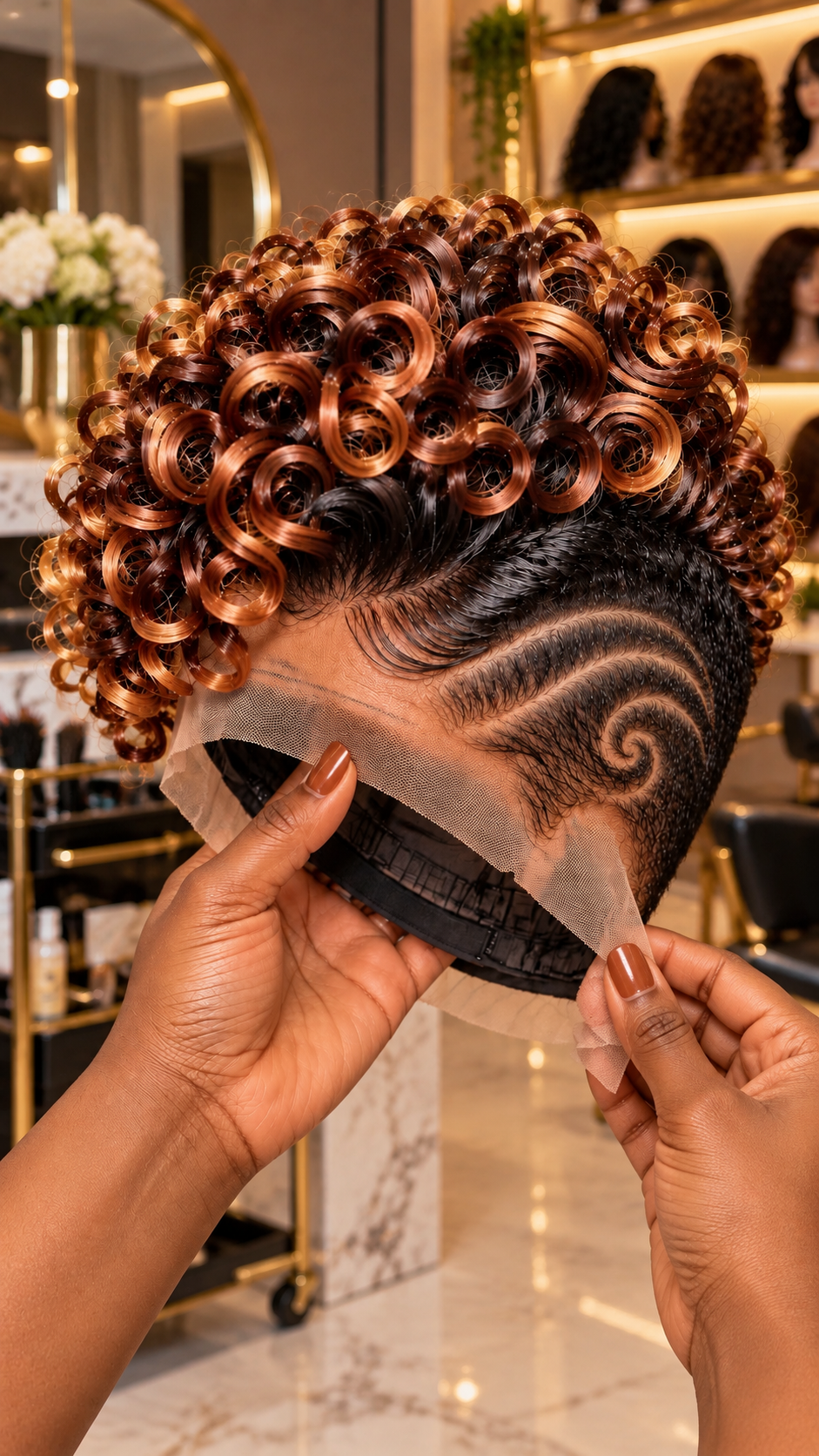
A small spiral at the temple gives this copper curl wig its most distinctive detail. Above it, open ringlets create a rounded silhouette, with bright copper and golden strands sitting against a much darker foundation. Below the curls, closely arranged black hair follows curved channels toward the spiral. The result depends on the relationship between those two areas: a lively, lifted top and a compact side design that deserves to remain visible when the wig is fitted.
The photograph shows the wig held in two hands before installation, with excess lace extending beyond the hairline. This is useful for understanding the intended placement, but it also raises practical buying questions. Will the temple pattern sit correctly on your head? How closely can a seller reproduce the copper placement? What happens to the rings after washing? Those questions matter more than a product description that simply calls the piece a curly pixie.
The Temple Spiral Should Determine the Fit
On the visible side, several pale curved channels separate sections of dark hair. They sweep downward into a tight inward spiral near the temple. These are not ordinary straight part lines, and the photograph does not establish exactly how they were created. A seller might use directional styling, customized hair placement, trimming, or a combination of techniques. Ask which method applies to the actual unit before assuming that a barber can recreate it on any wig.
Position is especially important here. If the cap sits too far forward, the spiral could fall closer to the cheek than intended. If the unit rides backward, the side pattern may sit above its intended location and expose an awkward gap near the natural hairline. A fitting appointment should therefore assess the temple placement alongside the front edge, rather than treating the front hairline as the only reference point.


Send your stylist a clear side photograph of your own head before ordering a custom version. Include the ear and natural temple area, with your hair prepared as you expect to wear it beneath the cap. This gives the stylist a better basis for discussing placement. The reference photograph does not show the wig being worn, so its relationship to an actual ear remains unconfirmed.
Copper Placement That Leaves Room for Black
The color is not uniform from root to curl tip. Dark brown and black sections remain visible underneath and between the rings, while copper, auburn, and lighter golden accents catch the light across the upper surface. Some curls appear brighter around their outer arcs, which makes their circular shape easier to read. Warm boutique lighting contributes to the overall glow, so the photograph should not be treated as a precise color chart.
For an online order, request a daylight video with the wig slowly turned from front to side. Ask the seller to include a neutral background and avoid beauty filters. This helps distinguish a copper-heavy blend from a darker auburn version that only looks bright under warm lights. If you want the black side panel preserved, say so explicitly; a general request for a copper wig could produce a piece with copper extending through the temple area.
For a custom commission, describe the placement before discussing a shade number. A useful brief would request a dark foundation, copper concentrated through the open crown rings, occasional lighter accents, and a predominantly black sculpted side. A colorist can then explain what is achievable with the chosen material. The photograph alone cannot establish whether the displayed fibers were dyed, blended during manufacture, or finished through another process.
Open Rings Need a Different Buying Test
The crown contains numerous open circular curls, with visible space inside many of them. Their widths vary, and they overlap without becoming one continuous mass. Several foreground rings have a broad, ribbon-like appearance. These details distinguish the style from small finger coils, tightly packed corkscrews, or a brushed curly crop. Substituting one of those curl types would change the character of the reference even if the copper color remained accurate.
Ask to see the actual unit moving gently in a video. The purpose is to assess whether the rings separate naturally, whether the dark base becomes exposed unexpectedly, and whether the silhouette stays balanced. A stationary photograph can conceal uneven distribution. Request a rear view as well: the visible image does not provide enough evidence to describe the nape length, back hairline, or complete rear curl arrangement.
Also ask whether the unit arrives styled exactly as shown. Some listings use a professionally finished sample while shipping a washed or loosely curled version. If recreating the rings requires a salon appointment, that service belongs in your budget. Request written instructions for restoring the supplied curl pattern after washing, including any material-specific restrictions.
How To Order This Style
Start with a wig maker or retailer who can show their own work involving open ringlets and sculpted temple patterns. A listing containing copper curls is only a starting point. Before paying, establish whether you are purchasing the photographed unit, a ready-made approximation, or a custom piece made from the reference. These options offer different levels of control over color placement, cap size, and side geometry.
For a ready-made purchase, obtain photographs of the exact item when possible. Compare the temple spiral, front curl length, and amount of dark hair beneath the copper. Read the return conditions before any customization takes place. Cutting lace, altering the side, or applying adhesive may affect return eligibility under the seller’s policy, so complete the initial inspection first.
A custom order should have a written specification covering measurements, material, color distribution, curl preparation, and the visible side pattern. Ask whether the quoted work includes a fitting or only production. If the maker cannot reproduce the spiral reliably, discuss that limitation before placing the order. A clear agreement is more useful than an enthusiastic promise based on a single photograph.
No supplier, stock status, or verified product listing can be identified from this image. Use it as a visual reference when contacting potential sellers, and ask for current evidence of their work rather than assuming that a similar promotional image represents an available product.
What the Exposed Lace Actually Tells You
A broad strip of untrimmed mesh extends beyond the front and visible temple. Its presence confirms that lace is exposed in this view; it does not establish a particular lace grade, exact coverage, or an adhesive-free wearing method. Its beige appearance is also influenced by the hands, background, and lighting behind it. Compatibility with your complexion needs to be assessed during fitting.
Part of the dark interior is visible beneath the front opening, including a band with stitching and a small fastening component. That limited view does not reveal the full adjustment system or attachment layout. Request a separate underside photograph showing the complete interior, including any combs, straps, elastic, or reinforced areas. Ask for the available cap measurements rather than relying on a label such as universal size.
At the first fitting, position and secure the cap according to its confirmed construction before removing excess lace. Check the temple spiral while looking forward and turning your head. Only then should a qualified stylist decide where to trim. Cutting too close to the decorative side area can leave little room for adjustment if the initial placement proves wrong.
Budgeting for the Color and Side Work
The table below gives illustrative USD planning ranges, not verified live prices or a valuation of the photographed wig. These are possible purchasing categories; the image does not confirm whether this particular piece is human hair or synthetic. Quotes can vary substantially with cap construction, customization, local labor, and the amount of finishing included.
| Purchase Category | Illustrative USD Range | What to Clarify Before Paying |
|---|---|---|
| Premium Custom | $450–$850+ | Whether individual sizing, detailed temple work, bespoke copper placement, and a styling consultation are included. |
| Standard Custom | $250–$450 | How extensively the base unit is altered and whether the spiral design is reproduced or only approximated. |
| Basic Human Hair | $140–$280 | Whether coloring, open-ring styling, lace preparation, and side customization require separate payment. |
| Premium Synthetic | $75–$170 | Whether the supplied curl pattern is durable through approved care and what restyling methods are permitted. |
| Basic Synthetic | $30–$80 | How closely the actual unit matches the reference and whether the temple detailing is present. |
Compare complete quotes rather than the wig price alone. Shipping, taxes, fitting, lace trimming, color work, and curl restoration may be charged separately. A lower-priced base can become more expensive once several appointments are added. Conversely, a higher custom quote needs a clear explanation of the work included; price alone does not prove that the side pattern or copper blend will match.
Protecting the Rings Between Appointments
The main care challenge is preserving the open centers of the curls without disturbing the compact side arrangement. Avoid pulling a brush through the finished crown simply to make it look tidier. That can separate the styled sections and change the circular pattern. Ask the maker to demonstrate how much handling the rings tolerate and which tools, if any, should be used between washes.
Washing instructions must match the confirmed material and construction. For human hair, ask about its processing history and how the copper color should be maintained. For synthetic fibers, obtain the manufacturer’s guidance before using heat, steam, dye, or styling products. Do not assume a hot tool can recreate the rings safely merely because the surface looks glossy.
The temple panel needs its own instructions. Find out whether its shape survives washing or requires professional resetting. Avoid scraping product residue from the pale channels or attempting to deepen them with clippers. Removing hair from a wig is difficult to reverse, and a small alteration could interrupt the spiral. If buildup develops, consult the stylist who understands how that section was constructed.
Between wears, support the cap without pressing the copper crown against a shelf or tight container. For travel, allow enough space around the raised rings to prevent sustained flattening. Before an important event, inspect the wig early enough to arrange a reset if needed. Choosing this piece successfully means securing both the visual result and a realistic way to maintain its most distinctive detail.
Search Terms
copper open ringlet wig · black and auburn pixie wig · spiral temple hair design · curved side channels wig · golden copper crown curls · two tone sculpted wig · untrimmed lace pixie · ribbon ring curl hairstyle