
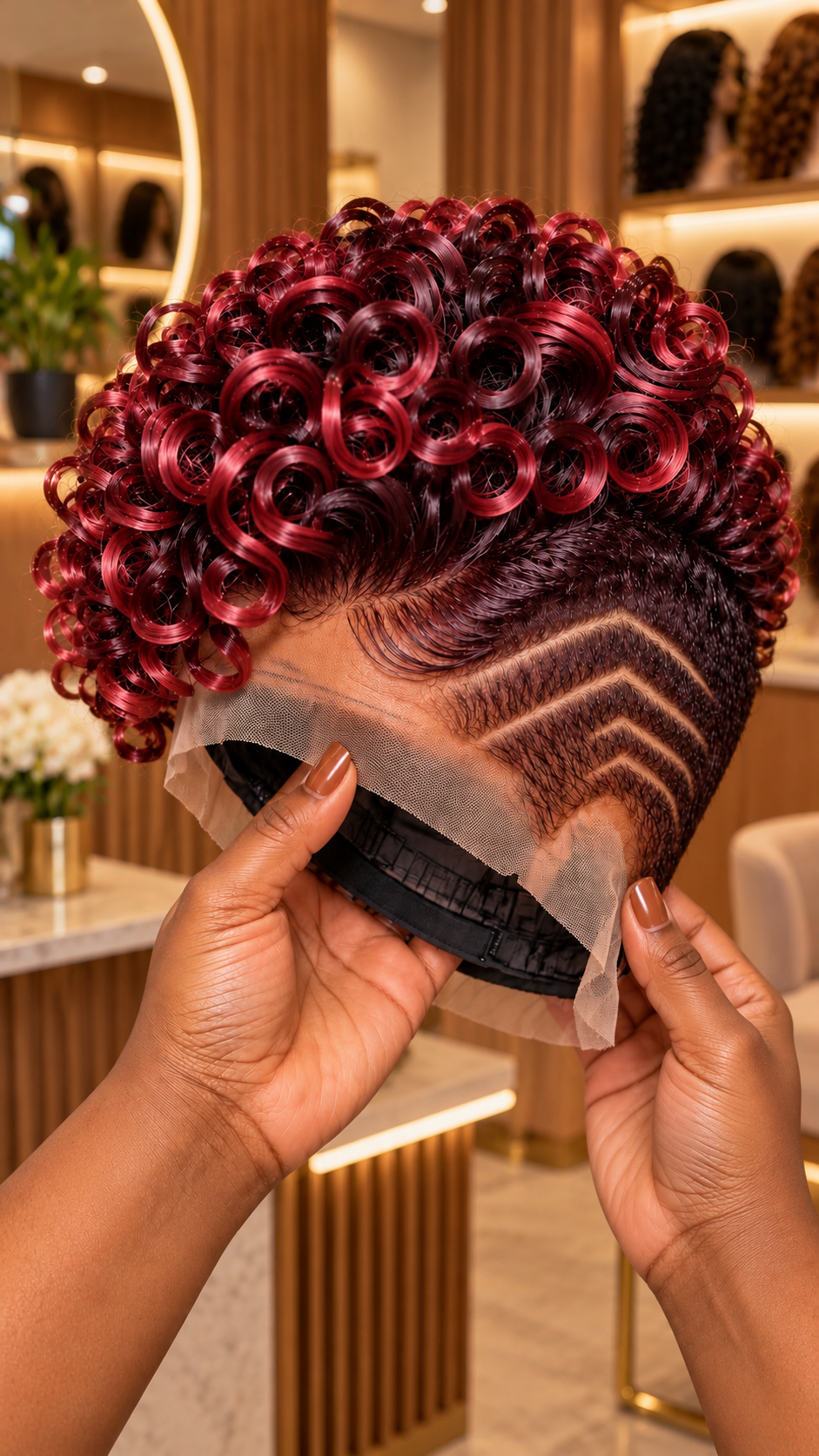
The most useful detail in this burgundy wig is the meeting point between its open ringlets and closely arranged side hair. Large, rounded curls create a raised silhouette, while pale, angular channels interrupt the darker temple area. Together, they give the piece two distinct visual rhythms: circular movement above and sharply changing direction below. Anyone ordering this design should preserve that relationship, because a similar color alone will not reproduce the same result.
Photographed before installation, the wig is held in two hands with excess lace extending beyond the hairline. The opening also reveals part of a black interior band. These details make the image useful as a styling reference, but they do not establish the fiber, exact cap construction, or attachment method. A successful purchase starts by separating the visible design from the specifications that still need confirmation.
Read the Angular Channels Before Choosing a Substitute
On the visible side, several narrow, scalp-colored channels form a nested, chevron-like arrangement. Their direction changes toward the temple rather than continuing as straight, parallel stripes. Dark burgundy hair borders these channels, creating a compact geometric panel beneath the curls. This is a major part of the design, so a seller offering a general curly pixie should show whether their product includes comparable side work.


The photograph does not establish how those channels were made. They might involve deliberate hair placement, cutting, or another customization technique. Calling them a conventional shaved fade would therefore be too specific. When discussing the reference with a wig maker or barber, describe the visible outcome: narrow angular separations, closely arranged surrounding hair, and a controlled transition into the fuller top.
Placement matters as much as the number of channels. A design positioned too low could collide with the ear area during fitting; one placed too high could reduce the space available for the ringlets. Ask for a side photograph of the actual piece held upright, with the ear region visible. This provides a more useful comparison than a tightly cropped photograph of the curls alone.
The Burgundy Changes Across the Curl Surface
The upper section shows rich red-burgundy reflections across broad curl surfaces, with deeper wine tones in the recesses. Hair near the visible temple appears darker than the brightest ringlets. Warm boutique lighting contributes to the overall appearance, so the photograph cannot confirm whether every difference comes from coloring, shadows, or both. Treat the image as a color direction rather than an exact shade guarantee.
For a custom order, explain whether you want this contrast retained. A uniformly bright red result would lose some of the depth visible here, while a very dark wine shade could make the circular openings less noticeable indoors. Request photographs in daylight and ordinary indoor light, preferably without filters. Include a close view of the lower side hair so you can compare it with the top.
If the seller offers a color chart, ask them to identify the closest available burgundy and explain how it will appear on the proposed fiber. Do not assume a color number used by one supplier matches another supplier’s range. For a replacement order, retaining a sample or the original product specification is more dependable than relying on a saved screen image.
Order Open Rings Rather Than a Generic Curly Top
The curls in this piece have visible hollow centers and relatively broad, ribbon-like surfaces. They are not simply a mass of tiny coils. Several face forward, while others tilt upward or sideways, allowing the top to retain movement without becoming a uniform row of identical circles. The larger loops sit above a darker, more compact area near the front and side.
When comparing alternatives, examine the openings between the curls. A tightly packed substitute may have similar volume but a much heavier appearance. A loosely curled substitute may lack the rounded outline. Ask the stylist to preserve recognizable ring shapes while keeping their arrangement varied. The goal is a balanced silhouette with enough separation for individual curls to remain readable.
The visible view does not show the complete back or opposite temple. Before approving a custom commission, request a rear view and both profiles. These should reveal whether the curl size progresses consistently and whether the lower edge remains compact. A dramatic front photograph can conceal an unfinished rear section or a sudden change in density that becomes obvious when worn.
A Fitting Appointment Should Protect the Side Pattern
This reference includes untrimmed lace across the front and visible side area. Its final appearance will depend partly on how the wig sits against the wearer’s hairline. The lace mesh is visible, but its presence does not verify HD lace, a particular lace origin, or suitability for adhesive-free wear. Those are product questions to resolve before booking installation.
Have the seller explain which measurements their cap requires and how they take them. Circumference alone may not address the relationship between the front hairline, temples, and ear positions. Because the angular panel is visually prominent, even a small positioning mismatch could affect its balance. Share your measurements through the seller’s stated method and ask how alterations would affect that panel.
At the appointment, first assess the fit with the lace intact and the curls supported. Check the front position, temple alignment, and comfort around the ears before discussing trimming. Any lace removal should follow the product’s construction and the installer’s assessment. Avoid cutting closer simply to imitate a photograph; once excess material is removed, the available correction options become more limited.
The black interior band visible through the opening is only a partial view of the underside. It does not prove that the cap contains adjustable straps, combs, silicone, or an elastic system. Request clear interior photographs and written attachment instructions. If you prefer a particular wearing method, confirm that the chosen product supports it rather than expecting the installer to improvise.
Where To Buy This Wig
Use the photograph when approaching a custom wig maker, a specialist wig boutique, or a salon that sells and fits styled units. Ask whether they are quoting for an existing product or a recreation. That distinction matters here: a ready-made burgundy curly wig may be available, while reproducing the angular temple arrangement and open ringlets could require separate work.
Before paying, request images of the actual item or a relevant completed commission. The essential views are the front, patterned side, opposite profile, back, and underside. Ask for a brief handling video if available, particularly one showing the piece upright. This can help you judge whether the curl arrangement remains coherent outside a carefully selected photography angle.
Put the agreed details into the order description: burgundy color direction, open ringlet size, compact lower sides, angular channel placement, cap measurements, and included finishing services. Also establish the production timeline and the seller’s policy for fit or color discrepancies. No supplier, stock status, or exact product identity can be verified from this image alone.
Budget for the Styling Work You Actually Want
The following USD amounts are illustrative planning ranges, not verified current prices or a quotation for the photographed wig. The five categories represent possible purchase routes; the image does not identify which material was used. A higher budget should be connected to documented materials, fit work, or styling labor rather than the photograph’s glossy appearance.
| Purchase Category | Illustrative Planning Range USD | Scope to Clarify Before Ordering |
|---|---|---|
| Premium Custom | $480–$950+ | Individually specified fit, burgundy color work, ringlet arrangement, and detailed temple customization; confirm the material separately. |
| Standard Custom | $260–$480 | Adaptation of an existing base with agreed curl styling and side detailing; extensive cap changes may cost extra. |
| Basic Human Hair | $140–$280 | A confirmed human-hair starting piece; matching the color and angular panel may require additional salon work. |
| Premium Synthetic | $85–$175 | A higher-specification synthetic option with a suitable preset curl pattern; confirm lace coverage and restyling limits. |
| Basic Synthetic | $30–$80 | An entry-level interpretation that may approximate the overall appearance without matching the side design or fit. |
Request separate amounts for the wig, color processing, curl setting, temple customization, and installation. This makes it easier to compare a boutique package with a lower-priced base that needs salon work. Shipping, taxes, consultation, and later refreshing appointments may also sit outside the quoted product price.
Ask what happens when the ringlets need resetting. A piece that requires specialist attention after each wash may have a different ownership cost from one supplied with a suitable, repeatable home-care method. The lowest initial price is useful only if the product can deliver the appearance and care routine you are prepared to maintain.
Keep the Open Centers From Collapsing
For this arrangement, maintaining separation is more relevant than adding extra volume. Repeatedly brushing through the finished rings could dismantle their shape. Begin with the maker’s instructions for the confirmed material and setting method. If a curl becomes displaced, ask whether it should be repositioned by hand, reset with an approved tool, or returned for professional styling.
Do not use heat simply because the surface looks like styled human hair. Synthetic fibers vary in heat compatibility, and previously processed human hair may also require limits. Obtain the permitted temperature and method in writing when tools are part of the care routine. Similarly, avoid adding dye or color-depositing treatments without confirming compatibility with both the fiber and lace.
The narrow side channels can become less visible if surrounding hair is disturbed or coated with excess product. Apply only products recommended for the unit, in the amounts specified. If the panel loses its arrangement, seek a wig stylist’s assessment before asking a barber to deepen the lines. Additional cutting may expose the foundation or alter a section that cannot be restored easily.
During transport, protect the raised loops from direct pressure. Use a carrier or support recommended for the cap and hairstyle, with enough clearance above the top. Before an event, allow time to inspect the ringlets and temple area after unpacking. A brief styling check is easier to arrange than a last-minute attempt to rebuild compressed curls.
Approve the Finished Piece From More Than One Angle
Before accepting the order, compare its silhouette, burgundy depth, and angular side placement with the agreed brief. Then assess it on the wearer: the front should sit comfortably, the temple panel should align appropriately, and the top should retain its open circular character. A faithful result depends on these proportions working together. Clear specifications and a careful fitting give the reference its best chance of becoming a wearable, maintainable purchase.
Search Terms
burgundy ringlet wig · open circular curl crown · chevron side hair design · wine red lace wig · ribbon ringlet hairstyle · dark burgundy temple waves · untrimmed frontal lace · compact sides curly wig