
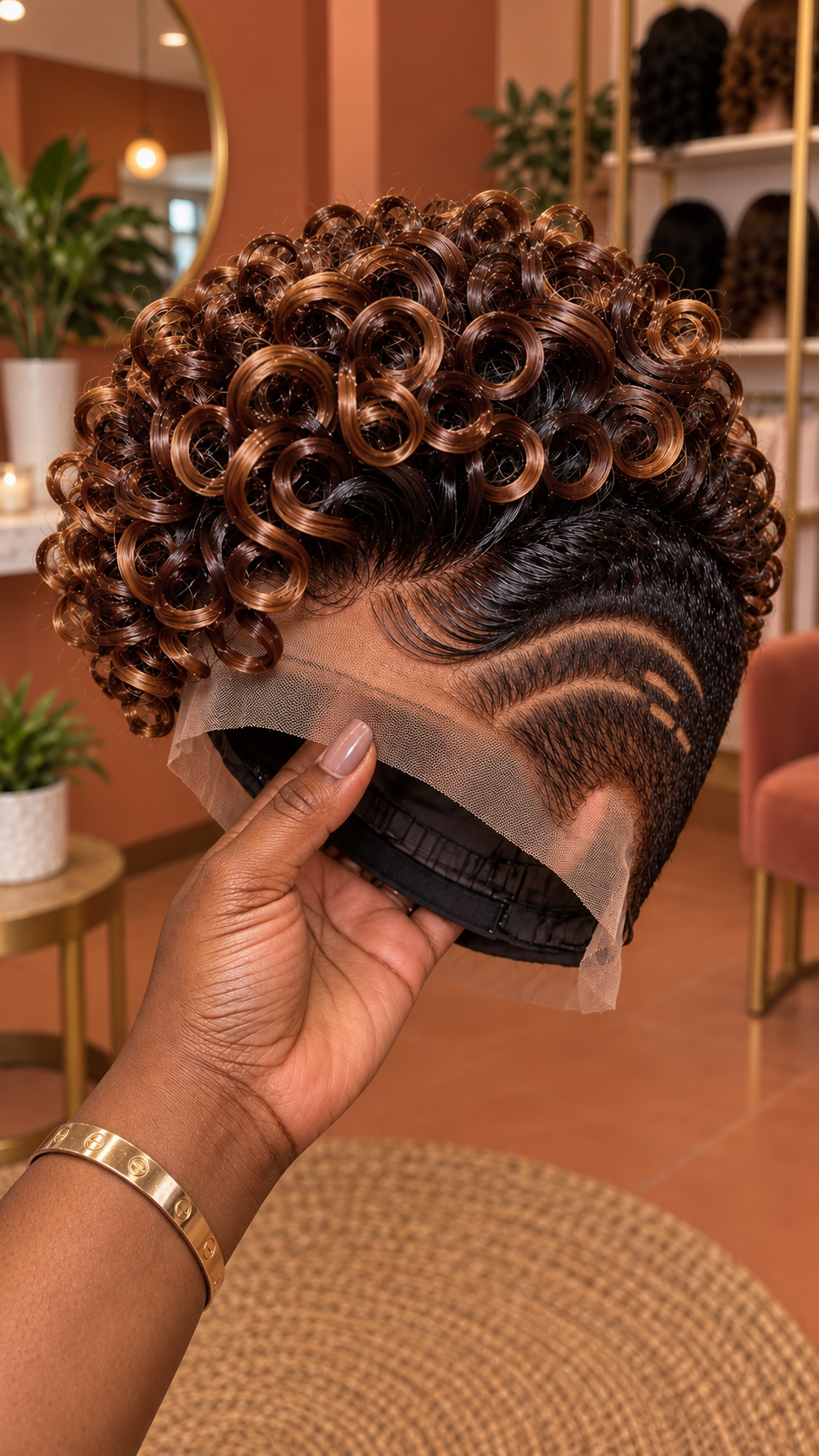
The detail worth preserving in this wig is the relationship between the open brown ringlets and the dark, closely shaped side. Large circular curls catch the light across the top, while a sweeping exposed channel creates a clear boundary above the temple. Smaller diagonal breaks add another layer to the side design. Buying a similar piece requires more than requesting a brown curly wig: the placement of the color, the openness of the curls, and the proportions of the side panel all contribute to this particular result.
The photograph shows the wig held before fitting, with excess lace extending across the front and around the visible temple. Part of the black interior edge is also exposed beneath the hair. This makes the image useful as a styling reference, but it does not establish the fiber, lace grade, full cap construction, or fastening method. Those details should be confirmed before paying for a reproduction.
Order the Color Placement Before Choosing the Shade Name
Chestnut, caramel brown, and warm copper-brown are useful starting points for a consultation, but none describes the whole arrangement here. The visible curls contain lighter golden-brown ribbons against deeper brown sections. Beneath them, the front base and close side remain much darker. The result has depth because the lightest strands sit within the circular shapes instead of covering every visible surface evenly.
A single all-over brown color would produce a different effect. So would a dark wig with only a few pale ends. When ordering, ask the maker to explain where the lighter color will begin, how much dark hair will remain underneath, and whether the side panel will stay black. A marked reference image can communicate these boundaries more accurately than a long list of shade names.


The warm interior lighting may influence how orange or golden the brown appears. Request a daylight photograph beside a neutral background before approving a color match. For a custom order, a small sample or clear strand comparison is particularly helpful. Decide whether your priority is the exact warmth shown here or a slightly cooler chestnut interpretation, and have that choice recorded with the order.
The Open Centers Give These Curls Their Character
The upper section consists of prominent ring-shaped curls with visible spaces through their centers. Several overlap, and their diameters vary rather than forming identical rows. Some face outward toward the camera; others tilt upward or sideways. This variation gives the top a rounded outline without turning it into one solid mass of tightly packed curls.
That distinction matters when discussing the finish with a stylist. Small finger coils, brushed curls, and loose barrel curls would each change the appearance substantially. Ask for open circular ringlets with enough separation to reveal their individual shapes. The front curls also project forward over the lace area, so their position should be assessed on the wearer before any final trimming.
Request a brief movement video as well as still photographs. It can show whether the ringlets retain their arrangement when the wig is gently turned and whether the underside looks balanced. The rear is not fully visible in this reference, so a maker should supply a proposed back view rather than assuming the image documents the entire haircut.
Keep the Temple Design in Proportion
The visible side has a broad curved channel running above a dark band of closely laid hair. Farther toward the outer side, smaller diagonal openings interrupt the darker area. Above the main curve, longer dark strands sweep back from the front. These changes in direction help connect the large curls to the compact side section.
Simply adding more lines would not necessarily improve the design. Their spacing must work with the available temple area, the intended ear position, and the height of the curly top. An enlarged channel could leave too little dark hair between sections. A side cut too high could also remove the transition that makes the ringlets appear integrated with the base.
For a custom piece, request a side photograph before approving the final detailing. If alterations are needed after delivery, book a wig stylist or barber who has experience cutting hairpieces. The construction beneath the hair must be inspected first. Cutting deeper to imitate a shaved pattern can expose the foundation, and removing hair from a wig is not equivalent to trimming hair that will grow back.
Budget for the Ringlet Work and the Side Detailing
The following USD figures are illustrative planning ranges, not verified prices for the photographed wig or live quotations from a seller. The categories represent possible purchasing options; the image does not confirm which material this piece uses. A quotation should specify the fiber, cap, color service, styling work, and any fitting appointment included.
| Purchase Category | Illustrative USD Range | What to Clarify Before Ordering |
|---|---|---|
| Premium Custom | $450–$850+ | Whether individual measurements, detailed color placement, ringlet setting, side design, and a fitting review are included. |
| Standard Custom | $260–$450 | How closely the available base can reproduce the reference and how many adjustments the quoted price allows. |
| Basic Human Hair | $150–$280 | Whether the price covers only the base wig or also includes coloring, cutting, and the circular curl arrangement. |
| Premium Synthetic | $85–$180 | Whether the supplied color and curl pattern already resemble the reference and what restyling the fiber permits. |
| Basic Synthetic | $35–$85 | Whether photographs show the actual unit, particularly its side density, front edge, and curl separation. |
The labor can matter as much as the base material. A wig that needs selective coloring, a new cut, and a complete ringlet set may require more work than a ready-styled unit. Ask for separate amounts for the wig and additional services. Shipping, taxes, installation, lace trimming, and later curl resetting should be identified wherever they apply.
Compare finished specifications rather than category labels alone. A higher price does not establish that the curls will match this reference, and a lower price does not explain which compromises have been made. The useful comparison is what each maker will deliver, how that result will be documented, and what happens if the supplied piece differs from the approved sample.
Where To Buy This Wig
No identifiable seller or product listing is provided with the photograph. Suitable places to look include local wig makers, salons offering custom hairpieces, and online retailers willing to show the actual unit before dispatch. Search for businesses whose portfolios include sculpted ringlets and close side detailing, since a general curly-wig catalog may not demonstrate the necessary work.
For a ready-made purchase, request current front, side, rear, and underside images. Ask whether the photographed piece is the unit being sold or an example of a previous commission. Confirm the material in writing, along with the cap size and the seller’s care instructions. Do not rely on shine or curl precision to identify human hair or synthetic fiber.
For a custom commission, agree on a few measurable priorities: the approximate ringlet size, the amount of brown coloring, the height of the top, and the position of the curved side channel. Have the maker explain any construction limits before taking a deposit. Also establish the approval stage, delivery estimate, and alteration policy so that changes can be discussed while they are still practical.
Use the First Fitting to Position the Haircut
The excess lace in this image indicates that the front edge still needs assessment before its final appearance on a wearer can be judged. Its visible mesh does not establish that it is HD lace. Likewise, the exposed black interior band does not confirm adjustable straps, combs, or a glueless system; those components are not clearly demonstrated here.
Follow the maker’s measuring instructions and send the requested measurements before ordering. At the fitting, check the wig with your own hair arranged as you intend to wear it. The front curls should sit at a comfortable position, and the side design should align sensibly with the temple and ear. Turning your head can help reveal lifting, shifting, or pressure that a front-facing mirror check misses.
Inspect the delivered wig and review the return terms before cutting lace or altering the hair. Once its position is agreed, a stylist can determine whether trimming or another fitting adjustment is necessary. Avoid cutting the lace on an unsupported wig simply to copy its appearance in a photograph; the final edge needs to suit the wearer and the particular construction.
Protect the Spaces Between the Ringlets
For this style, care should preserve the open curl centers and the change in direction above the side channel. Repeated brushing through the finished top could separate the arranged strands and turn the rings into a different curl pattern. Before attempting a full reset, ask the supplier how the original shape was created and which products are suitable for the confirmed material.
Handle the wig from its base when positioning it. If one ringlet shifts, work on that small section instead of disturbing the entire top. Heavy product application may make neighboring curls stick together or leave residue around the exposed side channels. Start with the supplier’s recommended amount and assess the result before adding more.
Washing and heat instructions must match the fiber. For synthetic hair, confirm whether heat is permitted and obtain the stated temperature limit before using a heated tool. For human hair, ask about previous color processing and the appropriate method for resetting the brown sections. Neither material should be assumed to tolerate an improvised coloring or high-heat treatment.
Choose storage that supports the base without pressing against the forward-projecting curls. A cramped bag or low lid can flatten the arrangement even when the wig has been carefully styled. For travel, leave clearance above and around the ringlets, keep the lace from catching on fasteners, and check that the side panel is not folded beneath the cap.
Approve the Finished Piece from More Than One Angle
Before accepting the order, compare the actual wig with the reference at a similar viewing angle. Check whether the brown remains concentrated through the ringlets, whether the dark side still provides enough contrast, and whether the curved channel has the agreed shape. Then inspect the rear and underside separately, because this photograph cannot establish their condition or construction.
A successful reproduction should also come with usable care information. Keep the material specification, approved photographs, and styling instructions together so that another professional can maintain the piece later. When the curl arrangement, fitting, and upkeep requirements are agreed in advance, this distinctive design becomes a much clearer purchase to evaluate.
Search Terms
chestnut ringlet wig · golden brown circular curls · dark base curly pixie · curved temple line wig · open loop curl crown · diagonal side hair design · untrimmed front lace wig · swept black temple hair