
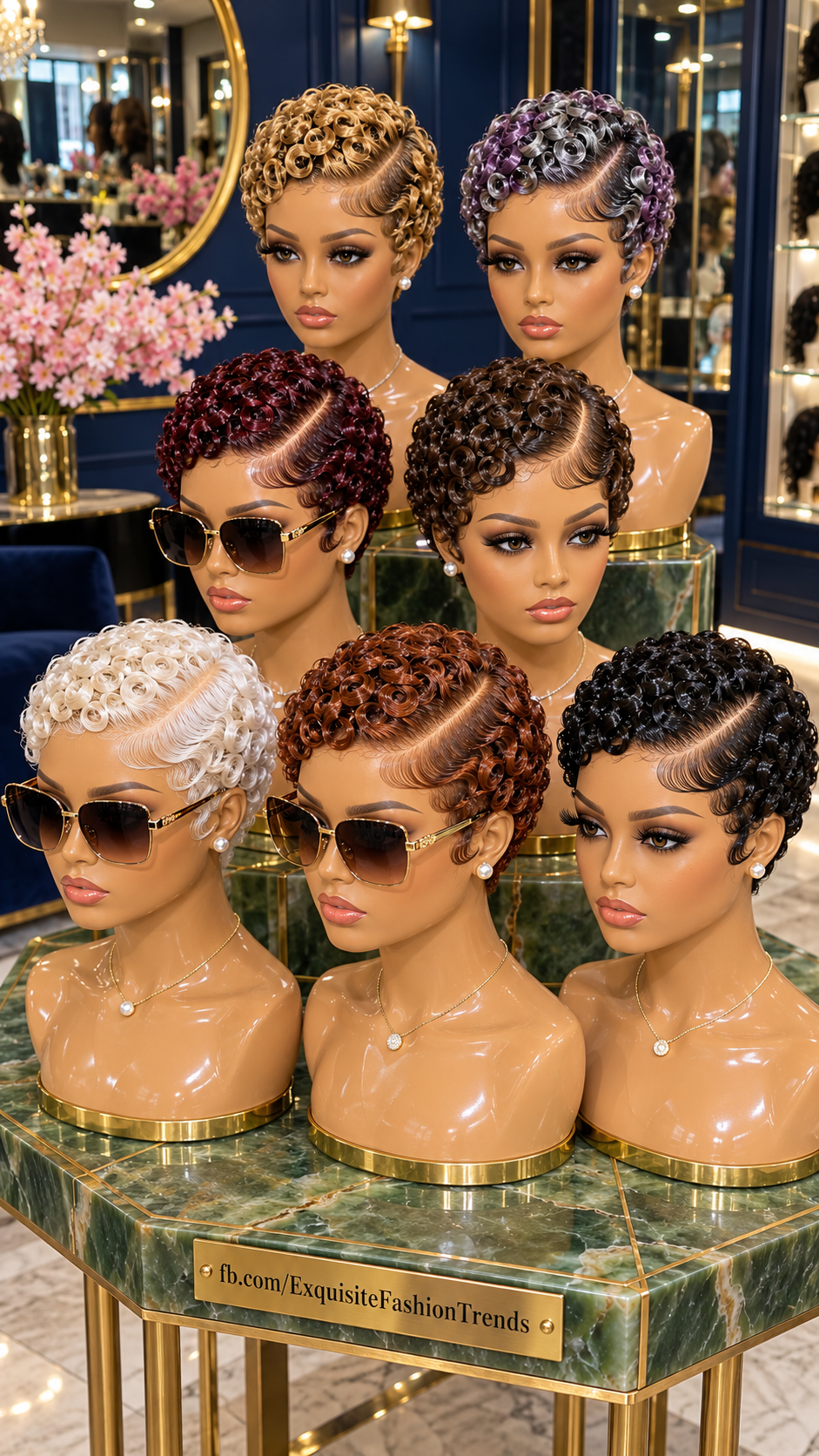
Choosing a pixie wig becomes more interesting when the same general haircut is presented in several colors. A shade that looks understated in black can become playful in copper, striking in platinum, or unexpectedly dramatic when silver and purple appear together. This seven-piece wig display demonstrates those differences while keeping the emphasis on compact circular curls, carefully placed side partings, and decorative finger waves.
The photograph shows seven mannequin busts arranged at different heights on a green marble-effect display with gold accents. The collection includes golden blonde, silver-purple, burgundy, chocolate brown, platinum blonde, copper auburn, and glossy black hairstyles. Five wigs appear in the middle and front positions, while two elevated mannequins complete the arrangement at the back.
Although the hairstyles belong to the same curly pixie family, they should not be treated as seven identical products in different colors. Their curl openings, parting positions, front-wave shapes, and color distribution vary. The silver-purple version is particularly distinctive because its metallic silver strands are mixed with violet sections rather than displaying one uniform shade.


For shoppers, the value of this collection goes beyond finding a favorite color. It offers an opportunity to compare how different shades affect the appearance of small circular curls, how the hairline changes between styles, and which details should be checked before ordering a similar wig.
The Seven Looks at a Glance
The upper-left mannequin wears a warm golden blonde pixie with small circular curls and a prominent side part. Beside it, the upper-right mannequin displays a combination of metallic silver, charcoal, and purple curls, with violet concentrated around portions of the crown and side.
The middle-left mannequin wears deep burgundy hair, accompanied by dark sunglasses. Its curls are compact and glossy, with a pronounced diagonal parting and sweeping front waves.
The middle-right mannequin has chocolate-brown curls arranged in closely overlapping circles. The warm brown shade creates depth without relying on a contrasting blonde or red section.
Along the front, the left mannequin wears creamy platinum blonde, the center mannequin displays copper auburn, and the right mannequin wears glossy black.
These three foreground wigs are particularly useful for comparing pale, warm, and dark colors because they share similar compact proportions while retaining individual differences in curl placement.
Golden Blonde for a Bright, Warm Appearance
The golden blonde wig at the upper left contains numerous circular curls arranged across a rounded crown. The shade appears warm and golden, with honey-like reflections visible along the outer strands.
A diagonal parting travels through the upper front-side section. Beneath it, the hair follows a flatter direction and curves toward the temple.
The color makes the individual curls easy to distinguish. Some ringlets have larger circular openings, while smaller loops occupy the spaces between them.
This option may appeal to women who prefer warm blonde hair without the much paler appearance of platinum.
For a custom order, the buyer should specify whether the desired blonde should lean toward gold, honey, or beige. These shades can look noticeably different even when marketed under similar names.
The Silver-Purple Combination Deserves a Closer Look
The upper-right mannequin offers the most unusual color arrangement in the collection. Metallic silver and darker charcoal strands appear among sections of purple and violet hair.
The colors are not distributed as a simple two-tone division. Instead, they appear across neighboring curls, creating an interwoven appearance.
Some circular curls are predominantly silver, while others display purple along their outer surfaces. Darker sections remain visible between them.
The hairstyle also includes a diagonal parting and curved strands near the front hairline.
This combination may appeal to shoppers who want a cooler fashion color without choosing a completely purple wig.
Why Placement Matters More Than the Color Name
Ordering a silver-purple wig does not guarantee the same result. One seller might offer silver roots with purple ends, while another might provide alternating sections of both colors.
The photographed hairstyle uses a more integrated appearance, with silver and violet visible throughout portions of the curled crown.
A buyer should send a close-up reference and ask the maker to explain how the two shades will be distributed.
It is also worth requesting photographs in neutral daylight. Warm salon lighting can change the apparent balance between silver, charcoal, and purple.
Burgundy for a Richer Red-Family Choice
The burgundy mannequin in the middle-left position wears a compact pixie covered with small circular curls. The hair has deep wine-red reflections, with darker areas inside the curl openings.
A diagonal parting separates the upper curls from the carefully arranged front section. The strands beneath the parting form broad curves that follow the forehead and temple.
Compared with the copper wig in the foreground, burgundy has a deeper red character and less orange warmth.
This makes it a useful option for customers who want noticeable color without choosing a particularly bright shade.
The mannequin’s sunglasses partially conceal the face, but the upper hair, parting, and temple styling remain visible.
Before ordering, ask whether the seller’s burgundy leans toward wine red, cherry red, or purple-red. The differences can be substantial.
Chocolate Brown Offers a Quieter Alternative
The middle-right mannequin wears a deep chocolate-brown pixie with small and medium circular curls.
Its warm brown coloring becomes especially noticeable where the strands catch the salon lights. Darker spaces inside the curls provide contrast, giving the upper hair a dimensional appearance.
The front contains a diagonal separation with a carefully arranged curved section beneath it.
The hairstyle does not require dramatic color changes to remain visually interesting. Its appeal comes from the circular curls and the direction of the front strands.
Chocolate brown can be a practical choice for customers who want something warmer than black but less conspicuous than copper or purple.
When comparing brown wigs, check the actual shade under daylight. Chocolate, espresso, mocha, and chestnut may be used inconsistently in product descriptions.
Platinum Blonde Makes the Curl Pattern Stand Out
The front-left mannequin wears a creamy platinum blonde pixie with densely arranged circular curls.
Because the hair is very light, the individual strands and spiral openings are particularly noticeable. The upper section contains several broad circular curls surrounded by smaller loops.
A visible side parting separates the crown from a series of closely aligned front waves.
The mannequin wears oversized sunglasses, but the hairline arrangement remains clearly visible.
This shade appears creamy rather than distinctly silver. That distinction is important because platinum blonde and silver-gray wigs can have very different undertones.
Questions to Ask About Pale Hair Colors
Light-colored wigs deserve careful inspection before purchase. The buyer should ask whether the color is uniform throughout the hair and whether the displayed shade matches the actual product.
If the wig contains human hair, the seller should explain whether it has been chemically lightened and how that processing may affect future styling.
If it contains synthetic fiber, the buyer should confirm the manufacturer’s instructions before considering any color alteration.
The photograph alone cannot establish how the pale shade was produced.
Copper Auburn Brings Warmth to the Front Row
The center foreground mannequin displays a rich copper-auburn pixie. Its circular curls contain warm reddish-brown reflections, with darker sections between the spirals.
The front hair is arranged into a broad curved wave beneath a diagonal parting. Smaller curls continue toward the temple, maintaining the compact silhouette.
Compared with the golden blonde wig, this version has a noticeably stronger reddish-orange character. Compared with burgundy, it appears brighter and warmer.
Copper auburn can be particularly attractive when the buyer wants a warm hairstyle with visible curl detail.
However, the color should not be selected solely from a shade name. A maker should confirm the balance between orange, red, and brown before preparing a custom unit.
Black Keeps the Focus on the Hair Design
The front-right mannequin wears a glossy black pixie with compact circular curls and a prominent diagonal parting.
The curls are closely arranged across the crown, while the front hair follows a broad sweeping curve toward the temple.
Several smaller ringlets sit near the outer side, creating a gradual transition into the compact lower section.
Without contrasting color, the hairstyle relies on the relationship between reflective strands, circular openings, and the exposed parting.
This version may appeal to women who want decorative salon styling while keeping a familiar dark hair color.
The photograph shows bright reflections along the black strands, but those reflections do not establish the hair material or indicate separate gray highlights.
Comparing the Front Hairlines
One detail worth examining across the collection is the way each wig approaches the forehead.
Several wigs display diagonal partings that create a visible separation between the upper curls and the lower front section. Beneath these partings, the strands form carefully arranged finger waves.
The waves are not completely identical. Some appear broader and more elongated, while others form smaller curves near the temple.
The platinum and black versions show especially noticeable sweeping front sections. The burgundy and copper wigs also display prominent directional waves.
For a custom order, it is useful to select one preferred hairline arrangement rather than asking a stylist to combine every detail from the collection.
Too many unrelated decorative elements could make the finished hairstyle appear crowded.
Choosing Curl Size Without Losing the Pixie Shape
All seven wigs contain compact circular curls, but the ringlets vary slightly in diameter and spacing.
Some curls have broad openings, while others are tightly wound and sit close to neighboring sections.
The result is a rounded silhouette that remains relatively close to the head.
A buyer who wants this appearance should pay attention to the overall proportions rather than focusing only on the number of curls.
Increasing density unnecessarily could conceal the circular openings. Making the curls substantially larger could produce a bulkier hairstyle.
A custom maker should consider the relationship between curl diameter, crown height, and lower-side fullness.
The photograph does not establish the setting technique used for any of the wigs, so customers should ask how the curls are expected to behave after cleansing.
How to Order This Style from a Wig Maker
The most effective approach is to select one mannequin as the primary reference and identify any specific changes separately.
For example, a customer might prefer the copper color but want the front-wave arrangement of the black wig. Another might choose the platinum curls while requesting a different parting orientation.
These changes should be discussed with the maker before production begins.
Provide the reference photograph and specify the preferred color, curl diameter, crown proportions, and front hairline arrangement.
Ask the maker to confirm which details can be reproduced with the proposed hair material and cap construction.
A consultation is especially useful when combining details from different wigs, because a color or styling change may affect the final appearance.
What to Check Before Paying for a Wig
The photograph shows styled wigs on mannequin busts, but it does not reveal their undersides.
Consequently, the image cannot establish whether the units contain human hair, synthetic fiber, or a blend. It also does not verify the lace grade, cap construction, or attachment system.
Before purchasing, request photographs of the actual unit removed from the mannequin.
The seller should provide a close-up of the front hairline, an underside view, and photographs showing the back and sides.
Confirm the cap measurements and whether the unit requires adhesive, clips, an adjustable band, or another installation method.
A mannequin display does not prove that a wig is glueless or made with HD lace.
For online orders, obtain written confirmation of the agreed specifications, shipping terms, and return or customization policy.
Planning the Cost of a Curly Pixie Wig
Pricing depends on more than color. A custom unit with individually arranged circular curls and detailed finger waves may require considerably more styling labor than a basic ready-made pixie.
The silver-purple version may involve additional color-placement work, while pale blonde or silver human-hair options could require more extensive processing depending on the starting material.
The following USD ranges are illustrative budgeting estimates, not verified current offers or prices for the photographed wigs.
| Wig Category | Illustrative USD Range | Typical Budget Considerations |
|---|---|---|
| Premium Custom | $380–$900+ | Personalized color distribution, detailed circular curl setting, tailored hairline work, and custom cap fitting. |
| Standard Custom | $190–$460 | Professional styling of a suitable base wig, including selected parting and finger-wave customization. |
| Basic Human Hair | $100–$290 | A possible starting unit; coloring, curl setting, and installation may be additional services. |
| Premium Synthetic | $65–$210 | A pre-styled alternative where the selected fiber and construction support the intended curl arrangement. |
| Basic Synthetic | $25–$95 | A budget-friendly option that may offer similar colors without the same precision in curl placement or hairline styling. |
These categories describe possible purchasing choices. They do not identify the materials used in the seven displayed wigs.
Ask whether the quoted amount includes installation, lace preparation, color customization, and future styling adjustments. Comparing the total cost is more useful than comparing base wig prices alone.
Maintaining Small Circular Curls
Compact circular curls require a different maintenance approach from loose waves or straight hair.
Brushing directly through the finished curls may disturb their arrangement and reduce the visibility of individual spiral openings.
Before washing, ask the seller whether the style can be restored at home or requires professional resetting.
For human-hair units, the appropriate routine depends on the hair’s processing history and the products used during styling.
For synthetic wigs, follow the manufacturer’s instructions and do not apply heat unless the fiber’s heat tolerance has been confirmed.
When storing the wig, use a support that preserves the rounded crown without compressing the curls. Avoid placing heavy objects against the styled hair.
Extra Care for Fashion Colors
The purple-silver, burgundy, copper, platinum, and golden blonde options may have different care requirements depending on their materials and coloring methods.
Human hair that has undergone extensive lightening may require additional conditioning and gentler handling.
Synthetic colors may be integrated into the fibers and should not be treated like conventional dyed human hair.
Buyers should avoid experimenting with color removers, dyes, or high-temperature tools without verifying compatibility.
Matching the Wig to the Occasion
The seven shades offer different styling possibilities.
Golden blonde and copper can complement warm neutral outfits, while chocolate brown and black provide understated choices for a wide range of clothing colors.
Burgundy offers a rich accent for evening outfits, and the silver-purple combination may appeal to customers who enjoy more expressive fashion styling.
Platinum blonde can create a striking contrast with darker clothing.
These are styling possibilities rather than fixed rules. Personal preference, comfort, and the desired overall appearance should guide the final choice.
Accessories can also influence the presentation. Several mannequins wear small earrings, necklaces, or sunglasses, demonstrating how compact pixie hairstyles can be paired with different fashion details.
Choosing One Wig from the Collection
The strongest purchasing decision begins with selecting the details that matter most to the wearer.
Someone who prioritizes color may be drawn to the unusual silver-purple arrangement. Another customer may prefer the warm copper curls, while someone seeking a versatile everyday shade might choose chocolate brown or black.
For buyers who care most about hairstyle construction, the important comparison is between the circular curl arrangements, diagonal partings, and front finger waves.
Before ordering, identify one primary reference, confirm the intended hair material and cap measurements, and establish whether additional salon work will be necessary.
This collection demonstrates how much personality a compact curly pixie can offer. Its appeal lies not simply in presenting seven colors, but in showing how thoughtful color selection and carefully arranged curls can produce seven distinct interpretations of a recognizable hairstyle.
Search Terms
Golden blonde ringlet pixie · Silver purple mixed curl wig · Burgundy side part finger curls · Chocolate brown circular pixie · Creamy platinum spiral hairpiece · Copper auburn sculpted hairline · Glossy black rosette wig · Seven color pixie wig display