
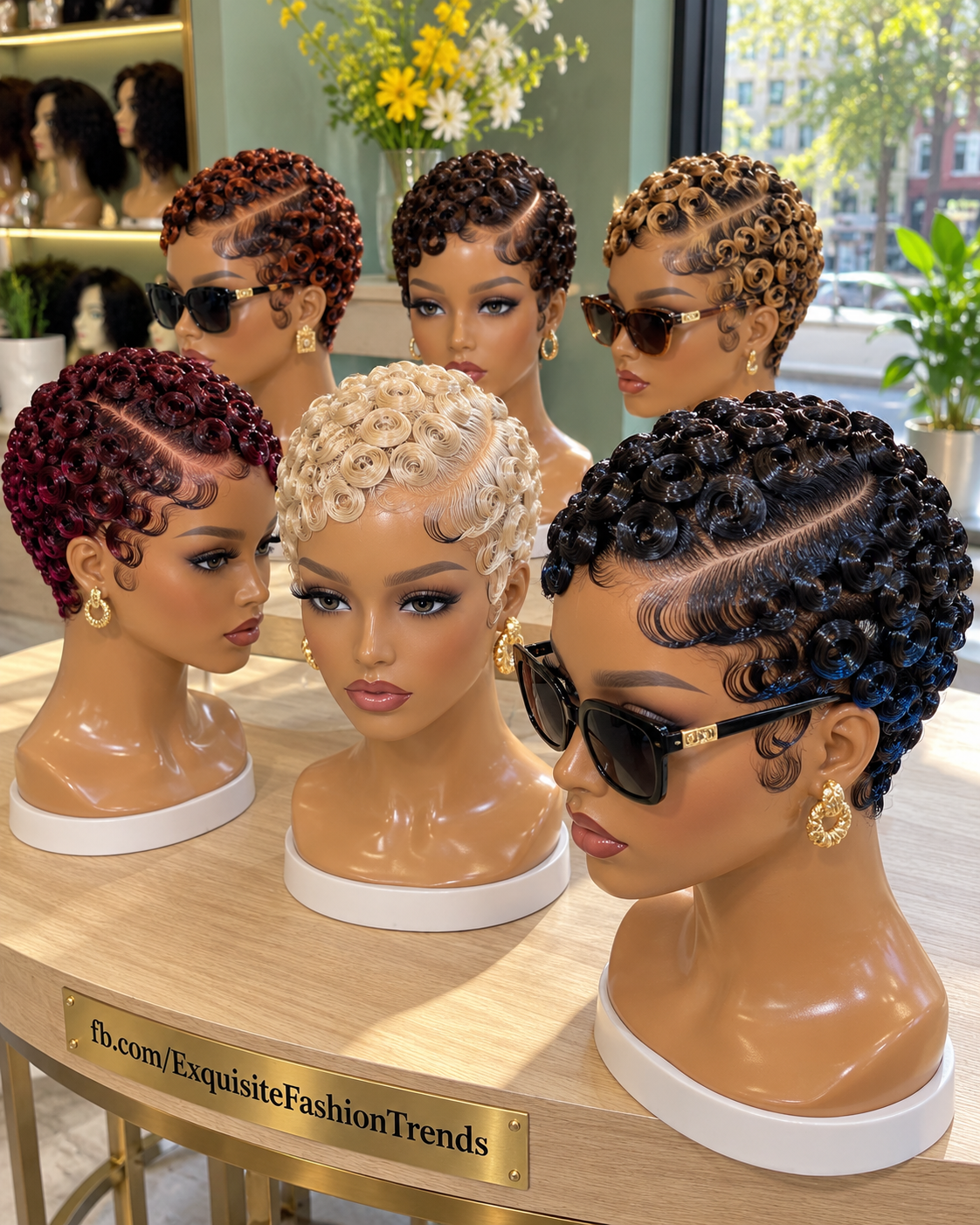
When several hairstyles share the same basic silhouette, the smallest styling decisions become the most interesting. A curl positioned slightly closer to the forehead, a diagonal part that travels farther toward the crown, or a different balance between the upper ringlets and temple waves can change the entire appearance of a pixie. This six-piece salon display offers an excellent opportunity to examine those differences before choosing a hairstyle.
Arranged on a light wooden display table beside a large salon window, the six mannequin heads showcase compact circular curls in copper auburn, deep chocolate brown, golden caramel, wine burgundy, pearl blonde, and glossy black with subtle blue reflections. The hairstyles share a recognizable family resemblance, but their front arrangements, curl sizes, and visible partings are not identical.
The photograph is particularly useful because the mannequins face different directions. The central pearl-blonde style offers a nearly frontal view, the black example on the right reveals an elaborate diagonal part and side-wave arrangement, and the burgundy mannequin on the left shows how closely arranged curls can follow the contour of the head.


For women considering a pixie wig, this collection illustrates an important purchasing principle: choosing the right color is only half the decision. The placement of the curls, the shape of the forehead waves, and the proportions of the side sections deserve just as much attention.
What Makes These Six Hairstyles Worth Comparing?
All six designs use compact circular curls rather than long hanging spirals. The upper hair contains numerous rounded formations, several with visible hollow centers. Fine strands are arranged into decorative waves along the forehead and temples.
However, the distribution of these elements changes from one mannequin to another.
The black hairstyle in the foreground has a particularly prominent diagonal separation, with broad curved waves extending beneath it. The pearl-blonde example places several larger circular curls close to the forehead, creating a softer front appearance.
The burgundy hairstyle emphasizes dense curl coverage along the visible side. The copper and caramel examples display warm reflective surfaces that make the individual curls easy to distinguish.
These differences matter because two wigs advertised under the same general hairstyle name may look quite different once worn.
The Black Pixie Makes Its Side Part the Centerpiece
The largest mannequin in the foreground wears a glossy black hairstyle with subtle blue-toned reflections concentrated in portions of the lower side curls.
Its most noticeable detail is the long diagonal part extending from the upper front toward the rearward crown. The exposed separation divides the circular curls above from a broad finger-wave panel beneath.
Several prominent circular rolls sit near the parting. Their rounded openings create depth, while smaller curls continue along the visible side.
Below the separation, fine strands form elongated curves that sweep toward the temple. A smaller decorative curl sits near the ear.
The overall hairstyle remains compact, but the side profile contains substantial artistic detail.
For customers interested in this particular design, the diagonal part and wave placement should take priority over simply requesting a black curly pixie.
Subtle Blue Reflections Rather Than an Entirely Blue Crown
The upper hair appears predominantly black. Blue reflections are most noticeable in selected curls toward the lower right side.
The photograph does not establish whether these reflections come from colored strands, lighting, or a combination of both.
A buyer seeking a blue-black variation should request a color sample before ordering. A fully navy-blue wig would produce a different appearance from the predominantly black hairstyle shown here.
Pearl Blonde Brings the Circular Curls Forward
The center-front mannequin wears a pale pearl-blonde hairstyle with ivory and champagne tones.
Several prominent circular curls sit close to the forehead, giving the front a rounded appearance. The individual formations are relatively easy to distinguish because the pale strands contrast with the darker spaces inside their loops.
The visible front hairline contains fine curved strands, including a larger wave directed toward one temple.
Unlike the black example, the pearl-blonde hairstyle does not rely on an equally prominent exposed diagonal part across the visible front.
Its appearance is softer, with the circular curls providing most of the decorative detail.
The pale coloring also makes the spacing between neighboring curls particularly noticeable. This is useful when evaluating a custom wig because excessive spacing can make the foundation more visible than intended.
Customers seeking this shade should compare pearl blonde, ivory blonde, and pale champagne samples under neutral lighting.
Burgundy Curls Create a Rich, Compact Profile
The front-left mannequin wears a deep wine-burgundy hairstyle with darker red roots and glossy cherry reflections.
Numerous circular curls cover the upper head and continue toward the visible side. Several prominent ringlets sit near the diagonal part, while smaller formations create dense coverage toward the lower area.
The parting travels across the upper front and separates the raised curls from a carefully arranged wave section.
The front strands follow broad curves toward the temple, with smaller curled accents near the ear.
The burgundy shade appears richer and cooler than the copper hairstyle positioned behind it.
For a custom order, deep wine burgundy or black cherry may be more appropriate descriptions than bright red.
Because the photograph is taken under mixed daylight and salon lighting, the final shade should be verified using a current sample from the seller.
Copper Auburn Offers a Different Kind of Warmth
The upper-left mannequin displays a copper-auburn pixie with glossy reddish-brown curls.
The upper hair contains numerous compact circular formations arranged close together. Several ringlets face outward, revealing their hollow centers, while others overlap neighboring curls.
A diagonal part creates a visible separation across the upper front. Beneath it, fine strands follow curved paths toward the temple.
The copper shade contains stronger orange-brown reflections than the burgundy example.
Its warm coloring makes the circular structure particularly noticeable in the sunlight entering the salon.
Customers considering this color should distinguish copper auburn from bright ginger. The photographed shade has noticeable brown depth, especially between the curls.
Chocolate Brown Keeps the Look Rich and Understated
The rear-center mannequin wears a deep chocolate-brown hairstyle with glossy espresso reflections.
Its crown contains compact circular curls arranged into a rounded silhouette. The visible front includes a diagonal part and a curved wave that travels toward the temple.
The brown shade is darker and less golden than the caramel example beside it.
Several curls appear almost black in the shadowed areas, while their outer surfaces reveal warmer brown reflections.
This creates depth without relying on obvious contrasting highlights.
For customers who find natural black too dark but do not want a bright hairstyle, chocolate brown offers a useful alternative.
Ask the seller whether the proposed shade is dark chocolate, espresso, or medium brown, since those names can represent noticeably different colors.
Golden Caramel Highlights the Crown’s Shape
The upper-right mannequin displays a warm golden-caramel hairstyle with honey-brown reflections.
Numerous circular curls cover the upper head, with several prominent formations visible near the front and along the side.
A diagonal part travels through the upper section, separating the raised curls from the carefully directed forehead waves.
The lighter color makes the individual ringlets stand out clearly. Their circular openings create small areas of shadow that contrast with the golden outer strands.
The mannequin wears sunglasses, but the upper hairstyle remains easy to examine.
This shade appears warmer and more golden than the chocolate-brown example.
For a similar result, golden caramel or honey brown may be useful color descriptions, provided the supplier confirms the actual shade.
The Real Difference Is in the Forehead Styling
Looking beyond color reveals one of the most useful aspects of this display: the forehead waves vary noticeably between the mannequins.
The black hairstyle uses a broad sweeping wave beneath a prominent diagonal part. The burgundy and copper examples contain similarly directed strands, although their visible wave proportions differ.
The pearl-blonde version places more visual emphasis on the circular curls near the front, with softer curved strands beneath them.
The chocolate and caramel examples combine diagonal partings with compact front-wave arrangements.
These differences should influence the choice of a custom reference.
A customer who prefers a prominent side part should not assume that every curly pixie in the collection will produce the same result.
Likewise, someone who prefers softer forehead styling may find the pearl-blonde arrangement more appealing, regardless of the final color selected.
Why Curl Placement Matters More Than Curl Count
A compact pixie does not necessarily become more attractive when additional curls are added.
The important consideration is how the curls are distributed across the head.
In this collection, larger circular formations often occupy prominent positions near the upper front, while smaller curls fill surrounding spaces.
This arrangement creates depth and helps maintain a rounded silhouette.
When curls are placed too close together, their individual shapes may become difficult to distinguish. When they are spaced too widely, the foundation may become more visible than intended.
The photographed hairstyles demonstrate several ways to balance these concerns.
For custom production, ask the maker to preserve the relationship between the prominent front curls and the smaller supporting formations.
The desired result should be evaluated through photographs rather than a simple promise of a particular number of curls.
Matching the Hairstyle to a Client’s Preferences
A salon consultation should begin with the client’s preferred silhouette rather than an immediate color recommendation.
Some women prefer a compact hairstyle with very little height. Others want a fuller crown that makes the circular curls more prominent.
The position of the diagonal part also affects the appearance. A part that travels toward one temple creates an asymmetric front, while a less prominent separation can make the curls appear more continuous.
Clients should consider whether they prefer broad finger waves, smaller decorative temple curls, or a simpler hairline.
Once these preferences are established, color selection becomes easier.
The same curl arrangement can be requested in a different shade, provided the maker can reproduce the construction and color combination.
Get the Details on This Wig Style Before Ordering
For shoppers interested in a similar design, the photograph is a styling reference rather than verified evidence of a particular product’s specifications.
The six hairstyles are displayed on mannequin busts with white bases. Their undersides are not visible.
Consequently, the photograph does not establish whether the hairpieces are removable wigs, what fibers they contain, or whether they use lace-front construction.
Before ordering, ask the seller for photographs of the actual unit, including its underside.
Confirm the fiber composition, cap size, attachment method, and any available lace options.
If a seller describes a unit as glueless, request specific information about the securing system rather than relying on the mannequin presentation.
It is also worth asking whether the hairstyle is sold ready to wear or requires professional finishing after delivery.
Building a Clear Custom-Order Brief
A useful custom-order brief should identify one mannequin as the main reference and specify which details must remain unchanged.
For example, a customer might prefer the black mannequin’s diagonal part but want the chocolate-brown color. Another may choose the pearl-blonde front arrangement in copper auburn.
Such combinations should be discussed explicitly rather than assuming the maker will understand them from the photograph alone.
Ask for confirmation of the intended curl diameter, crown height, front-wave direction, and color placement.
For a fitted wig, the maker may require head circumference, front-to-nape distance, and ear-to-ear measurements.
Before production is completed, request progress photographs showing the crown and hairline.
Final approval should include front, side, rear, and underside views of the actual product.
This process is especially valuable when ordering online, where a customer cannot examine the wig in person before payment.
When a Ready-Made Pixie Is the Better Choice
Not every customer needs a fully customized wig.
A ready-made unit may be suitable when the buyer is flexible about the exact curl arrangement and primarily wants a compact curly silhouette.
It may also offer a shorter waiting period and fewer decisions during the ordering process.
However, customers seeking the precise diagonal part, circular curl placement, and decorative forehead waves shown in this display should compare actual product photographs carefully.
A generic curly pixie with loose spirals may not provide the same appearance.
Before purchasing a ready-made unit for restyling, ask a qualified wig stylist whether its material and construction can accommodate the desired changes.
Major alterations to a preformed curl pattern may not be practical, particularly when the fiber type is unknown.
Budgeting for a Salon-Style Finger Curl Pixie
These USD amounts are illustrative planning ranges, not verified live prices for the displayed hairstyles. The cost of a similar wig may depend on its fiber composition, cap construction, color selection, curl-setting labor, and degree of customization.
| Purchase Category | Illustrative USD Range | What to Discuss With the Seller |
|---|---|---|
| Premium Custom | $320–$750+ | Individual measurements, detailed circular curl placement, personalized forehead waves, selected color work, and fitting requirements. |
| Standard Custom | $170–$390 | Reference-based pixie construction with selected adjustments to the crown, parting, and front styling. |
| Basic Human Hair | $100–$255 | A human-hair pixie foundation that may need separate curl setting, coloring, and salon finishing. |
| Premium Synthetic | $70–$185 | A manufactured-fiber option with prearranged circular curls and available color choices, subject to seller specifications. |
| Basic Synthetic | $25–$95 | A lower-cost curly pixie that may approximate the silhouette without matching the intricate forehead styling. |
The price difference between categories should not be interpreted as a guarantee of styling quality.
A higher quotation may reflect more complex construction or additional services, but buyers should request a clear explanation of what is included.
Professional installation, shipping, taxes, custom color processing, and later styling adjustments may be charged separately.
For a design with many individually arranged circular curls, the amount of finishing labor can be an important part of the quotation.
Keeping Circular Curls Presentable Between Appointments
The maintenance challenge for this hairstyle is preserving the individual circular formations rather than encouraging additional volume.
Repeated brushing through the crown can separate the carefully arranged strands and change the curl openings.
Before cleaning or restyling, establish whether the unit contains human hair, synthetic fibers, or a blend.
For confirmed human hair, ask the stylist whether the curls were formed through a setting technique that can be repeated safely.
For synthetic hair, follow the manufacturer’s care instructions and avoid heat unless the permitted temperature has been verified.
Do not assume that a glossy appearance means the hair can tolerate hot tools.
If the curls begin losing their circular shape, a professional refresh may be preferable to repeatedly manipulating them at home.
Different Colors Call for Different Care Decisions
The lighter and more saturated shades deserve particular attention when selecting maintenance products.
If the pearl-blonde or golden-caramel hairstyles were produced from chemically processed human hair, their coloring history may influence how they respond to further heat or chemical services.
Burgundy and copper shades may require color-preservation care, depending on the materials and dyeing methods used.
The chocolate-brown and black versions may show styling-product buildup through changes in shine or strand separation.
These considerations are conditional because the photograph does not establish the actual fiber composition or coloring process.
Customers should request material-specific instructions rather than using the same products and techniques on every wig.
Salon Fitting Should Preserve the Original Design
When a custom wig arrives, the first appointment should focus on fit and inspection rather than immediate restyling.
Check the crown proportions, diagonal part, front waves, and overall silhouette while the unit is positioned correctly.
If the wig includes lace, the stylist should assess the hairline before trimming any excess material.
Permanent changes to the front hairline should be approached carefully because they can affect the placement of decorative waves.
Similarly, cutting into the circular curls may change their shape and make them difficult to restore.
Once the fit is satisfactory, any necessary finishing work can be planned around preserving the selected mannequin’s original styling character.
The Best Choice Is the One With the Right Details
This collection shows why choosing a pixie hairstyle should involve more than selecting the most attractive color. The black example emphasizes an elaborate diagonal part and broad temple waves. Pearl blonde draws attention to the circular curls near the forehead. Burgundy and copper provide rich red-toned alternatives, while chocolate brown and golden caramel offer two different interpretations of warm brown styling.
For buyers, the most useful approach is to identify the preferred crown, parting, and front-wave arrangement before deciding on the final color.
A reliable wig maker or salon professional should be able to discuss these details, explain the available construction options, and provide photographs of the actual finished unit.
With careful selection, the