
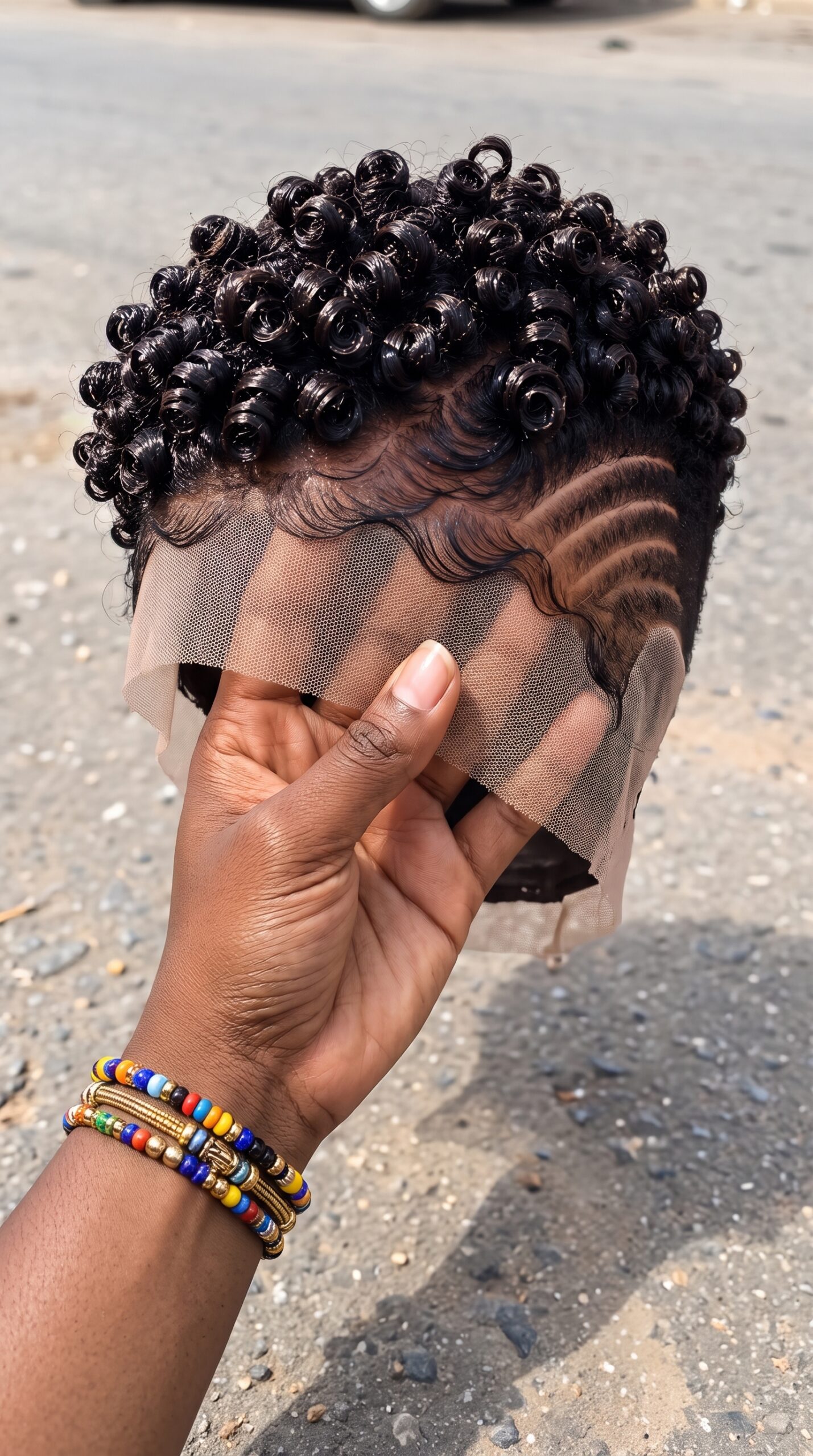
Some hairstyles are memorable because of their color. Others stand out because of the precision of their curls and the artistry surrounding the hairline. This black pixie lace wig belongs to the second category. Its compact crown is filled with glossy, open-centered ringlets, while the visible temple displays a series of curved separations that create a graceful, layered pattern. Along the forehead, delicate sweeping strands connect the curls to the frontal lace, giving the hairstyle a decorative appearance without requiring contrasting hair colors.
The wig is photographed outdoors in natural daylight, held in one hand above a rough roadside surface. The beige lace remains untrimmed, extending across the frontal area and down toward the visible temple. This presentation allows prospective buyers to examine the relationship between the crown, hairline, side pattern, and exposed mesh before installation.
The upper curls appear predominantly natural black, with deep espresso and charcoal reflections where sunlight catches the strands. The ringlets are compact and closely arranged, creating a rounded silhouette. Unlike wigs with elongated ribbon arches, this hairstyle relies on numerous small circular loops that face different directions across the crown.


The visible side introduces a contrasting styling approach. Several curved channels follow the contour of the temple, separating closely arranged dark hair into narrow bands. The lower curves become progressively smaller, creating a nested appearance that complements the rounded curls above.
For buyers interested in this hairstyle, the most important considerations are the shape and density of the ringlets, the placement of the temple curves, the frontal hairline arrangement, and the suitability of the lace and cap for professional fitting.
The Circular Crown Creates a Compact Silhouette
The upper hairstyle contains numerous glossy circular curls arranged closely together. Several rings face outward, revealing their open centers, while others turn diagonally or overlap neighboring sections.
The curls vary slightly in apparent diameter. Some are relatively broad, particularly near the upper center, while smaller loops fill the surrounding spaces.
This variation prevents the crown from appearing like a collection of identical manufactured circles. The individual curls remain recognizable, but their overlapping arrangement creates a continuous rounded shape.
The hair does not extend into long hanging spirals. Instead, the ringlets remain compact and follow the general contour of the head.
This makes the hairstyle particularly suitable for customers seeking a decorative pixie appearance rather than a longer curly bob.
Why Curl Diameter Matters More Than Maximum Volume
A successful reproduction depends on maintaining the relationship between curl size and crown density.
If the curls are made excessively large, the upper hair may become bulky and lose its compact appearance. If they are too small, the individual circular openings may become difficult to distinguish.
The reference shows a balanced arrangement of relatively small ringlets with recognizable hollow centers.
Customers commissioning a similar wig should request a rounded crown with closely grouped circular curls rather than maximum height.
A photograph from above can help establish whether the curls are distributed consistently across the upper surface.
The Temple Waves Give the Hairstyle Its Personality
The visible temple contains several curved separations that travel across the closely arranged side hair.
The upper curve follows a relatively long sweeping path beneath the crown. Additional curves appear below it, becoming more compact as they approach the lower temple.
These channels reveal a scalp-toned surface, creating clear boundaries between the dark hair sections.
The curves are not straight parallel stripes. Their direction changes gradually as they follow the contour of the side, producing a layered, nested appearance.
The lower section contains a smaller curved detail that completes the decorative arrangement near the temple edge.
This side design is particularly important because it distinguishes the wig from ordinary black curly pixies with undecorated sides.
Preserving the Curved Pattern
When placing a custom order, customers should provide a clear side photograph showing the complete temple arrangement.
The maker should understand that the design contains several graduated curves rather than identical straight lines.
The spacing between the channels should remain proportionate. Excessively wide separations may expose unwanted gaps, while narrow spacing could make the pattern difficult to recognize.
The photograph does not establish the exact construction technique beneath the exposed channels. They should not automatically be described as razor cuts made into natural hair.
Any cutting or thinning should be discussed before it begins because removing hair from a wig may be irreversible.
Delicate Frontal Waves Connect the Crown to the Lace
Along the frontal hairline, fine dark strands are arranged into elongated curves that follow the forehead area.
These strands create a transition between the rounded ringlets and the exposed beige lace.
The frontal styling is less bulky than the crown. Its strands lie relatively close to the mesh, allowing the upper curls to remain the primary source of volume.
Several curved sections sweep toward the temple, visually connecting the hairline to the decorative side pattern.
This arrangement resembles ornamental finger-wave styling, although the exact setting method cannot be established from the photograph.
Customers should distinguish these waves from ordinary loose baby hairs when discussing the design with a wig maker.
Why the Hairline Should Not Be Overworked
The frontal waves already contain substantial decorative detail.
Adding excessive baby-hair loops or additional curls could make the hairline appear crowded and obscure the intended arrangement.
For an accurate reproduction, the stylist should preserve the existing sweeping direction and maintain the relationship between the frontal waves and temple curves.
A close-up photograph of the hairline can help confirm the styling before shipping.
The photograph does not establish whether the hairline has been customized through plucking, ventilation, or another technique.
Natural Black Enhances the Circular Curl Pattern
The wig appears predominantly black, with glossy reflections across the circular curls and frontal waves.
There are no clearly distinguishable blonde, copper, burgundy, or silver highlights.
The monochrome appearance places greater emphasis on the shape and direction of the strands.
Sunlight creates subtle charcoal reflections along the curved surfaces, making the individual ringlets easier to distinguish.
The compact side hair appears darker because its strands lie closer to the underlying surface and reflect light differently.
This contrast creates visual depth without requiring a separate color treatment.
Choosing Between Natural Black and Jet Black
Wig suppliers may offer natural black, jet black, off-black, and other dark shades.
These colors can appear similar in photographs, particularly when the hair has a glossy surface.
The reference shows a very dark appearance, but it does not establish a manufacturer’s exact color code.
Customers should request daylight photographs of the proposed shade before approving a custom order.
A color sample may be useful when the buyer wants to match existing hair or achieve a particular level of darkness.
The Untrimmed Lace Is an Important Buying Detail
The photograph shows a broad section of beige lace extending beyond the frontal hairline and toward the visible temple.
The mesh remains untrimmed, leaving material that may later be adjusted to fit an individual wearer’s forehead and side contours.
The lace appears relatively fine, but its exact grade cannot be confirmed visually.
It should not automatically be identified as HD lace without reliable manufacturer information.
Likewise, the presence of lace does not establish whether the wig is suitable for adhesive-free installation.
The appropriate attachment method depends on cap construction, fit, and the intended wearing conditions.
Checking the Lace Before Installation
A professional installer should begin by positioning the wig on the wearer’s head and evaluating the frontal hairline.
The temple curves should also be checked because incorrect positioning may shift the decorative pattern away from its intended location.
Only after confirming the fit should the excess lace be trimmed.
The lace color should be compared with the wearer’s complexion under appropriate lighting.
Removing too much mesh can compromise the hairline and may be difficult to correct.
What the Photograph Reveals About the Cap
The wig is supported from beneath, with part of the dark interior cap visible behind the loose frontal lace.
However, the photograph does not provide a complete underside view.
The exact cap circumference, full attachment arrangement, and number of adjustable components remain unverified.
Buyers should request a separate photograph showing the cap turned inside out.
This can help identify any adjustable straps, combs, elastic components, and other fastening hardware.
Cap measurements should be compared with the wearer’s actual head measurements rather than relying exclusively on generic size labels.
Finding a Wig Maker for Decorative Ringlet Pixies
Customers searching for this hairstyle should look for wig makers experienced in compact circular curls, sculpted frontal waves, and decorative temple arrangements.
Independent wig studios, specialist lace wig salons, and custom hairpiece makers may offer suitable services.
When reviewing previous work, look for examples of open-centered ringlets and carefully arranged curved side patterns.
A stylist experienced only with ordinary curly wigs may not necessarily be able to reproduce the combination shown in the reference.
Send the photograph and explain that the desired hairstyle contains glossy black circular curls, ornamental frontal waves, and several graduated temple curves.
Preparing a Custom Order
Before paying a deposit, confirm the proposed fiber type and whether it can maintain the intended circular curls.
Ask whether the temple pattern and frontal waves will be completed before delivery.
Request the cap measurements, lace specifications, attachment details, and expected production timeline.
Establish whether the quoted price includes the completed styling and any necessary hairline customization.
For a custom commission, request photographs from the front, side, above, and rear before shipping.
These views can help confirm that the finished wig resembles the reference beyond the single angle shown in the original photograph.
Ready-Made or Custom: Which Is More Suitable?
A ready-made black curly pixie wig may provide a similar color and crown shape but lack the decorative temple curves and ornamental frontal waves.
Some products contain ordinary spirals or uniformly cropped sides without the distinctive pattern shown in the photograph.
Custom production may offer greater control over curl diameter, crown density, temple geometry, and cap fit.
Before purchasing a basic wig for later customization, consult a specialist to determine whether its density and construction can support the intended result.
Creating exposed channels in an unsuitable wig may reveal underlying materials or produce unwanted gaps.
Illustrative Prices for Black Ringlet Pixie Wigs
The cost of this hairstyle may depend on the number of individually arranged circular curls, the decorative temple pattern, the frontal wave styling, and the lace construction.
Although the design does not require visible multi-color processing, the sculpted hairline and side arrangement may involve specialist labor.
The following USD figures are illustrative planning ranges, not verified current retail prices or quotations for the photographed wig.
| Wig Category | Illustrative USD Range | Potential Purchasing Considerations |
|---|---|---|
| Premium Custom | $320–$770+ | Individually arranged black ringlets, sculpted frontal waves, graduated temple curves, and possible lace customization. |
| Standard Custom | $175–$395 | Customized circular crown and decorative side styling with selected cap and frontal adjustments. |
| Basic Human Hair | $100–$250 | A possible human-hair foundation that may require separate curl setting and specialist temple work. |
| Premium Synthetic | $75–$190 | A potential pre-styled alternative if the manufacturer offers comparable ringlets and curved side detailing. |
| Basic Synthetic | $30–$95 | Budget alternatives may resemble the black curly silhouette without reproducing the intricate temple design. |
These categories describe possible purchasing options rather than the confirmed material of the photographed wig.
The image does not establish whether the hair is human, synthetic, or blended.
Before accepting a quotation, confirm whether the price includes the finished curls, temple styling, lace preparation, and cap adjustments.
Shipping, professional installation, and future maintenance may be charged separately.
Installation Should Preserve the Temple Curves
The installer should begin by checking the cap fit and positioning the frontal hairline correctly.
The decorative temple channels and frontal waves should be evaluated before trimming the excess lace.
Once the wig is properly aligned, the mesh can be adjusted conservatively according to the wearer’s hairline.
The circular crown should be handled carefully during fitting. Pulling on the ringlets may disturb their arrangement or alter the overall volume.
Any corrections to the temple should be discussed before cutting or thinning begins.
After installation, photographs from the front and visible side can help confirm that the curved pattern remains clearly recognizable.
Maintaining the Glossy Black Ringlets
The upper curls depend on their circular openings remaining visible. Repeated brushing, pulling, or compression may disturb the arrangement and reduce the separation between individual ringlets.
The frontal waves require different handling because their appearance depends on closely aligned strands following deliberate curved paths.
Customers should obtain maintenance instructions from the original maker before attempting to restyle either section.
The correct approach depends on the fiber type and the method used to create the formations.
If the wig is synthetic, heat styling should only be attempted when the manufacturer confirms suitable temperature limits.
If it contains human hair, previous styling treatments may influence its response to further heat or chemical processing.
Keeping the Temple Pattern Visible
The decorative side curves may become less distinct if the surrounding strands are repeatedly disturbed or coated with excessive product.
Ask the original stylist which products and maintenance techniques are appropriate for the temple arrangement.
Avoid attempting to deepen or widen the exposed channels without professional guidance. Removing hair from a wig can be irreversible and may expose the underlying construction.
When storing the unit, support the cap without compressing the circular crown or stretching the frontal lace.
If the waves lose their original direction, specialist restyling may be preferable to extensive home adjustments.
A Pixie Wig That Balances Curls and Decorative Side Styling
This hairpiece combines a rounded crown of glossy black ringlets with delicate frontal waves and several graduated temple curves.
The monochrome color allows the individual curl shapes and sculpted side pattern to remain the primary visual attractions.
For buyers seeking a similar result, accurate curl geometry, temple placement, and hairline styling should take priority over generic black curly wig descriptions.
Request actual product photographs, confirm the cap and lace specifications, and discuss the proposed styling method before commissioning custom work.
The strongest reproduction will preserve the compact black ringlets, ornamental frontal waves, graduated temple curves, and proportional crown without introducing unnecessary additional colors or decorative details.
With suitable construction and careful fitting, this hairstyle offers a distinctive example of sculpted pixie wig styling in which circular curls and flowing temple waves create a coordinated, expressive appearance.
Search Terms
Black ringlet pixie lace wig · Glossy circular curls with temple waves · Natural black sculpted curly crown · Graduated curved side part wig · Beige untrimmed lace pixie hairpiece · Ornamental finger wave temple curls · Compact black spiral ringlet wig · Curved temple line black pixie hairstyle