
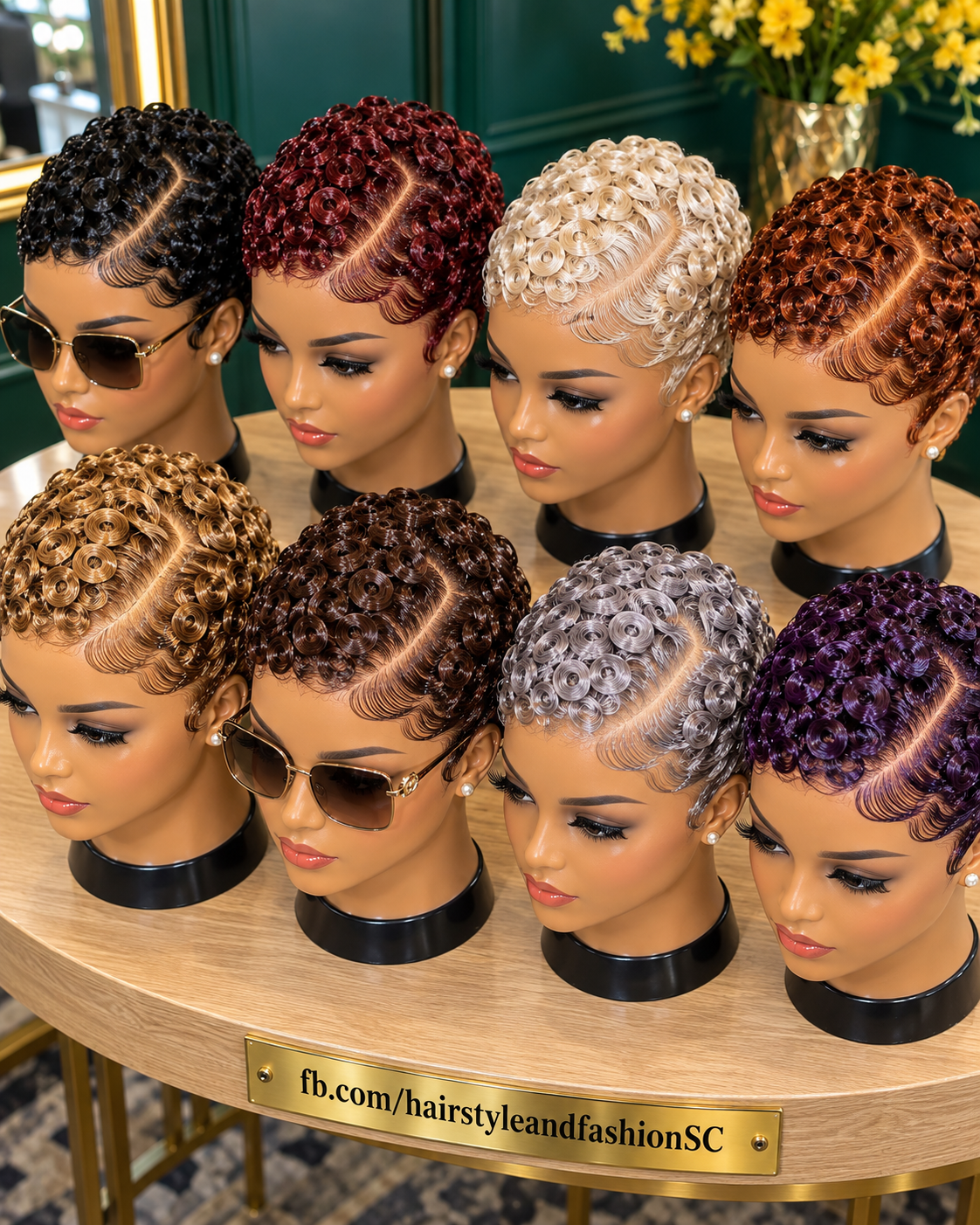
Imagine selecting a hairstyle from eight colors displayed together, only to discover that the shade you initially preferred is not the one that best reveals the curl pattern. That is the interesting choice presented by this salon collection. Eight mannequin heads display compact pin curl pixie hairstyles in natural black, ruby burgundy, champagne blonde, copper auburn, golden honey, chocolate brown, pearl silver, and deep violet purple. Each hairstyle combines closely arranged circular curls with a diagonal parting and carefully directed waves along the forehead.
The mannequins are arranged in two rows of four on a rounded light-wood table against a deep green wall. The upper row contains black, burgundy, pale blonde, and copper examples. The lower row introduces golden honey, chocolate brown, silver, and purple. Two mannequins wear sunglasses, while the others leave their faces unobstructed. All eight have black mannequin bases, making the display visually consistent despite the different hair colors.
The collection is particularly useful for comparing how color affects the visibility of individual pin curls. Light blonde and silver shades reveal the circular openings with considerable clarity. Darker black and chocolate-brown versions emphasize reflective shine and the contrast between raised curls and closely directed hairline sections. Burgundy, copper, and purple introduce richer color without changing the overall compact pixie concept.


Although the hairstyles share a recognizable structure, the photograph does not prove that they are identical wigs produced in different colors. Their curl placement, parting angles, and front-wave arrangements show small visible differences. A customer seeking an accurate reproduction should therefore select a particular mannequin rather than ordering a generic multicolor pin curl pixie.
Understanding the Eight-Color Selection
The display offers a broad range of shades, but they can be understood through three main color families: dark neutrals, warm metallic-inspired colors, and cooler or jewel-toned options.
Natural black and chocolate brown provide the darkest choices. Their reflective surfaces make the curls noticeable without requiring contrasting highlights. The golden honey, champagne blonde, and copper auburn examples introduce warmth at different levels of brightness.
Ruby burgundy and deep violet purple offer saturated color with darker depth, while pearl silver creates the coolest and most reflective-looking alternative.
These differences matter because a color that looks striking in isolation may create a different impression when combined with compact circular curls and a diagonal parting.
Customers should consider not only their preferred shade but also whether they want the individual curl openings to be highly visible or prefer a darker, more unified crown.
Natural Black Reveals the Importance of Curl Placement
The upper-left mannequin wears a glossy black hairstyle with numerous small circular pin curls distributed across the crown. A diagonal part runs from the front toward the upper side, separating the raised curls from a closely directed section of hair.
Along the forehead, fine strands follow curved paths that create a finger-wave-inspired arrangement. The waves continue toward the temple, where smaller curls frame the side.
The black color appears consistent, with bright reflections along the outer surfaces of the circular formations. These reflections come from the lighting rather than clearly visible contrasting dye.
This version is suitable as a reference for customers who want the hairstyle’s construction to remain the main attraction. The dark shade gives the crown depth while allowing the diagonal part to remain noticeable.
Ruby Burgundy Introduces a Rich Wine-Red Appearance
The second mannequin in the upper row displays a deep ruby-burgundy hairstyle. Its circular curls contain glossy red reflections, while darker wine-colored areas remain visible between neighboring formations.
The diagonal part is prominent, creating a clear division through the upper front. Beneath it, closely directed strands form curved waves that follow the forehead.
The burgundy shade appears richer and more red than the purple example in the lower row. It also differs from copper auburn, which contains stronger orange-brown warmth.
For a custom order, customers should distinguish ruby burgundy from black cherry, violet burgundy, and bright cherry red. These color names can produce noticeably different results depending on the manufacturer.
Request photographs under neutral lighting before approving the final shade.
Champagne Blonde Creates a Pale Circular Crown
The upper third mannequin wears a light champagne-blonde hairstyle with soft ivory and beige undertones. Its pale color makes the individual circular curls particularly easy to distinguish.
The crown contains numerous compact pin curls, with several hollow centers visible across the upper section. The diagonal part is clear, and the front hairline contains delicate waves that follow the forehead.
This shade is not the same as bright golden blonde. Its appearance is lighter and more neutral, with subtle warmth rather than strong yellow or orange reflections.
Customers considering this color should compare champagne blonde, ivory blonde, and pale beige blonde samples before ordering.
If the wig is made from human hair, achieving a very light shade may involve chemical processing. The hair’s condition and previous coloring history should be discussed with a qualified professional.
Copper Auburn Gives the Crown a Warm Metallic Appearance
The upper-right mannequin wears a rich copper-auburn hairstyle with glossy reddish-brown reflections.
The upper curls are closely arranged, forming a rounded silhouette with numerous visible circular openings. A diagonal part divides the crown from the front-wave section.
The forehead waves follow a curved direction toward the temple, creating a transition between the raised curls and the closely fitted lower hair.
The color is noticeably warmer than burgundy and deeper than a bright orange copper. It contains brown depth that helps the circular formations remain distinguishable.
For customers seeking this shade, a description such as rich copper auburn with chestnut undertones may be more useful than requesting plain red hair.
Golden Honey Blonde Highlights Every Pin Curl
The lower-left mannequin displays a warm golden honey-blonde hairstyle. Its crown contains numerous small circular curls arranged into a compact rounded shape.
The color includes golden and caramel reflections, creating a warmer appearance than the champagne-blonde example above.
The diagonal part is visible near the front, while the forehead contains carefully directed curved strands.
Because the hair is relatively light, the circular openings remain prominent even where neighboring curls overlap.
This version may appeal to customers who want a bright hairstyle with warmth rather than a cool platinum appearance.
When ordering, ask the seller to clarify whether the proposed shade is honey blonde, golden blonde, or caramel blonde. These colors may vary significantly between suppliers.
Chocolate Brown Offers a Rich Neutral Alternative
The lower second mannequin wears a deep chocolate-brown hairstyle with glossy warm reflections. Sunglasses partially obscure the upper face, but the crown and front-wave arrangement remain visible.
The upper section contains compact circular curls, several of which have visible hollow centers. A diagonal part runs through the front, separating the raised curls from the closely directed forehead waves.
The chocolate-brown shade provides warmth without the brightness of copper or blonde.
This version can serve as a reference for customers who prefer a relatively understated color but still want the detailed appearance of sculpted pin curls.
The exact brown shade should be confirmed through product-specific photographs because chocolate, espresso, and chestnut may differ in warmth and depth.
Pearl Silver Creates the Coolest Interpretation
The lower third mannequin displays a pale pearl-silver hairstyle with subtle gray and lavender-gray reflections. The upper curls are arranged into numerous compact circular formations.
The light color makes the individual ringlets particularly noticeable. Their rounded surfaces reflect the salon lighting, while darker spaces between them create depth.
A diagonal part is visible near the front, and fine strands form curved waves across the forehead.
The silver shade differs from pure white platinum because it contains cool gray depth.
Customers should request color samples before ordering, particularly if they want to avoid excessive yellow warmth or an overly dark charcoal result.
The photograph does not establish whether the silver appearance was achieved through coloring, precolored fibers, or another method.
Deep Violet Purple Completes the Jewel-Toned Range
The lower-right mannequin wears a rich violet-purple hairstyle with dark plum undertones. Its crown contains numerous glossy circular curls arranged into a compact silhouette.
The diagonal part remains visible, and the forehead waves follow a curved direction toward the temple.
The purple shade is noticeably cooler than burgundy. It contains stronger violet reflections rather than predominantly red tones.
This version offers a distinctive alternative for customers who want saturated color without selecting bright electric blue or vivid magenta.
When ordering, specify deep violet purple with dark plum depth rather than simply requesting purple hair. The latter description may result in a much brighter or lighter shade.
Across the eight hairstyles, diagonal partings organize the relationship between the upper circular curls and the front-wave sections.
The exposed lines vary slightly in direction and length. Some extend farther across the upper side, while others are partly concealed by surrounding curls.
The parting is important because it determines how the hair is distributed across the front of the head.
A custom maker should establish the desired parting direction before setting the curls. Changing its position may alter the entire front composition.
Customers should identify the exact mannequin they prefer and provide a clear photograph of its parting arrangement.
The Circular Curls Are Compact and Closely Arranged
The upper sections contain numerous small circular formations with visible hollow centers. Several curls face outward, while others overlap or turn diagonally.
The overall crown shape is rounded rather than elongated. The curls remain concentrated near the upper head without forming long hanging spirals.
The lighter colors reveal the individual circles more clearly, while the darker versions emphasize reflective shine and shadowed depth.
For custom production, the maker should discuss curl diameter, crown density, and overall height before styling begins.
A wig with much larger loops may create a different silhouette even if its color matches the reference.
Forehead Waves Provide the Final Styling Detail
The front sections contain carefully directed strands that follow curved paths across the forehead.
These waves create a contrast with the raised circular curls above. Their appearance depends on strand direction rather than additional volume.
Some mannequins display broad sweeping waves, while others contain smaller curved sections near the temples.
The exact arrangement should be discussed when ordering. A generic finger-wave hairline may not reproduce the preferred mannequin’s design.
For natural-hair styling, a qualified stylist may use appropriate setting products and careful directional combing. For wigs, the method depends on the fiber composition and construction.
What the Display Does Not Reveal About Construction
The photograph provides a clear comparison of the exterior hairstyles but does not show the underside of the wigs.
The mannequin heads do not establish whether the units contain lace fronts, internal combs, adjustable straps, or particular cap technologies.
The photograph also cannot confirm whether the hair is human, synthetic, or a blend.
Buyers should request product-specific information before purchasing.
If a seller advertises a wig as glueless, ask for confirmation of the actual securing system and fitting requirements.
The presence of a mannequin head does not provide evidence of adhesive-free suitability.
Finding a Wig Maker for Multicolor Pin Curl Pixies
Customers seeking these hairstyles should look for wig makers experienced in compact pin curls, diagonal parting, and precision forehead waves.
Ordinary curly wig sellers may offer similar colors and lengths but not necessarily the same circular curl structure.
When contacting a salon, provide the reference photograph and identify the preferred mannequin by position and color.
Ask whether the stylist can reproduce the curl diameter, parting direction, and front-wave arrangement.
Local wig salons may offer consultations where customers can compare color samples and discuss cap fit. Online custom makers may also accept reference-based orders if they provide accurate specifications and photographs of completed work.
Before paying a deposit, confirm whether the seller has an actual unit available or intends to produce a new custom version.
Preparing a Custom Order From the Eight-Color Display
Begin by selecting the preferred shade. The collection includes natural black, ruby burgundy, champagne blonde, copper auburn, golden honey, chocolate brown, pearl silver, and deep violet purple.
Next, discuss the crown. The maker should understand the desired compact circular curls and rounded silhouette.
The diagonal parting should then be reviewed separately. Specify the direction and position of the visible separation.
The forehead-wave arrangement should also be confirmed, particularly if the customer wants to reproduce one mannequin closely.
Once the styling details are agreed upon, discuss the fiber composition, cap construction, lace coverage if applicable, and installation requirements.
For custom sizing, the maker may request head circumference, front-to-nape distance, and ear-to-ear measurements.
Before shipment, request photographs of the actual completed unit from the front, both sides, above, and rear. An underside photograph should also be included.
Illustrative Pricing for Jewel-Toned Pin Curl Pixie Wigs
The following USD ranges are illustrative planning estimates rather than verified current selling prices for the displayed hairstyles. Actual costs depend on fiber composition, color processing, cap construction, styling labor, and seller location.
| Wig Category | Illustrative USD Range | Potential Purchase Scope |
|---|---|---|
| Premium Custom | $300–$735+ | Individual cap planning, detailed circular curl styling, selected color processing, and precision forehead-wave work. |
| Standard Custom | $165–$385 | Reference-based pin curl styling with selected color and front-wave customization. |
| Basic Human Hair | $100–$250 | A human-hair pixie base that may require separate coloring, circular curl setting, and hairline styling. |
| Premium Synthetic | $75–$195 | A manufactured-fiber alternative with prearranged curls or selected color options, depending on availability. |
| Basic Synthetic | $30–$100 | An entry-level curly pixie that may approximate the silhouette without reproducing the detailed pin curl arrangement. |
These categories represent possible purchasing options. The photograph does not identify the material used in any of the eight displayed hairstyles.
Color processing may influence the final price, particularly for pearl silver, champagne blonde, and deep violet-purple options.
The number of individually arranged curls and the complexity of the forehead-wave pattern may also affect labor costs.
Ask whether the quotation includes installation, styling adjustments, shipping, taxes, and any necessary lace finishing.
Maintaining Compact Circular Pin Curls
The upper curls require careful handling because their appearance depends on preserving the individual circular formations.
Aggressive brushing can separate the strands and change the arrangement of the curls.
Before cleaning, confirm the fiber composition and ask the maker how the curls were formed and secured.
Do not apply heat until the material and permitted temperature range are confirmed. Synthetic fibers may have strict limitations, while processed human hair can also be vulnerable to excessive heat.
If individual curls begin to lose their shape, professional resetting may be preferable to repeated home attempts.
Protecting the Forehead Waves During Wear
The forehead waves require a different maintenance approach from the crown. Their appearance depends on closely arranged strands retaining their curved direction.
Repeated friction, rough handling, or pressure from tight headwear may disturb the styling.
When removing a wig, avoid pulling directly on the decorative front sections or delicate hairline.
If the waves become less distinct, consult a stylist before attempting to reshape them.
For storage, choose a support that maintains the cap shape while leaving sufficient space around the circular curls.
Color Care Across the Eight Variations
Dark black and chocolate-brown hairstyles may show product residue through reduced shine or visible buildup.
Copper and burgundy shades may require attention to color preservation, depending on the material and coloring process.
Pearl silver and champagne-blonde hair can make unwanted tonal changes more noticeable. Deep violet-purple coloring may also require special care if it was produced through chemical processing.
For confirmed human hair, ask a stylist about suitable color-safe products and whether professional toning or color maintenance may eventually be necessary.
For synthetic hair, follow the manufacturer’s instructions and avoid unverified dyeing or heat treatments.
Planning the Final Fitting Appointment
After purchasing a similar wig, inspect the curl arrangement, color, parting, hairline, and cap construction before making permanent changes.
Book a stylist experienced in sculpted pixie wigs and precision forehead-wave styling. Explain which mannequin serves as the reference.
The stylist should assess the cap fit and hairline position before performing any required trimming or customization.
Once the wig is fitted, minor adjustments may be needed to ensure the circular curls and front waves sit appropriately on the wearer.
Excessive reshaping should be avoided if the goal is to preserve the original design.
Selecting a Color That Complements the Sculpted Curls
This eight-piece collection demonstrates how a consistent pin curl pixie concept can produce distinct appearances through color, curl placement, and front-wave direction.
The black and chocolate-brown versions emphasize reflective depth. Champagne blonde and golden honey make the circular curls particularly noticeable. Copper auburn introduces warmth, while ruby burgundy and deep violet purple offer rich jewel-toned alternatives