
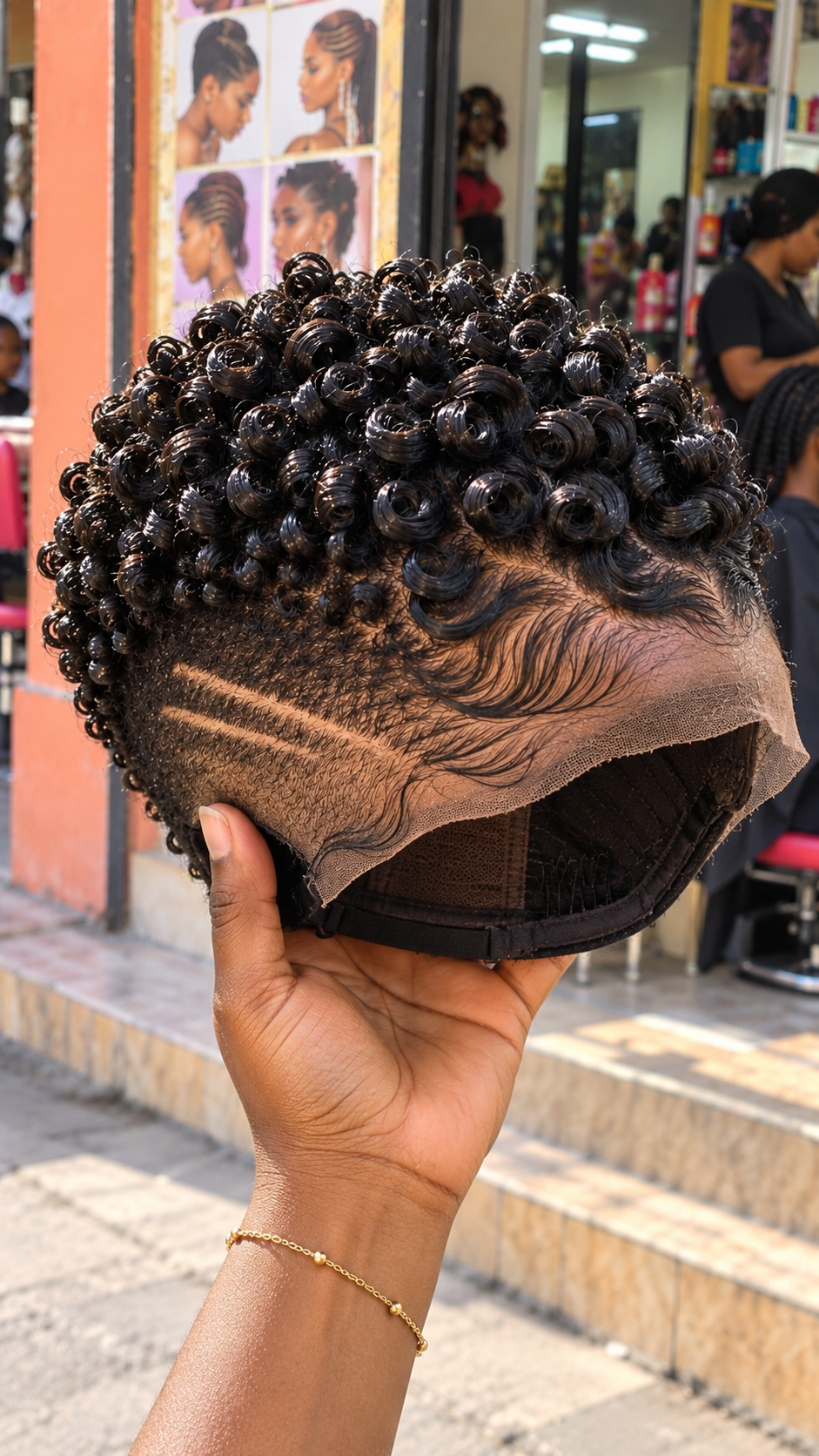
A striking black pixie wig can be recognized by the craftsmanship of its hairline long before anyone examines the individual curls. In this photograph, a dense collection of glossy spiral rosettes rises above an elaborate arrangement of sweeping forehead waves, while two narrow diagonal channels introduce a sharp decorative accent along the closely cropped side. The contrast between the rounded curls, flowing front strands, and precise side detailing gives the hairstyle a distinctive character.
The wig is photographed outside a working neighborhood salon, supported in one hand with its untrimmed lace and dark interior cap facing the camera. The image provides an unusually informative view of a pre-installation unit. The front hairline, circular curl arrangement, visible side artwork, lace perimeter, and part of the interior construction can all be examined without relying on a finished portrait.
The most interesting aspect is the relationship between the compact spiral crown and the long, directional waves near the forehead. The upper curls are tightly grouped, but the front styling stretches into elegant curves that follow the lace boundary. The two side channels remain separate from these waves, creating an additional layer of detail beneath the rosettes.


For buyers considering a similar design, the main challenge is finding a wig that preserves these different styling techniques within one balanced silhouette. A generic black curly pixie may have the correct color and approximate length while lacking the intricate hairline work that makes this particular hairstyle recognizable.
The Forehead Waves Create the Strongest First Impression
The front hairline contains a series of long, carefully arranged strands that sweep diagonally across the exposed lace. Several narrow sections follow similar curved paths, creating a layered finger-wave appearance beneath the circular curls.
The waves begin near the upper front hairline and travel across the forehead area before bending toward the visible side. Some strands extend farther downward than others, producing an elegant progression of curved lines.
Unlike ordinary baby hairs arranged into a few small loops, this front styling occupies a substantial area. The strands appear deliberately grouped and directed, forming a decorative panel that connects the dense crown to the lace perimeter.
The glossy black surface emphasizes the direction of the hair. Reflected daylight follows the curves, making individual strands easier to distinguish against the lighter mesh beneath them.
The photograph also shows fine hairs near the edges of the wave arrangement. These smaller strands contribute to the layered appearance without replacing the broader directional sections.
Why the Front Waves Need Their Own Styling Plan
A custom wig maker should treat the forehead waves as an independent styling element rather than assuming they will naturally emerge from the curled crown.
Their appearance depends on strand direction, spacing, and the position of the hairline. If the waves are shortened excessively, they may lose the elongated movement visible in the reference.
If they are placed too low, the styling could interfere with the intended lace-trimming area or sit awkwardly against the wearer’s forehead.
During customization, request a close photograph of the front hairline before the lace is cut. This allows the direction and extent of the waves to be evaluated while corrections may still be possible.
The stylist should also explain how the waves were arranged and which products or techniques are appropriate for maintaining them.
A Crown Filled With Compact Circular Rosettes
Above the sweeping hairline, the wig contains numerous tightly arranged circular curls. Several form recognizable ring-shaped openings, while others overlap and turn inward toward neighboring sections.
The upper hairstyle is densely packed, but the individual rosettes remain visible. Some curls are relatively broad, particularly near the upper center, while smaller loops fill the surrounding spaces.
This variation creates a rounded, layered silhouette rather than a uniform collection of identical curls.
The rosettes are concentrated close to the head. They create noticeable fullness without extending into long hanging strands, making the overall hairstyle compact despite its elaborate upper construction.
Along the visible side, smaller curls descend toward the transition into the closely cropped lower section. This helps connect the raised crown to the side without introducing an abrupt gap.
Fine flyaway strands are visible around several loops. Their presence contributes to the strand-level detail, although the main circular arrangement remains clearly recognizable.
Distinguishing Rosettes From Ordinary Spiral Curls
A conventional curly pixie may contain numerous small spirals, but the photographed hairstyle uses curls arranged into distinct circular formations.
The openings within the rosettes are important. They create dark spaces that emphasize the curved surfaces and prevent the crown from appearing like an uninterrupted mass of hair.
When ordering, ask for compact circular rosettes with varied loop sizes rather than generic loose curls.
The maker should preserve enough separation between the larger loops to keep their shapes recognizable. Excessive density could cause the curls to merge, while insufficient density might expose unwanted gaps.
Request photographs from the front, side, and slightly above the crown before approving a custom unit.
Two Diagonal Channels Add Precision to the Lower Side
The visible side contains two narrow, pale channels running diagonally through closely arranged dark hair. Their paths are broadly parallel, although the lower channel appears shorter and slightly different in direction.
The upper channel extends backward beneath the descending curls. A second line sits below it, separated by a band of dark hair.
These channels are distinct from the sweeping forehead waves. The front waves are formed from directional strands, while the side divisions appear as lighter exposed paths through the closely cropped hair.
The contrast makes the artwork visible without requiring additional coloring. The surrounding hair remains deep black, and the lighter channels stand out against the dark surface.
The pattern is relatively restrained. It does not contain a large zigzag, intersecting triangles, or an elaborate network of carved lines.
The photograph suggests razor-inspired side detailing, but the exact production technique cannot be established visually. A wig maker should confirm whether the channels are created through cutting, parting, ventilation, or another method.
Why Two Lines Can Be More Effective Than Additional Artwork
The two channels complement the elaborate upper curls without competing with them. Adding several more lines could make the lower section appear crowded and reduce the emphasis on the forehead waves.
For a close reproduction, the spacing between the two channels should remain visible. If they are placed too close together, they may appear as one broad division.
Their position relative to the hairline is equally important. A design placed too far toward the rear may become difficult to see from the front.
The photograph does not reveal the opposite side clearly enough to establish whether matching artwork appears there. Customers requesting symmetrical designs should specify that requirement before production.
Midnight Black Hair Under Natural Outdoor Lighting
The wig appears predominantly deep black, with cool charcoal reflections across the glossy curls. Some rosettes display narrow grayish highlights where daylight strikes their outer surfaces.
These lighter reflections should not automatically be interpreted as silver-colored strands. The photograph does not show a clear pattern of contrasting dye colors.
The dark appearance remains consistent across the crown, forehead waves, and lower side. This creates visual unity despite the differences in curl size and hair direction.
The raised rosettes reflect more light than the closely cropped lower hair because their curved surfaces face the light at different angles.
The front waves also produce narrow reflective bands that emphasize their movement across the lace.
Customers seeking this appearance should request a deep natural black shade and confirm the color under daylight. Some commercial black wigs contain warmer brown undertones or cooler blue-black reflections.
The photograph cannot establish the fiber type or the products responsible for the glossy appearance.
Evaluating the Exposed Lace Before Installation
A broad section of beige-brown lace extends beyond the front hairline. The mesh remains untrimmed and hangs beneath the sweeping waves, allowing its general shape to be examined.
Fine dark strands emerge near the lace boundary, while the longer forehead waves extend across the mesh area.
This arrangement requires careful fitting because the decorative hairline occupies a substantial portion of the front.
The photograph does not establish the exact lace classification. It would be inaccurate to identify the material as HD lace without independent product confirmation.
Likewise, the visible lace does not prove that the wig is suitable for adhesive-free wear.
Before purchasing, ask the seller for the lace specifications, available cap sizes, and recommended installation method.
A professional installer should position the wig correctly before trimming any excess lace. Removing too much material near the waves could permanently alter the intended hairline.
The Dark Interior Cap and Visible Construction
The underside of the wig is partially exposed. A dark brown to black cap structure can be seen beneath the lace, including stitched sections and a reinforced perimeter.
The photograph does not clearly establish the complete attachment system. Any additional combs, straps, or clips should be confirmed with the seller rather than assumed.
The visible cap provides useful information about the unit’s construction, but it does not establish the exact manufacturing method or material quality.
Ask for a complete underside photograph showing the front lace area, rear perimeter, and all included securing components.
Head measurements should also be confirmed before ordering. These commonly include circumference, front-to-nape distance, ear-to-ear measurements, and temple placement.
Correct sizing is particularly important because the forehead waves and side channels must align with the wearer’s head.
Finding a Wig Maker for Sculpted Rosettes and Finger Waves
This hairstyle requires experience with two different styling techniques: compact circular rosettes and elongated finger-wave hairline arrangements.
A stylist experienced only with ordinary loose curly wigs may not be familiar with the precision needed to reproduce both elements.
Look for custom wig studios specializing in sculpted pixie units, spiral rosette curls, finger-wave hairlines, and precision side designs.
When contacting a salon, send the reference photograph and explain that the front waves must remain visible beneath the circular crown.
Identify the two diagonal side channels separately so they are not confused with the directional hairline styling.
Ask whether the maker can reproduce the design using a construction method suitable for the chosen cap and hair density.
Review examples of previous work before booking. Photographs showing detailed hairline waves and compact circular curls are more relevant than a general portfolio of long wigs.
Ordering a Similar Unit Without Losing the Hairline Detail
The ordering process should begin with the front styling. Confirm the intended direction of the sweeping waves and their relationship to the circular rosettes above.
Next, discuss the crown density and curl size. The maker should understand that the upper section contains numerous compact ring-shaped curls rather than loose hanging spirals.
Provide accurate head measurements according to the maker’s instructions.
Once the base is prepared, request photographs showing the front waves and side channels before the final curl arrangement is completed.
After styling, request front, side, and rear photographs. The reference does not fully reveal the back, so additional views are necessary to establish how the hairstyle continues around the head.
Before delivery, confirm the hair material, cap construction, lace specifications, and included securing components.
Also clarify whether the quotation includes installation, lace preparation, shipping, and future styling adjustments.
Illustrative Prices for Midnight Black Rosette Pixie Wigs
The combination of densely arranged circular rosettes, elaborate forehead waves, and two diagonal side channels may increase the labor required to produce a similar unit. The following USD figures are illustrative planning ranges, not verified live prices or quotations for the photographed wig.
| Wig Category | Illustrative USD Range | Possible Purchase Characteristics |
|---|---|---|
| Premium Custom | $320–$760+ | Individual cap sizing, advanced circular rosette styling, elaborate finger-wave hairline preparation, and precision side customization. |
| Standard Custom | $170–$375 | Customized black rosettes, sweeping front waves, and professionally arranged diagonal side channels. |
| Basic Human Hair | $100–$245 | A human-hair pixie base that may require additional curl formation and hairline styling. |
| Premium Synthetic | $70–$185 | Higher-priced synthetic options with prearranged curls and possible decorative hairline styling, subject to manufacturer specifications. |
| Basic Synthetic | $25–$95 | Budget black curly pixie alternatives that may resemble the silhouette without reproducing the elaborate rosettes and forehead waves. |
The main cost variable may be the amount of precision styling required. Creating numerous recognizable circular rosettes can involve more controlled work than preparing an ordinary curly pixie.
The forehead waves may also require specialist labor because their direction and spacing must remain consistent.
The side channels can add further customization costs, depending on the construction method.
Because the visible hairstyle is predominantly black, elaborate color processing may not be necessary for a similar appearance. However, the final cost still depends on the selected material and supplier.
Customers should compare complete quotations that include the wig, customization, shipping, installation, and any necessary adjustments.
The photograph does not establish whether the displayed wig is human hair, synthetic, or a blend. The table describes possible purchasing categories rather than confirmed product characteristics.
Maintaining the Circular Rosettes Between Salon Visits
The upper hairstyle depends on preserving the individual ring-shaped curls. Aggressive brushing may separate the rosettes or cause neighboring curls to merge, reducing the visibility of their circular openings.
Before washing, confirm the fiber type and obtain the maker’s recommended care procedure.
If the wig is human hair, repeated washing and heat styling may gradually affect the curl arrangement. If it is synthetic, heat compatibility must be confirmed before using heated tools.
Avoid applying excessive heavy products to the rosettes. Product buildup can cause strands to cling together and reduce the separation between the curls.
When handling the wig, support the cap rather than pulling on individual loops.
During storage, place the unit on a suitable stand that maintains the cap shape without compressing the upper curls.
Protecting the Sweeping Front Waves
The forehead waves require a different approach from the circular rosettes. Their appearance depends on the direction of the strands and the spacing between the curved sections.
Avoid aggressive combing across the hairline. If the waves lose their arrangement, consult a stylist familiar with finger-wave techniques.
The lace beneath the waves should also be handled gently during installation and removal.
Pulling directly on the fine mesh or attached strands can place unnecessary stress on the hairline.
Any adjustments should use methods appropriate for the confirmed fiber and construction.
Preserving the Twin Side Channels
The two diagonal channels should remain free from displaced strands that could reduce their contrast against the dark lower hair.
Avoid brushing across the channels in a way that moves hair into the exposed areas.
If the pattern becomes less visible, consult a professional familiar with the wig’s construction.
Do not attempt to deepen the channels with clippers or a razor without professional assessment. Depending on the cap and hair placement, additional cutting could expose underlying material or permanently damage the design.
The lower side should also be protected from unnecessary friction during storage and transportation.
A Black Pixie Defined by Curl Arrangement and Hairline Artistry
This hairstyle demonstrates how a single dark color can support an elaborate composition. The circular rosettes create decorative volume, while the sweeping forehead waves introduce graceful movement across the lace.
The twin diagonal side channels add precision without overwhelming the upper styling. Together, these elements produce a compact pixie silhouette that remains visually interesting from the front and side.
Customers seeking a faithful reproduction should prioritize accurate curl arrangement, carefully directed hairline waves, suitable cap measurements, and professional installation.
The photograph provides a valuable styling reference, but the quality of a finished purchase must be established through the actual wig, its specifications, and the skill of the professional preparing it.
With appropriate customization and material-specific maintenance, a similar unit can offer a distinctive combination of glossy black rosettes, elaborate finger waves, and restrained side artwork that highlights the craftsmanship of sculpted pixie hairstyling.
Search Terms
Midnight black compact rosette lace wig · Sweeping forehead finger wave pixie · Black circular spiral crown hairstyle · Twin diagonal shaved effect side lines · Glossy black ringlet wig with baby hair waves · Untrimmed beige lace coily pixie unit · Dark cropped temple with parallel razor accents · Black sculpted rosette wig exposed cap