
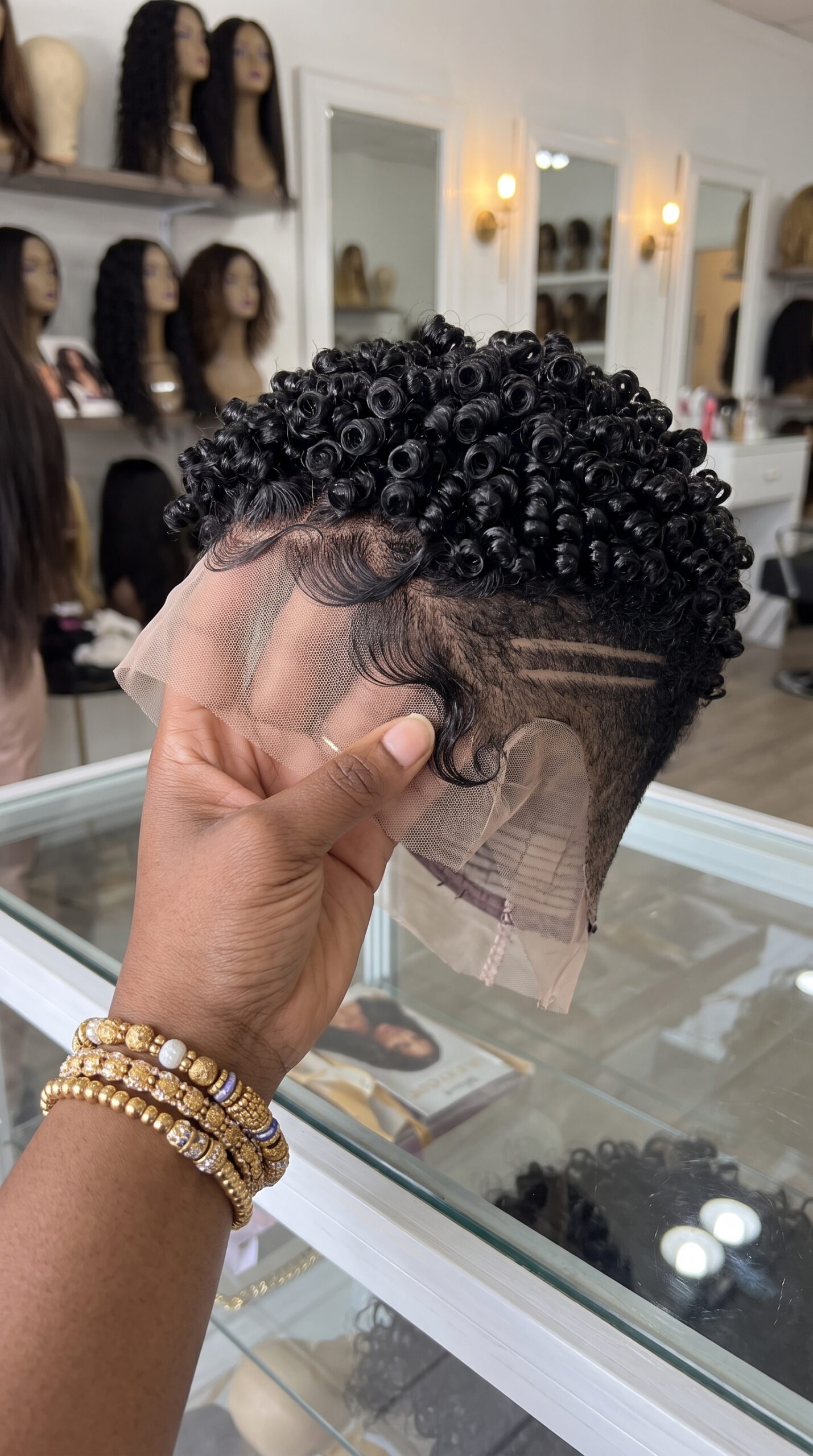
Imagine finding a compact curly wig that looks impressive on the salon counter, only to discover after purchase that the side pattern disappears when the unit is fitted. That is precisely the kind of problem worth preventing with a careful inspection. The midnight-black hairpiece in this photograph has a densely arranged crown of glossy tubular coils, two narrow temple etchings, sweeping forehead strands and a distinctive curled accent beside the ear area. Because the unit is being held with its lace extended, the photograph gives buyers a useful opportunity to evaluate the relationship between the styling and the foundation before installation.
The crown contains dozens of small to medium corkscrew curls, many with visible circular openings. Their arrangement forms a rounded, elevated upper surface, while the lower side becomes much more compact. Beneath the curls, two exposed lines travel diagonally backward through the dark hair. The front includes elongated feathered waves, and a longer S-shaped strand turns into a small loop near the temple.
The wig is presented in a beauty shop with its untrimmed lace visible across the forehead and ear-area perimeter. A portion of the interior cap can be seen through the hanging mesh, although the complete fastening arrangement is not established. The photograph does not confirm whether the hair is human or synthetic, which lace grade was used, or whether the unit is designed for adhesive-free installation. These specifications should be verified separately before ordering.


The Most Useful Starting Point Is the Temple Position
This hairstyle contains several elements that must align with the wearer’s face. The diagonal side lines sit above the ear area, while the longer perimeter curl descends toward the temple. If the cap is positioned too far forward or backward, those elements move with it.
For this reason, choosing the correct foundation can be as important as reproducing the curls. The crown may look accurate when held in hand, yet the side decoration can appear misplaced when fitted to an unsuitable cap.
Before commissioning a custom unit, the buyer should discuss cap sizing and intended wearing position with the maker. Where possible, a professional wig stylist can help establish the measurements and determine how the side should align.
The Crown Uses Closely Arranged Corkscrew Formations
The upper hairstyle consists of many individual tubular curls with visible spiral winding. Several openings face outward, revealing hollow centers that distinguish the curls from ordinary loose ringlets.
The coils are relatively compact and closely positioned. Larger tubular formations occupy the central crown, while smaller sections fill the surrounding spaces and continue toward the outer edges.
This arrangement produces substantial texture and height without extending into long hair. The curls sit above a rounded foundation, keeping the overall silhouette compact.
For custom production, the maker should preserve the narrow spiral structure rather than replacing it with oversized circular ribbons. The difference in curl diameter changes the appearance considerably.
The Curl Openings Give the Black Hair Dimension
Although the wig appears almost entirely midnight black, the crown contains noticeable visual depth. Glossy outer strands catch reflections from the salon lighting, while the inner spaces remain much darker.
Each visible opening helps separate one corkscrew from its neighbors. That distinction is especially important in a monochromatic hairstyle, where no contrasting blonde or copper streaks are used to identify individual sections.
Adding too much hair between the coils could conceal the circular openings and make the crown appear heavy. A well-made version should balance density with clearly recognizable individual spirals.
An elevated approval photograph can help confirm whether the coil winding remains visible across the crown.
Midnight Black Requires Careful Light Evaluation
The photograph shows rich black strands with narrow charcoal reflections. There is no clearly visible secondary color or intentional highlight pattern.
Some sections appear slightly lighter because the glossy hair reflects overhead lighting. This should not automatically be interpreted as brown or gray highlighting.
When ordering, buyers should request a deep black color consistent with the photograph and ask for a neutral-light image of the actual hair.
A strongly blue-black shade could create a different effect, while warm dark brown may appear less intense under bright lighting.
Matching the color is important, but it should not replace attention to the detailed spiral arrangement.
The Diagonal Etchings Create a Restrained Side Design
The visible side contains two narrow exposed channels positioned beneath the crown. Both travel diagonally toward the rear, with a small amount of dark hair separating them.
Their direction follows the contour of the head instead of forming purely horizontal stripes. The result is a compact barber-inspired detail that does not overwhelm the upper curls.
These lines should not be confused with elaborate multi-channel artwork. Their relative simplicity allows the crown and front hairline to remain prominent.
A custom maker should reproduce the two visible paths rather than adding extra lines or changing their angle.
Preserving the Hair Between the Etchings Is Essential
The exposed channels remain recognizable because the hair between them is retained. This dark section creates the boundary that distinguishes one line from the other.
Cutting the paths too widely could reduce that separating section and cause the two channels to merge visually.
Because the strands are attached to a wig foundation, they cannot naturally regrow after removal.
A professional should therefore map the pattern before cutting and preserve the established widths during later maintenance.
The Lower Side Remains Closely Curled
Beneath the side etchings, the hair becomes finer and more compact. The lower area retains visible black strands rather than appearing entirely shaved.
This creates a transition from the raised tubular crown into a much flatter side, keeping the wig balanced around the ear area.
For a custom recreation, the maker should avoid extending the large upper coils throughout the entire side. Doing so could obscure the etched lines and add excessive bulk.
The goal is a graduated difference in curl size and projection, with the crown remaining the dominant area.
The Forehead Waves Create a Distinct Face-Framing Shape
Near the front lace, elongated black strands travel through several gentle curves. These strands differ from the tubular curls above them and provide a lower-density transition toward the perimeter.
The arrangement forms a feathered wave rather than an ordinary row of baby hairs. Several sections overlap, producing a layered appearance beneath the main crown.
This front styling should be preserved carefully during installation. Removing the finer strands automatically could change the hairline’s appearance and make the upper curls begin too abruptly.
A close frontal photograph can help the buyer approve the wave direction before shipment.
The Long Temple Strand Ends in a Delicate Loop
One of the most recognizable details is the longer strand near the visible temple. It follows an elongated S-shaped movement before curling inward near the lower perimeter.
This small loop creates an individual accent separate from the tubular crown and diagonal side markings.
Its scale matters. Enlarging it into a prominent circular design would change the side profile, while removing it could make the area appear less distinctive.
For a faithful reproduction, request the same narrow descending curl with a small inward-turning endpoint.
The Ear-Area Lace Requires Individual Preparation
The photograph shows a broad section of lace extending around the front and lower side, including the region where the wig would sit near the ear.
That excess material provides room for professional fitting, but it must be evaluated in relation to the wearer’s anatomy before trimming.
The stylist should establish the cap position, check the placement of the temple curl and side etchings, and only then determine the final lace boundary.
Cutting the mesh before fitting may reduce the opportunity to adjust the placement.
The Visible Mesh Does Not Establish a Commercial Lace Grade
The lace appears beige-brown under the salon lighting. Its fine appearance can be seen across the front, but the photograph cannot confirm whether it is HD lace, transparent lace or another commercial material.
Buyers should ask the seller for the exact lace specification and available shades rather than relying on visual impressions.
The appropriate lace color also depends on the wearer’s intended installation and the supplier’s actual product options.
Likewise, visible lace does not automatically prove that the unit is designed for adhesive-free wear.
The Interior Cap Needs Its Own Product Photograph
Portions of the cap foundation are visible beneath the hanging mesh, but the entire construction is not shown clearly.
A customer should request a complete underside photograph of the actual wig before purchasing.
The seller should confirm cap dimensions, fastening options, adjustment mechanisms and any available customization.
These details influence the practical wearing experience independently from the sculpted crown.
Correct Measurements Protect the Style’s Position
The forehead waves, temple curl and diagonal etchings are attached to the same wig foundation. Their positions change together when the cap is moved.
For a made-to-order unit, follow the manufacturer’s measurement chart. Depending on construction, circumference, ear-to-ear and front-to-nape measurements may be requested.
A professional wig stylist can help determine whether a standard size is suitable or whether custom sizing should be considered.
The objective is to establish a comfortable wearing position that also preserves the intended placement of the decorative side details.
Find a Maker Who Understands Compact Corkscrew Crowns
Producing this hairstyle requires experience with narrow tubular curls and precise front-wave styling.
The crown contains many closely arranged spirals, so the maker must control their diameter, direction and spacing. The side requires a separate skill: maintaining closely curled hair while creating two narrow exposed channels.
Custom lace-wig studios and salons specializing in sculpted finger coils are practical places to begin.
When evaluating portfolios, request examples showing detailed crown construction and conservative side artwork.
Where to Buy a Similar Midnight Black Wig
Specialist wig makers, custom lace-wig studios and selected beauty supply retailers may offer comparable compact spiral styles.
A ready-made black curly wig might provide a suitable foundation, but the exact tubular crown and temple details may require additional professional work.
Send the reference photograph to prospective sellers and ask whether the design can be supplied fully styled.
Confirm whether the price includes the completed curls, side etchings, front waves and lace preparation.
Booking a Salon Appointment for Final Styling
The amount of work required depends on whether the purchased unit arrives fully prepared.
A finished wig may need fitting and minor adjustments after transportation. An unfinished base could require extensive coil setting, side cutting and hairline styling.
When booking, describe the desired crown as narrow tubular corkscrews and explain that the side contains two diagonal etched lines and a long curled temple strand.
This helps the salon determine the appropriate service and time requirements.
A Production Brief Should Identify Four Key Areas
The crown requirement should specify dense, compact tubular spirals with visible circular openings and a rounded upper silhouette.
The side should contain two narrow diagonal etched channels above a closely curled lower section.
The front needs elongated feathered waves, including a small descending loop near the temple.
Finally, the practical specification should identify the intended cap size, lace material, attachment preferences and installation method.
Separating these requirements helps prevent a generic black curly wig from being substituted for the detailed reference.
Product Approval Should Cover More Than One View
An elevated photograph should reveal whether the individual corkscrews retain their spiral winding.
A direct side photograph should show both etchings and the lower hair density.
A frontal view should document the feathered forehead waves and the descending temple curl.
A rear photograph can confirm that the curl construction continues around the back.
An additional underside image should establish the actual cap and attachment system.
Pricing Should Reflect the Labor of Individual Coil Setting
The compact length and single black color do not automatically make this wig inexpensive. The crown contains numerous carefully formed spirals, and the hairline requires fine directional styling.
Side etching, cap construction and lace preparation may add further costs.
Estimated Price Ranges for a Midnight Black Corkscrew Wig
| Category | Illustrative Price Range | Potential Scope |
|---|---|---|
| Premium Custom | $310–$570+ | Higher-grade hair, personalized cap sizing, individually arranged corkscrew crown, detailed forehead waves, twin temple etchings and lace preparation. |
| Standard Custom | $190–$340 | Prepared spiral crown, established front styling, paired side lines and standardized cap options. |
| Basic Human Hair | $110–$205 | A human-hair foundation requiring coil setting, side refinement, hairline styling and professional fitting. |
| Premium Synthetic | $75–$150 | A quality pre-set interpretation that may preserve the compact corkscrew structure with less frequent professional resetting. |
| Basic Synthetic | $35–$85 | A budget alternative where coil winding, temple precision, hairline detail or cap construction may be simpler. |
These are illustrative budgeting estimates rather than verified quotations for the photographed wig. Actual prices vary according to material, supplier, location, customization labor, cap construction, shipping and installation.
Ask for a completed-unit quotation when comparing sellers. An inexpensive foundation requiring substantial professional work may ultimately cost more than a finished custom piece.
Human Hair Can Offer Greater Restoration Flexibility
A human-hair version may allow individual corkscrew sections to be reset when they loosen, depending on the condition of the strands.
The fine forehead waves can potentially be maintained separately from the crown.
Heat should be chosen according to the hair’s actual quality and processing history.
Premium Synthetic May Retain the Original Coils
A quality synthetic version may maintain its pre-set tubular spirals with comparatively little daily manipulation.
However, heat tolerance varies and conventional permanent hair coloring should not be assumed suitable.
Buyers should confirm the actual fiber before selecting maintenance tools or chemical products.
Wash the Crown Without Disturbing the Spiral Winding
Before the first wash, photograph the crown from above. This records the individual coil arrangement and approximate diameter.
During cleansing, avoid aggressive rubbing that can intertwine neighboring spirals or loosen their winding.
Use methods appropriate for the confirmed material and allow the wig to dry without compressing the crown.
Afterward, restore only the sections that have shifted.
The Side Etchings Need Conservative Care
The exposed diagonal lines are permanent elements of the wig and should not be widened automatically during routine maintenance.
If fine strands move across them, careful repositioning may restore their appearance without cutting.
When professional refinement becomes necessary, use the original side photograph to preserve the established line widths and spacing.
The Temple Loop Should Remain a Small Accent
The longer perimeter strand has a distinct inward-turning endpoint. Its appearance should be preserved independently from the crown curls.
If it becomes displaced, a stylist can restore the original direction using methods suitable for the hair or fiber.
Heavy styling product should be avoided around the delicate section because buildup can obscure the individual curve.
Avoid Excess Product on the Black Corkscrews
The crown already has a glossy appearance. Heavy oils or waxes can cause neighboring coils to adhere together and lose their separate outlines.
Use styling products sparingly and according to the confirmed material.
When buildup becomes noticeable, appropriate cleansing may restore the curl separation more effectively than adding further shine product.
Installation Should Preserve the Existing Front Design
When the wig arrives, inspect the crown, forehead waves, side etchings, lace and cap before permanent alterations.
The installer should establish the final wearing position and check the location of the temple curl.
Only after that placement is correct should excess lace be trimmed and optional styling adjustments considered.
Storage Should Protect the Compact Spiral Crown
A suitable wig stand or mannequin head can help preserve the rounded corkscrew arrangement between wears.
The side should remain free from pressure that could distort the fine temple strands.
Make sure the cap and lace are fully dry before storage.
For transportation, use packaging that provides sufficient clearance around the raised coils.
The Distinctive Appeal Comes From Precision at Different Scales
This midnight-black wig combines compact tubular spirals, diagonal temple etchings and fine feathered front waves. The upper hair provides dense circular detail, while the lower side remains relatively restrained. A small descending temple loop completes the arrangement without requiring additional decorative carving.
For buyers, the essential checks are coil diameter, spiral winding, crown density, etched-line placement, forehead-wave direction, lace condition and cap suitability.
For wig businesses, close crown photographs, direct side views and complete interior images can communicate the product more accurately than a generic black curly-wig description.
A faithful custom recreation should preserve the narrow corkscrew curls and delicate hairline styling without exaggerating volume, introducing extra side lines or adding contrasting colors. The quality lies in maintaining the precise relationship between these individual details.
Search Terms
midnight black tubular corkscrew wig · twin diagonal temple etchings · compact spiral coil crown · feathered black lace hairline · curled temple loop wig · black precision side part wig · dense narrow ringlet hairpiece · untrimmed lace black corkscrews