
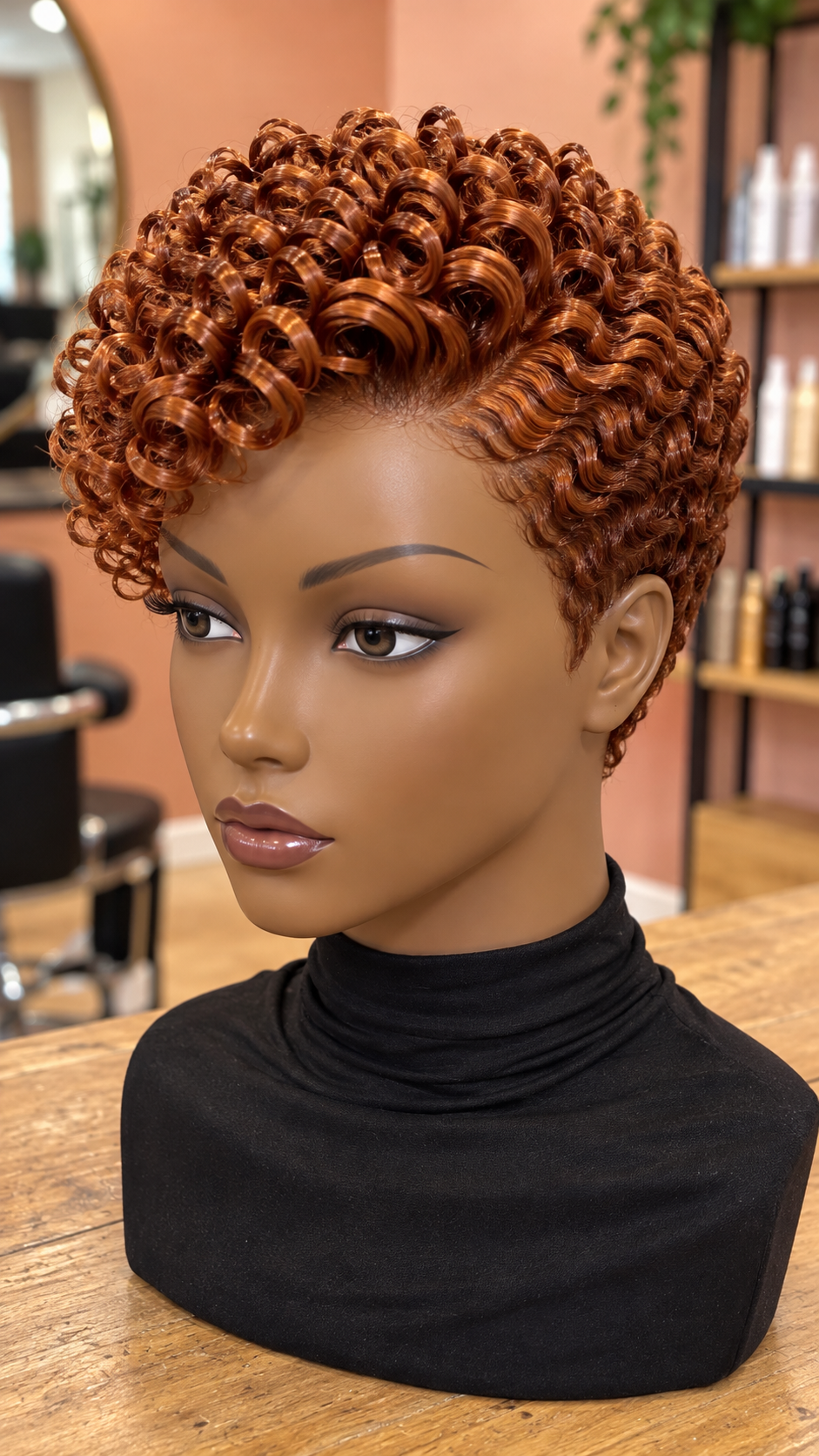
A wig can look beautifully styled on a mannequin without revealing whether its design will be easy to reproduce, fit or maintain. This molten-copper spiral piece is an interesting example because its appeal does not come from a dramatic shaved pattern or contrasting black roots. Instead, it presents an almost continuous copper-brown arrangement, with large circular curls across the crown, smaller spiral formations around the sides and a delicate sequence of wave-shaped strands near the temple.
The photograph shows a mannequin wearing a compact copper-colored hairstyle inside a salon. The upper curls form rounded, raised loops, while the hair around the visible ear sits noticeably closer to the head. The front contains a softly graduated hairline beneath the spirals, and the right temple has an elongated arrangement of narrow S-shaped waves. There is no clearly exposed geometric carving through the side, which distinguishes this unit from the many sculpted wigs built around barber-style stripes.
The mannequin presentation reveals the hairstyle’s visible proportions, but it does not show the complete interior construction. The photograph cannot establish whether the hair is human or synthetic, whether the piece uses a particular lace grade or how the cap is secured. Those details should be verified before purchasing rather than inferred from its convincing finished appearance.
The Color Is Continuous, but the Curls Make It Look Varied
At first glance, the hairstyle appears to contain several different copper shades. The crown reflects bright reddish-orange light, while the deeper areas among the curls look closer to auburn, cinnamon and dark copper-brown.


However, these changes in appearance do not necessarily indicate separate highlighting formulas. The glossy strands reflect light differently depending on their direction, producing lighter and darker surfaces within individual curls.
This matters when selecting a custom color. A buyer who requests several contrasting streaks might receive a busier result than the reference. The photographed style is better described as a rich, predominantly copper-brown hairpiece with natural-looking tonal depth across its curled surfaces.
For a custom order, the ideal shade should remain warm and saturated without becoming excessively bright orange, pale blonde or deep burgundy. A neutral-light photograph of the actual available hair is useful before approving the color.
Rounded Crown Volume Comes From the Spiral Arrangement
The upper crown is densely populated with open circular curls. Several large spirals face forward, allowing their hollow centers to remain visible. Others overlap from slightly different directions, producing a layered appearance without an excessively tall silhouette.
These formations are not ordinary loose curls hanging downward. The hair has been arranged into individual rolled sections that remain close to the rounded crown while still projecting above the foundation.
The most prominent curls occupy the forward upper area, creating a gently elevated crest. Smaller curls surround them and help the hairstyle maintain a continuous surface toward the back.
A maker recreating this wig should preserve the changing curl diameters rather than attempting to produce identical circles throughout the crown. That variation is part of the style’s character.
Large Circular Openings Should Remain Visible
Several upper curls contain noticeable open centers. These spaces allow darker recessed hair to show through the copper ribbons and give the crown a more dimensional appearance.
The openings should not be treated as missing hair that requires additional filling. Increasing density indiscriminately could turn the crown into a solid mass of curls and make individual spirals difficult to recognize.
A well-constructed version needs enough hair to provide coverage while preserving the larger circular forms.
When ordering from a custom stylist, an elevated crown photograph should be requested before final approval. That view makes it easier to evaluate the relationship between open rings and smaller supporting curls.
The Front Crown Has a Deliberately Irregular Curl Rhythm
Across the forehead, the largest curls are positioned at different angles. Some openings face almost directly forward, while neighboring spirals tilt slightly upward or toward the side.
This prevents the hairstyle from resembling a row of identical curled tubes. The slight variation gives the front a more organic visual rhythm.
Several coils overlap near the center, while smaller sections fill the outer edges. This helps maintain a rounded silhouette without creating long strands that fall across the eyes.
A stylist should therefore prioritize the balance between the prominent front rings and the surrounding smaller curls, rather than simply arranging every section into perfectly matching spirals.
The Temple Waves Are the Most Distinctive Fine Detail
Along the visible side, several elongated strands form narrow S-shaped movements immediately below the larger upper curls. Their form differs substantially from the circular crown, creating a separate decorative area near the temple.
These fine waves follow the contour of the head and gradually transition into smaller curls near the ear. Their direction guides the eye backward without requiring exposed shaved channels.
The absence of prominent carving is important. A custom wig maker should not automatically add lines or geometric patterns to the side simply because the crown is sculpted.
The reference gains its personality from carefully arranged strands rather than razor-cut decoration.
The Side Has a Continuous Copper-Brown Surface
Unlike hairstyles with strongly contrasting black side panels, this wig maintains its copper-brown color throughout the visible lower section. The shade becomes darker where curls overlap or receive less light, but no sharply separated black undercut is apparent.
This continuity gives the hairstyle a cohesive appearance from crown to ear.
For custom coloring, the side should remain within the same warm family as the upper curls. Introducing an entirely black lower panel would change the relationship between the upper and lower hair.
The maker may use natural tonal variation to create depth, but the overall side should still read as copper rather than a different dominant color.
The Ear Remains Uncovered
The visible ear is not hidden beneath long ringlets. Instead, the surrounding hair follows the contour of the head, with smaller curls arranged above and behind it.
This detail influences the overall silhouette. The wig retains noticeable crown volume without making the sides equally bulky.
A customer seeking a similar result should mention the uncovered-ear appearance when discussing cap placement and side styling.
Leaving the side curls too long could cause them to fall over the ear, while cutting too much hair could produce a sharper, more exposed profile than the reference.
The Nape Gradually Reduces in Curl Size
The hair becomes more compact as it approaches the back of the neck. The larger crown spirals give way to smaller curled sections that follow the natural outline of the head.
This gradual reduction prevents the wig from appearing heavy at the lower rear. The nape retains visible curls but does not form a long hanging section.
The transition is particularly important when recreating the hairstyle from a mannequin photograph. A maker should not concentrate all the styling attention on the front while leaving the lower rear unfinished.
A rear photograph should be requested before approving a made-to-order unit, because the supplied side view cannot establish every detail of the back.
The Hairline Has a Softer Beginning Than the Crown
Near the forehead, the first strands appear finer and less densely arranged than the large upper curls. This creates a gradual transition before the crown becomes fuller.
The visible hairline is an important part of the hairstyle’s appearance, but it does not prove any particular cap or lace construction.
Different wig foundations can create similar results when placed on a mannequin.
Customers should therefore ask the seller how the front is constructed, which fitting options are available and whether the actual unit includes lace that needs trimming.
A Mannequin Display Cannot Establish the Fiber
The glossy copper curls could be produced using different materials. Human hair and synthetic fiber can both be arranged into sculpted spiral styles, although their maintenance and restyling options differ.
The photograph alone is not sufficient to distinguish between them reliably.
For buyers, this is a practical issue rather than a minor technicality. Human hair may offer greater flexibility for professional resetting, while some synthetic styles retain their pre-arranged shape with less intervention.
The seller should identify the actual fiber before the customer selects styling tools, care products or future coloring services.
Choose the Material According to the Desired Routine
A customer who expects to refresh individual copper spirals professionally may prefer a human-hair option, provided the material is suitable for the required styling.
Someone who wants the same pre-set appearance for repeated wear may find a quality synthetic interpretation practical.
However, synthetic fibers vary in their heat resistance, and conventional permanent coloring is not automatically compatible.
Human hair also requires appropriate care, particularly if it has undergone processing to achieve the copper shade.
The best decision comes from matching the material to the intended wearing and maintenance routine rather than assuming the most expensive option is always necessary.
The Exact Cap Construction Should Be Requested Before Ordering
The mannequin photograph does not expose the underside of the hairpiece. Its attachment system, full cap foundation and any adjustment components are therefore unknown.
Before purchasing, ask the seller for a photograph of the actual wig removed from the mannequin.
The underside image should show the construction clearly enough to discuss cap size, attachment preferences and installation requirements.
If a particular lace type is advertised, request verification of the material specification. A convincing forehead appearance alone is not evidence of HD lace.
Fitting Influences the Position of the Side Waves
The crown, hairline and temple waves are arranged on the wig foundation. Their final position depends on how the cap sits on the wearer.
A unit placed too far forward may bring the copper spirals closer to the forehead, while a cap sitting too low could change the relationship between the side curls and ear.
For made-to-order construction, follow the maker’s measurement instructions. Circumference, ear-to-ear width and front-to-nape length may be relevant depending on the cap.
A professional wig stylist can help establish the correct size before an expensive custom order is placed.
Where to Find a Similar Copper Spiral Pixie Wig
Specialist wig makers, custom lace-wig studios and salons experienced with sculpted finger coils are practical sources for this hairstyle.
A general hair retailer may stock copper curly wigs, but an ordinary loose-curly unit will not necessarily reproduce the raised circular crown or precise temple waves.
When contacting a seller, provide the photograph and identify the main requirements: rich copper-brown color, large upper spirals, smaller side curls, an uncovered ear and a compact nape.
Ask whether the wig is available as a finished product or must be commissioned.
The Right Stylist Needs Experience With Mixed Curl Sizes
Creating this hairstyle requires more than curling every strand with the same tool. The crown contains larger rolled formations, while the temple and nape use smaller curls.
The professional must also maintain the elongated waves around the temple without converting them into additional circular coils.
When evaluating a stylist, look for portfolio photographs showing compact sculpted curls from the side and rear.
Examples of ordinary loose curls alone may not demonstrate the skills required for this particular construction.
A Custom Brief Should Describe the Crown and Temple Independently
The crown requirement should describe rounded copper spirals with mixed diameters, prominent front openings and a compact elevated silhouette.
The temple should contain elongated S-shaped strands that transition into smaller curls near the ear.
The nape should remain compact, with a gradual reduction in curl size rather than a long hanging section.
The color specification should emphasize continuous cinnamon-copper and auburn depth without unrelated bright blonde streaks or a contrasting black side.
Once these visual requirements are confirmed, cap construction, material and fitting preferences can be discussed.
Photographs to Request Before Approving a Custom Unit
A frontal photograph should show the upper curls and the softer hairline transition.
A direct side image should capture the temple waves, exposed ear and compact lower curls.
An elevated crown photograph can reveal the arrangement of larger and smaller spiral openings.
A rear photograph should document how the curls continue toward the nape, while a separate underside image should establish the actual cap construction.
For remote orders, these views can help prevent misunderstandings before shipping.
Pricing Should Account for Curl Placement and Color Work
The wig’s compact length does not eliminate the work involved in creating its raised circular crown and closely arranged side curls.
The final price may also reflect material quality, copper coloring, cap construction and professional customization.
Estimated Pricing for Cinnamon Copper Sculpted Spiral Wigs
| Category | Illustrative Price Range | Potential Scope |
|---|---|---|
| Premium Custom | $310–$565+ | Higher-grade hair, individual cap sizing, custom copper coloring, hand-arranged spiral crown, detailed temple waves and compact nape shaping. |
| Standard Custom | $190–$340 | Prepared copper spiral crown, coordinated side curls and standardized cap options. |
| Basic Human Hair | $110–$205 | A human-hair foundation requiring color work, spiral setting, temple refinement and professional fitting. |
| Premium Synthetic | $75–$150 | A pre-colored and pre-set alternative that may retain its circular curls with relatively limited professional resetting. |
| Basic Synthetic | $35–$85 | A budget interpretation where curl spacing, tonal depth, side precision or cap construction may be simpler. |
These figures are illustrative budgeting estimates rather than verified prices for the photographed wig. Actual quotations vary according to material, seller, location, customization labor, cap construction, shipping and fitting.
Before comparing suppliers, ask whether the quoted price includes the completed spiral crown and temple styling. A cheaper foundation may require additional salon work that changes the overall cost.
Human Hair Can Support Targeted Curl Restoration
A human-hair version may allow individual spirals to be reset when they lose their circular shape, depending on the condition of the hair.
The copper color may have involved chemical processing, so heat should be selected according to the strands’ actual tolerance.
Restoring only displaced sections can reduce unnecessary manipulation compared with rebuilding the entire crown.
Pre-Set Synthetic Fiber May Retain the Sculpture
A well-made synthetic version may preserve the circular curl pattern with relatively limited daily styling.
This can suit customers who prefer to keep the original hairstyle rather than change it frequently.
Heat tolerance varies, and conventional permanent hair dye should not be assumed compatible with synthetic fiber.
Confirm the material before selecting styling tools or chemical products.
Washing Should Preserve the Different Curl Sizes
Before the first wash, photograph the wig from above and from the side. These images document where the larger curls begin and how they become smaller around the ear and nape.
During cleansing, avoid aggressive rubbing that can intertwine neighboring coils.
Use methods appropriate for the confirmed hair or fiber and allow the wig to dry without compression.
Afterward, restore only the sections that have shifted rather than automatically resetting the entire hairstyle.
The Temple Waves Need Their Own Maintenance
The elongated strands near the temple should remain distinct from the circular crown. If they lose their direction, restore the original wave movement rather than rolling them into additional large curls.
Heavy styling product can cause neighboring wave ridges to adhere together, making the detail less visible.
Use styling aids conservatively and follow material-specific care recommendations.
Maintain the Copper Color’s Deeper Areas
If a human-hair version eventually requires a color refresh, the professional should preserve the auburn and cinnamon depth inside the spiral openings.
Applying one bright orange formula throughout the unit could remove some of the natural-looking contrast.
A selective color refresh may be appropriate depending on the hair’s condition and the actual processing history.
For synthetic wigs, color changes should only be considered using methods compatible with the confirmed fiber.
Protect the Side and Nape From Unnecessary Cutting
The smaller curls around the ear and nape are part of the finished design. They should not be removed automatically during maintenance.
Because wig hair does not naturally grow back, repeated cutting can gradually change the lower silhouette.
If individual curls become displaced, careful repositioning may be sufficient.
The objective is to retain the gradual transition from large crown spirals into smaller lower formations.
Storage Should Prevent Compression of the Crown
A suitable wig stand or mannequin head can help maintain the rounded spiral arrangement between wears.
The side should remain clear of hard surfaces that could flatten the temple waves.
Make sure the wig is fully dry before storage.
For transportation, use packaging with sufficient space to protect the circular openings without crushing the upper hair.
The Finished Style Should Preserve Copper Continuity and Curl Variation
This molten-copper wig is distinctive because its visual interest comes from gradual changes in curl size rather than elaborate shaved artwork. Large open spirals form the upper crown, smaller curls continue around the temple and ear, and compact sections complete the nape. Fine S-shaped waves provide the main side accent.
For buyers, the essential quality checks are crown density, visible spiral openings, copper-brown depth, temple-wave direction, uncovered ear, compact lower curls and verified cap construction.
For wig businesses, side-profile and elevated crown photographs can help customers understand these details more effectively than a general curly-wig description. Additional rear and underside images can confirm characteristics that the mannequin presentation does not reveal.
A faithful custom reproduction should preserve the same color family and the controlled progression between curl sizes. Extra blonde highlighting, shaved lines or oversized crown volume would create a different hairstyle rather than a more accurate version of the reference.
Search Terms
molten copper spiral pixie wig · cinnamon auburn circular curls · sculpted copper temple waves · rounded copper coil crown · uncovered ear copper wig · tapered curly copper nape · reddish brown open spiral wig · copper salon mannequin hairpiece