
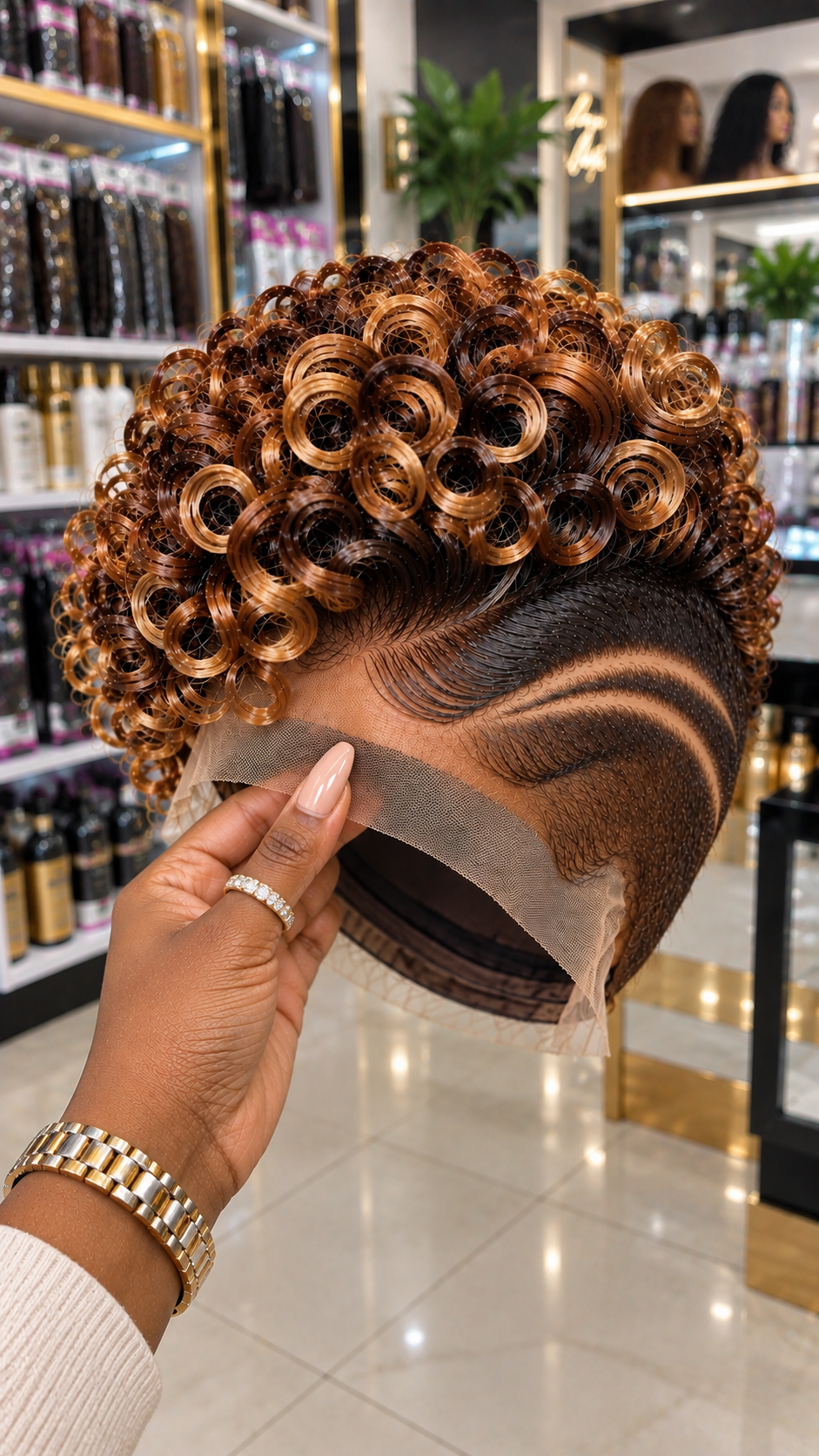
Finding a wig that reproduces this particular hairstyle requires looking beyond the familiar description of a honey brown curly pixie. The photograph presents a carefully organized contrast: a generous collection of golden amber and caramel circular curls occupies the upper head, while the visible temple is shaped into two broad, arched parting channels. Between these areas, a dark, closely arranged section of hair follows the side contour, establishing a strong boundary between the elevated curls and the lower design.
The wig is being held inside a hair and beauty supply shop, with its beige lace extending beyond the front and side hairline. This is a pre-installation view, not a photograph of the unit being worn. The untrimmed mesh and partially exposed dark interior make the image useful for examining construction, although they cannot establish the fiber composition, exact lace grade, or complete cap specifications.
The upper ringlets are particularly striking because their circular openings remain visible despite the density of the arrangement. Golden amber strands appear beside deeper caramel and chestnut-brown curls, creating a lively distribution of warm colors. Beneath them, the temple hair appears dark brown to nearly black, with two exposed arcs that follow related but not identical paths.


For a buyer, the central question is whether a seller can reproduce this combination of individually recognizable circular curls, warm color variation, and broad side geometry. Those characteristics determine whether a finished unit resembles the reference or merely belongs to the same general hairstyle category.
Begin the Purchase Decision With the Side Silhouette
When evaluating this wig, the temple offers a practical starting point because its shape is relatively easy to compare between photographs. The visible side contains two prominent exposed channels arranged in broad arcs. The upper channel begins beneath the dark transition area and sweeps backward, while the lower channel follows a related curve farther down the temple.
The hair between the channels forms a dark, elongated band. Below the lower separation, the remaining hair follows the lower side contour. The arrangement is more expansive than a pair of narrow, straight decorative lines.
The channels appear beige against the surrounding dark strands. However, the photograph does not establish whether they were produced through deliberate parting, density control, trimming, or another construction technique. Because the design belongs to a wig, the exposed areas should not automatically be described as shaved lines on a natural scalp.
A seller offering a comparable hairstyle should provide a close side photograph showing both arcs from their starting points to their visible ends. A distant frontal image would not be sufficient to evaluate the geometry.
What Makes These Arcs Different From Simple Parallel Lines?
The two separations do not maintain identical spacing throughout their visible paths. The upper channel rises into a broad curve beneath the crown, while the lower one creates a deeper contour around the temple area.
This variation produces a layered appearance. The dark hair between the channels becomes a prominent part of the design rather than merely filling an equal-width space between two stripes.
When commissioning a similar unit, the customer should identify the broad upper arc and the lower curved boundary as separate requirements. Asking for a generic double-line side design could result in a much narrower or straighter arrangement.
The intended side should also be confirmed. A wig photographed while being held may not clearly establish whether the design is intended for the wearer’s left or right temple.
How the Amber and Caramel Rings Distribute Visual Weight
The upper hair contains numerous circular barrel-like curls, but the arrangement is not visually uniform. Some of the most prominent rings sit near the upper middle, where their openings face outward. Others are positioned along the front and outer edges, partially overlapping neighboring curls.
Several lighter golden amber rings appear against deeper caramel and chestnut-brown sections. The brighter curls catch the salon lighting, while darker strands inside the openings provide additional contrast.
The warm coloring is particularly noticeable near the upper front, where individual loops show golden and caramel reflections. The central and rearward visible areas contain a mixture of lighter and darker rings.
The photograph does not prove that each tonal difference represents a separate dye color. Reflections, hair placement, and lighting may contribute to the appearance. Nevertheless, the visible result is clearly multitone rather than a completely uniform black or brown crown.
Customers should therefore ask for actual photographs of the proposed color combination. A seller’s generic honey blonde sample may not communicate the deeper chestnut elements visible in this hairstyle.
The Dark Temple Keeps the Bright Crown From Dominating
The lower hair appears considerably darker than the elevated curls. This difference creates a visual foundation beneath the golden amber arrangement and makes the exposed arcs easier to recognize.
If the entire wig were colored a similar golden shade, the relationship between the crown and side would change. The channels might remain visible, but the dark band between them would no longer provide the same contrast.
For a close reproduction, the buyer should request a warm amber and caramel crown with a darker brown or nearly black temple section.
The exact shade codes should be confirmed through the supplier. Product naming conventions vary, and the photograph alone cannot establish the manufacturer or coloring process.
The Ring Openings Are a Quality Checkpoint
One of the easiest ways to distinguish this hairstyle from an ordinary curly pixie is to examine the center of each curl. Many of the upper loops have clearly visible circular openings, producing a collection of small barrel-like shapes.
Some openings are comparatively wide, while others are narrower or partly concealed by neighboring strands. This variation makes the arrangement appear layered rather than mechanically identical.
The curls also differ in orientation. Several face outward, while others tilt upward or toward the surrounding hair. Smaller loops fill the spaces around larger rings, especially near the outer perimeter.
The hairstyle’s height comes partly from this arrangement. The upper curls form a rounded profile without requiring long hair to hang around the face.
A buyer should compare these characteristics with the actual product offered. A wig containing loose corkscrew curls may have a similar color and general silhouette, but it will not reproduce the same circular structure.
Why Adding More Hair Is Not Always the Answer
When a custom maker is asked to create a full crown, increasing hair density may seem like an obvious solution. For this design, however, excessive density could conceal the individual rings and reduce their visual separation.
The important factor is the relationship between the number of curls, their size, and their placement. The ring openings should remain recognizable even where several loops overlap.
The maker should assess whether the proposed hair material and length can support the intended shapes. The photograph does not establish the setting method, so no particular tool or process should be assumed.
Before approving a custom order, request a close-up photograph showing the ring construction under ordinary lighting rather than relying solely on the overall crown silhouette.
The Lace Perimeter Creates a Fitting Decision
The photograph clearly shows beige lace extending beyond the front and side hairline. The lace has not been trimmed to a final wearing position, and its mesh is visible where the hand supports the wig.
The front edge contains fine strands that transition into the elevated curls. Along the side, the dark temple hair approaches the lace perimeter near the decorative channels.
Because the temple design sits relatively close to the perimeter, fitting should be completed before any lace is removed. Trimming too aggressively could complicate positioning or reduce the available space around the side hairline.
The photograph does not establish whether the lace is HD lace or another specialized commercial type. The seller should provide product specifications rather than relying on the mesh’s appearance.
Part of the dark interior cap is visible beneath the lace. However, the image does not show the complete underside or establish the number and location of all attachment components.
Measurements to Resolve Before Paying
Ask the wig maker which measurements are required for the proposed cap. These commonly include head circumference, front-to-nape distance, and ear-to-ear width.
For this hairstyle, the relationship between the temple design and the ear-side area deserves particular attention. A cap that sits incorrectly may shift the visible arcs away from their intended position.
The customer should also ask for a complete underside photograph, including any adjustment straps, combs, or other attachment hardware.
The presence of lace alone does not establish whether the wig can be worn without adhesive. Installation requirements should be confirmed through the actual cap construction and a proper fitting.
Finding a Seller Who Can Deliver This Specific Arrangement
A general search for honey brown curly wigs may produce many products with similar coloring. The challenge is identifying a maker capable of reproducing the circular crown and broad double-arc temple design together.
Specialist lace wig salons, independent wig makers, and businesses accepting custom pixie orders are appropriate places to begin.
When reviewing portfolios, prioritize photographs showing close-up curl construction and detailed side styling. A seller may have extensive experience with long curly wigs without demonstrating the particular skills needed here.
The original photograph should be sent as a visual reference, accompanied by a concise description of the required elements: golden amber and caramel circular curls, a dark temple panel, two broad curved separations, and an untrimmed lace-front foundation suitable for fitting.
Ask whether the seller can produce the hairstyle on a cap matching the customer’s measurements and whether the unit will arrive fully styled.
What a Useful Pre-Order Sample Should Show
Before approving a custom unit, request a close photograph of the upper rings, a separate side view of the arcs, and a frontal image showing the overall height.
A rear photograph is also important because the supplied reference does not reveal the complete back. The maker should explain how the curls will continue around the unseen areas rather than assuming the customer wants a particular rear arrangement.
If the seller uses a sample unit, confirm whether it represents the actual hair material and coloring planned for the order.
For online purchases, obtain written confirmation of the agreed design, production time, shipping arrangements, and revision policy. A promotional photograph alone should not be treated as a guarantee of identical workmanship.
Custom Styling Versus Buying a Prepared Base
A ready-made curly pixie may be a practical starting point when the customer is flexible about the exact ring placement and side pattern. It may already contain a suitable warm color combination and compact length.
However, transforming an ordinary curly unit into this hairstyle could require significant work. The stylist may need to rearrange the crown into open rings, modify the side hair, and establish the two exposed arcs.
Not every base wig will support these alterations. The available hair length, side density, cap construction, and fiber properties may limit what can be achieved.
A custom commission is generally the more relevant option when the double-arc geometry and individually recognizable barrel curls are essential.
Before purchasing a base wig, ask the intended stylist to evaluate photographs of that exact unit. This can help avoid spending money on a product that cannot reasonably be adapted to the reference.
Estimated Budget for Amber Ringlets and Double-Arc Styling
The most relevant cost factors are the underlying wig material, the amount of work required to form the open rings, the warm color arrangement, and the precision of the temple separations.
The following USD amounts are illustrative planning estimates only. They are not verified live prices, actual seller quotations, or a valuation of the photographed wig.
| Wig Category | Illustrative USD Range | What the Budget May Cover |
|---|---|---|
| Premium Custom | $375–$860+ | Individually arranged amber ringlets, coordinated dark temple coloring, detailed double-arc styling, and personalized cap fitting. |
| Standard Custom | $185–$425 | Custom circular curl setting and two broad temple channels on a suitable prepared wig foundation. |
| Basic Human Hair | $105–$270 | A potential starting unit requiring additional curl styling, color matching, and temple customization. |
| Premium Synthetic | $75–$195 | A possible pre-styled warm brown alternative if the fiber and construction support the circular arrangement. |
| Basic Synthetic | $30–$95 | A lower-budget option for a similar color and compact silhouette, potentially without the precise ring and side geometry. |
The photograph does not confirm whether the displayed wig contains human hair, synthetic fiber, or a blend. These categories describe potential purchasing routes rather than verified characteristics of the unit.
Installation, lace trimming, cap alterations, shipping, and later restyling may be charged separately. A buyer should request an itemized quotation and confirm whether the completed double-arc pattern is included.
For this design, a lower-priced unit with accurate styling may be a closer visual match than an expensive base wig that lacks the distinctive circular crown and temple arrangement.
Installation Should Preserve the Side Proportions
Once the wig arrives, the first task is to inspect its condition. Check the lace for visible damage, examine the cap, and compare the curls and temple channels with the approved reference.
The wig should then be positioned on the wearer’s head without immediately trimming the lace. This allows the stylist to assess the hairline, crown height, and location of the side arcs.
The upper curls should sit at the intended height without making the cap feel unstable. The temple channels should remain visible and should not be pulled into an awkward position by the fitting.
If the cap requires adjustment, that should be addressed before permanent changes to the hairline.
Any lace trimming should follow the confirmed fitting position. A specialist can also advise whether the cap’s existing attachment system is suitable or whether another installation method is appropriate.
Care Should Focus on Preserving Separation
The hairstyle’s most vulnerable visual quality is the separation between its individual curls and temple channels. If the upper rings lose their openings, the crown may begin to resemble a more conventional curly pixie.
Repeated brushing, pulling, or compressing the loops could disturb their arrangement. Ask the maker whether the curls can be refreshed at home or whether professional restyling is recommended after cleansing.
The lower temple hair should be handled differently. Its appearance depends on the dark strands remaining aligned around the exposed arcs. Excessive combing across the channels may cause neighboring hair to shift into the separations.
If the wig contains human hair, washing and conditioning should account for any coloring or setting processes used. If it contains synthetic fiber, follow the manufacturer’s care instructions and confirm heat compatibility before attempting to restyle the rings.
Do not apply heavy oils simply to imitate the reflections visible in the photograph. Product buildup may change the appearance of the curls and make the closely arranged temple hair harder to maintain.
Evaluating the Finished Result Beyond a Single Photograph
A successful custom order should look convincing from more than one angle. The reference provides a detailed view of the upper ringlets, visible temple, lace perimeter, and part of the interior, but it does not show the complete rear or opposite side.
Before approving shipment, request photographs that establish the overall silhouette and confirm that the warm color distribution continues appropriately through the visible crown.
The side photograph should show both arched channels without hair obscuring their paths. The frontal view should establish how the curls frame the face, while the rear view should document the finished arrangement behind the crown.
After delivery, any substantial differences should be discussed with the seller before permanent alterations are made.
These checks are particularly valuable for a hairstyle where the decorative effect depends on careful placement rather than a simple haircut or a uniform curl pattern.
A Distinctive Choice for Customers Who Enjoy Sculpted Curls
The combination of golden amber ringlets and a dark double-arc temple can work well for customers who enjoy expressive salon styling. The circular curls provide visual richness, while the lower design introduces precision without requiring additional bright colors.
The hairstyle may be suitable for celebrations, portrait photography, fashion events, or personal everyday styling, depending on the wearer’s comfort and maintenance preferences.
Warm neutral clothing, black outfits, cream fabrics, and brown accessories can complement the amber coloring. Because the upper curls already contain considerable detail, simpler accessories may allow the hairstyle to remain the focal point.
For frequent wear, the customer should consider the amount of care required to maintain the open rings and closely arranged temple hair.
The best purchase is one that balances the desired appearance with appropriate construction, a comfortable fit, and realistic maintenance expectations.
The Purchase Should Be Judged by the Arcs and Rings Together
This wig demonstrates how a warm curly crown and a dark decorative side can create a coordinated hairstyle without relying on excessive length or elaborate color processing.
The golden amber and caramel ringlets establish the upper silhouette, while the double arched temple channels provide a distinctive side profile. The dark hair between the channels gives the design structure and contrast.
The exposed beige lace also makes fitting an important consideration. Buyers should confirm the cap construction, material, and attachment requirements before installation.
For a faithful reproduction, the strongest purchasing strategy is to prioritize the circular curl openings, warm color distribution, and accurate placement of the two broad temple arcs. A wig maker who can reproduce those relationships will be better equipped to deliver a result that captures the character of the photographed hairstyle.
Search Terms
Honey amber barrel curl lace pixie · Golden caramel double arched temple wig · Chestnut brown open ring crown · Dark brown temple twin arc partings · Warm amber circular coil hairstyle · Beige lace caramel pixie side design · Honey brown sculpted barrel ringlets · Double curved temple channels golden curl wig