
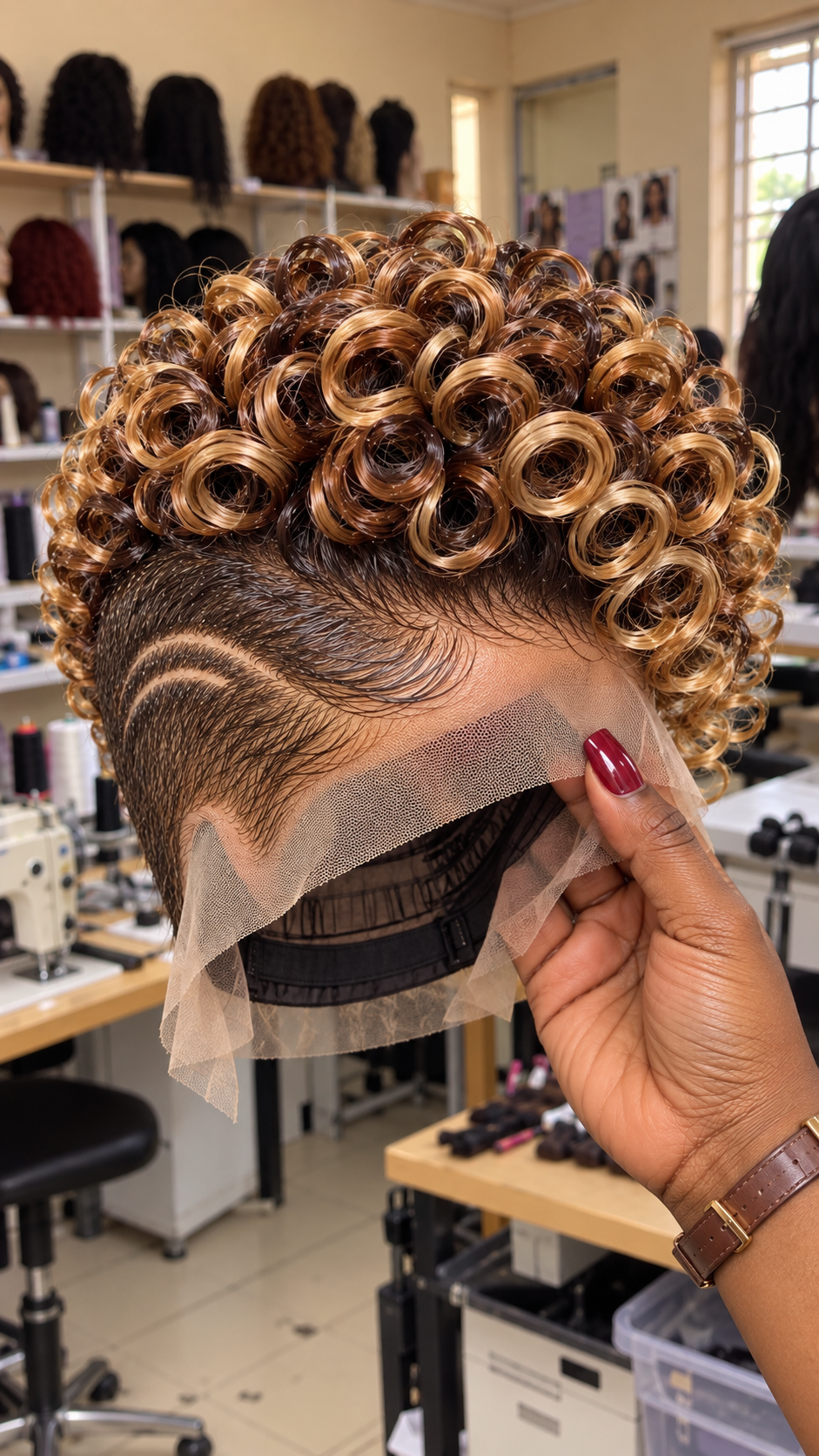
Buying a highly styled pixie wig is often a question of proportions rather than simply choosing an attractive color. The golden honey and espresso lace wig shown here offers a particularly interesting example: its crown is filled with raised circular ringlets in several warm blonde and brown tones, while the visible side is kept close to the cap and decorated with two narrow curved channels. Between these contrasting areas, glossy dark strands sweep toward the front hairline, creating a controlled transition into the elevated curls.
The wig is photographed in a working hair salon, held by one hand with the front lace extending beyond the hairline. The exposed interior shows dark fabric construction and a broad band running around part of the cap. The photograph provides useful information about the hairstyle’s appearance, but it cannot establish the fiber composition, complete fastening system, lace grade, or manufacturer.
What makes this unit especially recognizable is its distribution of golden honey highlights. The brightest curls occupy selected areas of the crown and front perimeter, while deeper caramel, chocolate, and espresso shades remain visible between them. This is not a uniformly blonde pixie, and the darker tapered side is an important part of the design.


The Color Story Begins With the Ringlet Placement
The upper hairstyle displays a combination of golden honey blonde, warm caramel, and deeper brown strands. Some ringlets appear almost entirely golden, while others contain darker sections that become visible as the curls turn inward.
The most prominent blonde loops are positioned around the upper front and outer crown. Their lighter color makes the circular openings particularly noticeable, especially where the hair curves toward the camera.
Deeper brown curls occupy portions of the center and rear-facing upper area. These darker strands create contrast between neighboring loops and prevent the crown from appearing like one continuous blonde surface.
The photograph also shows a very dark foundation beneath the curls. Around the visible side and lower crown boundary, the hair reads as espresso brown or near-black, with warm reflections appearing under the salon lighting.
Rather than presenting a simple root-to-tip gradient across every strand, the hairstyle uses contrasting color sections distributed among individual curls. That distinction matters when ordering a reproduction.
Requesting the Right Blonde Without Losing the Brown
Customers should specify that the crown requires golden honey highlights mixed with darker caramel and brown ringlets. Ordering an entirely blonde wig would remove much of the depth visible in the photograph.
Likewise, choosing a unit with only a few thin blonde streaks may not reproduce the strong golden presence around the upper front.
A useful supplier request should include the original photograph and a description of the approximate color relationship rather than an invented percentage of blonde hair. Exact color proportions cannot be measured reliably from a single image.
Ask for photographs taken under daylight and ordinary indoor lighting. Warm lighting can make golden blonde appear more amber, while darker brown sections may look almost black in shadow.
If a seller offers several shades labeled honey blonde, caramel, or golden brown, request actual product samples. Color names alone are not reliable enough for a detailed custom order.
Large Circular Openings Give the Crown Its Character
The curls are arranged into numerous hollow circular formations. Several ringlets create almost complete circles, with visible openings at their centers. Others form elongated loops that overlap neighboring sections.
The ringlet sizes vary across the crown. Some of the largest circles are concentrated near the front and upper middle, while smaller curls appear toward the outer edges and visible rear.
This variation gives the hairstyle a rounded silhouette without requiring every curl to be identical. The upper hair appears elevated, but the overall form remains relatively compact compared with a longer curly wig.
The ringlets also display pronounced shine. Reflections follow the curved strands, emphasizing their direction and making the golden sections especially prominent.
That shine does not establish whether the wig contains human hair, synthetic fibers, or a particular finishing product. Both material categories can produce reflective surfaces under appropriate lighting.
Comparing Curl Construction Across Different Sellers
Not every product described as a curly pixie wig will have these circular openings. Some units use tightly wound spring coils, while others contain loose spiral curls that hang downward.
The reference shows raised, organized loops that remain visually distinct from one another. A reproduction should preserve this arrangement rather than substituting a completely different curl pattern.
Ask sellers for a photograph taken from above to examine the crown distribution. A side photograph can make the curls appear more abundant than they are across the complete upper surface.
A rear view is equally important because the current image does not reveal the entire back of the hairstyle. The seller should demonstrate how the ringlets continue beyond the visible portion.
Buyers should also ask whether the curls are permanently manufactured into the unit or require regular professional resetting.
The Espresso Side Creates a Strong Foundation
Below the golden crown, the visible side is predominantly dark espresso brown. The hair lies closely against the cap, creating a much flatter profile than the raised ringlets above.
The contrast is striking because the color and hair length change together. The crown is brighter and elevated, while the side is darker and closely fitted.
Fine strands are visible along the lower side, with the underlying lace showing through in places. The hair appears arranged to follow the contour of the wig rather than extending outward in loose curls.
Near the upper side boundary, glossy dark strands sweep toward the front, forming a broad curved section that connects the crown to the hairline.
This transition is important because it prevents the blonde curls from appearing disconnected from the lower hairstyle.
Two Curved Channels Above the Temple
The visible side includes two narrow curved separations positioned close together. These channels follow an arched direction beneath the upper dark section.
The exposed underlying surface creates lighter lines against the espresso-colored hair. A narrow band of dark strands remains between the two channels, making their paired arrangement easy to recognize.
The curves are not straight diagonal stripes. Their direction follows the shape of the side, creating a barber-inspired decorative effect.
The lower section beneath the channels remains closely fitted, with fine strands extending toward the lace perimeter.
The photograph supports the presence of two principal curved channels. It does not establish an identical pattern on the opposite side, which is not visible.
Why the Curve Position Matters More Than Line Width Alone
A custom wig maker should be given a clear side photograph showing where the channels begin and how they travel across the temple.
If the arches are positioned too high, they may interfere with the dark section beneath the crown. If they are placed too low, they may sit differently against the wearer’s temple after installation.
The channels should also retain their relationship to the front hairline. Moving them backward can change the entire side profile.
Because the photograph does not establish the manufacturing technique, buyers should ask whether the design is created through hair placement, cutting, or another method.
Permanent cutting should only be performed after the cap construction and available hair coverage have been evaluated. Removing too much hair may expose the underlying mesh or create irreversible gaps.
The Front Hairline Connects the Two Styling Zones
At the front, fine dark strands are arranged along the lace in a sweeping direction. They connect visually with the closely fitted side and the darker foundation beneath the blonde ringlets.
The hairline does not display a heavy fringe of loose curls. Instead, the fine strands follow a controlled path across the forehead area.
This creates a transition between the elevated crown and the lower side without introducing an additional decorative element.
The beige lace extends beyond the visible hairline and has not yet been trimmed. Its mesh structure is clearly visible against the darker interior.
Although the lace appears relatively fine, the photograph does not establish its exact grade. Buyers should request the manufacturer’s specifications rather than assuming a particular lace category.
What the Interior Cap Can and Cannot Confirm
The wig is held open enough to reveal part of its interior. A dark fabric cap section is visible, along with a broad band running around the lower portion.
There are also visible seams and layered construction areas beneath the lace. These details indicate that the unit has an internal structure designed to support the hairstyle.
However, the photograph does not clearly establish the complete fastening system. It would be inappropriate to claim that specific combs, clips, adjustable straps, or other security components are included without additional evidence.
The visible band should not automatically be interpreted as proof of adhesive-free installation.
Questions to Ask Before Choosing a Cap Size
Request a complete underside photograph showing the cap opened fully. Ask the supplier to identify the available adjustment components and explain the intended installation method.
Provide the head measurements requested by the wig maker. A cap that fits poorly may shift the curved temple channels or change the position of the front hairline.
If the buyer wants adhesive-free wear, obtain explicit confirmation that the unit is constructed for that purpose.
It is also sensible to ask whether the cap can accommodate additional fitting adjustments without disturbing the hairstyle.
Ordering a Custom Golden Honey Pixie Wig
A custom order should begin with a clear explanation of the hairstyle’s essential characteristics. The buyer should identify the golden honey circular ringlets, darker brown curls between them, espresso tapered side, paired temple channels, and fine front hairline.
Ask whether the supplier can reproduce the hairstyle as a complete unit or whether a local stylist must finish the curls and side design after delivery.
Request examples of previous work involving sculpted ringlets and barber-inspired side patterns. Experience with ordinary straight lace wigs does not automatically demonstrate expertise in this particular construction.
Before production begins, confirm the cap measurements, fiber type, lace specifications, color selection, and expected completion time.
For custom work, establish the revision and return conditions in writing. Some modifications may be difficult once the curls and side channels have been completed.
Approving the Wig Before Shipment
Ask for photographs showing the front, visible side, opposite side, crown, and rear. The reference provides a strong view of one side but cannot establish the entire hairstyle.
Compare the placement of the golden ringlets with the darker curls. The color distribution should remain balanced rather than becoming uniformly blonde.
Examine the temple channels to confirm that they follow the intended curved path.
Finally, request a full interior photograph and confirm that the delivered cap matches the agreed measurements and fastening specifications.
Ready-Made Alternatives and Their Limitations
A ready-made honey blonde curly pixie may offer a similar color and compact silhouette at a lower initial cost.
However, the exact circular ringlets and paired temple channels may not be included. A product with loose blonde curls and a plain dark side could resemble the general color arrangement while differing substantially in construction.
Some ready-made wigs may be suitable for additional salon styling, but this depends on the material and hair placement.
Before purchasing a base unit for customization, ask a professional whether the desired side pattern and crown arrangement can be created safely.
Custom construction may provide better control over these details, but it also requires careful supplier selection and clear communication.
Illustrative Price Planning for Golden Honey Ringlet Wigs
The following USD figures are illustrative budgeting ranges rather than verified current product prices. The photographed wig’s actual material, supplier, and selling price are unknown.
| Wig Category | Illustrative USD Range | Potential Cost Considerations |
|---|---|---|
| Premium Custom | $350–$790+ | Individual cap measurements, multi-tone golden honey color placement, sculpted circular ringlets, and precise curved temple detailing. |
| Standard Custom | $190–$410 | Selected cap options with customized blonde and brown curls and a coordinated side pattern. |
| Basic Human Hair | $110–$280 | A human-hair starting unit that may require additional coloring, curl arrangement, and professional side styling. |
| Premium Synthetic | $80–$195 | A manufactured multi-tone curly pixie with prearranged ringlets, depending on available designs. |
| Basic Synthetic | $35–$95 | A lower-cost honey blonde pixie alternative that may not reproduce the hollow ringlets or curved temple channels. |
The complexity of the ringlet arrangement may influence the amount of labor required. Creating recognizable circular openings across the crown can demand more precision than styling ordinary loose curls.
The mixed golden and brown color placement may also affect production costs, particularly when selected strands require individual processing or placement.
Side detailing introduces another possible expense because the curved channels must be coordinated with the cap structure and available hair coverage.
Additional charges may include lace customization, installation, shipping, taxes, and future salon maintenance. Request an itemized quotation before committing to a purchase.
Planning a Professional First Fitting
The first installation should focus on cap alignment and the position of the temple channels. A wig stylist can assess whether the lace lies appropriately against the forehead and whether the side pattern follows the intended contour.
The excess lace should remain intact until the correct wearing position has been established. Trimming too close to the hairline can damage delicate strands or reduce the available fitting margin.
The stylist should also inspect the raised ringlets for compression caused by packaging or shipping.
If the curls require restoration, the method should depend on the confirmed fiber type and manufacturer instructions. Heat should not be applied automatically.
Once the fit is satisfactory, the stylist can determine whether any minor hairline adjustments are appropriate without changing the original design.
Maintaining the Golden Ringlets and Dark Side
The raised ringlets require careful handling because their circular openings are central to the hairstyle’s appearance. Repeated brushing can stretch the loops and disturb their arrangement.
Avoid pulling through the crown unnecessarily. If individual curls become displaced, use only methods suitable for the confirmed material.
The closely fitted side should be treated separately. Brushing across the curved channels may move strands into the exposed areas and reduce their visibility.
Heavy styling products can collect between the ringlets or along the side, making the hairstyle appear less organized.
Protecting the Blonde Color
If the wig contains colored human hair, ask about its processing history and recommended color-care products. Previously lightened strands may require particular attention during washing and restyling.
If the wig contains synthetic fibers, conventional hair dyes and heated styling tools may be unsuitable. Follow the manufacturer’s instructions before attempting any changes.
Store the wig on an appropriately sized stand that supports the cap without compressing the ringlets. Avoid placing pressure against the curved temple design.
For travel, use protective packaging that provides enough space for the raised crown and prevents the lace from snagging.
A Golden Pixie for Buyers Who Appreciate Detailed Styling
This wig combines warm golden honey ringlets with a darker espresso side, creating a strong contrast between color, elevation, and hair direction.
The paired temple channels add a decorative element without overwhelming the crown. Their curved placement complements the rounded ringlets above, giving the hairstyle a coordinated appearance.
The design may appeal to customers seeking a compact statement hairstyle for celebrations, photographs, or regular personal styling. Its practicality will depend on cap comfort, installation requirements, and the maintenance needed to preserve the curls.
Before purchasing, verify the fiber, lace specifications, cap measurements, and fastening method. Request complete product photographs and confirm whether the advertised price includes the finished styling.
The most convincing reproduction will preserve the golden honey circular ringlets, darker brown sections, espresso tapered side, paired curved temple channels, and fine front hairline. These visible details provide a practical guide for evaluating ready-made options or commissioning a custom wig.
Search Terms
Golden honey hollow ringlet pixie wig · Espresso tapered side blonde crown wig · Twin curved temple channel lace unit · Caramel brown and golden loop curls · Honey blonde circular crown hairstyle · Beige untrimmed lace with dark hairline · Double arched side design pixie wig · Multi-tone blonde ringlets espresso base