
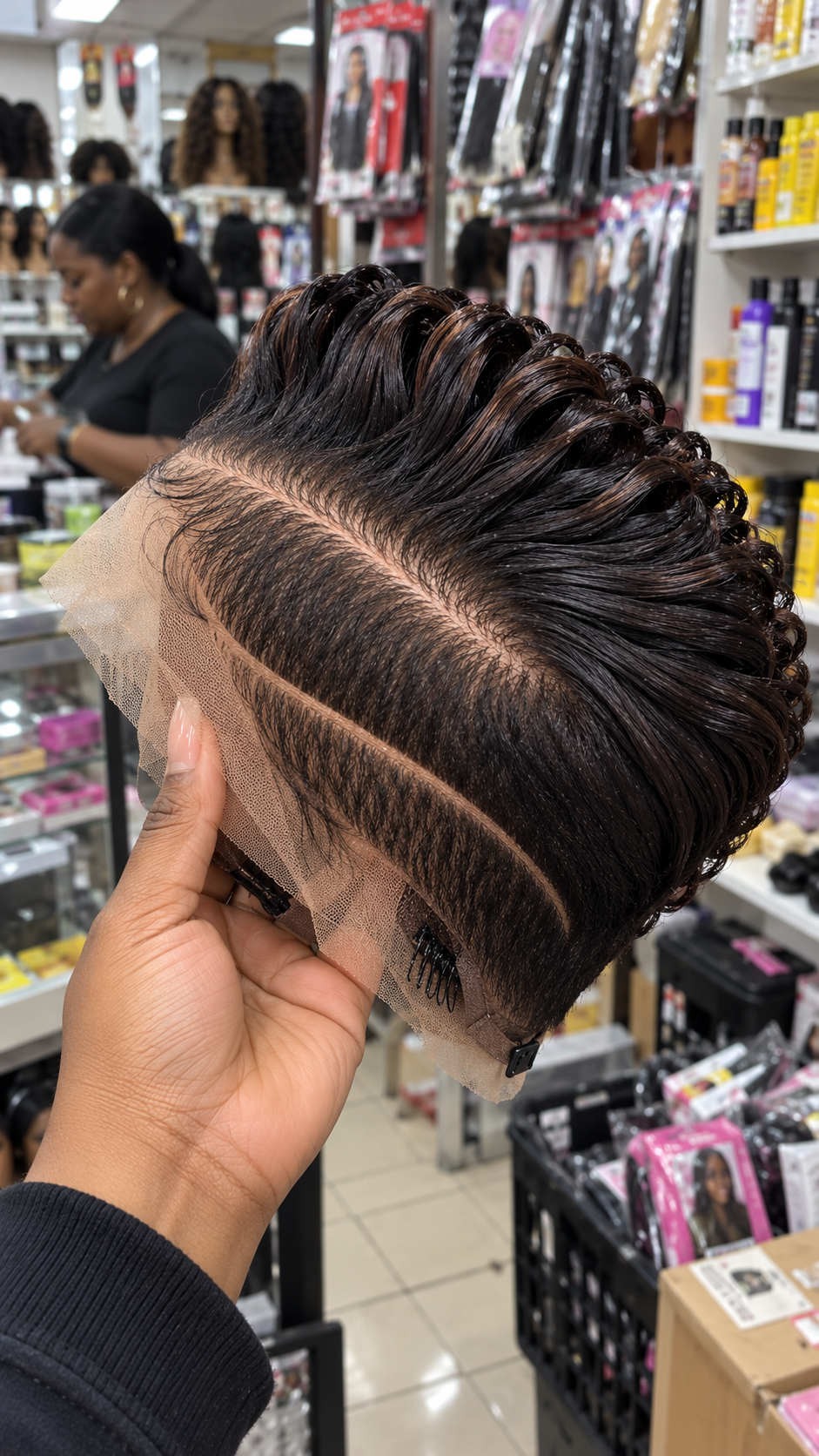
Not every striking wig relies on abundant curls or dramatic color. Sometimes the most compelling detail is the direction of the hair itself. In this photograph, a compact lace pixie wig is held above a beauty supply counter, revealing an elaborate combination of elongated ribbon-like curls, glossy dark strands, warm chocolate-brown reflections, and a sharply separated lower side section. The design is particularly interesting because the hairstyle changes character depending on where the viewer looks: the upper hair rises into overlapping curved sections, while the lower portion lies close to the cap in a carefully arranged diagonal pattern.
The photograph also offers something valuable to anyone considering a purchase. Rather than showing the wig already installed on a model, it exposes the uncut lace, portions of the interior, and visible securing components. This makes it possible to evaluate the relationship between the decorative hairstyle and the practical construction underneath.
For buyers searching for a brown-black pixie lace wig, a sculpted ribbon-curl hairstyle, or a compact wig with a distinctive side part, the important question is not simply whether the style looks attractive. It is whether the exact hair arrangement can be reproduced, fitted comfortably, and maintained without destroying the deliberate shape that makes the design recognizable.
Reading the Hairstyle From the Separation Line Outward
The central organizing detail is a broad, exposed diagonal parting that runs through the visible upper-side area. The parting creates a clear division between two sections of hair that have been arranged in different directions. Its pale brown base contrasts against the surrounding dark strands, making the separation immediately noticeable.
On one side of this parting, the hair is swept upward and backward into a sequence of elongated, glossy curved sections. On the other, the hair lies much closer to the wig base, following a diagonal path toward the lower edge. The contrast creates an intentional layered appearance without requiring excessive height.
This separation should not be confused with a shaved barber line. The photograph shows an exposed channel between styled sections, not a clearly demonstrated razor-cut stripe through natural scalp hair. The distinction matters when communicating with a wig maker, because recreating a parting requires different work from cutting a decorative line into a faded hairstyle.
The parting also appears wider in certain areas because of the viewing angle and the way the surrounding hair has been directed away from it. A buyer should not assume that the channel will have precisely the same apparent width after the wig is placed on a head.
Elongated Ribbon Curls Instead of a Conventional Curly Crown
The upper hairstyle is composed of long, curved hair sections that rise from the front-side region and travel toward the rear. Many strands appear gathered into broad, ribbon-like arcs. Their ends turn into compact curls toward the back, creating a progression from stretched, flowing curves to tighter rounded formations.
This progression is what distinguishes the design from a typical all-over curly pixie. The front and middle sections are not filled with uniformly sized ringlets. Instead, the hair has been arranged into larger directional pieces that overlap and create an almost layered appearance.
The upper silhouette remains relatively compact. There is noticeable elevation above the parting, but the wig does not display a tall afro-style crown or long, freely hanging curls. Its structure depends on the careful placement of hair close to the head.
Along the rearward edge, smaller curled sections appear tightly grouped. They provide a visual ending to the longer arcs that travel across the top. Because the entire rear is not shown directly, the photograph cannot establish whether these curls continue uniformly across the back.
The Importance of Consistent Hair Direction
A successful reproduction would need to preserve the direction in which each major section travels. Randomly adding curls to the upper portion would not recreate the photographed result.
The long arcs appear to originate near the parting and front-side area before curving toward the back. Their overlap creates movement while maintaining a deliberate pattern. The smaller curls at the rear provide a contrasting shape that prevents the upper hair from appearing like a simple brushed-back style.
When ordering, ask the stylist to study the direction of the hair rather than focus exclusively on curl size. A reference photograph showing the upper surface is especially useful because it reveals how the arcs are distributed.
Chocolate Reflections Across a Nearly Black Base
The wig appears predominantly dark brown-black, with warmer chocolate and chestnut-brown reflections visible along the raised hair sections. The lighter appearance is concentrated where the curved strands catch the shop lighting.
These warmer areas are visually important because they help separate one ribbon curl from another. Without the contrast created by light, the dark sections could appear as a single continuous mass.
However, the photograph does not establish whether the wig contains deliberately colored brown highlights, naturally varied dark fibers, or reflections produced primarily by lighting and styling products.
Buyers who want this exact color effect should request additional photographs under neutral daylight. If the supplier describes the unit as a mixed-color wig, ask for the color code or a close photograph of individual strands. If it is sold as a single dark shade, determine whether the warmer reflections remain visible outside bright indoor lighting.
For a custom order, specifying a black-brown foundation with subtle chocolate accents may help communicate the desired appearance, but that would be a color request rather than proof of the photographed wig’s manufacturing formula.
The Lower Side Panel Deserves Its Own Inspection
Below the prominent diagonal parting, the hair is arranged in a close-fitting panel. The strands travel diagonally downward, following the side of the cap rather than projecting outward into curls.
Another narrow, curved separation is visible closer to the lower edge, creating a distinct boundary between the central side panel and the bottom section. This gives the wig a layered visual arrangement, with the upper ribbon curls, the close-fitting middle panel, and the lower hair section appearing as separate styling zones.
The lower panel is not completely bare or shaved to skin. Dark hair remains visible across the section, and the photograph does not support describing it as a skin fade.
This is an important detail for women who prefer sculpted pixie wigs but do not want a severely exposed side. The design provides a close silhouette through hair placement rather than relying entirely on a clipper-faded appearance.
When comparing online listings, pay attention to whether the side panel is made from styled hair, a very close-cut section, or a different construction. Products may look similar in small catalog thumbnails while behaving differently when worn.
What the Front Lace Tells a Careful Buyer
A substantial piece of beige-toned lace extends beyond the front hairline. The lace is visibly untrimmed, indicating that the photographed wig has not yet undergone its final fitting and lace-cutting process.
Fine hairs can be seen near the front edge, transitioning from the denser hairstyle toward the lace. Their arrangement suggests that the hairline has been styled or prepared to create a softer boundary, although the final result cannot be judged until the wig is fitted.
The lace color appears relatively light compared with the dark hair and the hand holding the wig. That does not necessarily indicate a poor match. Uninstalled lace may look different when placed against skin, particularly under strong retail lighting.
Still, buyers should ask for a photograph of the lace resting against a suitable skin-tone reference or request information about available lace shades. The seller should also identify the lace material and construction.
The visible mesh is not sufficient evidence to classify the product as HD lace. Terms such as transparent lace, Swiss lace, and HD lace should be verified through product specifications rather than inferred from a photograph.
Why the Lace Should Remain Uncut Until Fitting
The broad lace margin provides room for adjustment during installation. A stylist can position the wig, evaluate the front hairline, and determine where the lace should be trimmed.
Cutting too close before checking the fit may leave insufficient material for correction. This is particularly relevant here because the upper hair arrangement and side parting create a specific relationship with the forehead and temple.
If the wig sits too far forward or backward, the intended placement of the ribbon curls may change. The correct cap position should therefore be established before any irreversible trimming.
Visible Combs and Adjustment Components
The photograph exposes part of the underside near the lower edge. A dark comb attachment is clearly visible, along with black adjustment hardware near the cap perimeter. These components may help secure or adjust the wig, depending on its complete construction.
Only a portion of the cap is visible, so the total number of combs, the exact strap configuration, and the full interior design cannot be established from this angle.
It would also be inaccurate to guarantee that the wig is glueless merely because it contains securing hardware. Adhesive-free wear depends on several factors, including cap fit, the wearer’s hair preparation, available attachment methods, and the security required for everyday activities.
For buyers specifically seeking a glueless option, the seller should explain whether the unit was designed for adhesive-free installation and demonstrate how it is secured.
Ask for a full inside-out photograph, including the rear edge and both temple areas. This is the simplest way to establish which securing components are actually included.
Finding a Specialist for This Particular Hair Arrangement
A general wig installation service may be sufficient to fit the lace, but recreating or repairing the ribbon curls can require additional styling expertise.
Look for wig makers or salon stylists who regularly work with sculpted pixie hairstyles, directional finger-wave designs, and structured curl setting. Their portfolios should show controlled hair placement rather than only conventional curled wigs.
When contacting a salon, explain that the hairstyle combines broad upper arcs with compact rear curls and close-fitting side sections. Send the reference image and ask whether the stylist can reproduce the arrangement without increasing the crown height or changing the diagonal parting.
If purchasing a ready-made unit, confirm whether the photographed styling is exactly what will be shipped. Some sellers use sample images to represent a general hairstyle family, while individual units may vary in curl placement and density.
For a custom wig, ask the maker to provide a progress photograph before the final styling is secured. This gives the buyer an opportunity to identify any major differences in the parting direction, upper curl shape, or side-panel arrangement.
Choosing Between a Ready-Made Unit and Custom Construction
A ready-made wig may offer faster delivery and a lower initial cost. It can be a practical choice when the buyer is comfortable with the available cap dimensions and accepts minor variations in the hairstyle.
Custom construction becomes more valuable when the customer wants precise placement of the diagonal parting, specific proportions for the upper ribbon curls, or a cap tailored to individual measurements.
The challenge is that this hairstyle has several interconnected elements. Increasing the length of the upper hair may change the size of the arcs. Adding more density can obscure the separation channel. Altering the side panel may affect the balance of the entire silhouette.
For that reason, custom-order instructions should prioritize the overall geometry before discussing small finishing details.
A useful order request would specify the compact upper profile, elongated backward-directed curls, narrow side separations, and dark brown-black appearance. The seller can then explain which elements are achievable with the chosen hair material and construction method.
Estimated Wig Costs for a Ribbon-Curl Pixie Design
Pricing for a wig of this type depends on factors that cannot be established from the photograph alone. Hair material, lace coverage, cap construction, styling labor, and the amount of individual customization can all affect the final quotation.
The following US dollar amounts are illustrative budgeting estimates rather than verified current selling prices. They describe possible purchasing categories and do not confirm the material or value of the photographed unit.
| Purchase Category | Illustrative USD Budget | What May Influence the Cost |
|---|---|---|
| Premium Custom | $300–$700+ | Personalized cap measurements, extensive hand styling, detailed parting placement, and specialist finishing work. |
| Standard Custom | $160–$350 | Selected customization of the upper curl arrangement, cap fit, and side styling. |
| Basic Human Hair | $90–$240 | A human-hair base unit that may require additional styling to approach the reference. |
| Premium Synthetic | $60–$175 | A higher-grade synthetic wig with prearranged curls and potentially more detailed lace construction. |
| Basic Synthetic | $25–$90 | A budget-oriented alternative with potentially simpler curl placement and fewer customization options. |
These ranges are not a substitute for a written quotation. The exact hairstyle may be unavailable in some categories, particularly when intricate hand positioning is required.
Installation, shipping, lace preparation, additional styling, and future maintenance may be charged separately. Buyers should request an itemized quotation that distinguishes the cost of the wig from the cost of salon services.
For this design, spending more does not automatically guarantee greater visual accuracy. A seller’s demonstrated ability to reproduce the directional curls and parting arrangement is a stronger quality indicator than price alone.
Keeping the Ribbon Sections Intact During Everyday Use
The elongated upper curls create a different maintenance challenge from loose ringlets. Their appearance depends on neighboring strands remaining grouped in carefully directed sections.
Running a brush through the hairstyle may separate those sections and destroy the intended arcs. Before attempting any restyling, determine how the curls were set and whether the manufacturer recommends specific maintenance products.
If the wig is synthetic, avoid heat tools unless the supplier confirms the fiber’s heat tolerance. Even fibers marketed as heat-resistant have temperature limits, and improper styling can permanently distort their shape.
If the unit contains human hair, the ribbon curls may be reset using appropriate techniques, but the safest approach depends on the hair’s processing history and the original styling method.
Moisture and humidity can also influence the arrangement, depending on the material and products used. The buyer should ask whether the hairstyle is intended to retain its shape after washing or whether professional resetting will be necessary.
The lower side sections should be handled separately from the upper curls. Aggressive manipulation can disturb their directional placement or expose more of the underlying cap than intended.
Photographs to Request Before Paying
The supplied image is useful because it shows the wig from an elevated side angle, but it does not provide a complete assessment of the finished product.
A front-facing photograph would clarify the position of the hairline and the direction of the upper curls across the forehead. A photograph of the opposite side would establish whether the side arrangement is symmetrical. A direct rear view would show how the compact curls terminate at the back.
An underside photograph would help confirm the cap construction, comb placement, and adjustment system. A brief video under ordinary lighting could also reveal whether the chocolate-brown reflections are consistently visible or largely dependent on the shop’s overhead lights.
For online purchases, ask the seller to confirm that these additional images show the actual unit being offered rather than a separate demonstration sample.
A Hairstyle Built Around Direction Rather Than Excess Volume
The defining achievement of this lace pixie wig is its deliberate distribution of hair. The upper section uses elongated, glossy curves that move toward compact rear curls, while the lower sections follow the head through narrow separations and closely arranged strands.
Its dark foundation and warm brown reflections add depth without overwhelming the hairstyle’s structure. The untrimmed lace and visible cap attachments provide useful information for buyers, although material specifications and fitting claims still require confirmation.
For women considering this design, the strongest purchasing strategy is to evaluate the accuracy of the parting, the placement of the ribbon curls, and the suitability of the cap before focusing on marketing labels. A well-matched wig and a capable stylist can preserve the design’s distinctive character while adapting the installation to the wearer’s needs.
Search Terms
Chocolate brown ribbon curl pixie wig · Diagonal exposed part lace hairstyle · Glossy backward swept curl wig · Brown black sculpted pixie hairpiece · Double separation side panel wig · Uncut beige lace pixie unit · Compact rear ringlet lace wig · Side comb adjustable cap hairpiece