
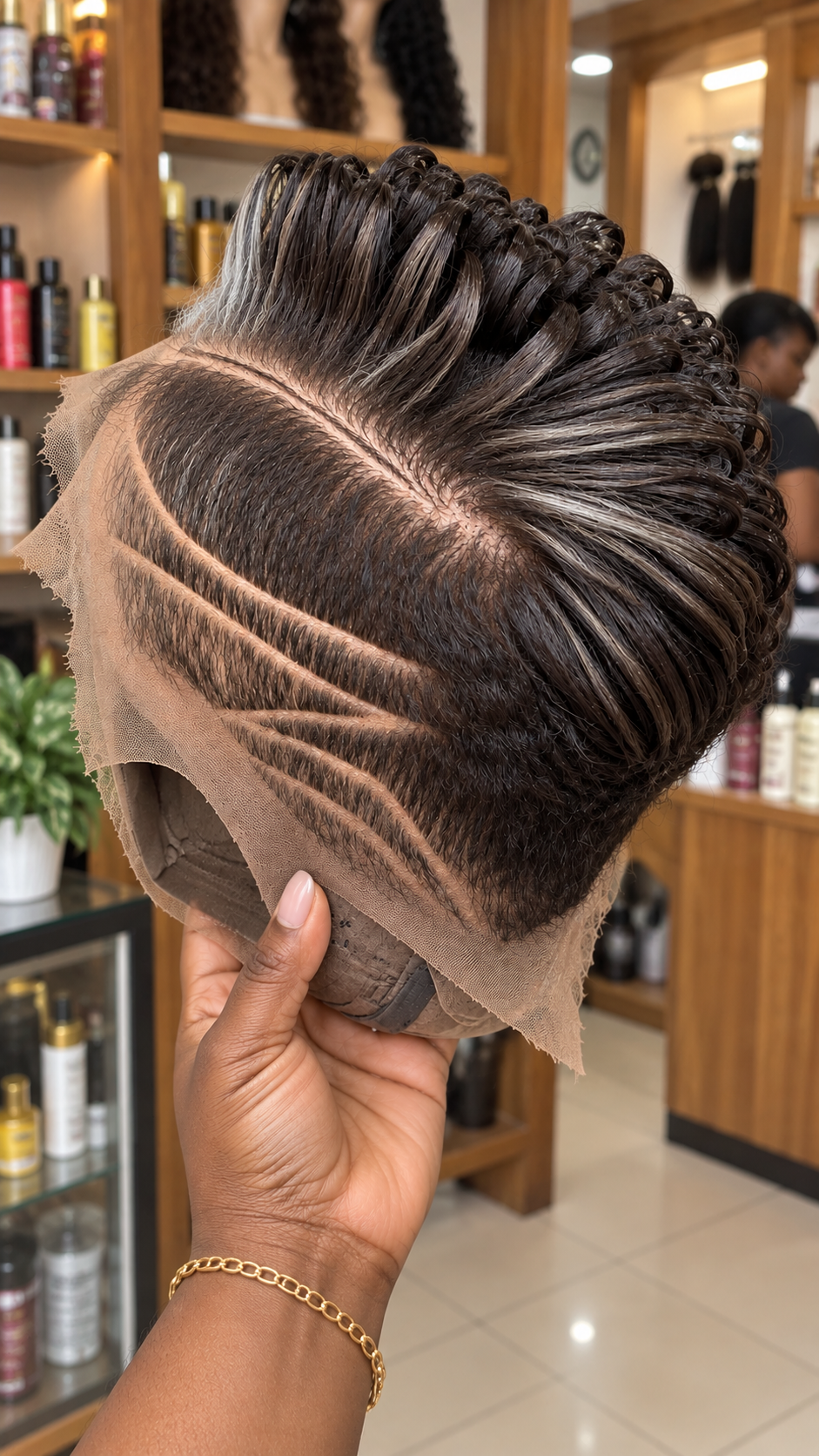
Imagine ordering a pixie wig because of its silver highlights, only to discover that the finished product has the wrong hair direction. The color might be close, the length might be acceptable, and the cap might fit perfectly, yet the hairstyle would still look substantially different. That is the central purchasing consideration with the wig pictured here. Its appearance depends on elongated strands being directed backward and upward, with narrow silver-gray accents following the same movement rather than interrupting it.
The photograph shows a lace wig held in one hand inside a hair retail salon. Its dark brown-to-black foundation supports elongated ribbon-like curls across the upper section, while the visible side contains several sharply separated diagonal channels. The front and side perimeter extend into untrimmed beige lace, and part of the interior cap can be seen beneath the hairstyle.
Unlike a conventional finger-coil pixie with small circular curls distributed evenly across the head, this design uses longer, flattened sections of hair that bend backward into raised loops. The result has a distinctive sense of direction. The silver accents appear as slender streaks within the darker strands, becoming particularly noticeable where the hair fans outward above the temple.
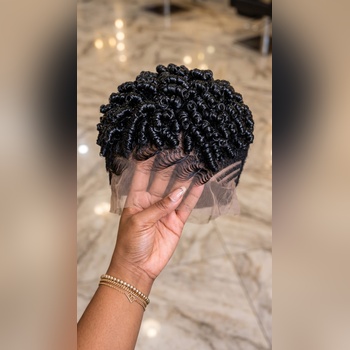
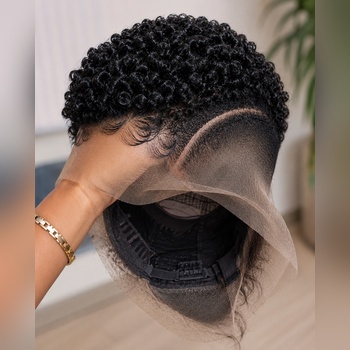
For anyone planning to purchase or commission this hairstyle, the most important question is not simply whether the seller offers a silver-highlighted wig. It is whether the maker can reproduce the relationship between the backward-swept upper hair, the closely fitted temple panel, and the three prominent lower separation lines.
Hair Direction Is the Detail That Determines the Silhouette
The upper hairstyle begins with relatively narrow strands rising from the front and upper side. These strands travel backward in coordinated sections, eventually bending into raised loops and curved formations. Their arrangement creates an elongated visual flow rather than the rounded, evenly distributed volume associated with many curly pixie wigs.
Near the upper-left portion of the photograph, several strands rise almost vertically before curving backward. Their darker roots provide a strong foundation for the lighter silver-gray streaks visible along portions of the hair. Toward the right, the strands become more diagonal, spreading outward and backward across the upper side.
The upper rearward area contains overlapping loops with compact circular openings. These are not identical to the larger, elongated ribbon sections closer to the front. The transition between the two gives the hairstyle dimension without requiring excessive height.
This arrangement matters during production because the same hair length can produce very different results depending on setting direction. If the maker curls everything forward, the hairstyle may resemble a traditional curled fringe. If the sections are allowed to fall downward, the distinctive lifted structure disappears.
A customer should therefore request photographs showing the wig from a slightly elevated front-side angle before approving a custom order. This perspective reveals whether the upper sections genuinely travel backward and whether the raised loops retain their intended shape.
The Silver Placement Follows the Movement of Individual Strands
The coloring is more restrained than a fully silver or platinum hairstyle. Most of the visible hair remains very dark, with a cool brown-black appearance under the salon lighting. Thin silver-gray and ash-toned streaks appear among the longer upper strands, particularly along the front-to-side transition.
These lighter strands are not concentrated into a solid block of color. Instead, they appear intermittently through the darker hair, producing narrow reflective bands that emphasize the styling direction.
Some sections look charcoal gray, while others appear closer to pale silver. The photograph cannot establish whether these differences come from multiple highlight shades, lighting reflections, or the way individual strands overlap. A buyer should avoid assuming that the wig contains a particular numbered color blend without confirmation from the seller.
Choosing a Similar Color Combination
When discussing the color with a wig maker, describe the dark foundation first. Request a predominantly dark brown-black appearance with selective cool silver-gray streaks placed through the swept-back upper sections.
The amount of silver should remain controlled if the goal is to reproduce the photographed appearance. Excessive light coloring could overwhelm the dark foundation and reduce the contrast between the upper styling and the closely fitted side.
Ask the seller for a sample photograph under neutral lighting. Silver fibers can appear almost white under bright illumination or considerably darker in shadow. A video showing the hair moving slightly under ordinary light can help reveal whether the highlights are distributed through individual sections or concentrated in large blocks.
For human-hair options, any proposed bleaching or toning should be discussed with a qualified colorist. For synthetic options, the requested shade must be available in a compatible manufactured fiber. The photograph does not identify which material was used.
Three Lower Channels Give the Temple Its Distinctive Geometry
The visible temple is one of the most intricate areas of the wig. Beneath the upper swept-back strands, a broad dark panel follows the side of the head. A long exposed separation runs diagonally along its upper boundary, distinguishing this closely fitted section from the raised hair above.
Below that panel, three prominent narrow channels extend diagonally across the lower temple area. Their paths are not perfectly parallel. The uppermost of the three is longer and more pronounced, while the lower channels follow shorter, slightly different trajectories.
The dark hair between these separations lies close to the cap, creating a contrast with the lifted ribbon curls above. The lower section resembles a sculpted taper with carved-line styling, although the photograph does not prove that the channels were produced by shaving. They may instead reflect controlled hair placement and exposed foundation areas.
This distinction is important when ordering. A barber working on natural hair may create comparable patterns with clippers or a razor, but a wig maker must account for the hair attachment method and the cap beneath it. Cutting too deeply into a constructed wig could damage the foundation.
What to Request Before Approving the Side Pattern
Ask for a close photograph of the temple with the hair positioned as it will be worn. The maker should show the broad upper separation and the three narrower lower channels clearly.
Discuss their direction, spacing, and endpoints. The lines should remain visually distinct without becoming excessively wide. An additional crossing line or a sharply different angle could transform the intended appearance into another design.
The photograph shows only one side clearly. A buyer should request the opposite side and rear before assuming that the same pattern continues around the entire head.
A Different Kind of Pixie Volume
Many customers associate pixie wigs with tightly cropped hair or uniformly distributed curls. This hairstyle takes a different approach by concentrating visible height in the swept-back upper sections while keeping the lower side relatively close to the head.
The contrast gives the upper hair room to display its ribbon-like movement. The lifted strands are not simply piled on top of one another. Their direction creates an apparent progression from the front hairline toward the upper rear area.
For customers who prefer compact hairstyles but want something more decorative than an ordinary cropped wig, this arrangement offers a useful reference. The hair remains relatively contained while presenting noticeable detail through the upper curls and temple channels.
However, the final appearance will depend on head shape, cap fit, and the way the front hairline is positioned. The photographed unit is being held rather than worn, so its appearance on a particular customer cannot be guaranteed from this image alone.
The Visible Lace Should Be Evaluated Before Installation
A wide section of beige lace extends beyond the styled hairline. The mesh is especially noticeable along the front and visible temple, where it projects beyond the dark strands.
Fine hairs appear near the upper perimeter, creating a transition from the styled sections to the exposed lace. The hairline has a deliberate shape, but its final appearance will depend on positioning, trimming, and any customization performed during installation.
The lace should not be classified as HD lace simply because it appears fine or translucent in the photograph. Lace grades vary, and the seller should identify the actual material and construction.
The exposed mesh also indicates that the wig requires wearer-specific assessment before the excess lace is removed. Trimming should follow a fitting session rather than an arbitrary line selected while the wig is off the head.
Because the side pattern extends close to the temple perimeter, careless trimming could affect the relationship between the hairline and the decorative channels. A stylist familiar with lace-front wigs and sculpted side hairstyles is preferable for this work.
Examining the Cap Without Making Unsupported Assumptions
The photograph reveals part of the interior cap through the lower opening. Dark brown fabric construction and stitched sections are visible beneath the lace perimeter.
However, the angle does not provide a complete inspection of the underside. The number of internal combs, the full adjustment system, the cap circumference, and the exact lace coverage cannot be established confidently.
Before purchasing, request a complete underside photograph. Ask whether the cap contains adjustment straps, combs, an elastic securing band, or other attachment components. Their presence should be verified rather than inferred.
A wig advertised as glueless should be evaluated according to its actual construction and the wearer’s measurements. Even a unit designed for adhesive-free use may require fitting adjustments to remain secure and comfortable.
Finding a Specialist Who Can Reproduce This Arrangement
Searching for a general curly wig may produce many products with approximately the right length but none with the distinctive upper movement and lower temple pattern. A more targeted approach is to look for wig makers experienced in sculpted pixie styling, ribbon curls, finger-wave work, and detailed side parting.
When contacting a salon, send the reference photograph and explain that the backward hair direction is essential. Ask whether the stylist has previously created raised ribbon curls on lace wigs rather than only on natural hair.
Examples of comparable work are particularly valuable. Look for photographs where the curls retain their arrangement across several camera angles. A single carefully posed image may not reveal whether the hairstyle remains consistent from the front and side.
For local shopping, visit wig retailers that offer customization services or can refer customers to experienced wig stylists. Online wig makers may also accept reference-based commissions, but confirm their production process and return conditions before paying.
If a ready-made wig is offered as a close match, request current photographs of the actual item. Catalog images may show a sample that differs from the available unit in color distribution, curl orientation, or side detailing.
Organizing a Custom Order Around the Right Priorities
The first priority should be the shape of the upper hair. Confirm that the maker understands the elongated, backward-swept arrangement rather than substituting ordinary circular curls throughout the crown.
Next, establish the color distribution. The silver-gray streaks should appear within the upper strands while the lower temple remains predominantly dark.
The third priority is the temple geometry. The broad upper separation and the three narrower lower channels need to be considered together, not as unrelated decorative additions.
Once these design elements are agreed upon, discuss cap size, lace coverage, fiber type, and finishing services. Ask whether the quoted price includes styling, customization, and final inspection.
A custom maker may request head measurements such as circumference, ear-to-ear distance, and front-to-nape length. Follow the specific measuring instructions provided by the seller, since different cap systems may require different measurements.
Before shipping, request photographs from the front, the styled side, the opposite side, and above. A rear photograph should also be included because the supplied reference does not reveal the complete back.
Price Expectations for Silver-Accented Sculpted Pixie Wigs
The following USD ranges are illustrative budgeting estimates rather than verified market quotations or prices for the photographed wig. The actual cost will depend on the selected hair material, cap construction, coloring requirements, styling labor, and seller location.
| Wig Category | Illustrative Price Range | What Buyers May Expect |
|---|---|---|
| Premium Custom | $300–$700+ | Individual cap planning, carefully placed silver accents, advanced ribbon-curl styling, and detailed temple customization. |
| Standard Custom | $160–$350 | Reference-based upper styling and side detailing with more limited personalization. |
| Basic Human Hair | $95–$230 | A human-hair base that may need separate coloring, curl setting, and temple work. |
| Premium Synthetic | $70–$175 | A manufactured-fiber alternative with prearranged styling or contrasting strands, depending on availability. |
| Basic Synthetic | $30–$85 | An entry-level pixie alternative that may resemble the general length without matching the intricate arrangement. |
The table represents possible purchasing categories, not confirmation of the photographed wig’s material. Human hair and synthetic fibers cannot be reliably distinguished from this image.
One major cost consideration is the combination of styling techniques. A maker must coordinate the elongated upper curls with the closely fitted side, preserve the silver accents within the correct sections, and maintain the narrow temple separations.
Ask whether installation, lace trimming, shipping, taxes, and future adjustments are included. Some suppliers charge separately for color work or specialized styling, which can substantially change the final amount.
Preventing the Ribbon Curls from Losing Their Direction
Maintenance should begin with understanding how the raised upper sections were formed. Their appearance depends on the strands remaining grouped and directed backward. Brushing through them without guidance could disturb the arrangement.
Ask the wig maker whether the curls were set with styling products, heat, rollers, or another technique. This information will help determine how the hairstyle should be refreshed after wear.
Do not apply high heat unless the fiber type and permitted temperature range have been confirmed. Some synthetic fibers cannot tolerate conventional styling tools, while human hair may also be vulnerable to damage from excessive heat or previous chemical processing.
If the upper sections become flattened, avoid repeatedly pulling them upward by hand. A stylist may need to reset individual strands to restore the original direction.
Managing the Cool Silver Accents
Silver-gray coloring can be particularly sensitive to lighting and product residue. Heavy styling products may reduce the visual distinction between the lighter streaks and dark foundation.
Use only products suitable for the confirmed material. If the wig contains colored human hair, ask about its processing history before applying toners or additional color treatments.
If the wig is synthetic, never assume that ordinary hair dye or color-correcting products will work. The manufacturer’s instructions should determine which treatments are appropriate.
Protecting the Temple Channels During Everyday Wear
The lower side requires careful handling because its appearance relies on narrow separations remaining visible. Repeated friction from headwear, aggressive brushing, or pressure during storage may disturb the direction of the closely fitted strands.
When removing the wig, avoid pulling directly on the decorative temple sections. Handle the cap according to the manufacturer’s instructions, paying attention to the lace perimeter.
For storage, use a support that accommodates the cap without stretching it and leaves sufficient space around the raised upper curls. Avoid compressing the hairstyle beneath other items.
If the temple channels become less distinct, consult a stylist before attempting to widen them. Removing hair or cutting into the foundation could cause permanent damage.
The Installation Appointment Should Focus on Placement, Not Reinvention
A successful fitting begins with checking the cap position and confirming that the front hairline rests naturally on the wearer. The stylist should assess how the raised upper strands sit relative to the forehead and whether the visible temple pattern follows the intended angle.
Only after the position is established should the excess lace be trimmed as appropriate. Any additional hairline adjustments should be conservative, particularly where the decorative side pattern approaches the perimeter.
The upper curls may require minor positioning after the cap is secured. However, changing their direction substantially would undermine the original hairstyle. The goal is to preserve the backward movement and the contrast between the lifted strands and the close-fitting lower side.
Before completing the appointment, examine the wig from several angles. The front view should show the swept-back structure, the side view should reveal the temple channels, and an elevated view should show how the loops continue across the upper head.
Deciding Whether This Particular Design Is Worth Customizing
The value of this hairstyle lies in its coordinated construction. The silver accents alone are not enough to distinguish it from other highlighted pixie wigs. Its recognizable appearance comes from the backward-directed ribbon curls, dark foundation, broad temple panel, and three narrow lower separations working together.
For buyers seeking an accurate reproduction, a maker’s styling ability is likely to matter as much as the underlying wig material. An expensive base with poorly arranged curls may produce a less convincing result than a carefully planned unit with appropriate hair and skilled finishing.
Choose a supplier who can explain how the hairstyle will be constructed, provide evidence of similar work, and clarify what is included in the purchase. Confirm the unseen cap details and rear appearance before approving the order.
With those decisions made carefully, this silver-accented sculpted pixie can serve as a precise reference for a distinctive lace wig rather than becoming another generic highlighted curly hairstyle.
Search Terms
Smoky silver streak ribbon curl wig · Dark brown swept back pixie lace wig · Triple diagonal temple line wig · Silver gray highlighted sculpted curls · Raised ribbon loop crown hairstyle · Beige lace front carved side wig · Black and ash silver finger wave pixie · Side parted swept back ringlet wig