
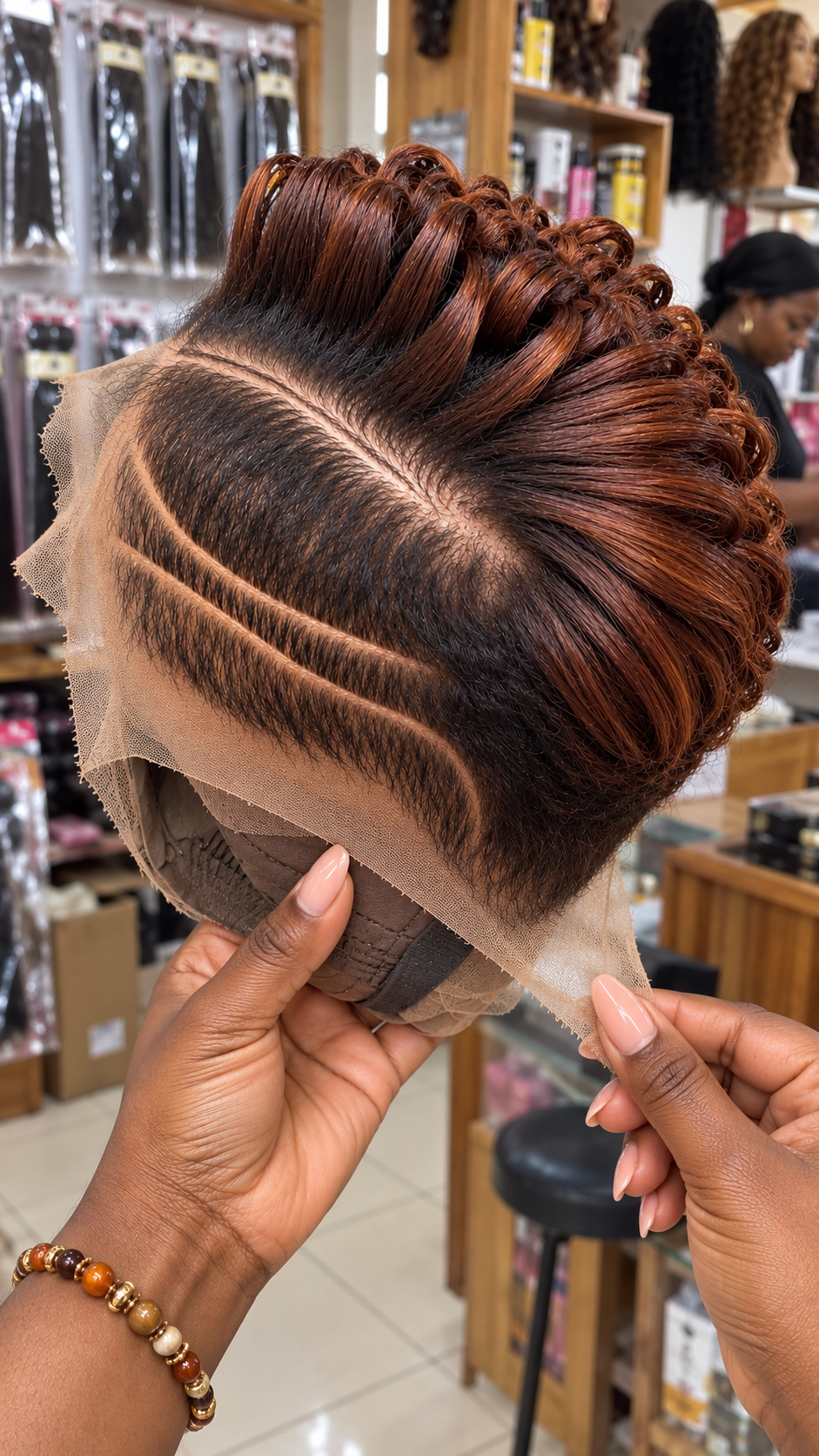
This cinnamon-copper wig is a useful example of how color placement can support sculpted construction without taking over the entire design. The upper crown carries warm copper and auburn reflections through a sequence of backward-folding loops, while the roots and lower side remain substantially darker. Beneath the crown, two long exposed pathways travel through a compact side section, creating a quieter geometric counterpoint to the larger movement above. The result is not simply a brown wig with lines; it is a carefully divided composition in which warm color belongs to the moving crown and deeper density gives the side its structure.
The photograph also shows the unit before final installation. Lace extends beyond the hair-bearing perimeter, part of the interior cap remains visible, and the close side can be examined before it sits against a wearer’s skin. This provides useful information about where fitting and trimming still need to happen. Lace is visibly present, but its specific grade cannot be verified from the photograph, so there is no basis for calling it HD lace unless the manufacturer or seller confirms that specification.
Cinnamon Copper Is Concentrated Where the Hair Bends
The warm color becomes most noticeable across the raised crown sections. Copper, cinnamon and auburn reflections travel over the outer surfaces of the loops, while the roots beneath them remain dark brown to nearly black. This creates depth at every bend. The eye sees the warmer surface first, then the darker recess underneath it.
The effect differs from ordinary evenly distributed highlights. There are no obvious pale stripes cutting randomly through the crown. Instead, the warmer color follows the direction of the styled sections. This makes the color appear integrated into the construction.
For a custom order, the distinction matters. Asking for “copper highlights” could produce narrow streaks, chunky sections or scattered bright pieces. A more accurate request would specify a deep root foundation with cinnamon-copper concentrated across the visible loop surfaces.
The actual shade should also be approved visually. Copper terminology varies considerably between suppliers. One seller’s cinnamon may lean red, another may appear orange, and another may be closer to chestnut. Photographs of the available hair under neutral lighting are more reliable than the shade name alone.
The Root Depth Is Essential to the Color Balance
The darker foundation performs several jobs. It creates shadow beneath the copper folds, connects the crown to the close side and prevents the entire wig from becoming one bright warm block. The contrast also makes the upper sections appear more dimensional.
This means the roots should not automatically be lightened during customization. A colorist trying to make the copper “more visible” could unintentionally remove the depth that gives the reference its character.
The root transition is also gradual rather than looking like one rigid horizontal color boundary. Warm strands become increasingly visible as the hair rises from the foundation. That relationship should be preserved when recoloring or refreshing the unit later.
The Forward Crown Uses Tall Ribbon-Like Sections
At the front and upper side, the hair rises into several elongated folds. Each section contains strands moving together in a broad ribbon before bending backward. These formations are more open than conventional tight curls and have enough spacing between them for the dark foundation to remain visible.
The first sections stand relatively high. This establishes the crown’s profile and gives the copper surfaces room to catch the light. The height is still controlled, however; the wig does not depend on excessive volume.
A stylist recreating the crown should therefore prioritize section direction rather than simply adding more hair. If the folds become too thick or are merged together, the dark spaces disappear and the construction begins to look heavier than the reference.
The Middle Crown Shifts Toward Broader Backward Movement
Moving away from the forward sections, the loops begin leaning more strongly toward the rear. Their outer surfaces remain warm copper-brown, while the darker roots continue to appear beneath them. The change in angle makes the crown feel directional rather than static.
This progression is one reason the wig photographs well from the side. The eye can follow the sequence from upright front folds into increasingly backward movement. The styling effectively traces the rounded contour of the cap.
For remote custom work, ask for an elevated side approval photograph. It should reveal whether the maker has created this gradual directional shift rather than repeating one identical loop around the crown.
The Rear Tightens Into Smaller Copper Forms
The back of the crown contains more compact looped pieces. They continue the warm color but reduce the scale, allowing the styling to settle into the rear rather than projecting outward at the same height as the front.
This is a practical construction choice as well as an aesthetic one. A rear made entirely from the largest front loops could create unnecessary bulk. Smaller forms maintain visual activity while respecting the shape of the head.
When approving a custom unit, a rear three-quarter photograph is therefore important. It can show whether the crown genuinely transitions into smaller work or whether the maker has concentrated only on the highly visible front.
The Side Panel Is Intentionally Dark and Compact
Below the colorful crown, the styling becomes much quieter. Fine dark strands sit close to the foundation and create a substantial side panel. This region is necessary because it gives the two exposed pathways enough contrast to remain readable.
The close hair should not be treated as an unfinished area waiting for additional color. Its deeper shade is part of the composition. Carrying bright copper through the entire lower side would reduce the visual separation between crown and geometry.
Density is also important. The side needs enough hair to appear deliberately populated rather than empty, but it must remain close enough for the exposed channels to stay visible.
The Upper Separation Marks the End of the Sculpted Crown
A narrow exposed path follows the lower edge of the crown. This division creates a clear border between the raised upper hair and compact side panel. It travels with the rounded contour of the wig rather than cutting through it as a straight stripe.
This pathway has a structural role. It should be considered separately from the longer lower side sweep. The upper separation defines where the crown begins; the lower line adds movement inside the close side.
Keeping those roles distinct helps a barber reproduce the reference accurately. If both lines are treated as identical decorative stripes, their spacing and proportions can quickly drift away from the original design.
The Lower Sweep Creates a Long Visual Route Around the Side
Beneath the primary separation is another exposed pathway that travels farther through the compact lower section. Its curve follows the profile toward the rear, with dark hair remaining above and below it.
The line is relatively restrained in width. It is visible without consuming the side. That balance matters because the dark sections surrounding it connect visually with the roots of the crown.
For future barber maintenance, preserving the width should take priority over making the line increasingly dramatic. Every additional amount removed from a wig is permanent, and repeated deepening can eventually make the channel much larger than intended.
The Two Side Paths Depend on the Hair Between Them
The exposed areas attract attention, but the dark strip separating them is equally important. It prevents the two paths from merging visually and gives the side a layered appearance.
This means maintenance should focus on protecting that central dark section. When fine strands move across an exposed path, they should first be repositioned. Cutting should only happen when genuinely necessary.
A clear photograph of the original side is useful at every future barber appointment. It gives the professional a reference for spacing, curvature and line width instead of relying on memory.
Untrimmed Lace Gives the Installer Useful Flexibility
The visible lace extends beyond the front and lower side. At this stage, that extra material is beneficial because the unit has not yet been committed to one final perimeter. A wig stylist can position the cap on the wearer and assess where the crown and side work naturally sit.
Only after that placement is established should the excess lace be removed. Cutting it while the wig is loose can reduce fitting options unnecessarily.
Fine strands appear near the front transition before density increases toward the side panel and crown. Those strands should also be evaluated during fitting rather than automatically removed for the sake of creating a sharper edge.
Cap Sizing Affects the Side Geometry
The side pathways are fixed to the wig foundation. If the cap sits too far backward, the entire design shifts backward. If it is positioned too far forward, the lines move toward the face. This makes sizing part of the visual result rather than only a comfort issue.
For a custom cap, follow the seller’s measurement instructions carefully. Circumference, ear-to-ear and front-to-nape dimensions may all be relevant depending on the maker’s construction.
A local wig stylist can take measurements before the order if necessary. This is particularly useful for a unit where precision side placement is one of the main reasons for choosing the design.
Ordering Should Begin With a Color-and-Structure Map
A useful production brief can describe the wig in layers. First specify the deep dark root foundation. Next identify the cinnamon-copper or auburn-brown color across the raised crown sections. Then describe the large forward folds, their backward progression and the smaller rear loop work.
The side specification should identify the compact dark panel, the upper separation beneath the crown and the second sweeping pathway below it. Finally, practical details such as cap size, lace shade and whether the lace should remain untrimmed can be discussed.
This gives the seller a much clearer target than a generic request for a copper sculpted wig. It also creates a checklist that can be used when approval photographs arrive.
Choose Between a Finished Custom Unit and Local Completion
A fully completed custom unit is convenient when the maker has demonstrated experience with both sculpted crowns and precision side work. The buyer can send measurements, approve the color and request photographs before shipping.
A locally completed base offers another advantage: the final side placement can be assessed directly on the wearer. A wig stylist can fit the cap, while a barber familiar with wig work can preserve or refine the sweeping paths afterward.
A hybrid workflow can also be effective. The maker can complete the copper coloring and crown construction, leaving only conservative final side adjustment to a local professional. The best choice depends on which specialist has the strongest relevant skills.
Approval Photos Should Show Color Under More Than One Light
Copper and auburn tones can shift dramatically according to lighting. Warm salon lights may make the crown appear more orange or red, while daylight can reveal deeper brown undertones.
For a custom order, ask for one neutral-light photograph in addition to the standard salon image. This helps establish whether the actual shade matches the intended cinnamon-copper range.
Also request a side view that clearly shows the dark roots and both exposed pathways. The color should not be approved separately from the construction because the two depend on each other in this design.
Price Is Driven by Labor Concentrated Into a Compact Unit
The wig does not require long lengths of hair, but several skilled processes may be involved: color placement, crown setting, close side density, precision channels, cap construction and lace preparation. Those factors can make a compact custom wig more expensive than a longer but simpler unit.
| Category | Estimated Price Range | What May Be Included |
|---|---|---|
| Premium Custom | $335–$580+ | Higher-grade hair, individualized cap sizing, planned cinnamon-copper coloring, sculpted crown formation, precision side work and detailed lace preparation. |
| Standard Custom | $205–$350 | Prepared warm-brown crown, dark-root placement and established side channels with more standardized fitting options. |
| Basic Human Hair | $120–$215 | A restylable foundation that may still require professional coloring, crown setting, side detailing and fitting. |
| Premium Synthetic | $80–$155 | A pre-colored and pre-set interpretation that may retain the sculpted crown with less frequent salon resetting. |
| Basic Synthetic | $40–$90 | A budget alternative where tonal depth, crown separation, side precision or cap construction may be simplified. |
These are broad planning ranges rather than verified prices for the exact photographed unit. Hair source, fiber, color processing, seller location, cap construction, labor, shipping and installation can all change the total.
Before comparing two quotes, ask whether coloring, crown formation and side detailing are included. A less expensive base may require enough additional salon work to exceed the price of a finished custom piece.
Human Hair Makes Future Color and Crown Work More Flexible
A human-hair version can be attractive for someone who expects to refresh the crown professionally. The broad folds can potentially be reset as they relax, and a colorist has more options if the cinnamon tone eventually needs attention.
However, previous coloring affects how aggressively the hair should be treated. Repeated high heat can reduce the condition of processed strands. A stylist should use an appropriate temperature rather than assuming every human-hair wig tolerates the same setting.
When refreshing the color, preserve the dark roots. Turning the entire wig into one uniform copper shade would remove an important source of depth.
A Pre-Set Synthetic Version Can Reduce Reshaping Work
A quality synthetic unit can be useful for a wearer who wants the broad crown arrangement to remain relatively stable. Pre-colored fiber also avoids some of the fading concerns associated with dyed human hair.
The limitation is flexibility. Heat tolerance varies, and conventional permanent hair dye should not be assumed suitable for synthetic fiber. Buyers should confirm the material before planning future modifications.
The choice between human hair and synthetic should therefore be based on the intended maintenance routine rather than simply the initial price.
Photograph the Crown Before the First Wash
Take an elevated photograph, a side image and a rear three-quarter image while the wig is still in its original arrangement. These provide a map of the large forward loops, the backward middle sections and the smaller rear forms.
During washing, avoid rubbing the crown as one mass. Neighboring folds can become intertwined, making their original separation difficult to recover. Clean according to the confirmed material and handle the lace carefully.
After drying, use the photographs to restore only the sections that have shifted. The objective is preservation rather than complete reconstruction after every wash.
Color Care Should Protect Both Copper and Dark Root Depth
On a human-hair unit, products intended for color-treated hair may help preserve the warm shade. Excessive heat and unnecessary chemical work should be minimized.
If the copper begins to fade, evaluate where the loss has occurred before recoloring. The raised surfaces may change faster than the deeper root areas. A targeted professional refresh can preserve the tonal architecture more effectively than covering everything with one formula.
Synthetic versions should be cared for according to their fiber instructions. Attempting conventional recoloring without knowing the material can permanently damage the unit.
Side Maintenance Should Focus on Keeping the Existing Paths Visible
The two exposed pathways should not automatically be deepened at every salon visit. If surrounding fine hair has moved across them, careful repositioning may restore the original appearance.
When actual cutting becomes necessary, use the reference photograph. The barber should preserve the spacing and the amount of dark hair between the channels.
This approach protects the lower side over time. Once too much hair has been removed, rebuilding the original proportions may require substantial reconstruction rather than simple maintenance.
Book the Fitting Before Additional Barber Work
When a new unit arrives, inspect the color, crown, side geometry, cap and lace before any irreversible changes. If the wig differs significantly from what was ordered, contact the seller first.
Once the unit passes inspection, establish its final position with the wig stylist. If the side requires refinement, the barber can then evaluate the channels while the cap sits correctly.
If the photographed geometry already looks accurate on the wearer, additional cutting may not be necessary at all. Preserving good work is often preferable to modifying it simply because an appointment has been booked.
Storage Should Maintain the Tall-to-Compact Crown Progression
The forward loops need vertical clearance, while the rear needs enough room to avoid compression. A suitable wig stand or mannequin head supports both areas more effectively than laying the unit flat.
Make sure the lace and cap are fully dry before storage. Avoid pressing the copper crown against other wigs or objects, and use a container with adequate depth during travel.
Protecting the physical structure reduces the need for repeated professional resetting and helps the warm color continue to reflect light across the intended surfaces.
The Value Lies in the Relationship Between Warm Color and Dark Structure
The strongest version of this wig will not be the one with the brightest copper or the deepest side channels. Its appeal comes from balance. Cinnamon and auburn reflections belong across the raised crown, while dark roots create depth underneath. Large front folds establish movement, smaller rear loops control the silhouette, and two sweeping side paths introduce geometry without overwhelming the lower profile.
For buyers, those relationships should guide the order. Confirm the warm color placement, root depth, crown progression, close side density, two-channel arrangement, cap sizing and actual lace specification. Request approval photographs that expose the construction instead of relying on one flattering front image.
For wig businesses, presenting those details clearly can make the craftsmanship easier for customers to understand. Accurate color descriptions, honest lace information, transparent customization pricing and practical fitting guidance create a stronger product listing than generic claims. The copper shade may attract attention first, but the