
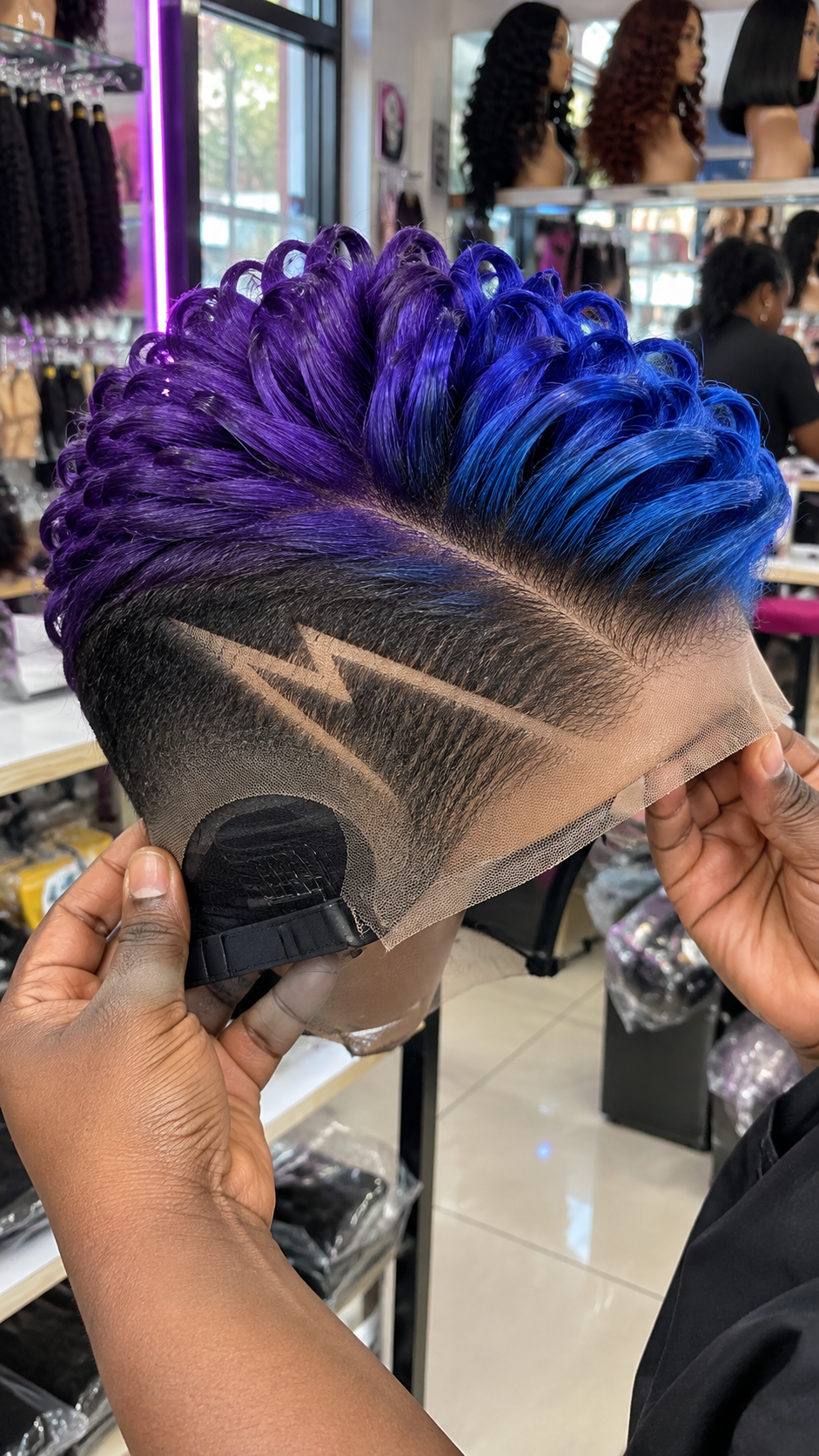
This wig is built around a much bolder design language than a conventional single-color sculpted unit. The crown moves through two saturated color zones: royal purple dominates the rear and left portion, while electric blue takes over across the forward and right side. Beneath that vivid crown sits an almost black close-cut foundation with a sharp lightning-shaped carved accent. The contrast is deliberate. The upper half uses color and curved movement; the lower half uses dark density and angular negative space.
The photograph is especially useful because the unit is being held before installation. The lace remains untrimmed around the front and side, the close lower section can be examined clearly, and part of the interior cap is visible. This gives a buyer information that would normally disappear once the wig is fitted. Lace construction is clearly present, but the image does not establish that the material is HD lace. That term should only be used if the seller can verify the actual lace specification.
The Color Story Runs Across the Crown Rather Than From Root to Tip
Many two-tone wigs use an ombré arrangement where one shade begins at the root and another appears toward the ends. This unit works differently. Purple and blue occupy different regions across the crown, creating a lateral color transition rather than a simple vertical fade.
The rear and left side are strongly purple, ranging from deep violet near the base to brighter royal-purple reflections over the raised loops. Moving toward the opposite side, blue becomes increasingly prominent until electric and sapphire tones dominate the forward crown.
A narrow darker transition remains visible where the two color families meet. That darker depth prevents the boundary from appearing like two unrelated blocks placed beside one another. The colors overlap enough for the change to feel connected while remaining distinct enough to preserve the blue-versus-purple contrast.
This placement needs to be specified clearly in a custom order. Asking only for “blue and purple” could produce alternating highlights, a half-and-half split, purple roots with blue ends or random mixed strands. The reference shows a directional crown transition, and that distinction should be part of the production brief.
Electric Blue Makes the Forward Loops the Main Focal Point
The blue section occupies a highly visible position near the front and upper side. Large folded sections rise from the darker roots and bend backward, allowing the electric-blue surfaces to catch strong reflections. Several of the folds contain darker blue inside their curves, which creates depth instead of presenting one flat bright tone.
The individual sections remain broad and separated. They resemble elongated ribbons or open loops rather than tight spiral curls. This gives the blue enough surface area to become visually dominant without requiring additional highlights.
When commissioning this color, maintaining darker roots can be valuable. Taking bright blue all the way to every visible root would reduce the shadow underneath the loops and make the crown appear flatter. The dark foundation provides the contrast that allows the electric color to stand out.
Royal Purple Controls the Rear Balance
The purple half does more than provide a second bright color. It balances the blue by occupying a substantial portion of the crown and rear. Large violet loops appear toward the upper left, while smaller purple forms become increasingly concentrated around the back.
The color also changes with the angle of the hair. Raised surfaces reflect brighter purple, while recessed areas become deep violet. That natural tonal variation creates enough internal contrast that the purple does not need a separate lighter highlight shade.
The rear concentration is particularly important. If purple were limited to a few scattered strands, the wig would read primarily as blue with purple accents. Here, both colors have enough territory to become major components of the design.
The Crown Changes Scale as It Moves Toward the Back
The forward blue loops are relatively broad and open. Moving around the crown toward the purple rear, the sections gradually become tighter and more numerous. This helps the styling follow the rounded cap instead of maintaining the same projection everywhere.
The change in scale also gives the color transition another layer. Large blue surfaces attract the eye first, while the denser purple rear provides visual weight behind them. The result is directional rather than symmetrical.
A custom maker should therefore reproduce both the color map and the changing loop scale. Matching the blue and purple shades while using identical curls across the entire crown would not preserve the construction shown here.
The Dark Root Zone Connects Two Saturated Colors
One of the quieter but essential choices is the dark root foundation. Nearly black hair appears beneath both the blue and purple crown sections. This shared base gives the two colors a common visual anchor.
It also creates separation from the side. The lower section remains predominantly dark, so the bright crown appears to rise from a much deeper foundation. Without that contrast, the side geometry could become lost within the saturated colors.
For buyers ordering a similar unit, root depth should be discussed as its own specification. A fully blue-and-purple base would create a very different result from the dark-root construction visible in the photograph.
The Lightning Accent Changes the Side From Curved to Angular
The most distinctive lower detail is the lightning-shaped carved accent. Unlike the crown, which is dominated by curves and loops, this side design uses sharp directional changes. Two exposed paths form a pointed zigzag through the dark close section.
The geometry creates an intentional contrast with the hair above. The crown moves fluidly backward; the side suddenly introduces hard angles. This prevents the entire wig from relying on one type of visual movement.
The lightning motif should not be reduced to a generic double line when placing an order. Its central point and abrupt change of direction are essential. Two ordinary parallel curves would produce a completely different profile even if their width and position were similar.
Negative Space Is Doing Most of the Work on the Lower Side
The exposed lightning shape is visible because the surrounding hair remains very dark and close to the foundation. The black field above and below the carved areas creates the contrast necessary for the geometry to remain readable.
This means the retained hair is as important as the removed area. Widening the lightning paths too aggressively would reduce the dark panels and make the side appear more open than the reference.
A barber maintaining the unit should therefore focus on preservation. If fine strands begin to cross the exposed design, repositioning them may be enough. Recutting should be conservative because hair removed from a wig cannot regenerate.
The Main Crown Boundary Has Its Own Function
Above the lightning motif is a longer exposed separation beneath the crown. This boundary follows the upper construction and divides the colorful loop section from the compact dark side.
Its role is different from the lightning design. The upper separation establishes the crown border, while the angular lower paths provide decoration within the side. Keeping those functions distinct prevents the geometry from becoming visually crowded.
During customization, the crown boundary should ideally be established before the lightning motif is finalized. That allows the barber or wig maker to see how much dark side area remains available for the angular design.
The Lace Perimeter Is Still at the Fitting Stage
Untrimmed lace is clearly visible around the front and side. This indicates that the final perimeter has not yet been customized to a wearer. That extra material is useful because a stylist can establish the cap position before deciding where the lace should be removed.
Fine dark strands appear close to portions of the front boundary. Their density increases as the hair approaches the colorful crown. The stylist should assess this transition on the wearer rather than cutting according to the loose unit alone.
Lace shade should also be confirmed directly with the seller. The mesh appears beige-brown in the photograph, but lighting and camera processing can alter perceived color. A product image is not a substitute for the maker’s actual lace-shade options.
The Interior Cap Is Visible Enough to Make Fit Part of the Design Conversation
The photograph exposes part of the cap and an adjustable strap area. This confirms that the bright exterior styling is built over a structured wig foundation. However, the image does not provide enough information to make broader claims about every internal construction detail.
Cap fit matters because the lightning geometry is fixed in relation to the unit. If the wig shifts forward or backward, the side design moves with it. Accurate sizing therefore influences the final appearance as well as comfort.
Customers commissioning this type of wig should follow the maker’s measurement guide carefully. If circumference, ear-to-ear and front-to-nape measurements are requested, each should be provided rather than relying on a generic size label.
A Custom Order Needs a Color Map, Not Just Two Color Names
The first instruction should identify electric or sapphire blue across the forward crown and royal-to-deep purple across the rear and opposite side. The second should preserve the dark root foundation beneath both colors.
The crown construction should then be specified separately: broad forward loops, backward directional movement and progressively tighter forms toward the rear. The side specification should describe a close dark foundation, the upper crown separation and the angular lightning motif.
Finally, practical requirements can be added: cap size, lace shade, whether the lace should remain untrimmed and whether the side geometry is completed before shipping or refined locally after fitting.
This level of detail gives both the buyer and maker a useful approval checklist and reduces the chance of receiving a generic blue-and-purple wig that lacks the reference’s actual architecture.
Choose the Professional Based on the Hardest Part of the Design
Not every wig maker who handles vivid color also specializes in carved side geometry. Likewise, a skilled barber may reproduce the lightning pattern accurately but have limited experience constructing lace wigs or arranging sculpted loop crowns.
A fully custom specialist who can demonstrate both skills may be the simplest option. If that is not available, the work can be divided. A wig maker can produce the colored crown and cap, while a local professional completes conservative side detailing after the unit has been fitted.
For local customization, bring the reference photograph to both professionals. The colorist or wig stylist needs to understand the blue-purple placement, while the barber needs an unobstructed view of the lightning geometry.
Approval Photos Should Be Taken From Both Color Sides
A single side photograph cannot fully verify this wig because the crown uses different dominant colors depending on the viewing angle. Ask for one image emphasizing the blue side and another showing the purple side.
An overhead image is also valuable because it reveals how the two color zones meet. The transition should not become an arbitrary center split if the goal is to reproduce the reference.
Finally, request a close side image of the lightning motif. Check the angle, width and amount of dark hair retained around it before the unit ships.
Pricing Needs to Account for Color and Precision Cutting Together
This wig combines several labor-intensive processes in a compact unit. Saturated color placement, dark-root control, sculpted crown formation, close side density, angular carving, cap construction and lace preparation can all contribute to the final price.
| Category | Estimated Price Range | What the Buyer May Be Paying For |
|---|---|---|
| Premium Custom | $375–$650+ | Higher-grade hair, individualized sizing, planned blue-purple coloring, dark-root placement, hand-shaped crown loops, precision lightning geometry and detailed lace preparation. |
| Standard Custom | $230–$395 | Prepared two-color crown and established side design with more standardized cap sizing and finishing. |
| Basic Human Hair | $130–$235 | A human-hair foundation requiring additional professional lightening, vivid coloring, crown shaping and side customization. |
| Premium Synthetic | $90–$175 | A pre-colored and pre-set alternative that may preserve vivid shades and sculpted loops with less ongoing color work. |
| Basic Synthetic | $45–$100 | A budget interpretation where color placement, crown complexity, side precision or cap construction may be simplified. |
These figures are broad planning estimates rather than confirmed prices for the photographed wig. Hair quality, fiber, coloring process, labor market, cap construction, lace choice, shipping and installation can all affect the final total.
When comparing quotations, ask whether the vivid color work and lightning side design are included. A lower-priced dark base that still requires extensive professional lightening, coloring and carving may not remain the cheaper option after customization.
Human Hair Makes Vivid Color a More Complex Maintenance Decision
If the unit is human hair, achieving electric blue and vivid purple may require significant processing depending on the starting hair. That history matters when the crown later needs heat resetting or color refreshing.
A stylist should avoid assuming that brightly colored human hair can tolerate repeated high temperatures. The condition of the strands should guide future styling. Color-safe cleansing and conservative heat can help protect both the hair and the saturated shades.
When fading occurs, blue and purple should be refreshed according to their original zones. Covering the entire crown with one purple or blue formula would eliminate the directional color design.
Pre-Colored Synthetic Fiber Can Offer an Alternative for Saturated Shades
For buyers primarily interested in maintaining the vivid palette, a quality pre-colored synthetic unit may be worth considering. The blue and purple can be built into the fiber without requiring repeated dye maintenance, and a pre-set crown may retain its loop arrangement well.
The tradeoff is flexibility. Synthetic fibers differ in heat tolerance, and conventional human-hair dye methods are generally not appropriate. Confirm the material before using hot tools or attempting recoloring.
The decision should therefore depend on whether the wearer values future restyling flexibility or wants the original saturated design to remain largely unchanged.
Wash the Two Color Zones Without Losing the Crown Map
Before the first full wash, photograph the wig from above and from both sides. The images should record where blue dominates, where purple becomes stronger and how the loop sizes change across the crown.
During cleansing, avoid aggressively mixing neighboring sections together. The goal is to preserve both the color placement and directional styling. Use products appropriate for the confirmed material and follow any recommendations supplied by the maker.
After drying, restore displaced loops according to the photographs. Treating the crown as one mass of hair can blur the color boundary and remove the separation between individual folds.
Vivid Blue and Purple Benefit From Careful Product Selection
Heavy residue can change how saturated colors reflect light. Excess oil may darken the appearance of bright blue, while product buildup can make purple sections look uneven and cause neighboring loops to adhere together.
Use styling products sparingly and choose formulas appropriate for the material. The objective is to maintain control while keeping the broad crown sections visually separate.
If the wig is human hair and the color begins fading unevenly, professional assessment is safer than repeatedly layering pigment at home. The two-color map is too important to treat as one uniform dye job.
The Lightning Design Should Age Through Preservation, Not Expansion
The angular side pattern is one of the easiest parts of the wig to alter permanently. Every time the exposed paths are widened, some of the surrounding dark foundation is lost.
When the design appears less crisp, first check for displaced strands. If cutting is required, the barber should use the original reference to preserve the pointed center and the narrow taper of each path.
Repeatedly making the lightning motif larger can eventually cause it to dominate the side and weaken the contrast between the geometric lower area and colorful crown.
Fitting Should Precede Any Final Side Adjustment
If the wig arrives with the lightning pattern already completed, a stylist should establish the final cap position before deciding whether anything needs refinement. Often the best choice may be to leave the existing geometry untouched.
If the side is intentionally delivered unfinished, fit the wig first and then map the lightning shape relative to the wearer’s temple and ear. This reduces the risk of creating a precise design that sits in the wrong location after installation.
When booking, tell the salon that the unit contains both vivid color work and carved side detailing so enough time can be reserved for careful inspection rather than routine fitting.
Storage Must Protect Both the Color and the Raised Loops
A suitable wig stand gives the broad crown sections enough space to retain their height. Avoid pressing the blue or purple loops against a wall or stacking another wig on top.
The unit should be completely dry before storage. Follow the maker’s recommendations regarding light and environmental exposure, particularly for vivid human-hair color that may fade over time.
During transport, use packaging deep enough to prevent crown compression. Rebuilding the large loops can be time-consuming, and unnecessary friction can also disturb the surface of saturated color.
The Strongest Version Preserves Contrast at Every Level
This wig works because contrast appears repeatedly throughout the design. Electric blue contrasts with royal purple. Both vivid colors rise from dark roots. Large curved loops contrast with the close side. The flowing crown then meets an angular lightning motif below. Even the visible lace represents a temporary transition between the finished hair area and the final installation.
For buyers, matching only the colors is therefore not enough. The order should preserve the directional blue-purple placement, dark foundation, changing crown scale, upper separation and lightning geometry. Cap measurements and lace specifications should be confirmed directly rather than inferred from the photograph.
For wig businesses, this is the kind of unit that benefits from detailed pre-installation photography. Showing the crown from both color sides, documenting the angular side work and explaining which customization services are included allows customers to understand why the design requires more than ordinary color selection. The vivid palette creates the immediate impact, but the carefully coordinated structure is what gives the wig