
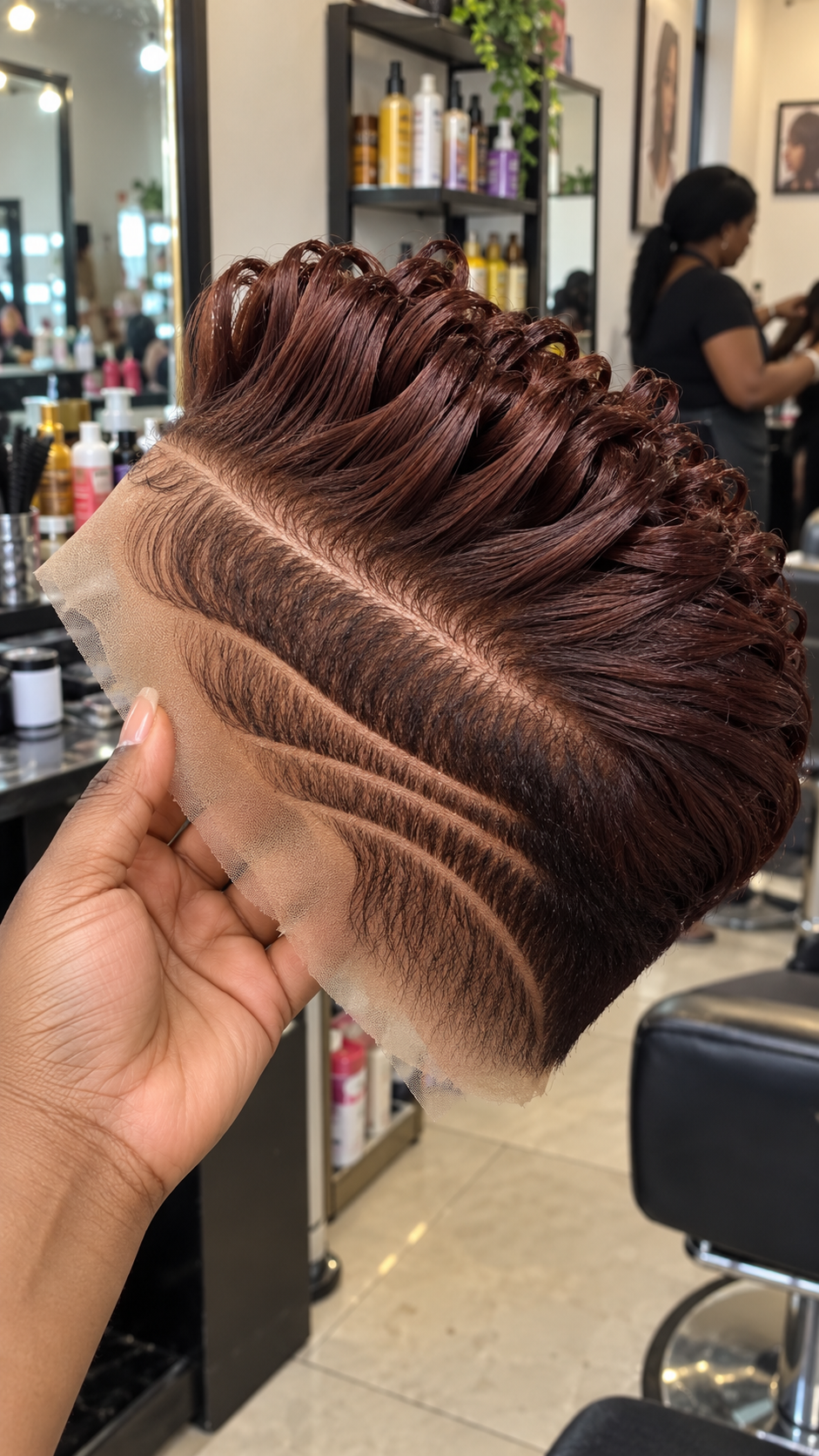
This mahogany-brown wig is built around a strong contrast between movement above and precision below. The crown rises into broad folded loops that travel backward in separate sections, while the side remains close to the foundation and is divided by two long sweeping channels. The rich brown color gives the upper construction a different character from black versions of this family: light catches the raised ribbons in warm chestnut and mahogany reflections, while the roots and recessed areas remain considerably deeper.
The photograph is also valuable because the unit is shown before installation. Excess lace remains visible around the perimeter, fine strands can be examined near the front, and the relationship between the crown and close side is unobstructed. The lace itself is clearly visible, but the photograph does not establish that it is HD lace. That specification should only be used if the wig maker or supplier confirms the material.
The Mahogany Palette Creates Dimension Without Separate Highlights
The visible hair stays within a deep brown family rather than using obvious blonde or copper streaks. What creates variation is the way light travels over the sculpted surface. Raised crown sections reflect warmer reddish-brown and chestnut tones, while the undersides, roots and close side appear darker.
This tonal behavior is important when ordering. A flat medium-brown wig would not necessarily reproduce the same depth, even if the basic shade looked similar on a color chart. The reference works because the foundation remains deep enough to create shadow beneath each raised loop.
A buyer should therefore show the photograph when discussing color instead of relying entirely on names such as mahogany, chocolate, chestnut or auburn brown. Supplier terminology varies, and a visual reference gives the maker a clearer target.
The Forward Crown Is Built From Tall Folded Ribbons
The front portion contains several elongated sections that rise noticeably before bending backward. These are not tight spiral curls. The strands within each section travel together, creating broad ribbon-like surfaces with open spaces between neighboring pieces.
Those openings are essential to the crown. They expose darker recessed areas and make the individual folds readable. If all of the upper hair were combed backward into one continuous surface, the color would remain attractive but much of the construction would disappear.
The height is also controlled. The loops rise enough to establish their form without expanding into an oversized crown. A custom stylist should preserve that proportion rather than assuming that more volume automatically improves the design.
The Middle Crown Changes From Upright to Backward Movement
Moving away from the front, the sections begin to lean farther backward. Their bends become broader, and the direction follows the rounded shape of the cap. This creates a transition rather than a row of identical upright loops.
The warm brown surface makes that directional change particularly easy to see. Light catches the top of each fold, while the inner portions remain darker. The result is a sequence of mahogany ribbons that appear to travel across the crown.
For a custom commission, an elevated side photograph is useful during approval. It can reveal whether the maker has reproduced this change in angle or simply repeated the same curl from front to back.
The Rear Compresses the Shape Instead of Continuing the Height
Near the back, the styling becomes tighter. Smaller looped ends appear around the larger sections, and the hair begins to follow the rear contour rather than continuing upward. This reduces bulk and gives the crown a natural visual endpoint.
The transition is important for wearability as well as appearance. A crown that remains equally tall all the way to the rear can feel visually heavy. Compressing the forms toward the back keeps the silhouette balanced while retaining enough detail to avoid an abrupt ending.
When buying remotely, request a rear three-quarter photograph. That angle can confirm whether the maker has completed the back with smaller sculpted work instead of leaving it comparatively plain.
The Upper Side Panel Creates a Quiet Zone Beneath the Crown
Below the sculpted top sits a substantial area of close dark-brown hair. This panel is intentionally calmer than the crown. The strands lie near the foundation and create a dense field that allows the exposed side channels to stand out.
A narrow separation also runs beneath the upper hair, establishing a clear border between the raised crown and compact side. This boundary should not be confused with the lower decorative channels. Its job is structural: it tells the eye where the crown ends.
The amount of hair retained in this panel matters. Cutting it too aggressively would weaken the dark foundation and make the exposed pathways dominate the entire profile.
Two Long Side Channels Establish the Lower Geometry
The most recognizable lower detail is a pair of sweeping exposed paths. The first travels diagonally beneath the main side panel. A second follows below it, creating a layered arrangement rather than a single isolated line.
These channels are not perfectly straight or mechanically parallel. Their direction follows the contour of the wig, and their spacing changes subtly as they move toward the rear. That curvature gives the side movement without requiring a crowded collection of smaller carved marks.
Dark brown hair remains between the channels and below the lowest path. Those retained sections are essential because they keep both lines individually readable. If repeated barber work gradually removes too much hair between them, the two channels can begin to merge visually.
The Lower Sweep Is Part of the Silhouette, Not an Extra Decoration
The lowest channel curves through the side and helps guide the eye toward the tapered rear. Because it sits close to the perimeter, its placement has a direct relationship with how the wig will sit on the wearer’s head.
This is one reason final fitting matters. If the cap is positioned too far forward or backward, the lower sweep moves with it. A beautifully constructed line can appear misplaced if the cap itself does not fit correctly.
For a made-to-measure order, follow the seller’s own sizing instructions. Circumference may not be the only relevant measurement. Depending on the cap, ear-to-ear and front-to-nape measurements can help establish a more reliable fit.
The Visible Front Lace Should Remain Uncut Until Placement Is Confirmed
The image shows lace extending beyond the front and lower side. That excess material provides useful fitting flexibility. A wig stylist can position the unit first, examine how the crown and side channels align with the wearer, and then determine where the final perimeter should be cut.
Fine strands are visible close to the front transition. These should be evaluated on the wearer rather than automatically removed. Their lighter density helps create a gradual transition before the compact side and heavier crown begin.
Buyers should also ask the seller which lace shades are available. The apparent color in a salon photograph can be affected by lighting and camera processing. Selecting from verified supplier options is safer than assuming the photographed mesh will match every complexion.
This Design Rewards Accurate Cap Sizing
Cap fit has a direct visual consequence here. The side channels occupy fixed positions relative to the foundation. If the unit slides backward because it is loose, those channels also shift. If it is pulled too far forward, the crown and front transition may sit differently than intended.
A local wig stylist can assist with measurements before a custom order. This may be particularly worthwhile for buyers investing in extensive crown and side work because correcting the cap after construction can be more difficult than getting the measurements right at the beginning.
When a standard-size unit is being considered, ask for the seller’s actual measurements rather than assuming that every medium or large cap follows the same dimensions.
Ordering Should Separate Color, Crown and Side Work
A useful custom brief begins with three independent specifications. First is color: deep mahogany or rich reddish brown with darker root depth. Second is the crown: elongated forward loops transitioning into broader backward folds and tighter rear work. Third is the side: compact density with two sweeping channels and a clear boundary beneath the crown.
After those visual requirements are agreed upon, discuss cap sizing, lace shade and the stage at which the unit will be delivered. Some customers may want the lace left untrimmed for a local fitting, while others may prefer more preparation from the maker.
Separating the order this way makes it easier to identify substitutions. A seller might match the brown color beautifully but provide a different side pattern. Another might reproduce the channels accurately but use a flatter crown. Approval becomes much easier when each component has already been discussed.
Where to Buy Depends on Who Will Complete the Precision Work
A fully customized wig can be commissioned from a specialist who already has experience with sculpted crowns and barber-inspired side detailing. This route can be convenient when the maker’s portfolio demonstrates similar work and the customer can provide reliable measurements.
Another option is to purchase a suitable human-hair or premium synthetic foundation and have the artistic work completed locally. This approach gives a salon more control over how the side channels align with the wearer, but it requires access to professionals who understand both wig construction and precision cutting.
A third approach is to divide the work. The wig maker can establish the mahogany color and crown loops, while a local barber or wig stylist completes conservative side refinement after fitting. This can be a sensible compromise when the crown is difficult to reproduce locally but personalized side placement is important.
Approval Images Should Focus on Proportion
Before a custom unit ships, ask for photographs that reveal more than the color. A side view should show both sweeping channels and the amount of dark hair retained between them. An elevated view should reveal the separation between the crown ribbons. A rear three-quarter image should show the reduction in loop size toward the back.
Inspect the actual wig being shipped whenever possible. Reference photographs demonstrate the target, but they do not prove that the commissioned unit has reproduced the same proportions.
If the seller is also preparing the lace, request a photograph before trimming. Once the perimeter or side hair has been cut, correction options become more limited.
Price Reflects Precision More Than Overall Length
The compact dimensions of this wig do not mean the labor is minimal. The crown needs directional setting, the brown tone may require custom color work, the side density has to remain controlled, and the two channels need accurate placement. Cap and lace preparation can add further cost.
| Category | Estimated Price Range | Likely Scope of Work |
|---|---|---|
| Premium Custom | $325–$560+ | Higher-grade hair, personalized sizing, custom mahogany coloring, hand-arranged crown loops, precision side channels and detailed lace preparation. |
| Standard Custom | $195–$335 | Prepared brown crown construction and planned double-channel side work with more standardized fitting options. |
| Basic Human Hair | $120–$210 | A restylable foundation requiring additional coloring, crown setting, side detailing or fitting from local professionals. |
| Premium Synthetic | $80–$150 | A higher-quality pre-set interpretation that may retain the sculpted crown with less frequent resetting. |
| Basic Synthetic | $40–$85 | A budget-oriented option where crown separation, brown tonal depth, side precision or lace construction may be simpler. |
These ranges are broad budgeting references rather than fixed retail prices for the photographed unit. Hair quality, fiber type, country, labor, coloring, cap construction, lace choice, shipping and installation can all affect the final total.
When comparing sellers, request an itemized quotation. A lower-priced base requiring separate coloring, crown shaping and barber work should not be compared directly with a completed custom unit whose price already includes those services.
Maintenance Economics Favor Preserving the Original Crown
The most cost-effective maintenance strategy is to avoid rebuilding the entire crown unnecessarily. If only one or two loops lose their direction, those sections can be addressed individually. Dismantling every fold at each appointment creates more work and increases the chance of changing the original proportions.
Human hair offers useful flexibility when professional resetting is required, but repeated heat should still be controlled. The mahogany color may involve processing, so the stylist should consider the condition of the hair before selecting a temperature.
A premium synthetic version may hold its pre-set structure with less frequent intervention, although heat tolerance and reshaping options depend on the exact fiber.
Wash With the Direction of the Crown in Mind
Before the first full wash, photograph the wig from the side, above and rear. These images record how the tall front sections transition into the lower rear arrangement.
During cleansing, avoid aggressive circular rubbing through the crown. That motion can mix neighboring ribbon sections together. Use products appropriate for the confirmed material and handle the lace gently around the front.
Once the unit is dry, follow the photographs when restoring displaced sections. The objective is to return each fold to its established direction rather than turning the entire crown into a new curl pattern.
Preserve the Mahogany Tone by Limiting Unnecessary Processing
The deep brown color contributes directly to the dimensional appearance of this wig. On a human-hair unit, repeated high heat or unsuitable cleansing products can gradually affect the richness of the shade.
If color refreshing eventually becomes necessary, the goal should be to preserve the deeper root and recessed areas as well as the warmer raised surfaces. Applying one flat brown indiscriminately can reduce the tonal depth visible in the reference.
Synthetic versions should only be recolored using methods appropriate for the confirmed fiber. Standard permanent human-hair dye should not be assumed suitable.
The Side Channels Should Be Refined Only When Necessary
The two sweeping paths do not need to be recut simply because the wig has been worn several times. Fine strands may occasionally shift across the exposed areas and make them appear less visible. Repositioning those strands should be attempted before removing more hair.
If actual barber work becomes necessary, the original side photograph should be available during the appointment. It provides a record of the initial width, curvature and spacing.
This preservation-first approach protects the dark hair between the channels. Once repeated cutting makes that central section too narrow, restoring the original geometry can become difficult.
Coordinate the Wig Stylist and Barber in the Right Order
If separate professionals are involved, fitting should generally establish the wig’s position before side refinement takes place. The wig stylist can check cap placement and prepare the lace. The barber can then evaluate the channels relative to the wearer’s actual temple and ear position.
For a unit whose side geometry already matches the reference, the barber may not need to cut anything at the first appointment. Preservation can be the better choice.
When booking, tell the salon that the wig already contains sculpted crown and side work. This helps prevent the appointment from being treated as though the customer were bringing an unfinished base.
Storage Should Support the Directional Crown
A suitable wig stand or mannequin head gives the broad upper folds room to retain their shape. Laying the unit flat under other objects can compress the tallest forward sections and distort the tighter rear loops.
Allow the cap and lace to dry fully before storage. If adhesive has been used, clean the perimeter with methods appropriate for the material rather than pulling residue away aggressively.
During travel, give the crown enough vertical clearance. Preventing compression is usually easier than reconstructing the entire loop sequence afterward.
The Best Match Will Preserve the Brown Depth and Double-Channel Balance
This wig is easy to oversimplify as a brown sculpted unit, but its identity comes from several relationships working together. Tall forward ribbons create elevation, the middle crown bends backward, the rear becomes tighter, and the close side provides a dark foundation for two long sweeping channels. The mahogany palette then adds warm reflection without replacing the deeper root structure.
For buyers, those relationships should become the quality checklist. Compare the crown progression, side density, number and direction of the channels, front transition and color depth before approving a custom order. Confirm lace and cap information directly with the seller rather than relying on assumptions from the photograph.
For wig businesses, detailed construction photography can make this type of unit easier to sell responsibly. Showing the wig before installation allows customers to understand the work hidden beneath the finished appearance. Pair those images with verified material information, transparent customization options and clear booking guidance, and the product can be presented for what actually makes it valuable: careful shaping, proportion and precision.
Search Terms
mahogany brown sculpted loop wig · double sweeping side channel wig · reddish brown lace wig · folded ribbon crown wig · deep brown side separation wig · backward loop mahogany wig · close side channel hairpiece · untrimmed lace brown wig