
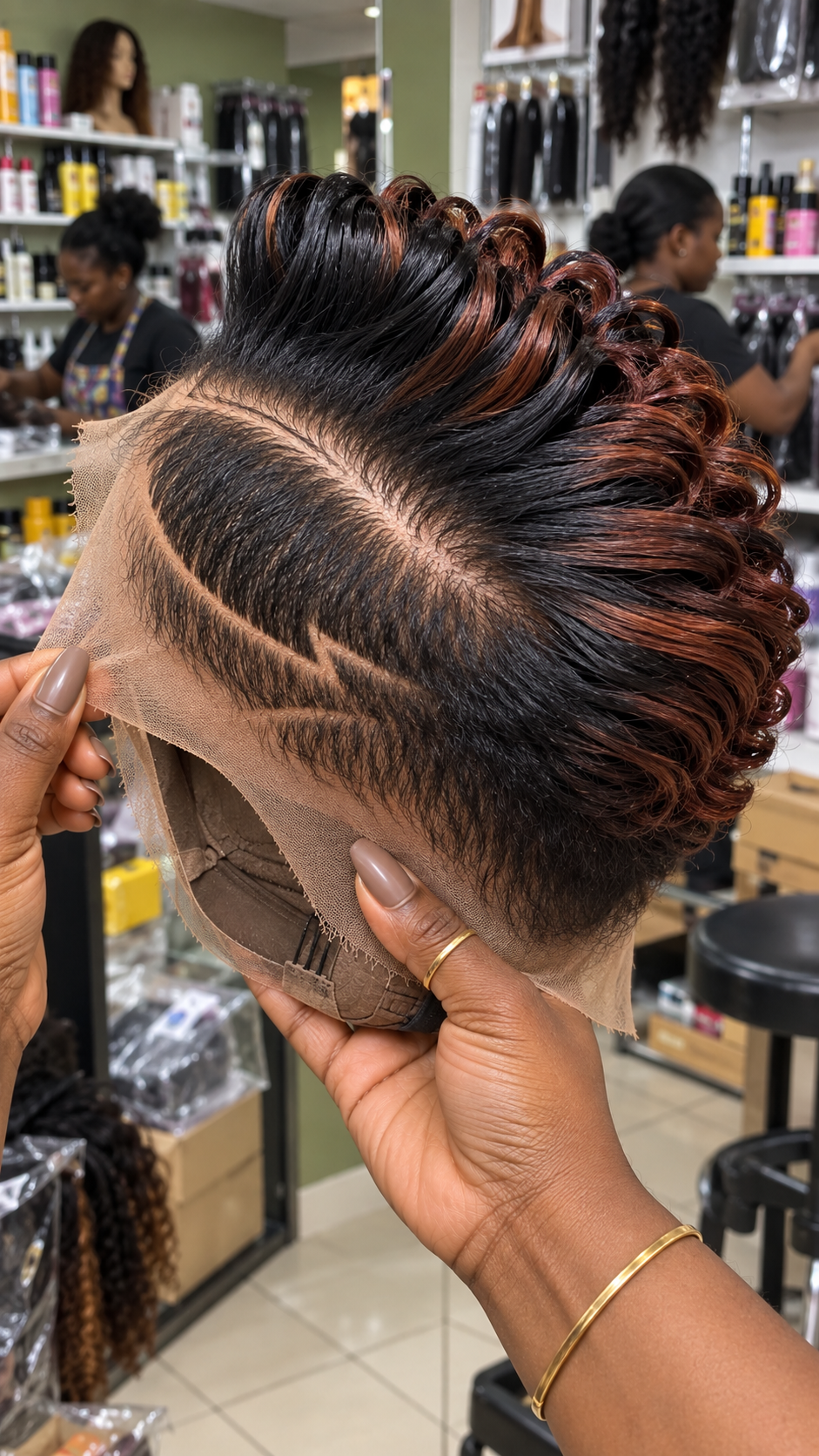
This wig takes a different route from the sweeping multi-line designs often paired with sculpted crowns. Its strongest detail is not a collection of parallel curves but a single long side division interrupted by a compact angular accent. Above that geometry, a dark foundation supports black looped sections threaded with burnished copper strands. Toward the rear, the copper becomes increasingly visible as the hair bends into smaller overlapping loops. The combination creates an asymmetrical visual hierarchy: color attracts attention to the crown, while the sharp side interruption gives the lower section its identity.
The unit is photographed before installation, which exposes information that would normally disappear once it is worn. Lace extends beyond the hair-bearing perimeter, part of the brown cap is visible underneath, and the side construction can be examined without the wearer’s ear or skin concealing it. The photograph clearly supports describing this as a lace wig, but it does not provide sufficient evidence to classify the material specifically as HD lace. That specification should come from the manufacturer rather than visual assumption.
Copper Placement Follows the Hair Instead of Forming Conventional Streaks
The warm copper is distributed through selected upper sections rather than covering the entire crown. Black remains the dominant foundation, particularly around the roots and forward side. Copper strands appear inside and over several loops, creating flashes of warm color as the hair changes direction.
This placement becomes stronger toward the rear half of the crown. There, the smaller bends expose more copper surfaces, producing a gradual visual transition from predominantly dark hair near the forward crown to a richer black-and-copper mixture farther back. It is not a simple two-color split, nor does the image show an evenly highlighted pattern.
That distinction should be included in a custom order. Requesting “black hair with copper highlights” leaves too much freedom to the maker. The important instruction is that the warm strands should participate in the loop construction, with dark roots and black sections remaining clearly visible between them.
The Forward Crown Uses Long Upright Sections
Several sections near the front rise steeply before folding backward. Their length is visually emphasized because they are relatively narrow and separated from neighboring pieces. This gives the forward crown a vertical rhythm without turning it into an excessively high silhouette.
The direction then begins to change. Moving across the crown, the loops become rounder and the copper strands become more noticeable. This progression keeps the upper surface from looking like a repeated row of identical pieces.
For a stylist, the lesson is that crown height should not be increased uniformly. The forward sections need enough elevation to establish their elongated shape, but the back requires a different treatment. A recreation that gives every section the same height and diameter would lose the gradual transition visible in the reference.
The Rear Is Where the Color and Loop Work Become Most Active
The back portion contains a denser collection of smaller curved sections. Copper and black strands overlap there, producing a busier surface than the comparatively restrained front. The loops follow the rounded rear contour rather than projecting straight upward.
This rear concentration performs two jobs. It gives the color somewhere to become more expressive, and it allows the crown to reduce its height while retaining visual detail. Instead of ending the large forward loops abruptly, the construction resolves them through progressively tighter forms.
Anyone commissioning this wig remotely should request a rear three-quarter photograph before shipment. That view can confirm both the copper distribution and the smaller loop construction. A simple front photograph would reveal very little about this part of the design.
The Long Side Division Creates a Strong Foundation
Beneath the crown sits a broad dark side panel. Its lower boundary is established by one long exposed division that travels diagonally around the unit. The path is relatively restrained compared with the elaborate multi-curve patterns found on some barber-inspired wigs, allowing the black density above and below it to remain substantial.
The exposed line is important because it visually lengthens the side. It guides the eye from the forward perimeter toward the rear while also separating two compact hair zones. The surrounding hair remains close enough to the base for that pathway to stay clearly visible.
If this wig is being recreated, the width of the line should be kept proportional. Enlarging it substantially would remove too much of the dark side panel and make the lower half compete with the colored crown.
The Angular Accent Is the Detail That Should Not Be Replaced With Another Curve
Near the central side area, the long division is interrupted by a small angular formation. One section turns upward and then back toward the main pathway, producing a sharp geometric accent. This is visually different from the rounded movement used elsewhere in the wig.
That contrast is important. The crown is composed almost entirely of curves and loops, while the side introduces a brief angular gesture. It gives the profile a point of tension without requiring several additional carved lines.
A vague instruction such as “add a design on the side” could easily produce a star, multiple stripes or another sweeping curve. A custom maker or barber should instead receive the reference image with the angular area specifically identified. Its scale should remain relatively small so that it behaves as an accent rather than becoming the dominant feature.
Dark Density Around the Accent Protects Its Shape
The geometric mark only works because sufficient black hair surrounds it. The upper side panel is densely populated with close strands, and another dark section remains below the long division. These areas act as negative-space boundaries around the exposed path.
This is where over-customization can damage the design. Adding more cuts around the angular element might seem like a way to make it more dramatic, but doing so would reduce the dark field that makes the original shape readable.
For maintenance, the surrounding density should therefore be preserved whenever possible. If loose strands begin to cover the exposed line, they can first be repositioned. Cutting should be a secondary measure rather than the automatic solution.
The Visible Lace Shows Why Installation Should Come After Inspection
A generous amount of lace remains around the front and lower perimeter. This gives the eventual installer room to position the unit before determining where the final edge should sit. It also allows the buyer to inspect the lace before any irreversible alteration has occurred.
The front contains finer strands that transition toward the denser dark side. A professional should evaluate this area on the wearer rather than cutting it according to the shape of the wig while it is being held. The final position affects not only the front hairline but also where the angular side accent lands.
If purchasing online, ask whether the unit will arrive with the lace uncut. Buyers who already have a trusted local wig stylist may benefit from retaining that flexibility. Lace shade should also be confirmed directly with the seller because the beige-brown appearance captured by the camera may differ under natural light.
The Cap Is Visible Enough to Make Sizing Part of the Conversation
The photograph reveals portions of the brown interior cap beneath the lace. Although the image does not provide enough information to make claims about every component of its construction, it does demonstrate that the outer styling is attached to a structured wig foundation rather than being shown after installation.
Cap size matters particularly with an asymmetrical side detail. If the wig sits farther forward than intended, the angular accent may move toward the temple. If it shifts backward, the design can lose its intended relationship with the face.
Follow the maker’s own measurement system when ordering. Do not rely entirely on labels such as small, medium or large because sizing standards vary between wig businesses. If a custom cap is available, accurate measurements can be worth paying for when side placement is central to the design.
There Are Three Sensible Ways to Source This Look
A buyer can commission the entire wig from one custom maker, purchase a prepared unit and have the side refined locally, or begin with an appropriate lace base and commission most of the artistic work from local professionals. Each route has different advantages.
A complete custom order is convenient when the maker has a portfolio demonstrating this type of crown construction. The buyer should provide the reference and request photographs of the actual finished piece before dispatch. This reduces the risk of receiving generic copper highlights or a completely different side pattern.
A partially prepared unit can be useful when the crown and color are difficult to reproduce locally but a skilled barber is available. In that case, the maker can establish the loops and copper placement while the final side accent is adjusted after fitting.
Starting with a base gives the greatest local control but also requires the strongest professional team. The wig stylist and barber need to understand how the crown, lace and compact side relate to one another. The total labor cost should be estimated before assuming that the base-unit route will be cheaper.
Give the Maker a Priority List Instead of a Generic Style Name
The first priority should be the black foundation with burnished copper concentrated through selected crown loops. The second is the crown progression: elongated forward sections changing into tighter rear loops. The third is the compact side panel with its long division and small angular interruption. Lace shade and cap measurements follow as practical specifications.
This hierarchy helps if the maker needs to discuss limitations. For example, a particular fiber may reproduce the color well but not tolerate extensive resetting. A different base might offer better styling flexibility but require separate coloring. Knowing which aspects matter most allows the customer to make an informed compromise instead of receiving an unexpected substitution.
Booking can then be planned around what remains unfinished. If the side needs local refinement, schedule that work after the lace fitting. If everything arrives completed, a single wig specialist may only need to position the unit, trim the perimeter and make conservative adjustments.
Cost Should Reflect Both Color Placement and Precision Work
This design contains several labor-intensive components despite its compact overall dimensions. The color needs deliberate distribution, the crown requires section-by-section formation, the side density must remain controlled, and the geometric accent needs accurate placement. Those services can make a custom unit substantially more expensive than a basic black-and-copper wig.
| Category | Estimated Range | What May Be Included |
|---|---|---|
| Premium Custom | $325–$560+ | Higher-grade hair, planned copper placement, individualized cap sizing, detailed crown work, precision side geometry and lace preparation. |
| Standard Custom | $200–$345 | Prepared two-tone crown, established side design and standard cap construction with some final fitting left to the buyer’s stylist. |
| Basic Human Hair | $125–$220 | A customizable human-hair base requiring additional coloring, crown formation or barber work to reach the reference. |
| Premium Synthetic | $85–$155 | A quality pre-set alternative where the loop arrangement and two-tone effect may require less regular reshaping. |
| Basic Synthetic | $40–$90 | A lower-cost interpretation that may simplify the copper distribution, lace construction or geometric side work. |
These figures are broad budgeting references, not universal selling prices. Country, labor rates, fiber, hair quality, lace selection, cap options, coloring and shipping can all change the final quotation. Installation and future barber appointments may also be additional expenses.
The most useful price comparison asks what is already completed. A $150 base requiring color, crown setting and side work is financially different from a $300 unit that arrives with those services finished. Requesting an itemized quotation makes that distinction visible.
Human Hair Can Be Useful When the Copper Needs Future Attention
A human-hair version provides more options if the crown eventually needs professional resetting or the copper tone requires refreshing. However, colored strands can be more sensitive to repeated heat and chemical processing. Any restyling plan should take the previous color work into account.
If the copper fades, recoloring should follow the existing placement rather than covering the entire wig with one warm shade. The black foundation is a deliberate part of the design. Losing it would remove much of the contrast that makes the rear loops readable.
A synthetic version may hold its pre-arranged loop shapes with less intervention, but recoloring options are more limited. Conventional human-hair dye should never be assumed suitable for synthetic fiber. Buyers should choose the material with future maintenance in mind rather than relying only on the initial price.
Photograph the Color Map Before Washing
Before the first thorough wash, take clear images of the crown from above and from the rear. These photographs will record not only the loop directions but also where the copper sections appear. If the crown loosens while wet, the images provide a practical guide for reconstruction.
Cleaning should avoid aggressive rubbing between the looped sections. The objective is to remove residue without mixing together strands that were deliberately separated. Products should also be chosen according to the actual fiber and color treatment.
After drying, the black and copper sections should return to the same directional relationships rather than being reorganized into new curls. Preserving the original placement is especially important because the highlighted strands visually trace the crown architecture.
Protect the Rear Loops During Storage
The rear contains some of the smallest and most numerous loop formations, making it vulnerable to compression. Storing the wig flat beneath other items can crush these sections even if the larger front loops remain relatively intact.
A suitable wig stand gives the rear enough room to maintain its rounded contour. Before storage, make sure the lace and cap are completely dry. If adhesive has been used, remove residue using methods appropriate for the lace rather than pulling or scraping aggressively.
For transport, support the crown so the rear is not pressed against the side of a bag or box. A little attention to storage can reduce the frequency of professional resetting and help preserve the color placement for longer.
The Angular Detail Needs Conservative Barber Maintenance
The small side accent should not become larger every time it is refreshed. Because its identity comes partly from its compact scale, repeated cutting can quickly change the design. The same principle applies to the long exposed division around it.
When the pattern appears less visible, inspect the surrounding strands before removing hair. If cutting is necessary, use the original photograph as a reference for both the angle and width. The goal is to recover the existing shape, not create a more dramatic version at every appointment.
This is especially important with wigs because removed density does not regenerate. Preserving the black panel around the accent will extend the period during which the original side composition can be maintained.
Inspect Color, Geometry and Fit as Separate Quality Checks
When a completed custom wig arrives, examine it in three stages. First look at color. The black foundation should remain prominent, with copper appearing selectively through the upper and rear loops rather than covering the entire unit.
Second, inspect construction. The forward crown should contain elongated raised sections, the rear should become tighter, and the side should retain its long exposed division plus the small angular accent. These are structural points and should be checked independently from whether the color is attractive.
Finally, inspect practical fit-related areas: cap size, lace perimeter and front density. Do this before cutting the lace whenever possible. If something materially differs from the agreed order, alteration may make seller corrections or returns more complicated.
A Small Geometric Detail Gives This Two-Tone Wig Its Own Identity
The strongest aspect of this piece is its refusal to rely on only one visual device. Black and copper provide tonal contrast, but the color is integrated into the movement of the crown. Large forward loops establish height, tighter rear loops create a controlled transition, and the lower side stays restrained enough for one angular accent to become meaningful.
That gives buyers a practical way to distinguish this wig from superficially similar options. Do not search only for the same colors. Look for the dark-root distribution, the changing loop scale, the close side density, the long side division and the compact geometric interruption. Those details are far more specific than a generic black-and-copper product label.
For a wig business, the same principle should guide the product listing. Show the side clearly, include an elevated crown view, identify the actual fiber and lace specifications, and explain which customization is included in the price. When the construction is this distinctive, accurate visual documentation can communicate the value of the work more effectively than exaggerated material claims.
Search Terms
black copper loop crown wig · burnished copper lace wig · angular side accent wig · dark root copper crown wig · single side division hairpiece · copper rear loop wig · geometric side detail wig · untrimmed lace two tone wig