
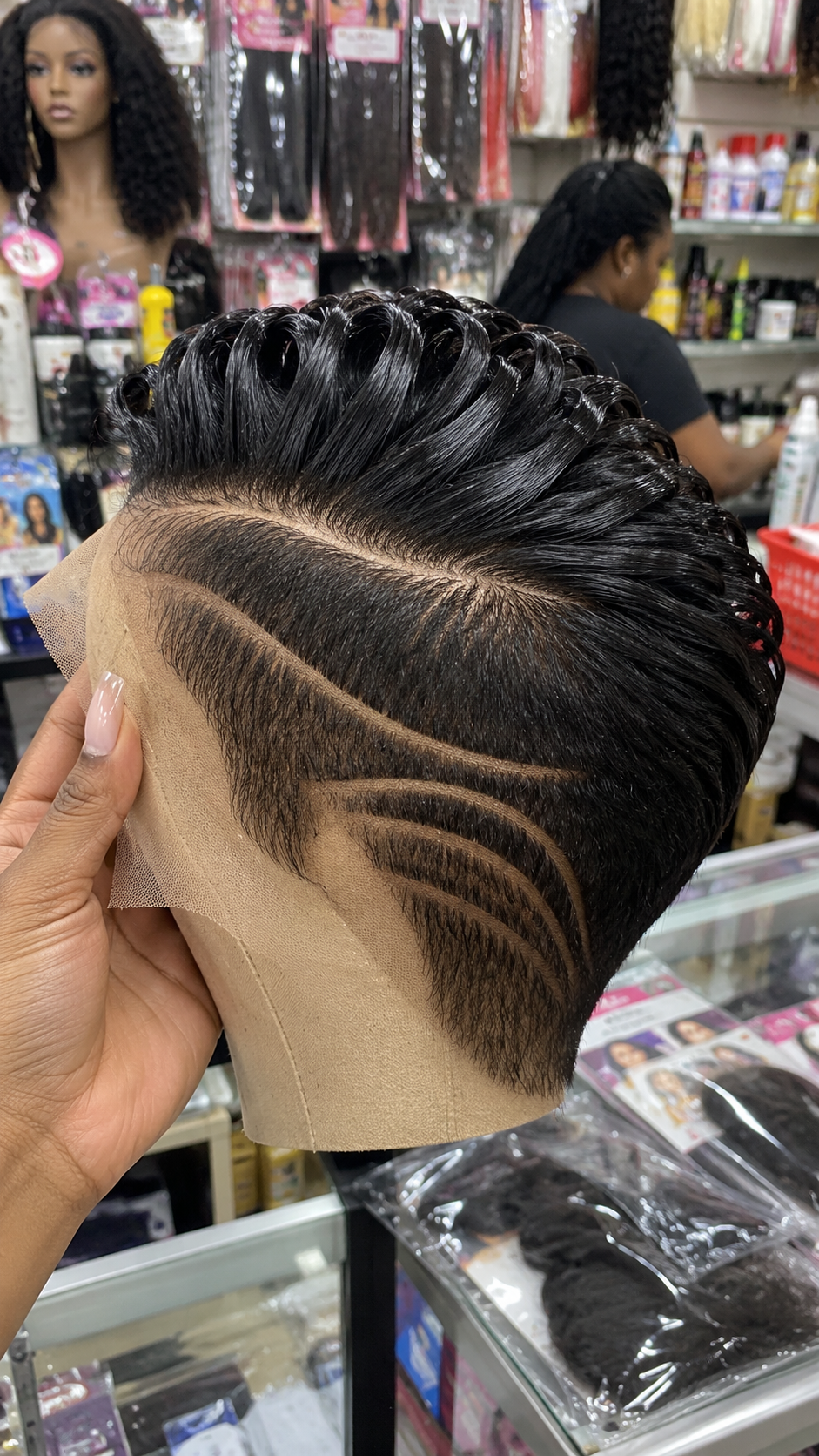
This jet-black wig is built around a particularly strong side profile. The crown carries large glossy loops that travel backward in controlled sections, but the lower half is where the construction becomes unusually graphic. A long separation establishes the boundary beneath the crown, while three tapered arches branch through the compact side area below it. The lines narrow as they travel toward the rear, creating a layered pattern without removing so much hair that the side loses its dark foundation.
The photograph is also unusually informative from a construction standpoint. The unit is shown before installation, with a broad lace perimeter still intact and a substantial portion of the foundation visible. Fine black strands occupy the lace and lower side, while the crown becomes progressively heavier above the main separation. Lace is clearly present, but the photograph does not establish its commercial grade. It should therefore be described as visible lace construction rather than automatically advertised as HD lace.
The Three Lower Arches Create a Graduated Side Composition
The lower design is more specific than a generic multi-line pattern. Three exposed arches sit beneath the principal crown boundary, but they do not behave like three straight parallel stripes. Each follows a curved trajectory, and their lengths gradually change as they approach the rear portion of the wig.
The upper of the three lower arches travels the farthest. Beneath it, another follows a similar direction while ending sooner. The lowest arch is again more compact. This graduated arrangement creates a nested appearance, with dark hair remaining between every exposed pathway.
That preserved density is crucial. If the channels were enlarged until the dark sections became extremely thin, the three arches would begin to merge visually. Their identity depends as much on the black hair between them as on the exposed lines themselves.
A barber reproducing the pattern should therefore receive the reference image rather than only a written request for three lines. The curve, taper, spacing and relative lengths all contribute to the finished profile.
A Separate Upper Boundary Connects the Artwork to the Crown
Above the three lower arches is another long separation running directly beneath the sculpted crown. This path serves a different purpose. Instead of acting as another decorative line, it establishes a visual boundary between the close side and the larger upper hair.
The distinction matters because it gives the side hierarchy. The eye first reads the heavy crown, then the narrow exposed boundary, then the compact black panel, and finally the three lower arches. Treating every separation as an identical stripe would flatten that hierarchy and make the side considerably busier.
For custom work, the upper boundary should be mapped first. Once its position is correct, the three lower arches can be proportioned within the remaining side area. This is safer than carving the lower design first and discovering that insufficient space remains beneath the crown.
The Crown Uses Broad Loops Instead of Tight Curls
The upper hair is arranged into large backward bends. Several sections rise from the crown and curve over themselves, producing open loop shapes rather than small spiral curls. The strands within each section remain relatively aligned, giving the outer surface a glossy ribbon-like appearance.
The loops are especially prominent through the front and central crown. They are large enough to create visible elevation but remain controlled in relation to the compact side. This proportion prevents the upper half from overwhelming the carved geometry below.
There is also meaningful space between several crown sections. Since the entire wig remains black, those darker gaps help distinguish one loop from another. The construction therefore depends on separation rather than color contrast.
A stylist refreshing this wig should avoid combining several loops into one broad backward sweep. Doing so might preserve the overall direction of the hair, but it would remove much of the architecture that makes the crown recognizable.
The Rear Resolves the Large Loops Into Smaller Forms
The crown becomes progressively tighter as it approaches the rear. Smaller looped ends appear around the larger central sections, allowing the styling to follow the rounded contour of the cap. The reduction in scale also prevents excessive bulk at the back.
This transition is easy to miss when shopping from frontal product photographs. A seller may offer a wig with convincing front loops but a comparatively plain rear. For this particular design, that would leave the silhouette incomplete.
Before approving a custom order, request a rear three-quarter photograph. It should reveal whether the large loops transition naturally into smaller work and whether the black hair continues to follow the head shape rather than projecting outward unnecessarily.
Single-Color Hair Makes Surface Control More Important
There are no obvious contrasting highlights in the visible hair. That puts additional responsibility on the shape and surface of the crown. Reflected light creates silvery-black highlights over the raised sections while the recessed areas remain much darker.
This natural light-and-shadow contrast is enough to make the loop pattern visible when the sections are correctly arranged. Adding a second color is not required to create depth. In fact, a customer wanting to reproduce this reference closely should prioritize the sculpted black construction before considering any color modification.
The same principle applies to shine. A glossy appearance should not be recreated by saturating the crown with heavy oil. Too much product can bind neighboring strands together and eliminate the gaps that give the black loops their definition.
The Lower Side Is Intentionally Kept Close
The hair surrounding the arches sits close to the wig foundation. Fine strands create dense black panels without the projection found in the crown. This density difference is one of the reasons the exposed paths remain easy to read.
If the lower section were left longer or fuller, strands could fall across the carved areas and conceal their shape. If it were cut too aggressively, the dark panels could become weak and expose more of the foundation than intended. The successful result sits between those extremes.
This is where barber experience can become valuable. The professional needs to control density while remembering that wig hair does not regrow. Each correction should therefore be more conservative than a comparable adjustment on natural growing hair.
The Lace Perimeter Leaves Installation Decisions Open
A broad area of lace remains visible around the front and lower perimeter. The wig has clearly not reached its final installation stage. For a buyer planning professional fitting, that can be an advantage because the stylist retains material with which to establish the final boundary.
The wig should first be placed in its intended position. The stylist can then check how the crown sits and where the side arches fall relative to the wearer’s temple and ear. Only after those relationships are correct should the excess lace be trimmed.
The photograph also shows finer hair around portions of the front. Those strands should not automatically be removed. Their density can be evaluated against the wearer’s desired hairline after the cap has been positioned.
When ordering online, ask which lace shades are available rather than judging only from this image. Store lighting and camera processing can alter how the material appears against the hand or background.
Cap Placement Can Shift the Entire Three-Arch Pattern
A carved-side wig makes accurate sizing especially important because the artwork has a fixed relationship with the cap. If a loose unit slides backward, the arches move with it. If the front is positioned too far forward, the pattern can sit closer to the face than intended.
Customers ordering a custom cap should follow the maker’s own measuring guide. Circumference alone may not be enough. Depending on the construction, front-to-nape and ear-to-ear measurements can help the maker understand how the unit needs to sit.
If there is uncertainty, booking a measurement appointment with a wig stylist before ordering can be useful. This is particularly sensible for an expensive customized unit where the side geometry represents a significant part of the purchase.
Ordering Should Start With Geometry Rather Than a Product Name
A seller may use completely different names for this style, so the reference photograph is more useful than trying to find one universal product title. The order brief should begin with the visible construction: jet-black hair, broad backward crown loops, a compact side, one principal separation beneath the crown and three nested tapered arches below it.
Next, clarify the installation state. Ask whether the lace will arrive untrimmed, whether the crown is permanently pre-shaped or requires salon setting, and whether the side artwork shown in the quotation is included in the unit being purchased.
This last question is important when shopping through social media. A seller may use a highly customized wig as an example while the listed price applies only to a basic unit. Confirming the included customization before payment prevents that misunderstanding.
Approval Should Be Based on Side Geometry, Not Just Overall Resemblance
For a commissioned piece, ask the maker to photograph the actual wig from the same general side angle as the reference. This makes comparison considerably easier. The upper boundary should follow the crown, and all three lower arches should remain visible as separate paths.
Check the dark panels between them. Those spaces should not become dramatically narrower simply because the maker has created deeper lines. Also inspect how the arches taper toward their endpoints rather than terminating as blunt rectangular cuts.
A second photograph from slightly above should show the crown loops. This can confirm that the hair has been separated into broad sections instead of merely combed backward.
Different Budgets Buy Different Amounts of Precision
Hair length is a poor predictor of cost for this type of wig. The unit is compact, but much of its value can come from labor: arranging the crown, controlling the side density, mapping four distinct exposed pathways and preparing the lace and cap for fitting.
| Wig Level | Estimated Price Range | Likely Scope |
|---|---|---|
| Premium Custom | $315–$545+ | Higher-grade hair, individualized cap sizing, hand-arranged crown sections, precisely mapped side arches and detailed lace preparation. |
| Standard Custom | $195–$330 | Prepared loop crown and planned side geometry with a more standardized cap and final fitting process. |
| Basic Human Hair | $120–$210 | A human-hair foundation intended for additional local crown shaping, side work and professional installation. |
| Premium Synthetic | $80–$150 | A pre-set alternative that may retain the crown pattern well when the fiber and construction are appropriate. |
| Basic Synthetic | $40–$85 | A budget interpretation where lace work, loop separation or the precision of the nested side arches may be reduced. |
These ranges are intended for planning rather than as fixed retail prices. Hair quality, fiber type, labor market, cap construction, lace selection, shipping and customization can all change the final cost. Professional installation may also be charged separately.
A useful quotation should identify which work has already been completed. If a lower-cost human-hair base requires separate crown setting, barber detailing and lace fitting, those services should be added before comparing it with a finished custom unit.
A Human-Hair Base Offers More Freedom for Future Crown Resets
Human hair can be attractive for a wearer who expects the crown to be professionally refreshed over time. The large loops may eventually relax, and a suitable human-hair unit usually offers greater flexibility for rebuilding their direction.
Heat should still be controlled. The appropriate temperature depends on the quality and processing history of the hair. A professional should establish safe limits rather than repeatedly using maximum heat simply because the unit is human hair.
Premium synthetic fiber may suit someone with a different priority. A pre-set synthetic crown can retain its arranged shape with less manipulation, although heat tolerance varies. The fiber specifications should always be checked before attempting to reset a synthetic loop.
Cleaning Should Preserve the Gaps Between Crown Sections
Before washing, photograph the crown from above. The image will provide a map if the wet hair temporarily loses its arrangement. Pay particular attention to which sections belong to the large forward loops and where the smaller rear work begins.
During cleansing, avoid vigorous circular rubbing through the crown. That motion can intertwine neighboring sections. Use products appropriate for the actual hair or fiber and handle the lace with particular care near ventilated areas.
After the unit has dried according to its care requirements, restore each crown section individually. The objective is not simply to push all the hair backward. The spaces between loops need to return as well.
The Side Arches Should Be Maintained With Minimal Cutting
The three lower arches are permanent design elements rather than lines that need routine deepening. When the pattern appears less crisp, first inspect whether fine strands have shifted over the exposed areas. Repositioning those strands may restore clarity without removing additional hair.
If barber work is required, the original photograph should remain available during the appointment. It provides a record of the initial widths, spacing and taper. The professional can then make the smallest adjustment necessary instead of enlarging all three channels.
This approach protects the black panels between the arches. Once those areas become too narrow, the nested pattern loses separation and can begin to resemble one broad carved section.
Salon Scheduling Should Follow the Order of Irreversible Decisions
If the wig is purchased online, inspect it immediately after delivery but before trimming. Check the black color, crown construction, number of side arches, lace condition and cap size. Any major discrepancy should be discussed with the seller before alterations are made.
The next appointment should establish fit. A wig stylist can position the cap and determine the lace boundary. If barber refinement is still required, that work can happen afterward with the wig sitting in its intended location.
For a locally built unit, a consultation can take place earlier in the process. Measurements can be recorded first, the base selected second, and the side design mapped only after the final cap position is understood. This reduces the risk of beautiful detailing ending up in the wrong location.
Long-Term Storage Should Protect Both Height and Geometry
A wig stand or appropriately sized mannequin head is useful because it supports the crown without flattening the loops. The rear also needs room; pressing it against a wall or storing it beneath other wigs can compress the smaller sections.
The lace should be completely dry before storage. Adhesive residue should be removed with methods compatible with the material rather than by aggressive scraping or pulling. Protecting the perimeter is particularly important when the unit will be fitted repeatedly.
For travel, the crown should be supported so the large loops are not crushed. A little extra space in the storage container is preferable to packing the unit tightly and paying for a complete salon reset afterward.
The Real Signature Is the Progression From Crown to Arches
This black wig succeeds because its upper and lower halves use different kinds of movement. The crown travels upward and backward through broad glossy loops. Beneath it, the side becomes flat and graphic, using exposed pathways to move the eye around the profile. The long upper boundary connects those two visual systems, while the three tapered arches add depth without overwhelming the compact side.
For buyers, this provides a precise checklist when comparing sellers. Look beyond the black color. Examine crown separation, rear compression, the main boundary beneath the crown, the three nested lower arches and the density preserved between them. Confirm the lace and cap specifications directly rather than assigning premium terminology from a photograph.
A well-made version does not need extra color or additional carved lines to attract attention. Its strength lies in proportion and disciplined construction. Clear reference photographs, accurate measurements, a detailed ordering conversation and conservative professional maintenance give the design the best chance of retaining that balance after installation and through repeated wear.
Search Terms
jet black loop crown wig · triple tapered side arches wig · nested side line lace wig · black carved side crown wig · sweeping crown separation wig · glossy backward loop wig · compact side arch hairpiece · untrimmed lace black wig