
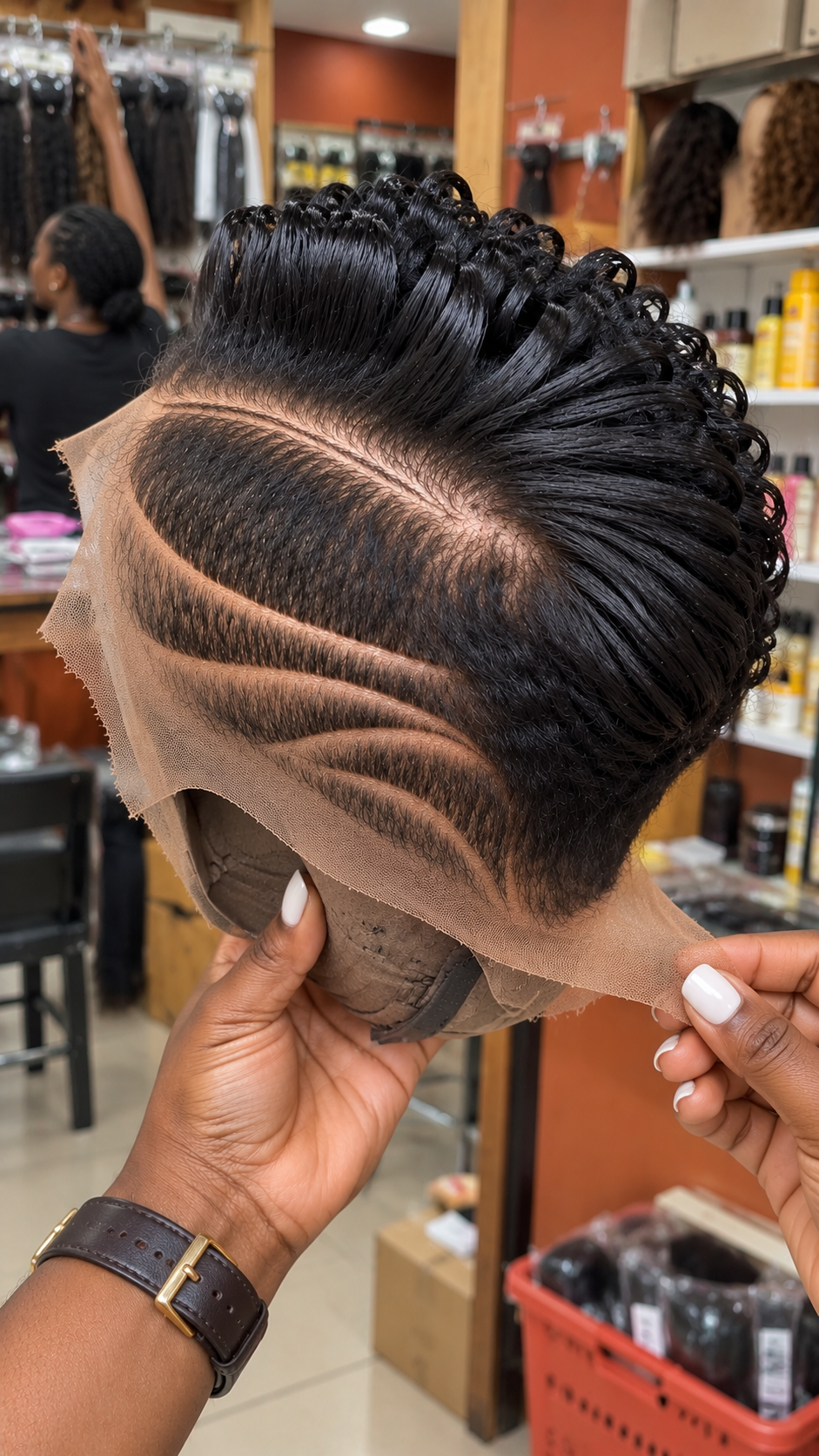
This raven-black wig puts almost all of its personality into silhouette and side geometry rather than relying on contrasting color. The photograph shows a sculpted crown made from broad backward-moving sections, a closely worked lower side, and a series of sweeping arcs that become progressively more expressive toward the lower perimeter. Because everything remains within the same deep black palette, the eye is drawn to differences in height, direction, spacing and density. It is a useful example of how a single-color wig can still carry substantial visual complexity.
The unit is photographed before installation, with generous lace extending beyond the finished hair area and the interior cap visible underneath. That makes this image particularly valuable for discussing customization. The lace has not yet been cut to a wearer’s individual hairline, while the side artwork appears to have already been established. A buyer choosing this design therefore needs to think about fitting and placement before asking a stylist or barber to make additional changes.
There is clearly lace around the perimeter, but its exact grade cannot be verified from the photograph. It would be inaccurate to advertise the unit specifically as HD lace without confirmation from the manufacturer or seller. What can confidently be discussed is the visible lace-front construction and the room available for final trimming.
A Monochrome Design Depends on Shadow and Separation
Without copper, blonde or red accents to outline individual sections, this crown has to create its own contrast. It accomplishes that through alternating raised hair and darker recessed spaces. Large black sections rise from the base, bend backward and form elongated loops. Narrow gaps remain between some of these sections, allowing the depth of the crown to stay visible even though every strand belongs to essentially the same color family.
The shine across the black hair strengthens this effect. Light catches the upper surface of each bend while the inner portions remain considerably darker. The crown can therefore appear almost striped from certain angles even though no contrasting color has been added.
This is an important consideration for anyone ordering a similar wig. A seller should not compensate for the absence of highlights by making the crown unnecessarily large. The visual interest should come from deliberate sectioning and direction. Excessive volume would change the proportions and weaken the relationship between the upper structure and close side area.
The Crown Changes Character From Front to Back
The front and middle crown contain broad sections that travel backward in long arcs. Several of them begin relatively upright before curving toward the rear. This produces visible length within each loop while keeping the overall hair compact enough to follow the shape of the cap.
Closer to the back, the arrangement becomes tighter. Smaller looped ends and curled pieces appear around the larger sections. The transition is gradual rather than abrupt, which prevents the crown from looking as though two unrelated hairstyles have been combined.
This rear construction deserves attention when requesting a custom piece. A maker could reproduce the broad front loops accurately yet simplify the back into ordinary combed hair. From a frontal photograph the difference might be difficult to detect, but the side profile would immediately lose depth.
For remote orders, ask for a crown photograph taken slightly above the wig and another from the rear three-quarter angle. Together they should reveal whether the large front sections transition into the tighter rear arrangement seen in the reference.
The Side Is Designed as a Sequence of Curves
The lower side introduces an entirely different type of movement. Instead of the vertical and backward direction found in the crown, several exposed pathways sweep horizontally and diagonally around the side. The uppermost separation establishes the boundary beneath the crown. Additional arcs appear below it, creating a layered pattern that becomes especially noticeable toward the front and lower portion of the unit.
The lines are not simply three identical marks placed beside one another. Their widths, lengths and curves differ. The upper division is long and substantial, while the lower accents create narrower channels through the compact hair. One of the lower curves bends more dramatically, giving the pattern a flowing profile rather than a rigid geometric appearance.
This difference is crucial for customization. If a barber reproduces the correct number of lines but ignores their trajectories, the wig will still look different. The reference should be treated as a map showing where each arc begins, how it travels and where it tapers.
Negative Space Does the Decorative Work
An interesting aspect of this wig is that some of its strongest design elements are actually areas where hair has been separated. The exposed pathways create contrast against the surrounding black density. This use of negative space means that line width becomes part of the styling language.
Making the channels substantially wider would dominate the side and reduce the amount of dark hair separating them. Making them too narrow could cause the arcs to disappear once the wig is worn under ordinary indoor lighting. Their proportions need to be maintained alongside the density of the surrounding hair.
For that reason, buyers should resist the temptation to request additional lines simply because the side offers room for them. More detailing would not necessarily improve this design. The current arrangement works because the arcs have enough space to remain individually readable while still forming one connected composition.
The Close Side Needs a Different Specialist Mindset
The crown behaves like styled wig hair, but the lower area borrows heavily from precision barber work. Fine black strands sit close to the foundation and create the dark surface around the arcs. Maintaining this portion requires restraint because repeated aggressive cutting can permanently reduce density.
A wig stylist who specializes primarily in longer units may be excellent at lace fitting and cap adjustment but less experienced with carved side work. Conversely, a barber who is skilled at creating lines on natural hair may not automatically understand lace, cap tension or the limitations of cutting a wig. For an expensive custom unit, finding someone comfortable with both disciplines—or coordinating two professionals—can protect the original design.
The fitting should come first. Once the cap sits correctly, the barber can see where the arcs fall relative to the wearer’s temple and ear. Only then should any refinement be considered.
Untrimmed Lace Creates a Useful Adjustment Zone
The photograph clearly shows lace extending well beyond the final hair-bearing edge. This should not be viewed as excess material that needs to be removed immediately. Before installation, it provides flexibility. A wig stylist can place the unit, check the front position, examine the side alignment and then decide exactly where trimming should occur.
The lace also continues around areas adjacent to the side artwork. Cutting too aggressively without the wig being positioned on the client could affect how comfortably the perimeter sits. A professional fitting can reduce that risk.
When purchasing online, ask whether the unit will arrive with lace uncut or pre-trimmed. Buyers who already have a trusted stylist may prefer receiving it uncut so the perimeter can be customized locally. Someone seeking a more ready-to-wear option may choose pre-trimming, but accurate measurements become even more important in that situation.
Lace shade is another point worth confirming directly with the seller. Salon lighting, flash and camera processing can alter its appearance substantially. The visible material in a photograph should not be treated as a guaranteed representation of how it will look against a particular complexion.
Cap Fit Determines Where the Artwork Lands
Cap sizing is often discussed as a comfort issue, but on this design it has an aesthetic consequence as well. The side arcs occupy precise positions. If the cap shifts because it is too loose, the pattern may sit farther forward or lower than intended. If the unit is too tight, the front can be pulled backward and change the apparent proportions between the lace boundary and crown.
Before ordering a custom version, follow the maker’s own measurement guide. Circumference may be only one of several measurements required. Front-to-nape and ear-to-ear measurements can also influence the fit depending on how the cap is constructed.
A salon consultation is useful when the buyer is unsure how to measure. A wig stylist can record the measurements and discuss whether the side design needs minor repositioning for the individual wearer before the unit is commissioned.
Commission the Geometry Before Discussing Extra Styling
A useful ordering conversation for this wig begins with structure rather than product names. Tell the maker that the unit should have a raven-black foundation, broad backward loop formations across the crown, tighter loop work toward the rear, a close lower side and multiple sweeping arcs with one prominent upper separation.
Then ask which parts will be completed before delivery. Will the crown arrive fully shaped? Are the side arcs already incorporated? Is lace trimming included? Does the quotation include cap customization? These questions expose differences between sellers that may otherwise be hidden behind similar product photographs.
When a custom maker accepts reference orders, request approval images before shipping. The most useful photograph for this particular wig is a direct side or slightly elevated side view because it reveals the crown height and line geometry simultaneously. A second image from above can verify the separation of the black crown sections.
Deciding Which Price Tier Makes Sense
This is not a design where the amount of hair alone explains the price. Labor is concentrated in the sculpted crown, close side work, line placement, front construction and final preparation. A carefully executed compact unit can therefore cost more than a much longer wig with simpler construction.
Different material tiers can still reproduce the general idea, but expectations should change with the budget. A fully customized human-hair version provides greater flexibility for future crown resetting and local refinement. A well-made synthetic version can be attractive when the buyer wants the upper structure to remain pre-set and does not expect extensive restyling.
| Purchase Level | Indicative Range | Where the Budget Is Likely to Go |
|---|---|---|
| Premium Custom | $320–$550+ | Higher-grade hair, individualized cap work, detailed loop formation, carefully mapped side arcs and professional preparation. |
| Standard Custom | $200–$340 | Prepared crown construction and deliberate side detailing with fewer individualized fitting services. |
| Basic Human Hair | $125–$220 | A restylable human-hair base that may require significant local work to reproduce the reference accurately. |
| Premium Synthetic | $80–$155 | A higher-quality pre-shaped option where the crown form may require less frequent resetting. |
| Basic Synthetic | $40–$90 | A lower-cost interpretation where line precision, lace construction or crown complexity may be reduced. |
These ranges are broad planning estimates rather than universal selling prices. Labor rates, country, hair quality, cap construction, lace selection and customization policies vary between businesses. Shipping and installation can also increase the final amount paid.
Instead of comparing totals alone, request an itemized quotation. A higher price may include side carving, crown setting and fitting preparation that a cheaper seller expects the buyer to arrange separately. Knowing that before ordering makes the comparison much more meaningful.
Daily Care Should Respect the Crown’s Section Map
The black crown may look like one continuous mass from a distance, but maintenance should treat it as a collection of separate sections. Running a brush indiscriminately through all of them can erase the gaps that produce the visible loop pattern. When adjustment is necessary, each larger section should be guided along its existing path.
Product quantity also matters. Heavy layers of oil, wax or holding product can cause neighboring sections to stick together and reduce the depth between them. A glossy appearance does not require saturating the hair. Use products compatible with the actual fiber and apply only what is necessary to restore control.
If the unit is human hair and the loops eventually require heat resetting, confirm the safe temperature first. Processing history can affect how much heat the hair tolerates. With synthetic fiber, never assume heat resistance; obtain the fiber specifications before using a heated tool.
Cleaning the Wig Without Erasing Its Architecture
Washing is one of the moments when this crown is most vulnerable to losing its arranged pattern. Before cleaning, take photographs from several angles. These provide a guide for reconstructing the sections afterward. If possible, note which loops travel backward and which smaller elements belong toward the rear.
During cleaning, avoid vigorous circular rubbing through the crown. The goal is to remove buildup while minimizing unnecessary tangling. Lace should also be handled carefully, particularly where ventilated hairs meet the front edge.
After washing, allow the unit to dry in a position that supports its overall shape. Once appropriate for the material, the crown can be returned to its original directional arrangement. Storing it on a wig stand afterward gives the larger sections room to remain elevated rather than being compressed flat.
Preserve the Arcs Instead of Constantly Deepening Them
The side detailing should be maintained differently from natural growing hair. There is no need to recut the channels routinely simply because time has passed. Hair removed from the wig is permanent, and repeatedly tracing the same pathways can gradually make them wider.
If the side begins to appear less crisp because surrounding strands have shifted, first try repositioning those strands. Actual cutting should be conservative and performed only when needed. The original reference image should remain available during maintenance appointments so the professional can compare the width and direction of each arc.
This approach also protects the dark spaces between the lines. Those spaces are essential to the composition. If repeated cutting gradually reduces them, several distinct arcs can begin to merge visually into one oversized shaved area.
What to Inspect Before Accepting the Finished Unit
Quality control for this wig can be performed without complicated terminology. Begin with the silhouette. The crown should rise enough for its broad loops to be recognizable without becoming excessively tall. Move to the rear and check that the construction becomes tighter rather than ending abruptly.
Next, examine the side. Confirm that the prominent upper separation follows a long curve and that the lower arcs remain distinct, with dark hair preserved between them. Look at the transition from the close side into the heavier crown and make sure it appears intentional rather than uneven.
Finally, inspect the practical areas that will affect installation: lace perimeter, cap fit, front density and any visible construction underneath. If the wig has been custom-made remotely, perform these checks before altering the lace whenever the seller’s return policy permits.
This raven-black design demonstrates why color is only one part of wig customization. Its identity is created through directional crown work, controlled density and negative-space geometry. For buyers, the most successful route is to commission those structural details deliberately, confirm them through multiple photographs and arrange professional fitting before irreversible trimming. For wig businesses, accurately showing these construction points gives customers a far better understanding of what they are paying for than a generic black-wig description ever could.
Search Terms
raven black loop crown wig · layered curved side arcs wig · black lace front sculpted wig · sweeping triple line wig · compact side pattern wig · backward loop crown hairpiece · uncut lace black wig · monochrome carved side wig