
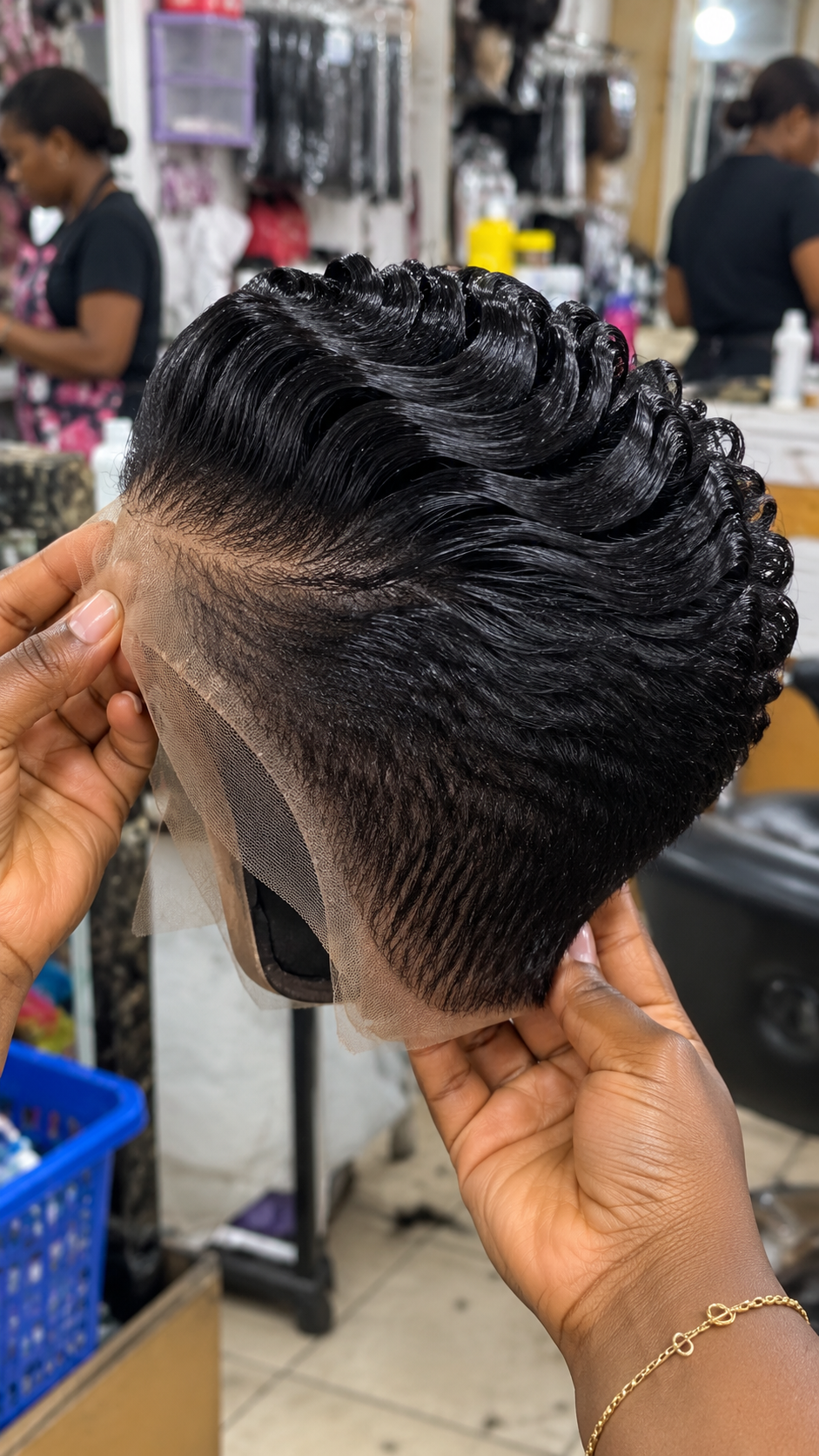
There is a particular kind of impact that comes from keeping a hairstyle entirely within one deep color family and allowing shape to provide the drama. This raven-black wig is a strong example. Instead of depending on contrasting highlights, the design uses broad sculpted waves, a lifted crown and carefully directed strands to create visible dimension. Light travels across the glossy black surface differently at every bend, making the hairstyle appear layered even though the color remains consistent from the front section through the rear.
The photographed unit also reveals much of its construction before installation. Lace extends around the perimeter, the interior cap can be seen beneath the hair, and the lower side area has been built with compact density that visually imitates a closely shaped salon cut. Above that foundation, the hair rises into wide sweeping sections. The contrast between the close lower panel and the elevated upper structure is what gives this wig its recognizable profile.
This is not simply a curled black wig. The arrangement depends on direction, spacing and controlled elevation. Anyone attempting to order a similar unit should therefore pay as much attention to the architecture of the hair as to the color itself.
Black Hair Can Show Dimension Without Added Highlights
At first glance, a single dark shade might seem less dimensional than a highlighted style. The opposite can happen when the hair has enough directional movement. Here, every ridge of the wave reflects salon lighting while every recessed section becomes naturally darker. Those alternating areas of reflection and shadow separate the individual sections without introducing another color.
The front rises upward before bending back. Farther across the crown, the movement becomes more horizontal and develops into pronounced S-shaped ridges. Near the rear, the sections tighten and gather into smaller turns. This change in scale gives the hairstyle progression rather than making every portion of the wig identical.
Raven black is also useful for emphasizing precision. Strong contrast between the hair and the visible lace makes the construction easy to inspect in a product photograph. Once properly fitted to a wearer, the dark hair can frame the face strongly while leaving jewelry, makeup and clothing choices open to many different color combinations.
A Crown Built Around Continuous Wave Direction
The upper structure is the central styling element. Large sections are shaped into repeated waves that travel across the head in a coordinated direction. They are not loose curls falling independently. Each section appears to support the movement of the next, creating a connected sequence from the lifted front toward the back.
That distinction matters when describing the design to a wig maker. Asking only for curls could produce a completely different result. A more accurate request would describe elevated front sections, broad sculpted S-waves through the crown and tighter curved movement toward the rear. The goal is controlled direction rather than random curl placement.
The amount of elevation should also remain proportionate. Too much height would change the compact character of the design, while too little height would flatten the wave ridges and reduce their visibility. A skilled stylist needs to preserve enough separation for the individual bends to catch light without creating unnecessary bulk.
The Side Profile Gives the Wig Its Identity
The lower side is visually different from the crown. Hair in this area sits much closer to the base, creating the appearance of a carefully shaped tapered panel. There are no bright color changes competing for attention, so the eye immediately notices the transition between the close side and the elevated black waves above it.
This relationship is one reason the hairstyle should be evaluated from the side before purchasing or approving a custom order. A front photograph alone would not communicate how much of the design depends on the lower profile. Ask a seller for side, back and three-quarter photographs when possible.
If a custom unit is being made, explain where you want the upper volume to begin. The transition should feel intentional rather than abrupt. The stylist should also consider the wearer’s head measurements because a cap that sits incorrectly can move this transition higher or lower than expected.
Understanding the Visible Lace and Cap
The uninstalled wig in the photograph provides a useful look at the perimeter. Lace is visibly extended beyond the hair area and part of the internal cap can be seen underneath. That gives the installer material to work with when positioning and customizing the unit.
The photograph does not provide enough information to responsibly label the material as a specific commercial lace grade. Terms such as HD lace should therefore be confirmed directly with the seller rather than assumed from appearance. Ask what lace is actually used, what color it is, how much coverage the construction provides and whether the unit arrives with the lace already customized.
The wearer’s complexion also matters. A lace color that works well for one person may require tinting or cosmetic adjustment for another. A professional wig stylist can assess the material against the skin before cutting away the excess. This is particularly important with a dark monochrome hairstyle because the perimeter can attract attention if the lace is not properly fitted.
Installation Should Protect the Sculpted Crown
A carefully arranged crown can lose its intended form if the unit is handled roughly during fitting. The installer should work around the sculpted sections instead of repeatedly pressing or pulling through them. Positioning the cap correctly before final perimeter work reduces unnecessary manipulation later.
During a salon appointment, show the stylist the original reference from multiple angles if those images are available. Explain that the wave direction is a priority. If the stylist needs to adjust the lower perimeter for the wearer, those changes should not automatically extend into the upper sections.
After fitting, examine the wig from both sides as well as the front. Check that the crown remains centered, the wave sequence still follows its intended direction and the lower profile sits naturally around the head. Small positioning differences can become obvious on a hairstyle with such deliberate geometry.
Who Can Recreate This Type of Wig?
Look for a wig stylist with experience in sculptural styling and lace customization rather than choosing only by general installation experience. The ability to install lace does not automatically mean a stylist can reconstruct broad wave ridges if the crown needs refreshing.
A wig maker may be the better first contact when the entire piece must be created from the beginning. Send the reference and ask specifically whether the maker can reproduce the compact side construction and connected wave sequence. If additional shaping is required after installation, a barber or precision-cut specialist who understands wigs may be involved as well.
Before booking, request examples of previous work involving directional waves or closely shaped wig sides. A portfolio can tell you much more than a generic service description. It also gives you an opportunity to see whether the stylist tends to create oversized crowns or understands more controlled proportions.
Ordering a Similar Unit Without Guesswork
Start with measurements. Follow the seller’s exact guide for circumference, front-to-nape length, ear-to-ear measurements and any other dimensions requested. Never substitute a guessed cap size when ordering custom work. Proper placement is essential for a design in which the crown and side profile need to align with specific areas of the head.
Next, describe the visual priorities in writing. Specify a deep raven-black appearance, elevated front movement, connected sculpted waves across the crown and a compact lower side. If the pictured lace construction is important, ask what comparable construction the maker offers rather than assuming every unit is produced the same way.
Confirm the hair material separately. A photograph cannot establish whether a unit is human hair, synthetic fiber or a blend. If you intend to use heated tools later, ask whether the actual material supports heat and request the manufacturer’s recommended temperature range.
Before paying a final balance on custom work, ask for current photographs of your finished unit. Compare its silhouette and wave direction with the reference. Color is straightforward in this example, so most of your attention should go to proportion, crown placement, perimeter construction and the relationship between the raised and close sections.
Preserving the Wave Ridges Between Wears
The crown should be protected from compression. A stand that supports the cap without stretching it is preferable to placing the wig underneath other units or storing it in an overcrowded bag. The large waves need space to retain their elevation.
Avoid brushing directly through the sculpted pattern unless the stylist specifically instructs you to dismantle and restyle it. Ordinary brushing could merge the separate ridges and remove the controlled direction that makes the design recognizable. When a section shifts slightly, targeted adjustment is usually more appropriate than combing through the entire crown.
Be conservative with styling products. The photographed surface has noticeable shine, but adding layer after layer of oil, serum or holding product can eventually make the strands heavy and reduce separation between the waves. Product choice should always match the actual hair or fiber used in the purchased unit.
Washing frequency should also depend on wear, product buildup and manufacturer instructions rather than a fixed universal schedule. If the unit requires washing, determine in advance how the crown will be reset afterward. For a highly sculpted piece, professional restyling may be worthwhile when the original wave structure begins to relax.
Pairing a Raven-Black Sculpted Wig With a Wardrobe
Because there are no contrasting highlights in the hair, clothing can provide as much or as little color as the wearer wants. Ivory, camel, chocolate and gray can create a restrained palette, while emerald, cobalt, burgundy or orange can produce stronger contrast. Metallic earrings can also stand out clearly against the dark hair.
The raised crown already provides significant visual detail, so accessories do not need to compete with it. A pair of earrings, a strong neckline or one statement accessory can be enough. For professional settings, the monochrome color can make the sculpted structure feel more restrained than the same design executed with several bright shades.
Makeup can follow a similar principle. The hairstyle does not require one particular palette. Warm neutrals, deep berry shades, classic red or softer nude combinations can all work because the hair provides a dark visual frame rather than introducing another dominant color.
Premium Custom / Standard Custom / Basic Human Hair / Premium Synthetic / Basic Synthetic
| Category | Best Reason to Consider It | Details to Verify |
|---|---|---|
| Premium Custom | For buyers prioritizing individualized cap measurements and extensive hand styling | Hair source, lace specification, cap measurements, crown construction and aftercare service |
| Standard Custom | For recreating the main silhouette with selected personalization | Available density, perimeter work, styling labor and turnaround time |
| Basic Human Hair | For buyers who want future restyling flexibility | Hair authenticity, processing history, density and recommended heat range |
| Premium Synthetic | For retaining a pre-shaped wave pattern with less frequent restyling | Fiber quality, heat tolerance, cap construction and long-term shape retention |
| Basic Synthetic | For a lower-cost interpretation of the silhouette | Fiber shine, durability, lace or front construction and maintenance requirements |
The final cost of a similar wig cannot be determined from the image. Hair material, cap size, lace specification, density, customization and styling labor can all change the price considerably. Request an itemized quote whenever possible so you know which services are included before placing an order.
A Better Way to Compare Sellers
When comparing two or three sellers, avoid judging only by the lowest number on a product page. One quote may include custom measurements, lace preparation and final styling while another may cover only the base unit. Ask each seller the same set of questions so the comparison is meaningful.
Request information about processing time, return conditions for custom items, maintenance support and whether photographs are provided before shipment. If you are ordering internationally, also consider shipping costs and any applicable import charges. For salon work, ask whether the quoted appointment includes fitting, lace trimming and final crown adjustment.
Most importantly, use the reference photograph actively during the consultation. Point to the broad black wave ridges, the lifted front and the compact lower profile. Visual communication can prevent the stylist from interpreting the request as an ordinary curly pixie or generic black wig.
What Makes This Particular Design Worth Recreating
The appeal of this unit comes from restraint. It does not need multiple colors, extremely long hair or oversized volume to attract attention. The stylist has concentrated the visual interest into the direction of the strands. Wide wave ridges create movement across the crown, while the darker recessed areas between them provide natural contrast.
That makes the design especially suitable for someone who loves statement styling but prefers a single dark color. It can look dramatic under salon lighting while remaining easy to coordinate with different outfits. From a business perspective, it is also a useful reference for demonstrating how much variation can be created within a black wig collection without relying on repeated color combinations.
For the closest recreation, preserve the characteristics that make this piece distinctive: raven-black color, lifted front sections, connected S-shaped crown movement, progressively tighter rear curves, compact side density and a lace perimeter that can be professionally fitted to the wearer. Changing too many of those elements at once would turn the design into another hairstyle entirely.
Search Terms
raven black sculpted wave wig · monochrome swept crown wig · black S-wave lace wig · raised ribbon wave crown · compact tapered side wig · visible lace perimeter unit · glossy raven wave hairstyle · directional black crown wig