
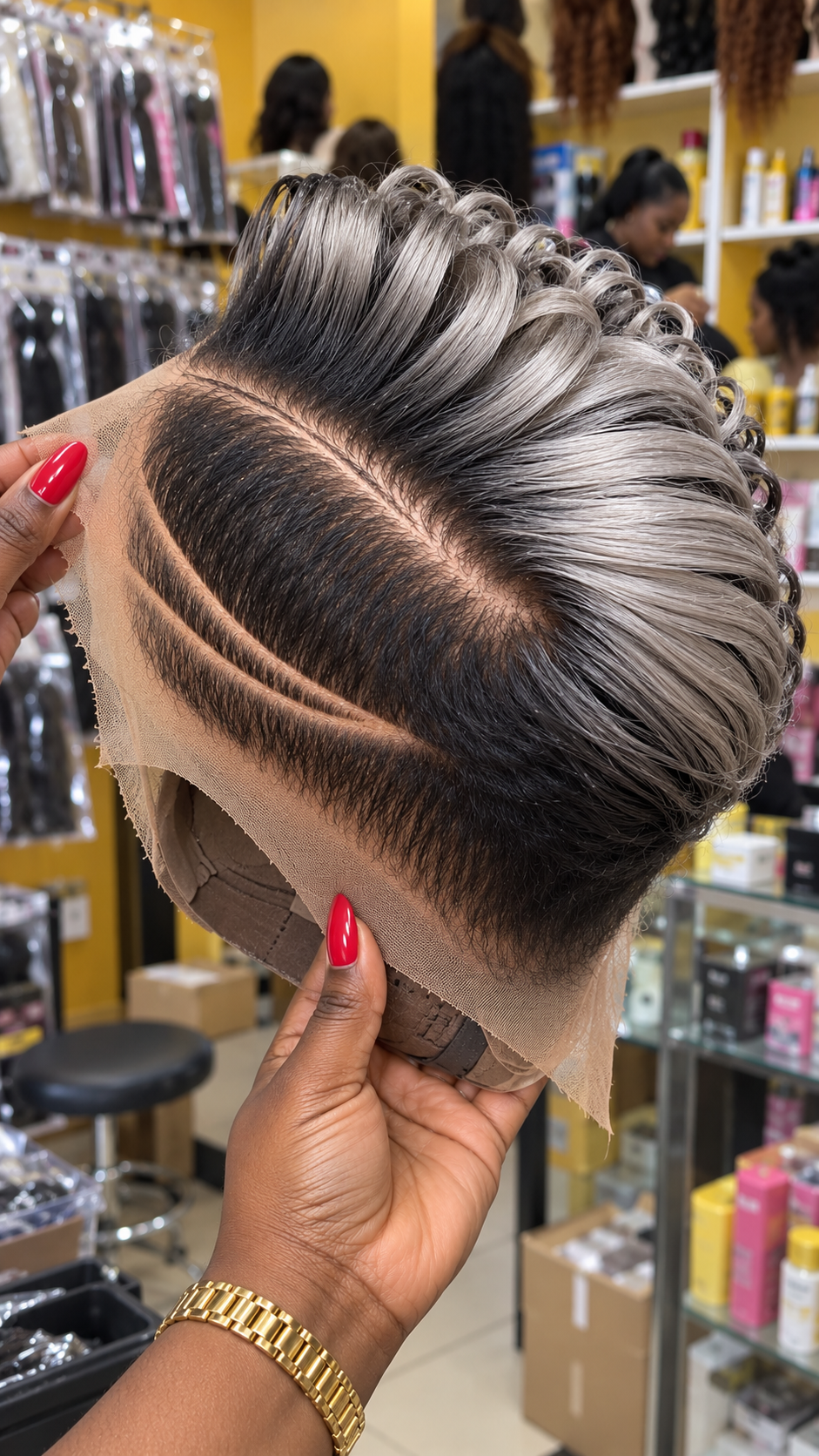
This smoky silver pixie wig combines a dark root area with cool silver lengths, broad sculpted loops, a pronounced diagonal part and two parallel line details along the close side. The photograph is especially useful for a custom order because the wig is being held away from the head, making the exterior styling, extended lace and part of the internal cap visible at the same time. Instead of relying on a generic description such as a silver pixie wig, a buyer can use the photograph to specify the exact color transition, crown direction, part placement and side detailing required.
The strongest visual feature is the transition from the dark base into cool gray and pearl-silver strands. The color does not begin as solid silver directly at the root. Darker hair remains around the part, side and lower perimeter, while increasingly lighter strands appear through the raised crown. Because the hair is arranged in broad loops, the silver catches the salon lighting across large curved surfaces and produces a highly dimensional result.
The construction of the hairstyle is equally distinctive. Wide sections rise from the diagonal part, curve backward and gradually settle toward the rear. Beneath the part, the hair remains close to the cap and carries two long parallel lines. Keeping these elements in the correct proportions is essential when recreating the look.
Smoky Roots And Pearl-Silver Lengths Create The Color Transition
The visible palette moves from very dark charcoal and black around the base into smoky gray, greige-silver and pale pearl tones through the upper strands. The brightest sections are concentrated across the outer surfaces of the loops, where the salon lighting produces an almost platinum reflection.
This is different from using one uniform gray shade across the entire wig. The darker foundation gives the crown depth and makes the silver sections easier to distinguish. It also prevents the parting area from becoming visually washed out.
When ordering, send the reference photograph and describe the desired result as a dark-root smoky silver blend. Ask the seller to show the actual available silver shades before production. Some silver fibers lean blue, others appear almost white, and others have a taupe or graphite undertone. For this reference, a neutral-to-cool smoky silver with a dark foundation is the closest visual direction.
Broad Ribbon Loops Shape The Raised Upper Section
The crown is not made from tiny curls. Instead, larger sections of hair are grouped into polished ribbon-like loops. Each section rises from the root, bends over and travels toward the rear. The repetition creates a structured ridge across the top without making the hairstyle excessively bulky.
The front sections stand more upright. Moving backward, the loops gradually become more horizontal and follow the rounded contour of the wig. This change in angle gives the crown a natural progression instead of making every section look identical.
A custom stylist should see a close photograph of this area before beginning. Request wide, separated loops with controlled backward movement. If the stylist uses tight ringlets or small spiral curls, the resulting texture will be substantially different from the photographed design.
The Long Part Creates A Clear Boundary Between Two Styling Zones
A strong diagonal part travels from the front toward the rear of the wig. Above this line, the silver sections immediately begin rising into the crown. Below it, the hair remains close and predominantly dark. The exposed part therefore performs more than a decorative function: it organizes the complete hairstyle.
The dark hair surrounding the part increases its visibility. This is another reason to preserve the darker root area rather than coloring every strand silver from the base.
Before a custom wig is styled, confirm which side should carry the part. Reversing it requires the direction of the upper loops and lower side detailing to change as well. If you are ordering remotely, mark the desired side clearly in your message to the wig maker.
Two Parallel Side Lines Give The Lower Section Its Signature Detail
Below the primary part are two narrow, closely spaced lines running across the side. These lines follow the general direction of the larger part while remaining visually separate from it. The dark surrounding hair creates enough contrast for both lines to remain visible.
This detail should be specified explicitly. Asking for a side design without mentioning the number of lines could result in a single line, three lines, a curve or a geometric pattern. For a close recreation, request two parallel lines positioned beneath the main diagonal part.
The spacing also matters. The two lines sit relatively close together and form a narrow dark strip between them. A stylist can use the reference to determine the appropriate width according to the size of the finished cap.
The Dark Lower Side Keeps The Silver Crown Visually Balanced
The close side remains considerably darker than the upper section. This gives the hairstyle a strong foundation and prevents the silver from dominating every visible area. It also makes the transition into the raised crown appear more deliberate.
Maintaining low volume below the part is important. If this area becomes too full, the parallel lines can disappear and the crown will no longer have the same contrast against the side. The stylist should preserve enough hair to keep the section natural while maintaining a close profile.
For buyers who want the reference reproduced closely, avoid adding extra color panels or additional carved patterns to this area. The double-line detail already provides a recognizable accent.
The Lace Is Visible But Its Exact Grade Must Be Confirmed
Extended lace is clearly visible around the perimeter in the photograph. This confirms that lace is incorporated into the unit, but the image does not establish its commercial specification. It would therefore be inaccurate to assume that it is HD lace solely from appearance.
Ask the seller what lace material is actually used, which shades are available and whether the lace will arrive uncut. If the wig will be professionally fitted, you can also ask the installer whether they prefer to receive the unit before the lace is trimmed.
A close-fitting pixie benefits from careful perimeter work because there is less hanging hair available to disguise the edge. Discuss lace customization and fit separately from the hairstyle itself.
Cap Fit Can Affect The Position Of Every Visible Detail
Because the diagonal part and double side lines have precise positions, correct cap sizing is important. A unit that shifts significantly on the head may cause these elements to sit farther forward or backward than intended.
Use the measurement instructions supplied by the individual wig maker. Typical measurements may include circumference, front to nape, ear to ear and temple to temple, but construction systems differ between sellers.
Ask the maker to confirm your measurements before production. For a higher-priced custom order, having a local wig stylist assist with measuring can reduce avoidable sizing mistakes.
A Detailed Order Message Should Cover More Than The Color
- Request a dark-root transition into smoky gray and pearl-silver upper strands.
- Specify broad sculpted loops rather than small ring curls.
- Confirm the direction of the long diagonal part.
- Request two parallel side lines beneath the main part.
- Keep the lower side dark and close to the cap.
- Ask what hair or fiber material will actually be used.
- Confirm the lace material and available lace shades.
- Ask whether the lace arrives uncut.
- Provide measurements according to the maker’s sizing instructions.
- Request information about the internal securing system.
- Confirm whether the crown arrives completely styled.
- Ask for care instructions specific to the silver color and hair material.
Premium Custom / Standard Custom / Basic Human Hair / Premium Synthetic / Basic Synthetic
The photograph does not provide a verified selling price or confirm the hair material, so an exact price for this particular unit cannot be stated from the image. The following ranges are general planning examples. Actual quotations can change considerably according to material, coloring method, cap construction, lace selection, density and styling labor.
| Category | General Planning Range | Main Cost Considerations |
|---|---|---|
| Premium Custom | $350–$750+ | Individual sizing, advanced silver coloring, detailed crown setting, lace work and side customization |
| Standard Custom | $220–$450 | Dark-root silver blend, custom parting, sculpted loops and double-line detailing |
| Basic Human Hair | $140–$300 | Hair grade, density, cap construction and separate professional styling |
| Premium Synthetic | $80–$180 | Higher-grade fiber, dimensional silver shades and stronger preset curl retention |
| Basic Synthetic | $45–$100 | Stock sizing, simpler color selection and fewer customization options |
Compare Silver Samples Before Approving The Final Shade
Silver can change dramatically according to lighting. A shade that appears pearl-white under bright salon lamps may look darker gray outdoors, while another may reveal blue or violet undertones. Ask the seller for photographs of the proposed color in more than one lighting condition.
Also inspect the root transition. In this reference, the contrast between the dark base and silver lengths is one of the most important visual characteristics. If the silver begins directly at the root everywhere, the finished wig will lose much of that depth.
If the wig is being custom colored, approve the shade before the stylist completes the elaborate crown setting. Correcting the color after the loops have been arranged may require significant restyling.
Choose A Stylist Who Can Reproduce Structured Loop Work
If you plan to buy a base unit and customize it locally, show this photograph to the stylist before purchasing the wig. Ask whether the available length and density are sufficient for the broad loops shown in the reference.
A stylist experienced primarily with loose curls may approach the crown differently from someone accustomed to sculpted pixie work. Ask to see examples of previous structured styles if possible. The ability to control direction and maintain separation between the loops is more important here than simply producing curl.
Discuss the double side lines during the same consultation. The crown and lower side should be planned together so that the diagonal part forms a natural boundary between them.
Ask For Approval Photos Before The Wig Is Shipped
Remote buyers should request several views of the completed unit. A side photograph should show the main part and both parallel lines clearly. An elevated angle should reveal how the silver loops travel across the crown, while a rear view should show how the upper sections finish toward the back.
Compare the amount of dark root with the original reference. Check whether the front loops stand higher and whether the sections gradually lean backward. Also make sure the silver remains dimensional rather than becoming one flat block of pale color.
These checks are much easier to make before shipping than after receiving the unit. Keep the approved photographs with your order information so they can also serve as references during future maintenance.
Storage Is Important For A Crown With Large Sculpted Sections
The looped structure can flatten if the wig is stored beneath other items or placed inside a container that presses against the crown. A suitable mannequin head or wig stand gives the upper sections room to retain their shape.
Do not brush through the loops as though they were loose everyday curls. The grouped strands are responsible for the ribbon-like appearance. Separating them can quickly change the hairstyle.
If the wig needs to be transported, ask the stylist how to support the crown. For an expensive custom piece, using a container large enough to avoid compression can save considerable restyling work.
Silver Hair Needs Material-Specific Maintenance
The photograph cannot determine whether the visible strands are human hair, synthetic fiber or another material. Maintenance instructions should therefore come from the seller after the material is confirmed.
If the unit is colored human hair, ask which products are recommended for preserving the cool silver tone. If it is synthetic, use products designed for the specific fiber. Avoid choosing care products simply because they are marketed for naturally gray hair.
Product buildup can also reduce the separation between the sculpted sections. Use finishing products sparingly and focus on preserving the direction of the strands rather than coating the crown heavily.
Heat Should Never Be Used Until The Fiber Is Identified
The polished appearance of the loops does not prove that the wig can tolerate heated tools. Some synthetic materials have strict temperature limits, while others should not be exposed to direct heat at all.
Ask the seller for the exact material specification and recommended maximum temperature. If that information cannot be obtained, have a professional wig stylist refresh the crown rather than experimenting with a curling iron or flat iron.
When a loop needs rebuilding, its size matters as much as its curl. Making the section substantially tighter will alter the continuous swept shape seen in the reference.
Search Terms
Smoky Silver Pixie Wig · Dark Root Silver Wig · Pearl Silver Loop Crown Wig · Double Side Line Pixie Wig · Deep Side Part Silver Wig · Gray Sculpted Pixie Wig · Lace Front Silver Pixie Wig · Swept Loop Crown Wig
Build The Purchase Around The Exact Details Visible Here
This wig gets its character from the relationship between color and structure. Dark roots establish depth around the part and side, while smoky silver and pearl-toned strands become increasingly visible through the raised crown. Broad loops create movement without turning the style into a conventional curly pixie, and the long diagonal part establishes a strong boundary between the elevated upper section and close lower area. Two parallel lines complete the side without overwhelming it.
The photograph also provides useful information about the unit itself. Lace is clearly visible around the perimeter, and part of the internal cap construction can be seen. Those observations can be included in an order discussion, while specifications that cannot be verified visually—especially the exact lace grade and hair material—should be confirmed directly with the seller.
Before paying for a custom version, document the preferred silver tone, root depth, loop width, crown height, part direction, number of side lines, cap measurements, lace specification and internal securing options. Confirm the production period, total cost, shipping terms and alteration policy as well. Ask whether the unit arrives fully styled and request several approval photographs before dispatch. With these details established in advance, the stylist receives a precise description of the smoky silver sculpted pixie rather than a vague request for a gray wig, making it much easier to preserve the distinctive color transition and structured crown shown in the reference.