
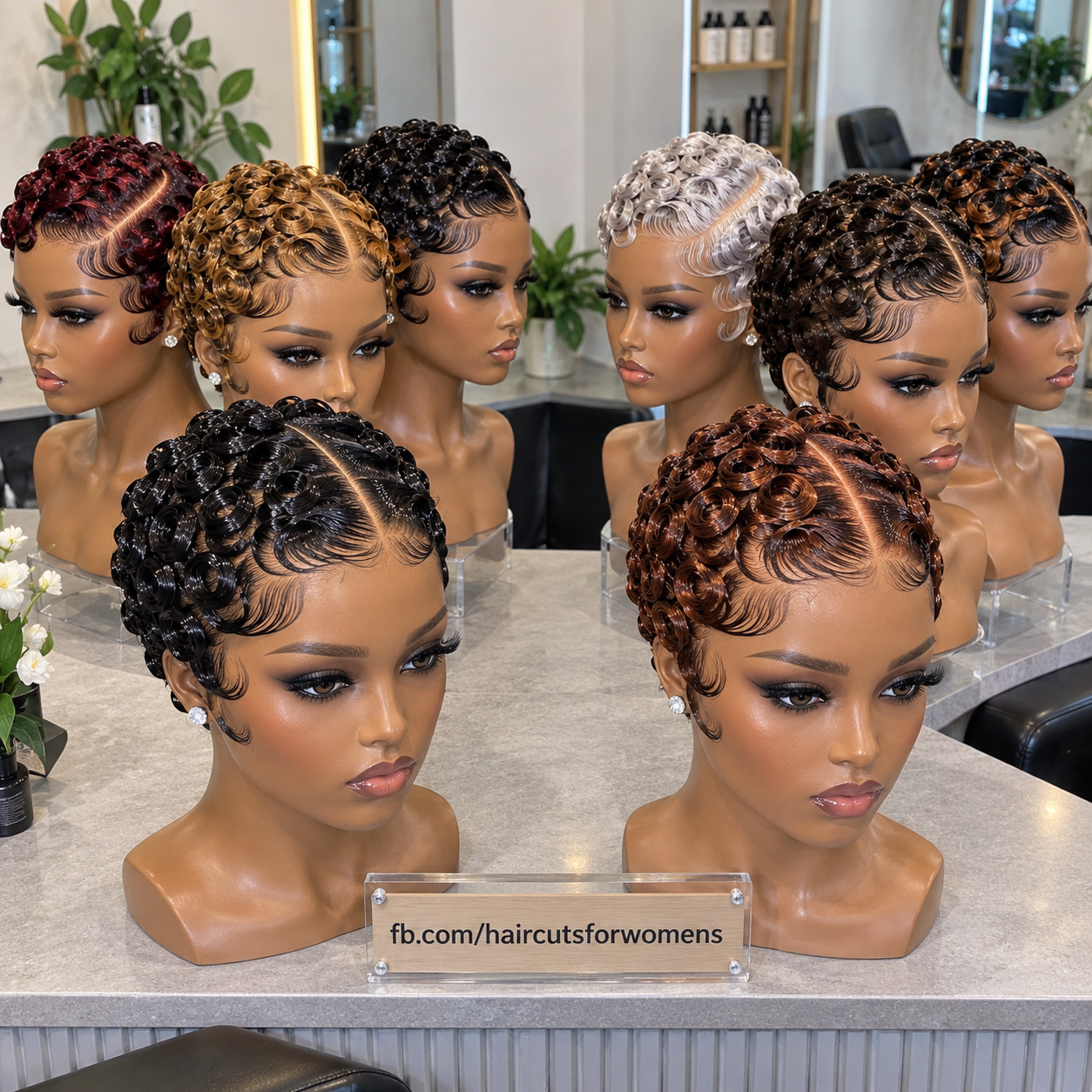
This sculpted pixie wig collection centers on one highly recognizable construction: compact glossy ring curls, a deep diagonal side part, sweeping finger-wave sections around the forehead and closely arranged curls that follow the head rather than creating excessive height. The display shows the same core idea in several color directions, including burgundy wine, golden caramel, natural deep black, pearl silver, espresso brown and warm copper brown. Because the silhouette remains consistent while the shades change, customers can compare colors without losing sight of the actual hairstyle they want to order.
Unlike a basic curly pixie, this design depends on deliberate placement. The curls are arranged as individual circular loops, the part is intentionally visible, and the hair surrounding the part is sculpted into broad curved sections. Around the temple, several smaller waves continue the movement toward the ear. These details make the wig attractive from the front and three-quarter angles, which is especially important for customers who want a pixie that photographs well from more than one position.
The image also demonstrates why a detailed reference photograph is valuable when ordering. Asking a stylist for a “curly pixie” leaves too many decisions open. Asking for compact ring curls, a diagonal side part, sculpted forehead waves, close sides and a specific color direction gives the stylist a much clearer target.
The Deep Diagonal Part Controls The Entire Composition
The most important structural detail is the diagonal part running from the front toward the crown. It separates the larger curl area from the sculpted wave section and creates a visible line through the hairstyle. Instead of hiding the part underneath dense curls, the design deliberately keeps it exposed.
This separation helps organize the crown. On one side, numerous circular curls build fullness. On the opposite side, larger curved sections lie closer to the head before transitioning into curls farther back. The result is an asymmetrical arrangement that still feels balanced.
When requesting this look, show the stylist exactly where you want the part to begin and which direction it should travel. A mirrored part can change the appearance considerably, especially when the wig will frequently be photographed from one preferred side.
Ring Curls Give The Crown Its Recognizable Shape
The upper area uses compact circular curls rather than loose spirals. Each loop has a visible center and sits close to neighboring curls, creating a dense pattern across the crown. The repeated circles produce depth because light reaches the raised edges while the inner sections remain darker.
The curls are concentrated without becoming oversized. That balance is important. If the loops are made much larger, the wig can lose the compact pixie silhouette. If they are made extremely small, the individual ring pattern becomes harder to see. A medium-small curl diameter similar to the reference provides a useful middle ground.
For custom orders, ask whether the stylist sets these curls individually or works from a pre-curled base. The method can influence the amount of control available over curl direction and placement.
Sculpted Forehead Waves Add Movement Below The Curls
The forehead area is not simply filled with more circular curls. Instead, several elongated wave sections sweep downward and outward from the diagonal part. These sections create a visual bridge between the crown and the temple.
The wave pattern becomes particularly noticeable on the front mannequins because the styling follows the forehead contour. This gives the wig a more intentional appearance than a crown where curls continue unchanged all the way to the perimeter.
Customers recreating the design should specifically mention the broad finger-wave effect around the front. If this detail is omitted from the order description, a stylist may create a conventional curled perimeter instead, producing a noticeably different result.
Burgundy Wine Creates A Rich High-Impact Version
The burgundy variation uses deep red and wine tones across the ring curls. Because darker areas remain between the loops, the crown retains depth rather than becoming a single block of red. The shade also works well with the sculpted front because reflected burgundy tones follow the direction of the waves.
Color terminology can vary between sellers. One shop may call this burgundy, another wine red, and another dark cherry. Customers ordering online should therefore request an actual color photograph instead of choosing solely from the shade name.
If you want the darker appearance shown in the reference, explain that you prefer a deep wine direction rather than a bright primary red. Ask how the color looks in daylight as well as indoor salon lighting.
Golden Caramel Makes Every Curl Easy To See
The golden caramel version strongly emphasizes the circular construction. Lighter strands catch the light around each loop, making the curl pattern visible even at a smaller viewing size. Deeper areas beneath the curls provide enough contrast to prevent the crown from looking flat.
This type of dimensional warm shade can be useful for customers who want noticeable color while staying within brown and golden families. Depending on the seller’s color system, similar shades may be described as caramel, honey brown, golden brown or warm blonde-brown.
When ordering, specify whether you want the entire crown lighter or prefer a deeper base with golden accents. Those two approaches can produce very different results even when both are sold under a caramel label.
Pearl Silver Creates A Bright Contrast Around The Part
The pearl-silver variation immediately draws attention to the part and sculpted wave sections. The pale curls reflect substantially more light than the darker versions, so the circular pattern becomes especially prominent.
Silver colors can shift visually according to lighting. A unit may appear platinum in bright daylight, pearl indoors or slightly smoky under cooler lighting. Customers should ask for current photographs of the actual material whenever exact color is important.
The reference suggests a pale silver direction rather than a dark charcoal shade. If ordering from a stylist, include the photograph and ask for confirmation before coloring begins.
Warm Copper Brown Brings Depth To The Circular Crown
Warm copper-brown versions combine reddish warmth with deeper brown undertones. This color direction complements the glossy ring pattern because highlights naturally appear on the raised sections of each curl.
Customers who find bright copper too vivid can ask for a deeper copper-brown or cinnamon-brown result. The additional brown keeps the color rich while still allowing the copper reflection to appear under light.
For a coordinated collection, this shade also sits naturally between burgundy and golden caramel. A wig seller can therefore present several warm options without making every unit look like a completely unrelated design.
Espresso Brown Offers A Softer Alternative To Very Dark Shades
One useful option for customers who prefer depth without relying on the same darkest shade repeatedly is espresso brown. Under indoor lighting, espresso can appear nearly black in shadow while revealing brown reflections across the ring curls.
This is especially attractive on highly polished curls because the highlights help reveal the circular pattern. Customers should ask whether the seller offers dark brown, espresso or soft-black alternatives and compare actual swatches before choosing.
Using a rich brown also works well with caramel accents when a two-tone variation is desired. A stylist can keep the foundation deep and introduce lighter pieces through selected curls rather than changing the entire crown.
Why The Front Two Wigs Are Useful Ordering References
The two front mannequins provide a particularly clear view of the construction. Their diagonal parts, circular crown curls, temple waves and perimeter styling can all be seen without obstruction. Customers should save a similarly clear angle when communicating with a wig maker.
It is helpful to provide more than one reference whenever possible. A front photograph communicates symmetry and crown placement, while a three-quarter image shows the depth of the part and the direction of the side waves. A profile image can clarify how closely the sides should sit.
Detailed references reduce misunderstandings, especially when the hairstyle combines several techniques in one compact design.
What To Confirm Before Paying For A Custom Unit
- Exact crown curl diameter and overall curl density
- Direction and starting point of the diagonal side part
- Placement of the sweeping forehead waves
- How closely the side sections will sit to the head
- Preferred burgundy, copper, caramel, silver, espresso or natural dark shade
- Whether dimensional color requires an additional coloring fee
- Hair or fiber material used to construct the wig
- Cap measurements and available sizing options
- Whether final curl setting is included in the purchase price
- Estimated customization and dispatch time
- Care instructions for preserving the circular curls
- Return or alteration rules for personalized orders
Premium Custom / Standard Custom / Basic Human Hair / Premium Synthetic / Basic Synthetic
No selling price is visible in the photograph, so an exact price for these units cannot be determined from the image. The figures below are general planning ranges only. Actual quotes can vary considerably according to material, cap construction, coloring work, curl setting, labor and seller location.
| Wig Category | General Planning Range | Typical Cost Considerations |
|---|---|---|
| Premium Custom | $350–$750+ | Individual sizing, advanced coloring, extensive hand styling and detailed perimeter work |
| Standard Custom | $220–$450 | Custom shade, diagonal part, ring-curl setting and sculpted wave work |
| Basic Human Hair | $140–$300 | Hair grade, density, cap type and amount of finishing work |
| Premium Synthetic | $80–$180 | Higher-grade fiber, color blending and stronger curl retention |
| Basic Synthetic | $45–$100 | Preset fiber colors, standard sizing and limited customization |
Ordering From A Local Salon Versus An Online Wig Maker
A local salon offers the advantage of an in-person consultation. You can show the reference, discuss the side-part direction, compare color samples and have your measurements checked before production. A local stylist can also evaluate the finished unit on your head and make minor adjustments when appropriate.
An online wig maker can offer more choice, particularly if the seller specializes in sculpted pixie units. Before ordering remotely, examine recent examples of comparable work. Look for clear photographs showing the front, sides and crown rather than relying on heavily cropped promotional images.
Ask the seller to confirm which parts of the reference can be recreated. Also confirm whether color customization, curl setting and final styling are included or charged separately. Keep the written order details so both parties have the same specification.
Protecting The Circular Curl Pattern After Purchase
These curls depend on their individual loop shapes, so aggressive brushing should be avoided unless the wig maker specifically recommends it. Pulling a brush through the crown can separate the circular sections and change the overall silhouette.
Store the wig on a suitable stand or mannequin head with enough space around the crown. Avoid placing heavy objects over the upper section during storage or travel. Compression can flatten the loops and require additional resetting.
Product choice should depend on whether the unit is human hair or synthetic fiber. Do not assume that a styling product or heat setting suitable for one material is safe for another. Request written care instructions from the seller, particularly if heat may be required to restore the curl pattern.
Using Color Variety Without Losing The Signature Style
For wig businesses, this image demonstrates a useful collection-building approach. The hairstyle does not need to be redesigned for every color. Keeping the diagonal part, circular crown, forehead waves and compact silhouette consistent creates a recognizable product family.
Color can then become the main customer choice. One buyer may prefer burgundy wine, another pearl silver, while another may choose espresso brown or golden caramel. This gives customers variety while making product photography and ordering options easier to organize.
Sellers can also introduce limited combinations such as espresso with caramel accents, deep brown with copper highlights or dark roots with pearl-silver curls. Each variation should still preserve the visual structure that makes the original design recognizable.
Search Terms
Deep Side Part Ring Curl Wig · Burgundy Wine Pixie Wig · Golden Caramel Curl Wig · Pearl Silver Pixie Wig · Espresso Brown Ring Curl Wig · Copper Brown Sculpted Pixie · Finger Wave Side Part Wig · Glossy Circular Curl Pixie Wig
How To Brief A Stylist For The Closest Result
Start by showing the stylist the reference photograph and identify the exact mannequin whose color you prefer. Then describe the structural elements separately: compact circular curls across the crown, a clearly visible diagonal part, broad sculpted waves near the forehead and close-fitting side sections.
Next, confirm color. Avoid vague requests such as “brown with highlights” when the reference contains a very specific warm direction. Ask to see available color rings, fiber samples or photographs of previous units in comparable shades.
Finally, discuss maintenance. Ask how the curls should be refreshed, whether the wave sections can be reset, which products are recommended and how the unit should be stored. A good consultation should cover the hairstyle after purchase as well as the initial appearance.
A Strong Pixie Collection Built Around Parting And Curl Placement
What gives this collection its identity is not simply the range of colors. The real foundation is the relationship between the diagonal part, circular crown and sweeping wave sections. Those elements remain recognizable whether the unit is burgundy, caramel, silver, copper, espresso or another deep shade.
The color choices then change the visual emphasis. Pearl silver makes every loop highly visible, burgundy adds depth and richness, caramel catches warm light, copper introduces reddish warmth and espresso keeps attention on the sculpted shape. This makes the hairstyle adaptable without requiring customers to sacrifice its signature construction.
For the closest custom result, provide the reference before placing the order, confirm the curl size and part direction, choose the color from an actual seller sample, supply accurate cap measurements and request photographs of comparable work. A careful consultation with a salon, barber experienced in wig detailing or specialist wig stylist is the most practical way to translate this highly sculpted pixie concept into a wearable custom unit.