
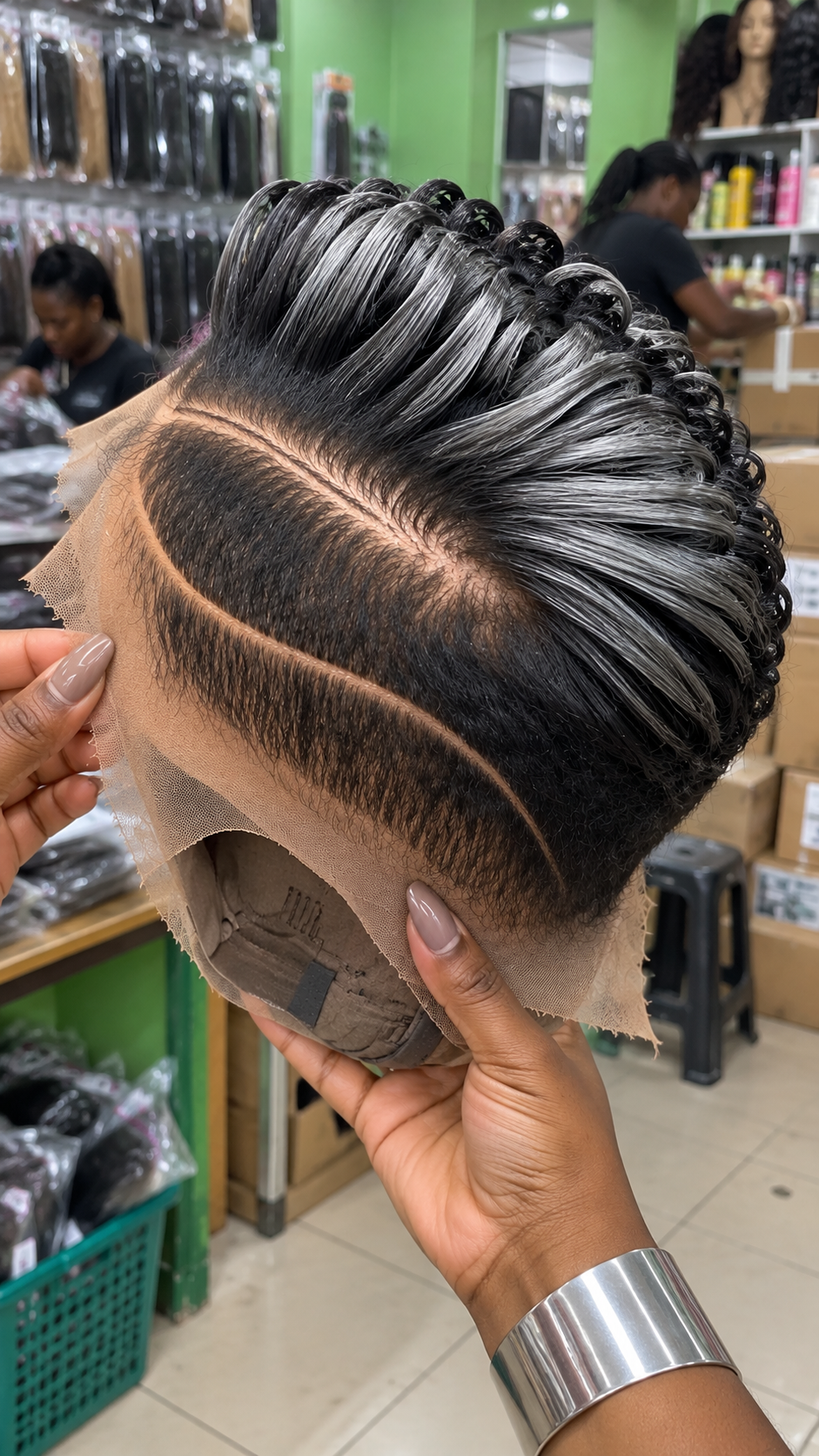
This raven black sculpted wig is built around contrast: a high, glossy looped crown sits above a much flatter side section, while one long curved separation line creates a strong visual boundary between the two areas. The result is a compact pixie-inspired unit that looks highly structured without relying on extra length or oversized volume.
The photograph is especially valuable because the unit is being held before installation. The lace perimeter, close side section, curved parting and crown construction can all be examined clearly. Instead of hiding the technical work beneath a finished salon presentation, this angle shows how the stylist has organized the hair to create the final silhouette.
For customers ordering a similar wig, the important request is not simply “black curly wig.” The crown height, loop direction, side sweep, density distribution and long curved separation all need to be communicated separately. Those details are what distinguish this design from a conventional curly pixie.
Raven Black Creates Strong Contrast Between Shine and Separation
The hair appears as a rich raven black with a highly reflective surface. Under salon lighting, individual strands produce silver-like highlights, but the underlying color remains consistently dark. This reflective quality makes every bend in the crown visible and emphasizes the directional styling through the side.
A single dark shade works particularly well here because the architecture of the hairstyle provides the visual interest. There is no need for multiple colors to reveal the shape: light naturally travels across the curved strands and creates alternating bright and dark areas.
If ordering this look, ask the stylist for a rich natural-looking black rather than assuming every black shade will photograph identically. Fiber type, human-hair processing and finishing products can all affect the final depth and reflectivity.
The Raised Crown Is Built From Long Sculpted Loops
The upper section is dominated by elongated loops rather than tiny coils. Near the front and center, the strands rise vertically before folding backward. As the pattern moves toward the rear, the loops become more directional and begin to follow the rounded contour of the wig.
This creates height without making the crown appear excessively wide. The volume is concentrated upward and backward, leaving the lower side compact. It is a useful construction choice for customers who want visible curl detail while keeping the overall silhouette controlled.
When commissioning the unit, specify elongated sculpted loops with visible strand separation. Generic instructions such as “tight curls” may produce a completely different texture and silhouette.
A Sweeping Diagonal Part Controls the Entire Profile
The most recognizable structural element is the long curved separation running from the front toward the rear. It divides the elevated crown from the close side panel and gives the design a strong directional flow.
The line is not completely straight. Its gentle curve follows the contour of the wig, which makes it appear integrated into the hairstyle rather than added as an isolated detail. Hair immediately above the separation is directed upward into the crown, while hair below it is pressed into a flatter sweep.
This contrast helps the part remain visible even when viewed from several feet away. For a custom order, include a side reference photograph and specify which side should carry the separation.
The Side Panel Uses Broad Finger-Wave Movement
Below the diagonal part, the hair is shaped into broad, flowing waves. The strands lie close to the base and move backward in coordinated sections. This area provides a visual pause beneath the highly active loop pattern above.
The side is particularly important because excessive volume here would blur the separation and make the wig appear rounder. Keeping this section flatter allows the crown to remain the dominant feature.
A stylist recreating the design should treat the side as sculpted directional hair rather than a second curly section. Product application, controlled combing and careful drying or setting may be required depending on the hair material.
The Lower Edge Stays Dense Without Becoming Bulky
The lower side and rear retain enough hair to create a believable transition into the crown. At the same time, the density appears restrained enough that the profile does not become heavy around the perimeter.
This balance matters when adapting the design to different head sizes. A wig with too much density in the lower zone may sit outward instead of following the wearer’s head. A custom wig maker should therefore consider crown density and perimeter density separately.
During a consultation, ask whether the stylist can adjust density by section. Showing this photograph can help communicate the desired relationship between the full upper loops and the flatter lower structure.
Visible Lace Shows the Unit Before Final Fitting
The lace extends beyond the styled perimeter in the photograph, indicating that final trimming and wearer-specific finishing still need to take place. This is useful from a purchasing perspective because customers can see that the photographed piece is a constructed wig rather than only a finished hairstyle on a client.
The image does not provide enough information to verify a specific commercial lace grade, so buyers should ask the seller directly about lace type, shade and construction. It is also worth confirming whether the unit arrives with the lace untrimmed or whether perimeter customization is included.
For professional installation, bring the wig to a stylist before cutting away excessive lace yourself. Once too much material has been removed, correcting the perimeter can be difficult.
What to Include in Your Custom Wig Request
- Rich raven black overall color.
- Elongated glossy loops concentrated through the crown.
- High crown with a compact lower silhouette.
- One long curved diagonal separation through the side.
- Broad directional finger-wave styling below the separation.
- Controlled density around the lower side and rear.
- Visible strand definition throughout the sculpted sections.
- Lace and cap measurements selected for the individual wearer.
Reference photographs should accompany these instructions. If possible, send both an overall image and a close side view so the stylist can see the relationship between the crown and the sweeping lower section.
Choosing a Wig Stylist for This Type of Sculpting
This design requires a different skill set from long straight, body-wave or loose-curly wigs. Look for a stylist whose portfolio includes sculpted pixies, finger waves, molded sections, loop curls and detailed side work.
Examine photographs from multiple angles rather than judging only frontal images. Side photographs reveal whether the stylist can keep separation lines crisp, maintain consistent strand direction and control density near the perimeter.
Before booking, ask whether coloring, construction, styling and installation are included in the quoted service. Some wig makers provide the finished unit while another stylist performs the final fitting, so understanding the workflow beforehand prevents confusion.
Price Guide for a Sculpted Raven Black Custom Wig
| Wig Category | Estimated Range | Typical Scope |
|---|---|---|
| Premium Custom | $390–$740+ | Higher-grade hair, personalized cap sizing, detailed crown sculpting, side-wave work and professional finishing |
| Standard Custom | $245–$420 | Custom sizing with hand-shaped loops, curved parting and directional side styling |
| Basic Human Hair | $165–$280 | Human-hair foundation with simplified sculpting and standard cap construction |
| Premium Synthetic | $100–$185 | Higher-quality fiber with preset curl structure and selected custom shaping |
| Basic Synthetic | $60–$125 | Budget interpretation with less individualized construction and styling |
These ranges are general estimates rather than a quotation for the exact wig pictured. Hair source, cap construction, location, stylist experience, installation and the amount of hand shaping required can significantly affect the final price.
Ordering Steps That Protect the Final Shape
Start with accurate head measurements and send the reference image before paying a deposit. Confirm the desired side for the curved separation, overall color, crown height and approximate density. Ask whether the stylist plans to reproduce the elongated loop pattern by hand or use a preset curl foundation.
Next, clarify the lace shade and cap construction. If the wig will be shipped, request photographs of the completed unit from the front, side and rear before dispatch. A side photograph is particularly important for this design because it allows you to check the diagonal separation and crown profile.
Finally, decide whether installation will be performed by the wig maker or by a local salon. If a second stylist handles installation, provide that stylist with the same reference photograph so the crown is not flattened or redirected during fitting.
Keeping the Sculpted Crown Intact Between Wears
The looped crown should be stored without pressure from above. Avoid placing the unit underneath other wigs or inside a container that compresses the loops. An appropriately sized wig stand can help retain the rounded structure.
Do not brush through the loops as though they were loose curls. The individual sections are intentionally arranged, and aggressive brushing can destroy the pattern. Small areas can be separated carefully with the fingers, while larger corrections are better left to a stylist.
Before applying heat, confirm that the hair or fiber can tolerate it. Product buildup can also reduce the reflective strand definition visible in the photograph, so use styling products sparingly and follow the wig maker’s maintenance instructions.
Why This Construction Has Strong Wig-Business Appeal
For a wig business, this type of unit photographs well because customers can immediately identify several handcrafted elements. The tall looped crown catches light, the sweeping side reveals directional styling, and the diagonal part gives the piece a recognizable signature from profile angles.
The basic construction can also support additional color editions without changing the hairstyle itself. Espresso brown, smoky graphite, cinnamon brown or burgundy variations could create distinct collections while preserving the same crown and side architecture.
Product listings should include close photographs of the lace, side separation and crown texture in addition to a finished installation. Showing the construction helps customers understand why a highly sculpted custom unit may cost more than a standard machine-styled wig.
Search Terms
raven black sculpted pixie wig · glossy loop curl wig · curved side part wig · finger wave side panel wig · lace pixie curl unit · elevated loop crown wig · diagonal part curly wig · sculpted black pixie unit