
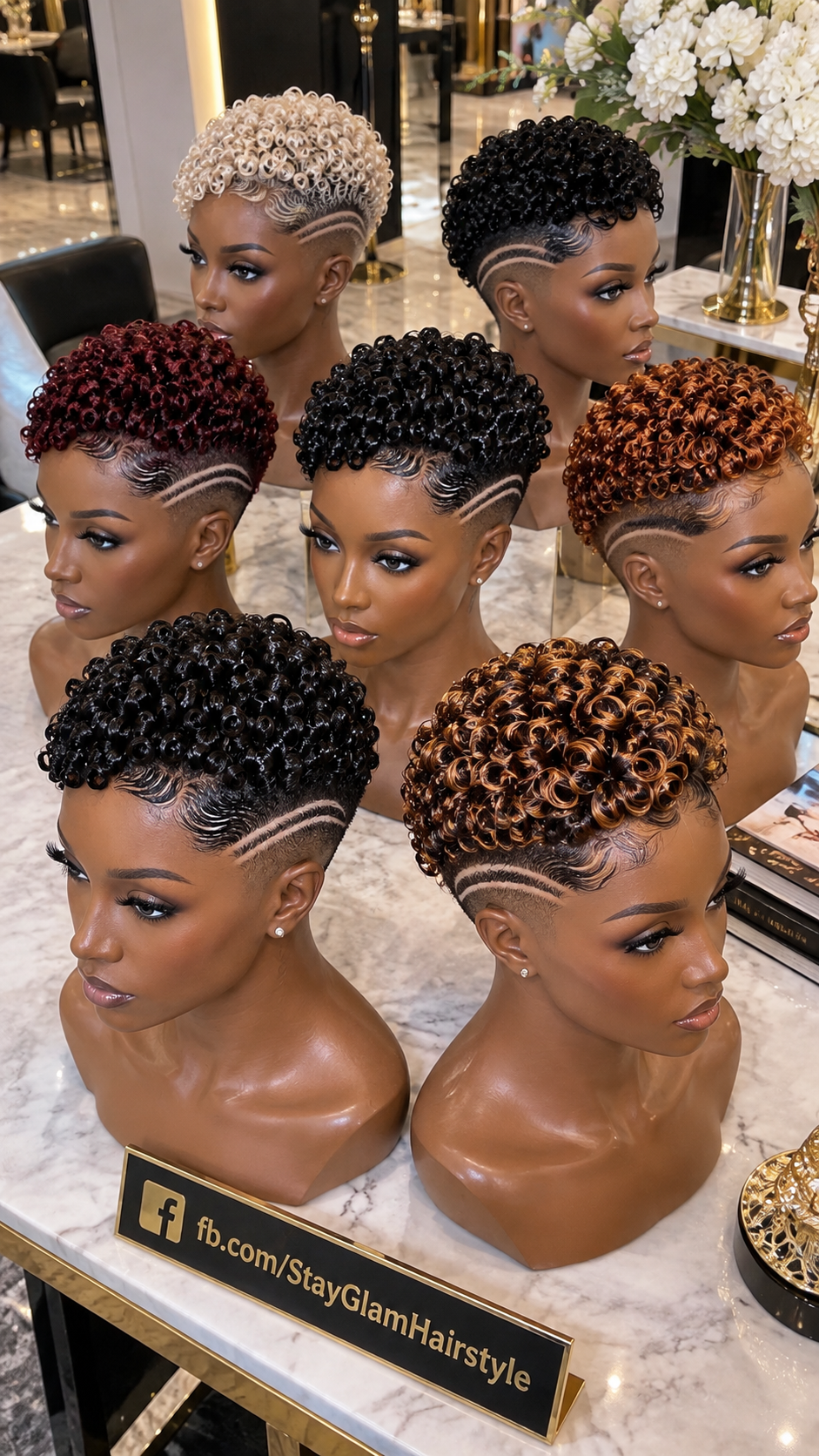
This six-piece pixie wig collection pairs dense glossy ringlet crowns with extremely close tapered sides and two sweeping curved line details. The display includes jet black, burgundy, platinum blonde, copper auburn and black-to-caramel color variations. Although the shades change from one unit to another, the construction stays closely related: compact curls dominate the upper crown while the sides are reduced dramatically to expose the curved detailing.
Compared with pixie wigs that rely on a deep side part or long finger-wave panel, these units place much more emphasis on the contrast between the rounded curl crown and the barber-inspired side. The result is a strong profile that can be appreciated from the front, side and three-quarter angles.
Small Ringlets Create a Full Rounded Crown
The upper sections contain numerous compact ringlets arranged very close together. Most curls form small circular or spiral openings rather than large loose loops. Their concentrated placement produces substantial fullness while keeping the overall length controlled.
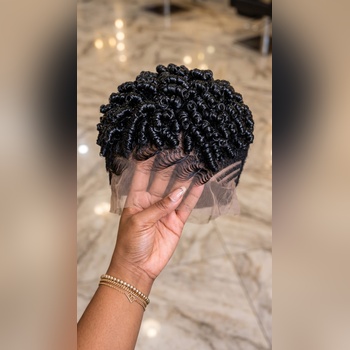
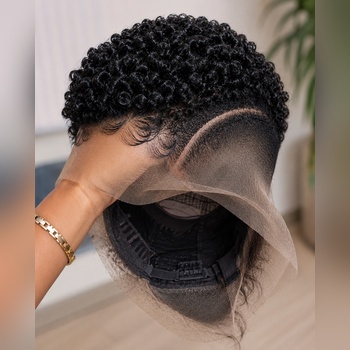
The curl diameters vary slightly throughout the crown. Larger circular sections are mixed with tighter coils, preventing the surface from looking repetitive. This variation also helps light move differently across neighboring curls.
When requesting a similar unit, describe the crown as densely packed polished ringlets with compact circular openings. Avoid requesting loose curls if the goal is to reproduce this particular structure.
The Crown Carries More Volume Than the Lower Sides
A major feature of these wigs is the dramatic difference in density between the top and perimeter. The ringlet crown remains thick and rounded, while the hair around the temple and ear is kept extremely close.
This difference makes the upper curls appear more substantial without requiring excessive height. It also prevents the wig from becoming bulky around the sides.
For custom work, the stylist should establish the desired crown width before reducing the side density. Both areas need to be planned together to maintain the proportions visible in the reference.
Double Curved Lines Define the Side Profile
Two narrow exposed lines sweep backward through the close side panel. Rather than running perfectly straight, both follow the natural curve of the head.
The upper line sits directly beneath the transition from the ringlet crown, while the second curve follows underneath with a relatively consistent gap between them. A strip of closely cropped hair remains visible between the two.
For an accurate recreation, request two slim parallel curved side lines with visible tapered hair separating them. The lines should not be merged into one wide exposed section.
The Side Design Changes Slightly Between Units
Although the collection follows one overall concept, the visible side detailing is not perfectly identical on every wig. Some curves appear longer and more pronounced, while others become narrower toward the rear.
This slight variation prevents the display from looking like six exact copies in different colors. It also demonstrates how the basic double-line idea can be adjusted while maintaining the same overall character.
When ordering, select one specific mannequin as the reference for line placement rather than asking the stylist to combine several different side patterns.
Jet Black Gives the Curls Maximum Contrast
The jet black units rely on light reflection rather than color variation. Their curl centers remain deep and shadowed while narrow highlights travel around the polished outer surfaces.
This contrast makes individual ringlets visible even when the crown is extremely dense. The dark color also creates a strong backdrop for the exposed side lines.
If choosing jet black, preserving curl separation is more important than introducing additional highlights. The construction already supplies considerable visual dimension.
Burgundy Adds Deep Berry Red Dimension
The burgundy version introduces a saturated wine-red direction through the ringlet crown. Raised sections reflect brighter berry and cherry tones while recessed curls remain considerably darker.
The close side appears deeper than the brightest crown sections, strengthening the difference between the upper curls and tapered perimeter.
For a custom order, show the color reference directly. A bright primary red would not reproduce the deep burgundy character visible here.
Platinum Blonde Reveals Every Small Curl
The lightest unit uses a pale platinum or creamy blonde direction. Because the strands are so light, the construction of the crown becomes particularly easy to examine.
Individual circular curls remain visible across the front, top and rear. Fine darker shadows inside the curl openings keep the pale crown from appearing completely flat.
Human-hair versions in this color may require significant processing, so buyers should ask about hair quality, coloring history and recommended care before ordering.
Copper Auburn Creates a Rich Warm Crown
The copper-auburn variation uses warm red-brown strands that become brighter along the raised surfaces of the curls. Shadowed sections retain deeper cinnamon and auburn tones.
This tonal movement naturally emphasizes the ringlet construction. Each curl changes from darker brown to brighter copper as it turns toward the light.
For a custom colorist, describe the target as rich copper auburn rather than bright orange copper.
Black And Caramel Ribbons Add Two-Tone Movement
One variation combines a dark foundation with warm caramel ribbons distributed through selected ringlets. Instead of coloring entire sections blonde, the lighter strands travel through the circular curls.
This placement allows the caramel color to reveal the direction of individual ringlets. Black remains dominant between the lighter sections, preventing the crown from becoming uniformly brown.
Ask for selective caramel ribbons over a dark foundation if you want this two-tone effect reproduced.
Fine Temple Waves Soften the Transition
Immediately above the curved side lines, fine strands are molded into small sweeping waves. These sections bridge the visual gap between the raised ringlets and the extremely close taper.
The waves are flatter than the crown curls and follow the contour of the temple. Their controlled direction adds detail without competing with the double-line pattern underneath.
A stylist should preserve these fine transitional strands rather than cutting the entire side to one uniform length.
The Lower Taper Follows the Ear Contour
Below the double lines, the hair becomes progressively closer as it approaches the ear and lower perimeter. This produces a clean tapered shape rather than an abrupt block of hair.
The compact lower section is especially visible on the mannequins positioned toward the front of the display. It creates enough negative space for the line pattern to remain clear from a distance.
During fitting, check that the taper sits at the intended height because cap placement can affect where the decorative lines appear relative to the wearer’s temple and ear.
The Back Remains Compact Beneath the Curl Crown
The ringlets continue toward the rear, but the lower back remains considerably closer. This creates a rounded upper silhouette with a narrow base.
The transition should be gradual. A sudden shelf between the curled top and tapered back would change the profile and make the crown appear disconnected.
For remote custom orders, request a rear three-quarter approval photograph in addition to the frontal and side views.
Reflective Hair Makes the Ringlets Stand Apart
The collection shows mirror-like glossy hair, silky reflective finish, healthy wet-look shine, individually visible strands and ultra-defined texture. This polished finish is particularly useful with a dense ringlet crown because it prevents neighboring curls from visually merging.
Black curls show narrow bright reflections, while copper, caramel and blonde versions display stronger tonal changes around their circular surfaces.
A lightweight finishing product is preferable for maintenance. Heavy oils can collect between tightly packed curls and reduce their separation.
How to Request This Construction From a Stylist
Begin by asking for a compact crown filled with small glossy ringlets. Explain that the curls should remain individually visible and should not be stretched into large loose spirals.
Next, request a close side taper containing two narrow curved lines. Fine sculpted temple strands should remain between the crown and the exposed side design.
Finally, choose one of the color directions and provide the specific mannequin image as a reference. Keeping the color request separate from the structural instructions can make the consultation easier.
Choosing a Salon for This Type of Pixie Wig
Look for a stylist experienced with wig customization, compact curl setting and precision tapered sides. Portfolios containing pixie units with barber-inspired detailing are particularly relevant.
Send the reference before booking and ask whether the stylist performs the complete service. Some wig specialists may set the crown but prefer a barber or another stylist to complete precision side work.
If you already own a wig, provide photographs of its current length and density so the stylist can determine whether the unit can support this construction.
Finding a Similar Wig to Purchase
Custom wig studios, independent wig makers and specialist pixie sellers are useful places to search. Focus on sellers that show detailed profile photographs because the side design is an important part of this style.
Send the reference and specify compact ringlets, close tapered sides, double curved lines and the exact color direction you prefer.
Ask whether the wig arrives fully styled or whether additional local customization will be necessary after delivery.
Ordering and Booking Steps
Choose the hair material and preferred color before submitting the measurements requested by the wig maker. Confirm which side should display the curved detailing and whether the reference should be reproduced directly or mirrored.
Discuss ringlet size, crown density and taper depth individually. Specify that the two exposed lines must remain narrow with visible hair between them.
Before payment, confirm cap construction, styling services and production time. For a made-to-order wig, request side and rear photographs before shipment whenever approval images are offered.
Price Guide for Comparable Custom Ringlet Pixie Wigs
| Category | Estimated Range | Typical Configuration |
|---|---|---|
| Premium Custom | $475–$950+ | Premium human hair, custom color work, extensive ringlet setting, precision taper and detailed curved side lines |
| Standard Custom | $275–$525 | Human-hair pixie with compact ringlet crown, close taper and professional side detailing |
| Basic Human Hair | $150–$310 | Human-hair foundation requiring additional ringlet setting, tapering or color customization |
| Premium Synthetic | $90–$195 | Higher-grade fiber with pre-set compact curls and stronger ringlet retention |
| Basic Synthetic | $45–$105 | Entry-level fiber option with simpler curl formation and limited side customization |
These ranges are general estimates for comparable custom work and are not prices for the exact wigs pictured. Hair quality, coloring, cap construction, stylist experience and location can all affect the final cost.
Inspect the Curl Pattern Before Final Approval
Check that individual circular ringlets remain visible across the crown. The upper section should look dense without turning into one undefined curly surface.
Also inspect the transition near the temple. Smaller sculpted strands should connect the ringlets with the tapered side rather than leaving an abrupt boundary.
On highlighted units, confirm that the lighter color follows selected curls instead of appearing as random patches.
Preserving the Curved Side Design
The two exposed lines should remain narrow during future maintenance. Fine hairs may gradually cross them, but refreshing the design should not automatically mean making the lines wider.
Ask the stylist to retain the original spacing and curvature. Repeatedly enlarging the design can remove too much of the tapered panel and change the proportions.
Keep a clear side photograph of the original unit for future appointments so the line placement can be followed accurately.
Caring for the Compact Ringlet Crown
Avoid brushing directly through the upper curls. Their shape depends on controlled strand placement, and aggressive brushing can quickly loosen the ringlets.
Store the wig upright on a suitable stand with enough clearance around the crown. When only a few curls become disturbed, targeted resetting is preferable to reshaping the entire unit.
For synthetic wigs, verify heat tolerance before using heated tools. Human-hair units should also be handled conservatively to preserve the original ringlet formation.
Search Terms
Double Curved Side Line Pixie · Compact Glossy Ringlet Crown · Platinum Blonde Tapered Curls · Burgundy Ringlet Top · Copper Auburn Pixie Ringlets · Black Caramel Curl Ribbons · Close Tapered Side Panel · Sculpted Temple Ringlet Wig