
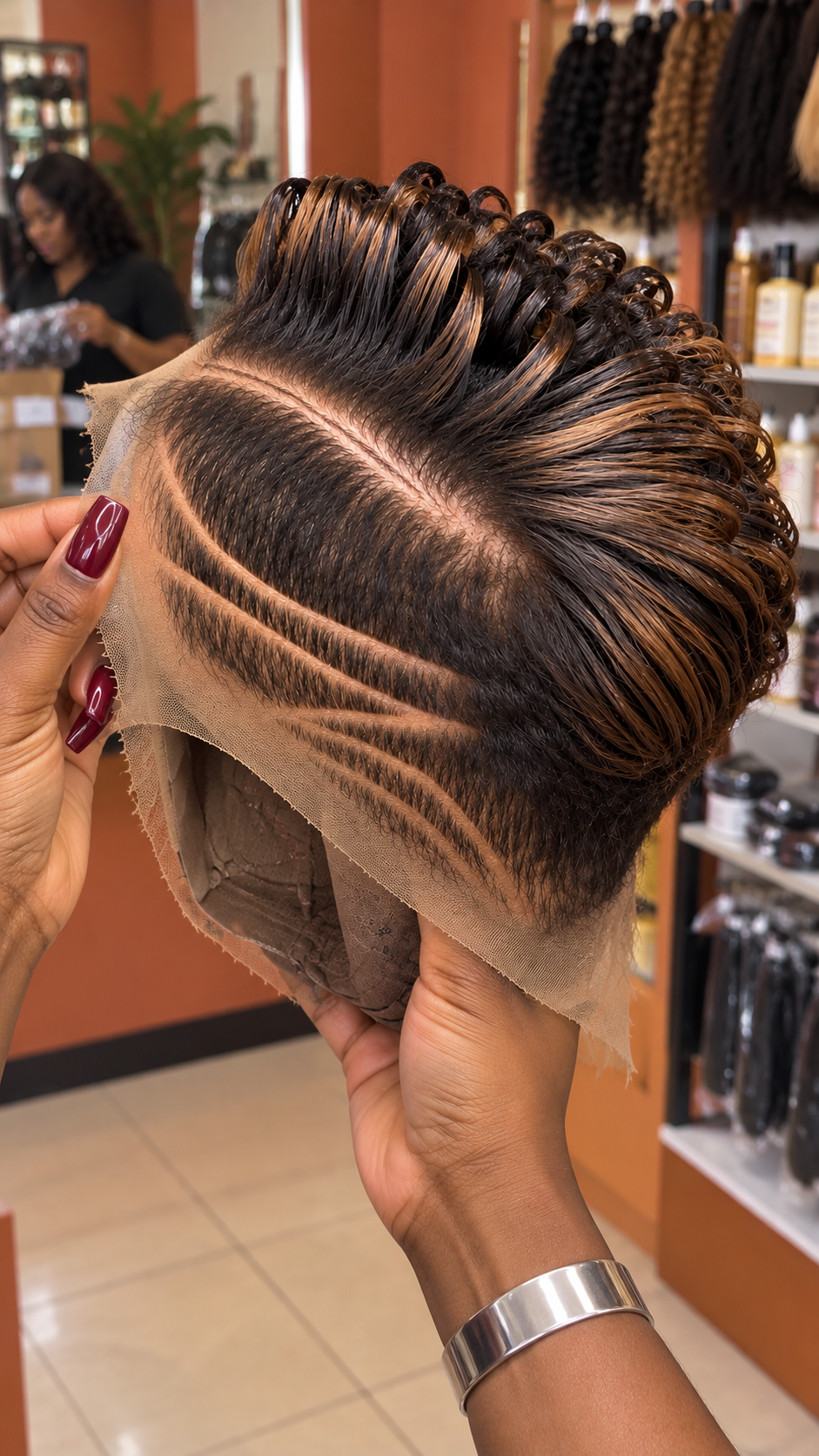
This sculpted pixie wig pairs a deep espresso-black foundation with fine honey-brown streaks, broad ribbon-like crown loops and three sweeping curved lines through the close side panel. The contrast between the elevated upper styling and the closely tapered lower section gives the unit a dramatic profile while keeping the overall silhouette compact.
The color work is especially effective because the lighter brown strands are integrated into the longer hair instead of covering the entire crown. Espresso black remains dominant at the roots and through the side panel, while narrow warm ribbons become more visible as the hair rises, bends and folds into the loops. The result is dimensional without looking heavily striped.
Honey Brown Streaks Trace the Movement of the Crown
The warm color follows the natural direction of the longer strands. Instead of appearing as isolated blocks, honey-brown and caramel-brown pieces travel from the darker foundation into the raised sections of the crown.
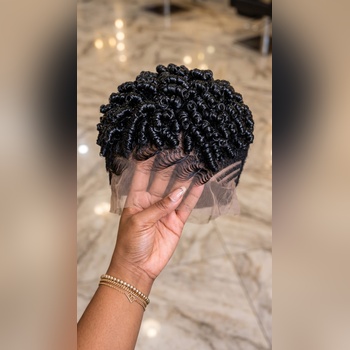
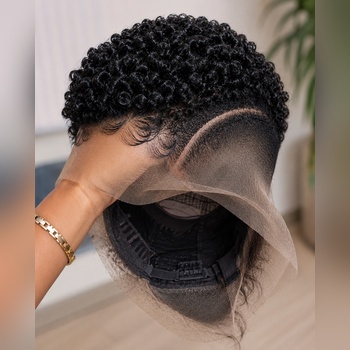
Because these lighter strands sit on the curved surfaces of the loops, they catch significantly more light than the black hair underneath. This creates a layered effect where some areas read almost espresso brown while others reveal brighter caramel reflections.
For a custom order, ask for a dark espresso foundation with fine warm brown ribbons concentrated through selected crown sections. The photograph should accompany the request because the highlight distribution is more important than the color name alone.
Broad Loops Give the Upper Section Its Sculpted Shape
The crown is formed from wide sections rather than small ringlets. Hair rises from the base, bends backward and creates open loops with clearly visible spaces between neighboring sections.
These loops are largest toward the frontal and upper crown. Farther back, they become increasingly integrated into the rounded shape of the wig. This progression prevents the hairstyle from developing excessive height across the entire top.
The strands remain highly separated within each loop, allowing the black and brown tones to travel together in visible ribbons.
The Front Rises Before Sweeping Backward
The longer frontal sections initially move upward, creating controlled lift before turning toward the rear. This gives the crown presence without requiring excessive overall length.
The movement is consistent across neighboring sections. Even though individual loops vary in size, they share the same backward direction, creating an organized flow through the hairstyle.
A stylist recreating this unit should establish the sweep first and then form the loops. Random curl direction would substantially change the character of the crown.
A Deep Diagonal Separation Defines the Side Profile
One strong diagonal division runs beneath the longer upper hair. It separates the elevated crown from the closely cropped-looking side panel and provides a crisp visual boundary between the two styling zones.
The line follows the contour of the wig, beginning higher toward the front and gradually descending toward the rear. Hair immediately above it gains length, while the strands below remain considerably closer.
This separation should remain narrow and controlled. Making it excessively wide would reduce the amount of dark side hair available for the additional curved details underneath.
Triple Curved Lines Give the Side Its Signature
Beneath the primary separation are three narrow curved lines that sweep backward through the close side section. They follow a similar direction but are not mechanically identical, which helps them sit naturally within the contour of the wig.
The spacing becomes part of the design. Dark hair remains between the lines, creating enough contrast for each curve to be recognizable independently.
When requesting this detail, avoid describing it simply as shaved lines. Specify three slim, parallel curved accents that follow the shape of the side panel. A profile photograph should always be supplied.
The Lower Side Remains Dark and Compact
The highlighted color is concentrated mainly through the longer upper strands. The side panel stays predominantly espresso black, which provides strong contrast against both the exposed lines and the warm crown.
This dark lower section also makes the wig appear visually lighter around the perimeter. The volume remains concentrated above, while the base hugs the head closely.
If warm highlights were distributed equally through the tapered side, the contrast would be reduced and the three-line pattern would become less prominent.
The Taper Gradually Tightens Toward the Bottom
The lower side does not maintain one uniform length. Hair becomes progressively closer as it approaches the bottom perimeter, creating a natural tapered appearance.
This gradual reduction is important for the silhouette. A heavy lower section would compete with the large loops above and make the entire wig appear bulkier.
When discussing the construction with a stylist, show the complete side profile and emphasize that the perimeter should remain close while the upper crown retains substantial movement.
Gloss Is Essential to the Ribbon Effect
The longer sections have a highly reflective finish that makes individual strands visible even within the darkest areas. Mirror-like glossy hair, silky reflective finish, healthy wet-look shine, individually visible strands and ultra-clear strand separation emphasize the relationship between the espresso base and honey-brown streaks.
Light travels lengthwise across the loops, which is why the warmer strands appear especially luminous along the highest points of each curve.
Maintenance products should be used conservatively. Excess oil or heavy styling cream can merge neighboring strands and reduce the clean ribbon effect.
The Color Placement Should Be Planned Before Setting
For a custom human-hair version, the highlighted strands should ideally be positioned with the final styling direction in mind. Randomly distributed color may disappear underneath the loops or create overly bright areas in unexpected places.
The strongest warm sections in this reference appear through the raised crown and sweeping rear portions. The root area remains considerably darker.
Show the colorist and stylist the same reference so the highlighting and final loop placement can complement one another.
Visible Lace Shows the Pre-Installation Construction
Excess lace remains visible around the lower perimeter in the photograph. This allows the wig’s side construction to be inspected before final trimming and fitting.
The photograph does not establish the exact commercial lace specification, so confirm the lace type and coverage directly with the seller. Ask whether the lace arrives uncut and whether customization is included.
For professional installation, allow the installer to evaluate the fit before removing large amounts of excess lace.
Cap Size Can Affect the Position of the Side Lines
The precision side pattern needs to sit in the intended position once the wig is worn. A poorly fitting cap can shift the diagonal separation and curved accents away from their planned location.
Use the wig maker’s measurement guide rather than guessing the cap size. For custom construction, provide all measurements requested by the seller.
If the unit includes adjustable components, use them for minor refinement rather than relying on them to compensate for a significantly incorrect cap size.
How to Describe This Wig During a Consultation
Break the request into separate components. Start with an espresso-black foundation and narrow honey-brown ribbons running through selected upper strands. Request large backward-swept loops rather than small circular curls.
For the side, specify a close dark taper with one primary diagonal separation and three slim curved accent lines beneath it. Explain that the warm highlights should remain concentrated above the side panel.
Finally, show the stylist this profile and discuss the desired crown height. The upper sections need noticeable lift, but the finished silhouette should remain recognizably compact.
Finding a Stylist for This Type of Custom Work
Look for professionals who regularly customize pixie wigs and can demonstrate precision sculpting in their portfolio. The large loops require controlled setting, while the lower panel requires careful shaping.
For the three curved accents, experience with barber-inspired wig detailing is valuable. Ask the stylist whether they perform this work themselves or collaborate with another specialist.
Send the photograph before booking so the salon can determine whether your existing wig has enough upper length and suitable side density.
Buying a Similar Wig Online
Search specialist custom wig boutiques and independent pixie wig makers rather than relying only on generic curly-wig listings. Look for sellers who show their units from multiple angles and provide close views of the side construction.
Send the reference photograph and ask whether the seller can reproduce the espresso-black base, warm ribbon highlights, large loop crown and triple curved side detail.
Confirm whether the advertised price includes final styling. Some sellers may supply a suitable highlighted foundation while leaving the detailed sculpting to a local stylist.
A Practical Ordering Process
Choose the hair material and provide the requested measurements first. Then identify the desired dark-to-warm color balance and specify that the highlights should follow selected crown strands.
Confirm which side will carry the three-line design. If the seller is working from photographs, make sure they understand whether the image should be reproduced directly or mirrored.
Before shipment, request a clear side photograph when approval images are available. Check the crown height, highlight distribution, diagonal separation, number of curved lines and lower taper.
Estimated Price Levels for Comparable Work
| Category | Estimated Range | Typical Configuration |
|---|---|---|
| Premium Custom | $475–$950+ | Premium human hair, dimensional highlighting, precision taper, hand-set loops and detailed side customization |
| Standard Custom | $275–$525 | Human-hair unit with warm streaks, sculpted crown and triple side-line detailing |
| Basic Human Hair | $150–$310 | Human-hair foundation requiring additional salon setting, tapering or color work |
| Premium Synthetic | $90–$195 | Higher-grade fiber with dimensional coloring and structured loop styling |
| Basic Synthetic | $45–$105 | Affordable pre-styled option with simpler color distribution and side detailing |
These are general reference ranges rather than prices for the exact wig pictured. Hair quality, cap construction, color processing, stylist experience, country and the complexity of the customization can all change the final cost.
Inspect the Highlight Distribution Before Approval
Look at the crown from the side and confirm that the warm strands are distributed through several separate loops rather than concentrated into one large block.
The dark foundation should remain clearly visible between the caramel-brown ribbons. This depth is what prevents the upper section from appearing uniformly light.
Also inspect the rearward sweep. The highlighted strands should continue naturally with the movement of the hair instead of stopping abruptly halfway through a loop.
Protecting the Large Loops Between Wears
Avoid brushing through the sculpted crown. These sections depend on controlled placement, and brushing can dismantle the open loops as well as disturb the highlight arrangement.
Store the wig upright on a properly sized stand and keep the crown away from shelves, boxes and neighboring wigs. Compression can flatten the elevated sections.
If the loops begin to loosen after repeated wear, professional resetting can restore their direction while preserving the dark-and-warm ribbon placement.
Refreshing the Triple Side Detail
The three curved accents should remain narrow and clearly separated. Over time, displaced strands may cross the exposed lines and make the pattern appear less precise.
A stylist can refresh the side panel without redesigning it. Bring the original reference and ask that the width, spacing and curvature remain consistent with the initial pattern.
Avoid repeatedly enlarging the lines during maintenance. Preserving the dark hair between them keeps the side detail balanced and prevents the lower panel from becoming visually sparse.
Search Terms
Espresso Black Ribbon Loop Wig · Honey Brown Crown Streaks · Triple Curved Side Lines · Caramel Highlight Loop Crown · Dark Tapered Side Panel · Backward Swept Brown Loops · Diagonal Pixie Side Parting · Glossy Espresso Caramel Strands