
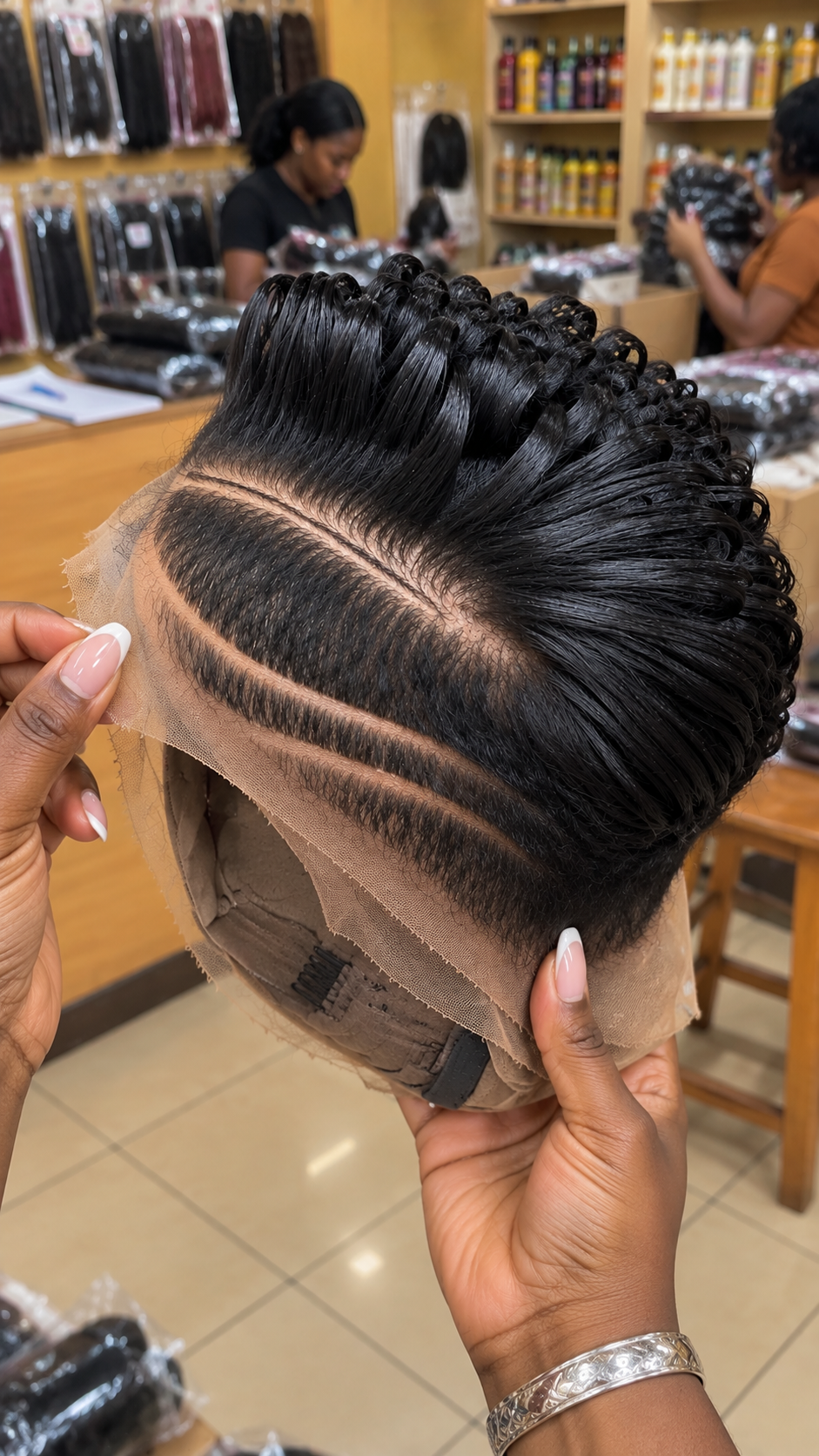
This jet black pixie wig is built around a striking contrast between an elevated crown of broad sculpted loops and an extremely close side panel marked by two long curved lines. The hairstyle uses a single deep black color, so its visual impact comes almost entirely from construction: the direction of the upper strands, the open spaces inside the loops, the precise diagonal separation and the controlled taper around the lower side.
The photograph also shows the unit before final lace trimming, giving a useful view of the relationship between the styled exterior and the cap underneath. For anyone trying to order or commission a similar wig, this angle is particularly valuable because it clearly reveals the side proportions that would be difficult to judge from a frontal portrait.
Broad Upright Loops Give the Crown Its Height
The upper section is not formed from small ringlets. Instead, the hair is divided into substantially wider sections that rise from the base and fold backward into open loops. Several of the frontal loops stand almost vertically before turning toward the rear.
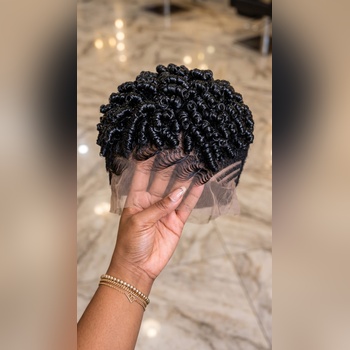
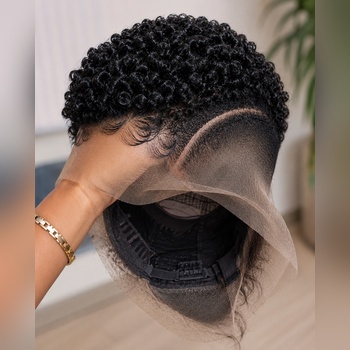
This technique creates height without requiring long free-flowing hair. The strands remain grouped together in polished ribbons, and the dark openings between neighboring loops provide enough contrast for each section to remain recognizable.
When requesting this construction from a stylist, describe it as a wide ribbon-loop crown with controlled backward movement. Simply asking for a curly pixie could produce much smaller curls and a completely different silhouette.
The Front Has More Lift Than the Rear
The crown is not equally high from front to back. The frontal and upper-middle sections rise more dramatically, while the loops gradually settle lower as they travel toward the rear.
This difference is important because it creates forward emphasis without turning the entire wig into a tall rounded shape. The rear remains compact enough to connect naturally with the close perimeter.
For a custom order, side-view photographs should be provided so the stylist can reproduce this progression in height rather than setting every loop to the same level.
Jet Black Keeps Attention on the Construction
No contrasting highlight color is visible in this unit. The deep jet black surface allows the sculptural arrangement itself to become the focal point.
Strong reflections appear along the raised strands, while the inner portions of the loops remain considerably darker. This creates depth even though the entire wig stays within one color family.
The monochromatic direction is also useful for emphasizing the side lines. Against the dark compact panel, the exposed curved divisions become immediately noticeable.
A Long Diagonal Division Establishes the Main Shape
A pronounced diagonal separation runs beneath the longer upper hair. It begins toward the front and continues backward, creating a clear boundary between the loop crown and the close side section.
Hair above this division gains length quickly and joins the elevated styling. Hair beneath it remains substantially closer to the foundation. This sharp difference is responsible for much of the dramatic profile visible in the photograph.
The division should remain relatively narrow. An unnecessarily wide part could remove too much dark hair from the side panel and change its proportions.
Twin Curved Lines Add Detail Without Overcrowding the Side
Beneath the primary crown separation are two elongated curved lines. They follow a similar backward direction while maintaining a visible strip of black hair between them.
The upper accent is positioned relatively close to the main diagonal boundary, while the lower curve travels nearer the perimeter. Together they create a layered three-line appearance when the main crown separation is considered, but the decorative side design itself consists of two secondary curves.
When booking custom work, specify two narrow curved side accents beneath the main diagonal crown division. This prevents the design from being mistaken for three decorative carved lines.
The Dark Side Panel Provides Essential Negative Space
A substantial section of close black hair remains between the crown and the lower perimeter. This dark area gives the exposed lines room to breathe and prevents the side from becoming overly complicated.
It also increases the apparent size of the loops above. Because the lower section sits so close to the foundation, even moderate crown height appears dramatic by comparison.
This is why adding additional decorative lines or making the existing curves much wider would significantly alter the visual balance.
The Lower Perimeter Uses a Gradual Taper
The hair becomes progressively closer toward the bottom of the side. Rather than ending in one abrupt length, the density reduces gradually as it approaches the lace perimeter.
This taper keeps the unit compact and allows it to follow the natural contour expected from a pixie silhouette. It also creates a cleaner foundation beneath the curved line work.
A stylist recreating the unit should plan the taper together with the side design. Cutting the side first without considering the position of the curves could leave insufficient density for the intended pattern.
The Rear Loops Become Smaller and More Compact
Toward the back of the crown, the large ribbon sections begin transitioning into tighter curled formations. This change prevents the rear from carrying the same height as the frontal portion.
The smaller rear loops also help connect the longer crown with the compact lower perimeter. From a side view, this produces a continuous rounded progression rather than an abrupt ending.
If ordering online, request a rear three-quarter photograph in addition to the direct side view. It can reveal whether this transition has been reproduced successfully.
High Gloss Reveals the Individual Black Strands
The hair displays a mirror-like glossy finish, silky reflective surface, healthy wet-look shine, individually visible strands and highly separated loop construction. Light travels lengthwise across each ribbon section, revealing the exact direction in which the strands have been arranged.
Because the unit is completely black, this reflective separation is especially important. Without it, neighboring loops could visually merge and the sculpted construction would become harder to distinguish.
During maintenance, use products sparingly. Heavy oils or thick styling creams can collect between the strands and reduce the crisp reflective separation.
The Visible Lace Shows a Pre-Installation Unit
Excess lace extends beyond the styled side and lower perimeter in the photograph. This indicates that the wig is being displayed before final trimming and fitting.
The visible lace is useful for examining the side construction, but the image alone does not establish the exact commercial lace type or coverage. Those specifications should be confirmed directly with the wig maker.
Ask whether the unit will arrive with uncut lace and whether customization, trimming or fitting is included in the quoted service.
The Interior Cap Should Be Checked Before Ordering
Part of the interior cap is visible beneath the lace. The photograph provides some construction information, but it does not reveal every component or establish the exact cap specification.
Ask the seller for interior photographs and measurements before purchasing a custom unit. With a precision pixie design, correct fit is especially important because the side lines need to sit at the intended position on the wearer’s head.
If adjustable elements are present, they can help refine the fit, but selecting an appropriate initial cap size remains important.
How to Explain This Wig to a Custom Maker
Start with the upper structure: request a jet black pixie with broad polished loops that rise strongly through the front and sweep backward across the crown. Make clear that you do not want small circular ringlets covering the entire top.
Then describe the side construction separately. Request a close black taper, one long diagonal separation beneath the crown and two slim curved accent lines below it.
Finally, specify the gradual reduction in crown height toward the rear. Sending the side reference together with a rear view will give the stylist a much clearer blueprint.
Where to Have the Style Professionally Recreated
A wig stylist specializing in precision pixie units is the most suitable starting point. Look for portfolios containing sculpted crown work, molded curls, close side shaping and detailed parting.
If the stylist does not perform barber-inspired side detailing, ask whether a precision barber can work on the wig after the basic silhouette has been established.
Before booking, send the reference photograph and ask whether the complete service includes crown setting, side tapering, line placement and final finishing.
Finding a Similar Wig Online
Search custom wig boutiques and independent makers who specifically offer pixie units. Broad searches for curly wigs are likely to return products with completely different curl structures.
Use descriptive phrases involving the visible characteristics: jet black ribbon loops, elevated crown, diagonal side separation and twin curved side lines.
When you find a potential seller, send the reference and ask whether they can reproduce the actual side construction rather than simply supplying a black curly pixie foundation.
A Practical Ordering Sequence
First select the hair material and provide the measurements requested by the wig maker. Confirm the jet black color and state that you do not want contrasting highlight streaks.
Next, identify the side on which the curved detailing should appear. Specify the large crown loops, elevated front and gradually lower rear styling.
Confirm the cap construction, lace configuration, density and styling services before payment. For made-to-order work, request approval photographs showing the crown and decorated side before shipment whenever possible.
Estimated Price Guide for Comparable Custom Work
| Category | Estimated Range | Typical Configuration |
|---|---|---|
| Premium Custom | $450–$900+ | Higher-grade human hair, custom cap work, precision taper, extensive hand-set loops and detailed side customization |
| Standard Custom | $250–$500 | Human-hair pixie with sculpted loop crown, close taper and twin curved side accents |
| Basic Human Hair | $140–$300 | Human-hair foundation requiring additional professional setting or side refinement |
| Premium Synthetic | $80–$180 | Higher-grade fiber with pre-set loops and stronger structural retention |
| Basic Synthetic | $40–$95 | Lower-cost fiber foundation with simpler crown and side customization |
These ranges are general estimates rather than prices for the exact wig pictured. Final cost can vary according to hair material, cap construction, stylist location, labor and the amount of hand sculpting required.
What to Inspect Before Accepting a Finished Custom Wig
Check the crown loops first. They should remain broad and visibly open, particularly across the elevated front. Small tightly packed ringlets would not reproduce the same construction.
Next, examine the side. The main diagonal separation should remain crisp, while the two lower curves should be narrow and clearly separated by dark hair.
Finally, inspect the taper and rear transition. The lower perimeter should stay close and the crown should gradually lose height as it moves toward the back.
Protecting the Sculpted Crown During Storage
Do not brush through the large loops during routine maintenance. Their shape depends on grouped strands remaining in their original direction.
Place the wig on a properly sized stand and keep sufficient clearance around the upper crown. Tight boxes and stacked storage can flatten the elevated sections.
If only one or two loops loosen, targeted resetting is preferable to disturbing the complete crown. For extensive reshaping, take the reference photograph to a professional stylist.
Keeping the Twin Side Curves Crisp
Fine strands can eventually move across the exposed curved lines after repeated handling. When this happens, a precision refresh can restore the contrast without redesigning the entire side.
Ask the stylist to preserve the original width and spacing. Repeatedly widening the curves during maintenance can gradually remove the dark hair separating them.
Keeping the original profile photograph is useful because it records exactly how the two accent lines relate to the larger crown separation.
Search Terms
Jet Black Wide Ribbon Loops · Twin Curved Side Lines · Elevated Black Loop Crown · Diagonal Crown Separation · Close Jet Black Side Taper · Glossy Backward Swept Loops · Double Curve Pixie Detail · Open Ribbon Loop Crown