
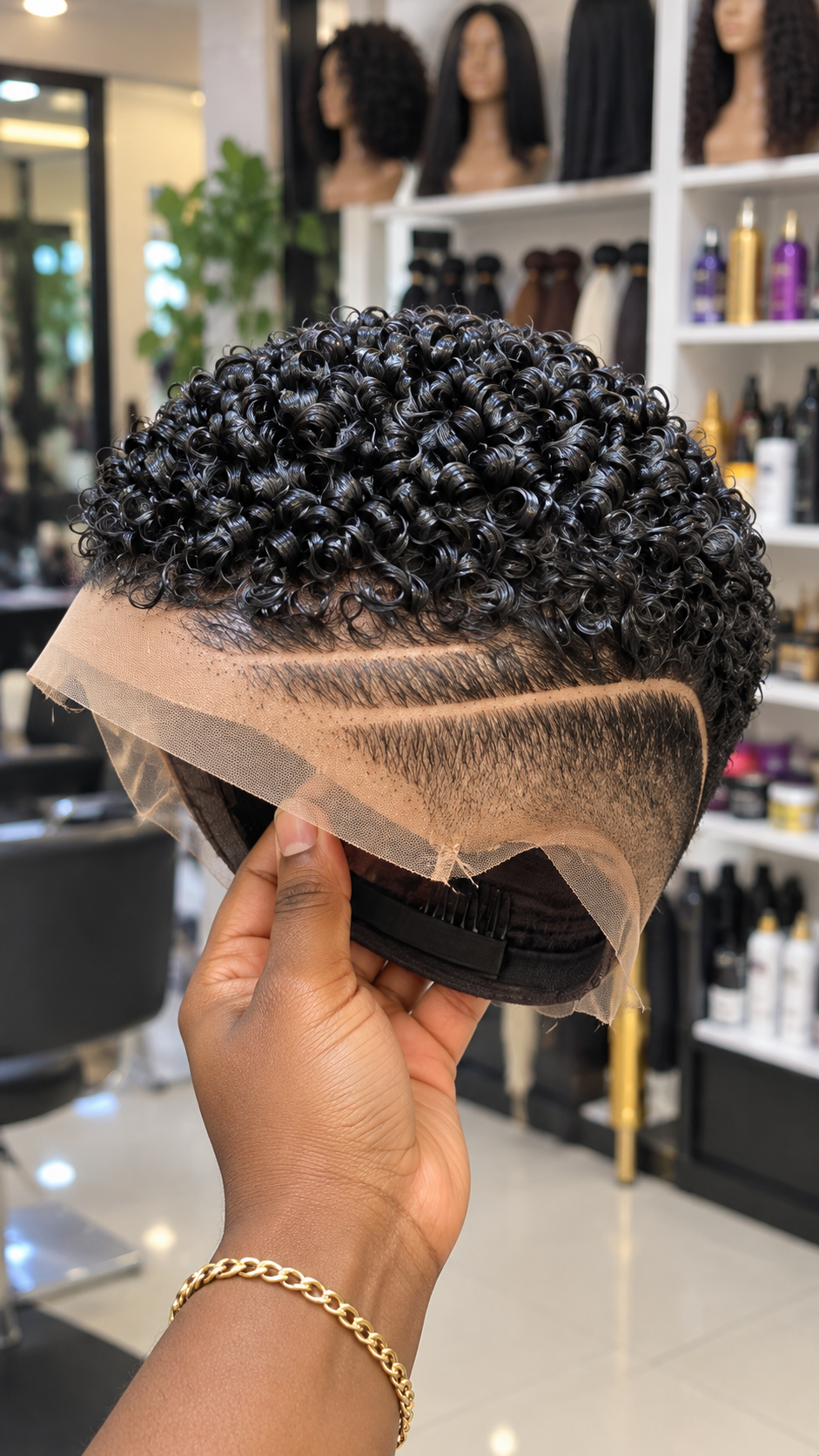
A tightly curled pixie can look completely different when the crown, tapered side and shaved detailing are designed as separate zones. This jet-black wig uses hundreds of compact micro coils across the crown, then drops into a much closer side section interrupted by two long parallel razor lines. The result is a strong salon-style profile with plenty of detail even though the overall silhouette stays compact.
The photograph also makes the construction especially useful for wig buyers because the lace extends beyond the hairline and the inside cap remains visible. It is clearly presented as a wearable wig unit rather than simply showing a haircut on a model. For anyone commissioning a similar piece, those construction details matter just as much as curl size or color.
Micro Coils Create a Dense Rounded Crown
The upper section is built from numerous small spiral curls rather than large ringlets. Each coil bends back toward itself, producing tiny loops throughout the surface. Their size is relatively consistent, but they are not arranged in perfectly uniform rows. That irregular placement gives the crown a fuller and more believable appearance.
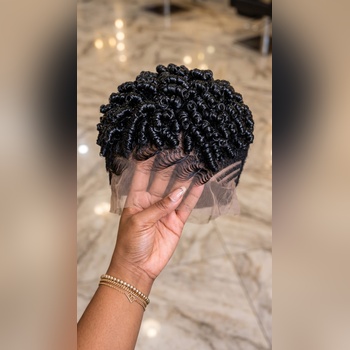
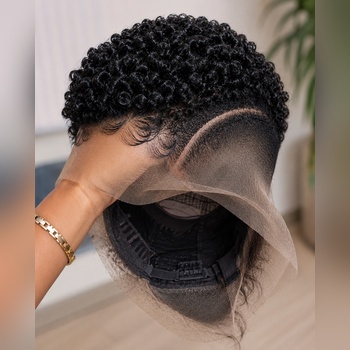
Density is important here. Too few curls would expose large gaps between the coils, while excessive hair could turn the crown into an oversized mass and hide the individual spiral shapes. The reference sits between those extremes: full enough to form a rounded dome while still allowing individual curls to remain visible.
A stylist recreating the design should establish the final crown height before shaping the side. Once the lower section has been cut close, dramatically reducing the crown later can disturb the intended proportions.
The Curl Pattern Is Smaller Than a Traditional Ring-Curl Pixie
These curls should not be confused with the larger circular pin curls often used for sculpted pixie styles. Here, the spirals are narrower, more numerous and slightly less formal. Some create complete loops while others form compact corkscrew shapes.
This gives the hair a lively surface with considerable strand detail. The coils catch narrow highlights along their bends, making the black hair appear dimensional without requiring another color.
When showing this design to a wig maker, describe the crown as dense micro coils or tiny spiral curls rather than simply asking for curly hair. Curl diameter is one of the most important characteristics of the finished unit.
Two Parallel Side Lines Become the Main Graphic Detail
The most distinctive element appears below the crown. Two long, closely spaced lines sweep across the side of the wig, creating clearly separated bands through the closely cropped hair.
The upper line begins farther forward and follows the contour beneath the curls. A second line runs below it at a similar angle. Instead of creating a complicated geometric motif, the design relies on two confident strokes that remain visible from a distance.
For a custom order, specify double parallel curved side lines and provide a side-view reference. The angle, distance between the lines and their relationship to the crown determine whether the result resembles the pictured design.
The Low Taper Makes the Razor Work Possible
The side area is cut dramatically closer than the crown. Fine dark hairs remain visible throughout this section, creating the appearance of a low tapered crop rather than a completely bare surface.
This shorter foundation is what allows the two lines to stand out. If the side hair were left too long, strands could fall across the channels and soften their edges. If it were removed completely, the contrast between hair and line could become harsher than the reference.
Ask the stylist to preserve a fine layer of dark hair around the design so the shaved channels remain integrated into the haircut.
A Soft Transition Connects the Coils and Cropped Side
Although the difference in length is substantial, the crown does not suddenly stop at a hard horizontal boundary. Small curls and shorter strands gradually transition into the cropped region.
This transition helps the wig imitate the structure of a professionally shaped pixie cut. It also prevents the upper section from appearing as though a separate curly piece has simply been attached over a shaved base.
When examining a custom unit before purchase, look closely at this boundary. A convincing transition should retain density near the crown while becoming progressively closer toward the side.
Jet Black Gives the Tiny Spirals Maximum Contrast
The hair uses a deep black shade from the crown through the tapered area. Rather than relying on highlights or an ombré effect, dimension comes from reflected light moving across the individual coils.
The result works particularly well with this curl scale. Every small spiral creates its own highlight and shadow, allowing the crown to show considerable detail despite using essentially one color.
For a similar appearance, request a rich jet-black or deep natural-black shade and compare supplier swatches before ordering. Under bright salon lighting, some natural-black fibers can appear noticeably brown, while true jet black generally remains deeper.
The Lace Extends Clearly Beyond the Styled Hairline
A broad lace section is visible around the front and side perimeter. The material extends beyond the finished hairline, indicating that it is intended to be customized during fitting rather than already cut flush against the hair.
Fine hairs are ventilated close to the lace edge, while the dense curls begin farther back. This distinction is useful because it gives a stylist material to work with when positioning and trimming the unit.
Before buying a similar wig, confirm the lace color, dimensions and placement. A close-up photograph taken against skin can be more informative than relying only on descriptions such as transparent or medium-brown lace.
The Interior Cap Confirms a Wearable Wig Construction
The photograph reveals part of the dark internal cap underneath the lace. A comb is also visible inside the unit, providing an additional anchoring point when the wig is worn.
Buyers should ask what other internal components are included. Depending on the construction, a pixie unit may use internal combs, an adjustable elastic system or additional securing points around the perimeter.
If a glueless fit is important, request confirmation specifically about the cap rather than assuming that visible lace automatically means the wig can be worn without adhesive.
Hairline Density Needs to Stay Lighter Than the Crown
A common problem with dense curly wigs is carrying crown-level density all the way to the lace edge. That can create an abrupt wall of hair at the front.
This design instead leaves a visible transition between the lace perimeter and the fuller curls. Fine strands appear near the front before the micro coils become considerably denser farther back.
When ordering a custom piece, discuss front density separately from crown density. Asking for a full crown does not mean the entire hairline should be equally heavy.
How to Request This Design From a Wig Stylist
Rather than sending only the words “black curly pixie,” divide the request into its major components. Ask for a jet-black compact micro-coil crown, closely tapered side section, two parallel curved razor lines and customizable lace perimeter.
Send this side photograph because it clearly communicates the line placement. If possible, provide an additional crown reference showing the curl density you want. A stylist can then determine whether an existing wig can be modified or whether the unit needs to be constructed specifically for the design.
For local services, search for a wig stylist who also demonstrates precision pixie cutting or barber-style detailing. The line work requires different skills from ordinary lace installation.
Buying a Similar Unit Online
Specialist wig stores, independent wig makers and salon-based sellers are the most logical places to search for a comparable design. Look beyond the main promotional photograph and inspect close-ups of the lace, sides and interior cap whenever they are available.
Before placing an order, ask whether the pictured wig is the actual unit for sale or an example that will be recreated. For handmade or customized designs, slight differences in curl placement and shaved lines are normal, so it is useful to establish expectations before paying a deposit.
Also confirm cap size, lace type, fiber or hair type, processing time and whether final cutting is included.
Price Guide for a Comparable Custom Pixie Wig
| Category | Typical Price Range | Possible Inclusions |
|---|---|---|
| Premium Custom | $450–$900+ | Premium human hair, customized cap, detailed curl work, lace customization and precision side design |
| Standard Custom | $250–$500 | Custom pixie shaping, micro-coil styling, tapered sides and personalized line placement |
| Basic Human Hair | $130–$300 | Human-hair base suitable for professional cutting, curling and side detailing |
| Premium Synthetic | $80–$200 | Higher-quality fiber with stronger curl retention and more detailed factory styling |
| Basic Synthetic | $35–$95 | Entry-level construction with fewer options for reshaping and customization |
Pricing can change substantially depending on hair quality, cap construction, lace area, stylist experience and whether the micro coils are individually shaped by hand. Precision side cutting can also add labor compared with a conventional curly pixie.
Booking the Service in the Correct Order
If purchasing the wig and styling service separately, contact the stylist before ordering the base unit. Send the product specifications and reference photograph so they can confirm that the wig has enough crown density and suitable side construction.
Once compatibility is confirmed, book the customization appointment and clarify whether the quoted price includes cutting, curling, lace preparation and fitting. Some stylists price these services individually.
For remote orders, request photographs of the finished side profile before shipment. This gives you an opportunity to inspect the double lines, curl size and transition before the unit leaves the seller.
Maintaining Hundreds of Small Coils
The crown should not be brushed like a loose curly wig. Running a conventional brush through the spirals can stretch them and merge neighboring coils.
Instead, separate or reposition individual curls carefully with the fingers when necessary. Store the wig upright on an appropriately sized stand and avoid pressing the crown against the inside of a box.
The desired surface should maintain mirror-like glossy hair, silky reflective finish, healthy wet-look shine, individually visible strands and ultra-detailed spiral texture. Heavy oils can weigh down the smallest coils and reduce separation, so finishing products should be applied sparingly.
Preserving the Double-Line Side Design
The side detailing will eventually require maintenance if the unit uses real human hair and the cropped area begins to lose its precise shape. Avoid attempting to deepen the lines yourself unless you are comfortable working with very short wig hair.
A barber or wig stylist experienced with clipper detailing can refresh the channels while preserving the surrounding hair. Bring the original reference photograph to the appointment because repeated trimming can gradually change the angle or width of the design.
With careful storage, restrained product use and occasional professional reshaping, the contrast between the dense micro-coil crown and double-line tapered side can remain the defining element of the wig.
Search Terms
Jet Black Micro Coil Crown · Double Parallel Side Lines · Curved Razor Line Pixie · Dense Black Spiral Coils · Low Taper Wig Side · Extended Lace Hairline · Cropped Side Curl Wig · Black Micro Spiral Pixie