
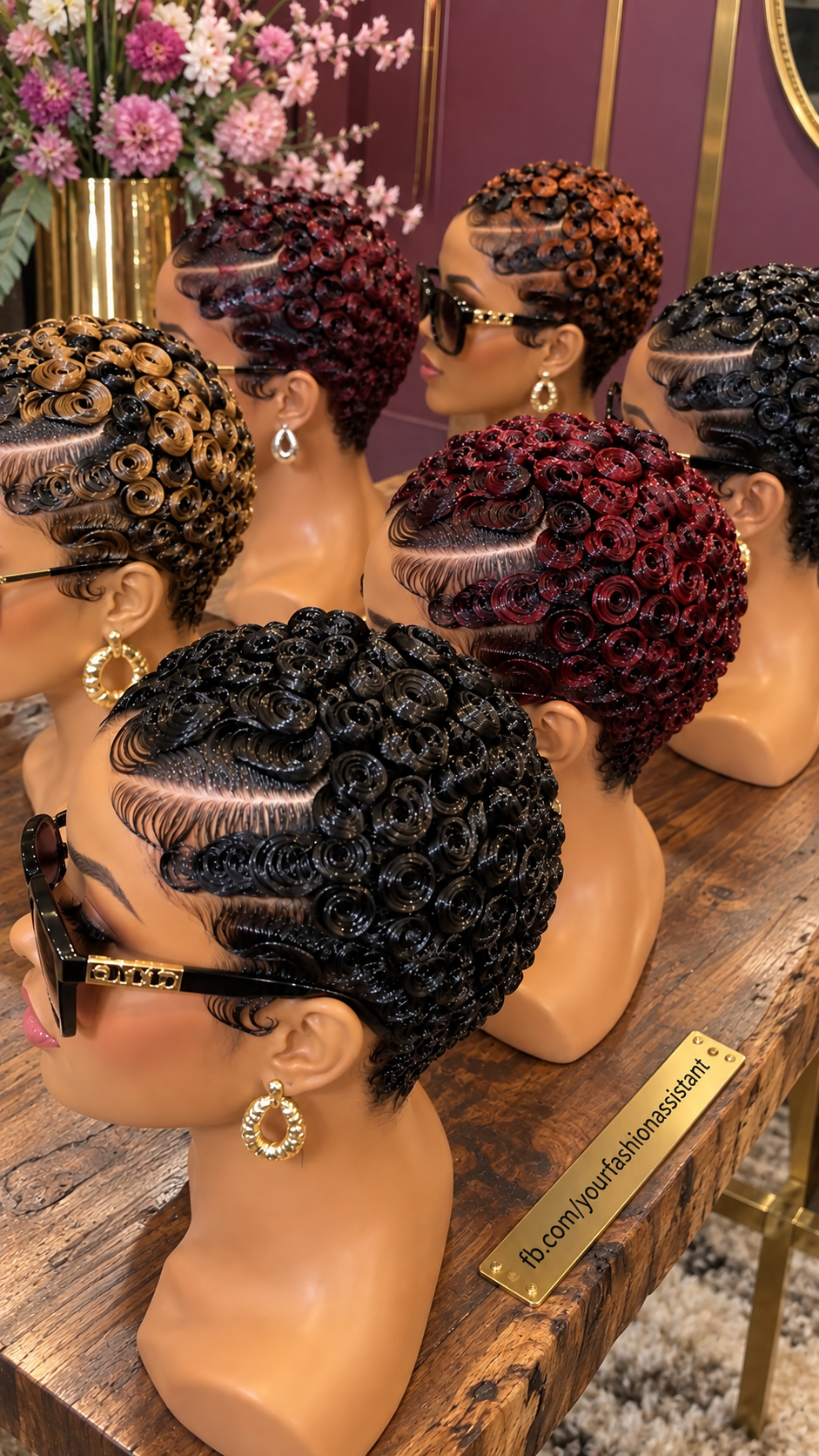
This collection brings together several striking pixie wig variations built around glossy ring curls, sculpted side waves, diagonal parting and a close tapered silhouette. The wigs share the same compact shape, but the different color combinations create noticeably different results. Jet black gives the curls a deep reflective appearance, burgundy adds wine-red dimension, while caramel, honey and copper tones make the individual circular curls easier to see from a distance.
One of the strongest details in this collection is the contrast between the tightly arranged curls across the crown and the flatter wave work around the temple. Instead of covering the entire wig with identical curls, the styling changes direction around the front and side. This creates a structured pixie shape that looks carefully constructed from every angle.
For anyone planning to order a similar wig, the photographs are useful references because they show several details that should be discussed separately with a wig maker: curl size, crown density, color placement, side-wave direction, diagonal parting and the close-fitting lower section.
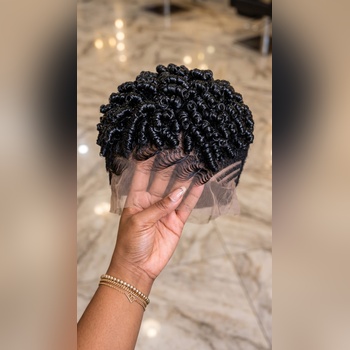
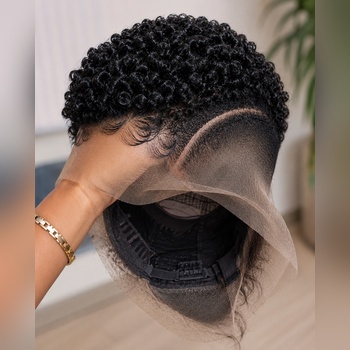
Small Circular Curls Build a Dense Rounded Crown
The crown is covered with numerous compact ring curls. Each curl forms a recognizable circular loop, and the curls are positioned closely enough to create fullness without losing their individual shapes. This is different from an ordinary curly pixie where the hair may simply be curled and allowed to fall naturally.
Here, placement is part of the design. Some rings face forward while others turn slightly sideways, helping the crown avoid an overly uniform appearance. The result is a rounded upper silhouette with plenty of visible detail.
The glossy surface makes this construction even more noticeable. Light reflects around the curved strands, emphasizing the circular shape of every ring. When ordering this type of unit, requesting small individually arranged ring curls is more precise than simply asking for tight curls.
Side Waves Create a Second Pattern Around the Temple
The crown curls are only one part of the hairstyle. Along the front and side, the hair changes into flatter sculpted waves. These sections sweep outward from the diagonal part before curving toward the temple and ear.
This combination gives the wig two distinct styling zones. The upper section provides height and circular detail, while the side section remains closer to the head and creates flowing lines.
On several units, multiple parallel wave sections are visible. Their spacing helps reveal the underlying shape rather than allowing the curls to cover the entire side. A stylist reproducing the look should plan these sections before setting the crown curls.
Jet Black Creates Strong Reflection and Depth
The jet-black versions demonstrate how effective a single dark color can be when the hair has a highly reflective finish. The outer surface of each curl catches the light while the interior remains considerably darker, giving the rings noticeable depth.
Black also places more visual emphasis on the sculpting itself. There are no contrasting highlights competing with the curl pattern, so attention stays on the circular crown, diagonal separation and sweeping side sections.
Buyers wanting this appearance should specify deep jet black with a glossy finish and ask to see the hair under ordinary indoor lighting before confirming the order whenever possible.
Burgundy Adds Wine and Cherry Reflections
The burgundy units introduce a richer color transition. In shadowed areas, the hair appears close to deep wine or dark burgundy. Where light reaches the upper curls, brighter cherry-red reflections become visible.
Because every ring turns through several angles, one curl can display multiple depths of the same color. This makes burgundy particularly effective for a hairstyle containing dozens of small circular formations.
For a custom order, phrases such as deep burgundy, wine red or burgundy with cherry reflections can help narrow the color direction. Requesting an actual color sample is still advisable because suppliers frequently use different names for similar shades.
Caramel and Black Create High-Contrast Curl Placement
One of the most distinctive variations combines darker hair with warm caramel or honey-colored curls. Rather than making the entire wig blonde, the lighter color appears among darker sections, allowing individual curls to stand apart visually.
This type of contrast can make the circular crown appear even more dimensional. Dark strands create shadow between the lighter rings, while caramel sections catch significantly more light.
For buyers interested in this combination, it is worth deciding whether the lighter shade should dominate the crown or remain an accent. A wig maker can alter the overall appearance considerably simply by changing the ratio of dark and light hair.
Copper Brown Offers a Warm Alternative
The warm copper-brown variation sits between burgundy and caramel in overall brightness. It retains deeper brunette undertones while reflecting copper and reddish-brown shades under direct light.
This color works especially well with glossy ring curls because the curved strands naturally reveal multiple tones. The deeper interior of each curl contrasts with the brighter outer edge, creating depth without requiring extremely light highlights.
When discussing this shade with a seller, terms such as copper brown, auburn copper or warm chestnut copper may help communicate the desired family of colors.
The Diagonal Part Is Central to the Entire Shape
A prominent diagonal part appears across many of these wigs. It separates the crown curls from the sculpted front and side sections and gives the hairstyle its directional flow.
The part is not merely decorative. Moving it higher, lower or changing its angle would alter how much space remains for the circular curls and how far the side waves can travel.
If commissioning a custom unit, provide a photograph showing the part clearly and tell the stylist which side you want displayed. This is particularly important when the wig will regularly be photographed from a preferred angle.
Close Sides Balance the Fuller Upper Section
Although the crown contains many curls, the lower sides remain comparatively close to the head. This contrast prevents the wig from becoming overly rounded from top to bottom.
The closer perimeter also draws attention upward toward the ring curls. Around the ear, the styling becomes particularly compact, while small curled details can remain near the temple to connect the upper and lower sections.
This proportion should be discussed before a wig is cut. Removing too much hair can make the crown appear disconnected, while leaving excessive volume around the lower sides changes the characteristic pixie silhouette.
Why Gloss Level Matters With Circular Curls
These wigs have a noticeably reflective appearance. Shine travels around each ring and helps separate one curl from the next. With a duller finish, some of the tightly packed curls could visually merge together.
However, shine should still allow individual strands to remain visible. Excessive product can cause several curls to stick together and make the crown appear heavy.
A professional stylist can select finishing products according to whether the wig is human hair or synthetic fiber. Products designed for one material should not automatically be assumed suitable for another.
What to Tell a Wig Stylist Before Ordering
Begin by describing the silhouette rather than the color. Request a compact pixie shape with a dense rounded crown, small ring curls and close lower sides. Then explain that you want a visible diagonal part with flatter sculpted waves sweeping toward the temple.
After the construction is understood, choose the color. Suitable directions based on this collection include jet black, deep burgundy, warm copper brown and black mixed with caramel or honey tones.
Also specify whether you want the rings extremely compact or slightly larger and more open. Even a small change in curl diameter can noticeably change the finished appearance.
Where to Have This Type of Wig Customized
Look for a custom wig maker, pixie wig specialist or salon experienced with sculpted curl work. A general hair salon may be able to install a wig, but reproducing the circular crown and controlled side waves requires more specialized styling experience.
Review portfolios before booking. Look for close-up photographs showing ring curls, finger-wave-inspired sections and cropped wig shaping. Photos taken from several angles are particularly useful because they reveal whether the stylist can maintain the design around the entire head.
When contacting the salon, send the reference image before making the appointment and ask whether both customization and installation can be completed there.
How to Search for Similar Wigs Online
Broad phrases such as “pixie wig” will return many unrelated designs. More descriptive searches can narrow the results considerably. Include the curl construction, color and side styling in your search.
Independent wig makers, specialist online wig stores and salon-based sellers may offer either completed units or customizable base wigs. Some sellers provide a basic pixie unit that requires additional styling after purchase, while others sell the wig already curled and shaped.
Always confirm what is included. Product photographs can sometimes show professional styling that is not part of the standard unit.
Questions to Ask Before Paying for a Custom Unit
Ask whether the displayed wig is the exact unit being sold or a reference for a made-to-order product. Confirm the hair material, cap construction, size, color, density and whether the circular curls arrive permanently styled or require maintenance after delivery.
If purchasing a highlighted version, ask whether color placement can vary between units. For burgundy or copper shades, request photographs under neutral lighting when available.
You should also confirm the seller’s customization and return conditions before requesting cutting, coloring or other personalized work, since customized wigs may have different return terms.
Booking a Professional Fitting
Once the wig arrives, a professional fitting can help position the part and side waves correctly. When booking, explain that the unit has a sculpted pixie shape rather than long loose hair. This gives the stylist a better idea of the work involved.
Bring or send the reference photograph and indicate which side should be most visible. Ask whether the appointment covers fitting, perimeter adjustment and minor curl repositioning.
If additional cutting is required around the ear or lower perimeter, it is safer to make those adjustments while the wig is properly positioned rather than trimming the unit beforehand.
Price Guide for Custom Ring Curl Pixie Wigs
| Category | Approximate Range | Typical Service Level |
|---|---|---|
| Premium Custom | $450–$900+ | Higher-grade hair, custom sizing, advanced color work, individual curl setting and detailed finishing |
| Standard Custom | $250–$500 | Custom shaping, selected color, ring-curl crown and sculpted side styling |
| Basic Human Hair | $130–$320 | Human-hair base suitable for additional cutting, coloring and professional styling |
| Premium Synthetic | $80–$200 | Higher-quality fiber with stronger pre-set curl retention and a finished pixie shape |
| Basic Synthetic | $35–$100 | Lower-cost pre-styled option with more limited customization |
These ranges are general references rather than prices for the exact wigs shown. Custom coloring, hand-set curls, cap construction, hair quality and the stylist’s labor can substantially change the final price.
Keeping the Ring Curls in Shape
A densely sculpted crown should be handled differently from loose curls. Avoid brushing directly through the circular formations because this can separate the strands that create each ring.
If a curl shifts during wear, reposition that individual section rather than disturbing the surrounding crown. Light maintenance is generally preferable to repeatedly resetting the entire hairstyle.
Storage is equally important. Use a wig stand or container with enough room above and around the crown so the rings are not crushed. Avoid placing the wig beneath clothing, bags or other items that could flatten the upper section.
Caring for the Sculpted Side Sections
The flatter waves around the front and temple can lose their direction through repeated friction. Handle these areas carefully when putting the wig on or removing it.
Before using mousse, holding spray or other styling products, check whether the product is appropriate for the wig material. Human hair and synthetic fibers can react differently to heat and styling formulas.
If the side pattern requires major restoration, taking the unit back to a stylist familiar with sculpted pixie wigs may be preferable to repeatedly restyling the section at home.
Choosing Between Black, Burgundy, Copper and Caramel
Each color emphasizes a different aspect of the same basic design. Jet black places attention on gloss and sculpting. Burgundy creates deep red variation. Copper brown introduces warmer reflections, while caramel-and-black combinations emphasize individual curl placement through stronger color contrast.
The underlying hairstyle remains consistent: a compact crown filled with circular curls, a strong diagonal part and sweeping side sections. That makes it possible to choose color according to the desired visual effect without giving up the recognizable structure of the pixie.
For a multi-color order, ask the stylist to confirm exactly where the lighter and darker shades will appear. Thoughtful placement can emphasize the rings and directional waves much more effectively than randomly distributed highlights.
Search Terms
Jet Black Ring Curl Pixie · Burgundy Circular Curl Wig · Copper Brown Ring Curl Pixie · Caramel Black Curl Crown · Diagonal Part Pixie Wig · Sculpted Temple Wave Wig · Glossy Circular Crown Curls · Tapered Ring Curl Pixie