
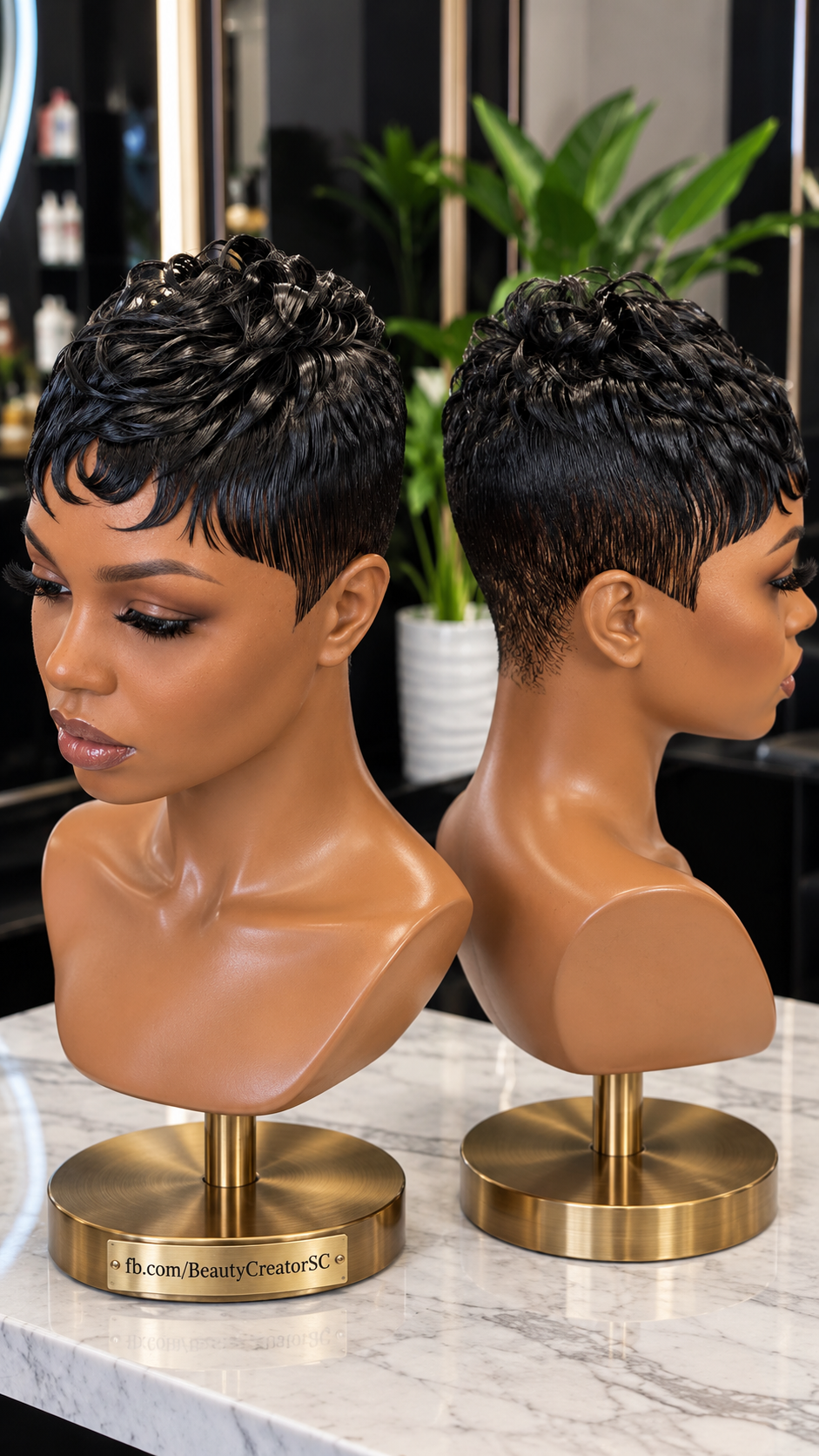
This jet black pixie wig combines two very different textures in one compact hairstyle: loose sculpted curls concentrated across the crown and sleek, closely laid hair around the sides and nape. The contrast gives the wig its distinctive shape. Instead of covering the entire head with identical curls, the styling keeps the upper section fuller while allowing the lower perimeter to remain narrow and close to the head.
The glossy black finish is especially important here. Light reflects strongly from the individual strands, revealing the direction of the curls as well as the fine combed sections around the temples. The result has a polished wet-look pixie appearance without requiring excessive volume.
Shown from both the front three-quarter view and the opposite side, the hairstyle also reveals how carefully the silhouette has been controlled. The front has several separated curved pieces falling toward the forehead, the crown rises into irregular loops, and the back gradually narrows toward a softly tapered nape.
A Tousled Curly Crown Creates the Height
The upper section carries most of the movement. Rather than forming perfectly uniform circular pin curls, the hair has been arranged into overlapping bends, loops and small curls. Some strands curve backward while others cross diagonally through the crown.
This irregular placement is what gives the top its fuller appearance. A completely symmetrical curl set would create a different result. Here, the intention is closer to a tousled curly pixie with deliberately arranged movement.
The longest pieces remain concentrated around the upper center and front. Length decreases as the hairstyle approaches the sides, producing a gradual transition instead of an abrupt shelf between the curly crown and the closely fitted perimeter.
The Front Fringe Uses Separated Curved Pieces
Several narrow strands extend toward the forehead rather than forming one heavy fringe. Each piece has its own curved direction, allowing small areas of the hairline to remain visible between them.
This is an important detail when requesting a similar wig. Asking only for bangs could result in a much heavier front section. A more accurate description would be piecey curved pixie fringe or a separated wet-look fringe with individual sections.
The front pieces also connect naturally with the longer crown. There is no obvious horizontal line separating bangs from the rest of the hairstyle, which helps maintain the continuous sculpted appearance.
Sleek Sides Keep the Pixie Shape Compact
The side sections are dramatically flatter than the crown. Fine strands are combed downward and slightly forward around the temple, then follow the contour of the head toward the ear.
This creates a close-fitting appearance similar to a precision pixie cut. The contrast is particularly visible in the side view, where the fuller crown transitions into progressively shorter-looking hair around the lower side and back.
For a custom unit, this area should not be left bulky. Too much density around the ears would change the silhouette and make the wig appear rounder. A stylist experienced with pixie wigs can thin and shape the perimeter while preserving enough hair for the sleek combed effect.
The Back Uses a Soft Tapered Nape
The rear view shows the hair narrowing naturally toward the neckline. It does not finish with a blunt horizontal edge. Instead, fine strands become progressively shorter-looking and create a soft tapered point around the center of the nape.
This detail helps the wig imitate the proportions of a salon-cut pixie hairstyle. It also prevents excessive density from accumulating at the back.
When ordering online, rear photographs are particularly useful for this reason. Many product listings concentrate on the front while providing little information about the nape. For this design, the back shape is an essential part of the finished look.
Why Jet Black Works Especially Well With This Styling
The hair appears predominantly jet black, with bright reflections created by the glossy surface and lighting. There is no obvious contrasting highlight color dominating the style.
Black allows the different textures to remain visually connected even though their shapes differ considerably. The crown curls, separated fringe and sleek perimeter all share the same deep base color.
At the same time, the reflective finish prevents the darker hair from appearing visually flat. Highlights reveal individual strands throughout the crown and produce narrow luminous lines across the sleek sides.
The Glossy Finish Is Part of the Look
A matte version of this wig would have a noticeably different character. The photographed style relies heavily on shine to emphasize the strand direction and sculpted crown.
The hair has a silky reflective finish with strong highlights along individual sections. This is particularly visible where the crown curls bend toward the light.
When recreating the look, however, excessive product can become counterproductive. Too much gel or oil may cause separate strands to collapse into thick sections. The goal is visible strand separation with controlled shine rather than a saturated or greasy appearance.
What to Tell a Wig Stylist
For a close recreation, request a jet black curly pixie wig with a tousled crown, separated curved fringe, sleek sides and tapered nape. Reference photographs should be supplied from more than one angle whenever possible.
Explain that the crown should retain noticeably more length than the perimeter. The curls should overlap organically instead of forming identical rows, while the sides should remain close to the head.
The front should contain several individually separated curved strands rather than a thick straight fringe. Around the ears, ask for a precise compact contour that connects naturally with the tapered back.
Before construction begins, confirm the cap size, preferred density, fiber type and whether the wig will arrive completely cut and styled. These details can significantly affect how closely the finished unit resembles the reference.
Where to Get This Pixie Wig Styled
Look for a pixie wig stylist, custom wig maker or salon experienced with precision cropped wigs. A general wig installer may be excellent at lace installations but may not necessarily specialize in detailed pixie cutting and sculpted crown styling.
Portfolio photographs can help identify the right stylist. Look specifically for previous work involving cropped wigs, tapered napes, wet-look styling and compact curly crowns.
If you already own a suitable wig, ask whether the salon provides wig customization rather than complete construction. Depending on the starting length and density, a stylist may be able to cut, thin and reshape an existing unit.
For local appointments, search for terms such as pixie wig stylist near me, custom pixie wig salon or curly pixie wig customization together with your city or neighborhood.
How to Buy a Similar Wig Online
Online searches should describe the actual construction rather than relying on broad phrases such as “black curly wig.” Including pixie length, crown curls, tapered sides and wet-look styling will narrow the results considerably.
Before purchasing, examine photographs showing multiple angles. A frontal image alone cannot confirm whether the back has the same tapered construction seen here.
Check whether the advertised wig arrives pre-styled. Some pixie units are photographed after professional salon finishing but are shipped in a more basic state. If the listing is unclear, ask the seller whether the curl placement and final cut shown in the promotional photograph are included.
Also confirm cap measurements and return conditions before ordering. Cropped wigs are particularly sensitive to fit because an incorrectly positioned cap can alter the apparent location of the ears, sideburn area and nape.
Human Hair or Synthetic Fiber?
The image alone does not reliably establish whether the displayed hairstyle is made from human hair or synthetic fiber. Similar looks can be produced using either material.
A human hair pixie wig generally offers greater flexibility for restyling. The wearer can reshape the crown and adjust individual pieces, provided appropriate styling methods are used.
Heat-friendly synthetic wigs can also work well for compact sculpted hairstyles because some fibers retain their set effectively. However, heat limits vary considerably, so the manufacturer’s instructions should always be checked before applying heated tools.
If the goal is to preserve one specific style for frequent wear, shape retention may matter more than maximum restyling flexibility. Discuss this with the wig maker before choosing the fiber.
How Much It Costs
The photograph does not provide pricing or confirm the seller of the displayed wigs. The figures below are therefore general estimates for comparable professionally styled pixie wigs rather than prices for these exact units.
| Wig Category | Typical Estimated Range |
|---|---|
| Premium Custom | $350–$800+ |
| Standard Custom | $180–$425 |
| Basic Human Hair | $100–$275 |
| Premium Synthetic | $60–$160 |
| Basic Synthetic | $30–$90 |
Professional cutting and final styling can substantially affect the total cost. When comparing quotes, determine whether the price includes the wig itself, customization, cutting, curl setting and final styling.
Booking a Custom Styling Appointment
Send the reference photographs to the stylist before booking rather than waiting until the appointment. Mention specifically that you want the fuller irregular crown combined with flatter sides and a tapered nape.
If supplying your own wig, tell the stylist its current length, density and fiber type. A photograph of the unstyled unit can help determine whether there is enough usable length on top and whether the sides can be reduced sufficiently.
For a newly constructed unit, follow the wig maker’s measurement instructions carefully. Proper circumference, front-to-nape and ear-to-ear measurements are particularly valuable for a close-fitting pixie.
Keeping the Crown Curls in Shape
A hairstyle with this amount of strand separation should be handled selectively rather than brushed throughout. Broad brushing can remove the deliberately arranged crown pattern and blend the fringe into one section.
Use fingers or an appropriate styling tool to reposition individual curls when necessary. Work on one area at a time so the rest of the crown remains undisturbed.
Store the wig on a suitable stand that does not compress the upper curls. The crown should have enough clearance to retain its height and irregular loop structure.
For human hair, occasional professional resetting may help restore the original appearance after repeated wear. Synthetic units should be maintained according to their specific fiber requirements, particularly when heat is involved.
A Pixie Built Around Contrast
The strongest element of this hairstyle is the contrast between its sections. The crown is deliberately active and dimensional, while the sides remain sleek and restrained. The fringe breaks into individual curved strands, while the nape gradually narrows into a compact silhouette.
Combined with the reflective jet black finish, these elements create a distinctive curly crown pixie wig that looks noticeably different from a conventional all-over curly crop.
When shopping for or commissioning a similar piece, prioritize the crown shape, separated front pieces, close-fitting sides and tapered back. Those characteristics are more important to recreating the photographed hairstyle than simply matching the black color.
Search Terms
Jet Black Curly Pixie Wig · Wet Look Pixie Wig · Tousled Crown Pixie Wig · Tapered Nape Pixie Wig · Piecey Fringe Pixie Wig · Glossy Black Pixie Wig · Sleek Side Curly Pixie Wig · Sculpted Crown Pixie Wig