
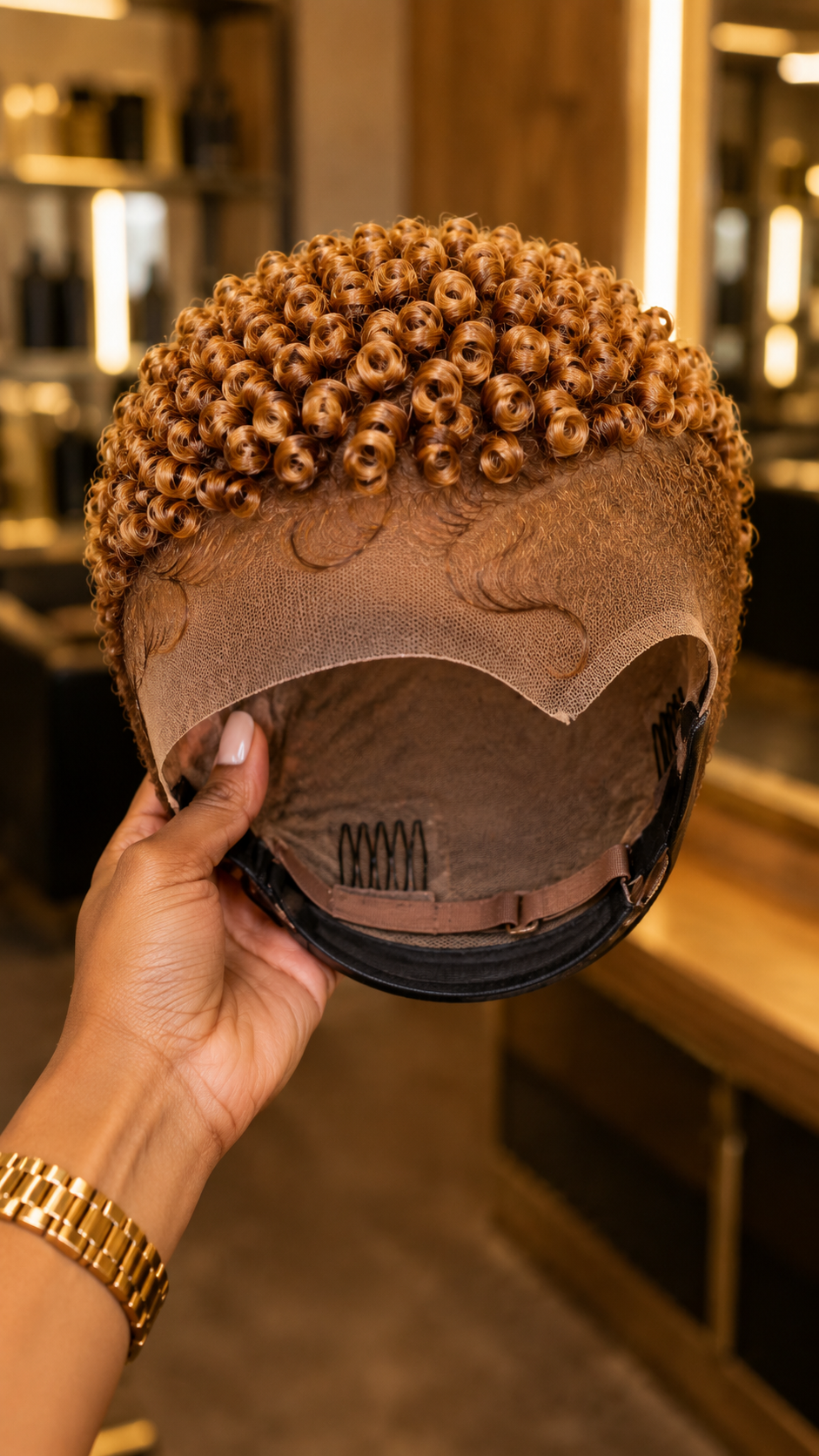
A dark unit can forgive a slightly coarse lace or a small density gap at the edge. A light honey unit cannot. This short spiral sits in a pale warm blonde-honey tone and is shown with the lace fully open so the interior hardware and the hairline are visible together. Every knot, every millimetre of mesh, and every thin spot along the edge is more readable than it would be on black or deep brown. The colour itself becomes a stress test for the lace and the edge construction.
If the lace is fine and the density graduates cleanly, the unit can still melt. If either is average, the light tone will advertise the fault under daylight. That is the practical difference this shade forces on the buyer.
Where To Buy This Light Honey Pixie
Custom makers
Makers who specialise in light warm-toned short curly units with high-grade lace are the strongest source. Ask specifically for a honey or pale blonde spiral with lace fine enough to disappear against light hair and skin. Request close-ups of the hairline and the underside under natural light.
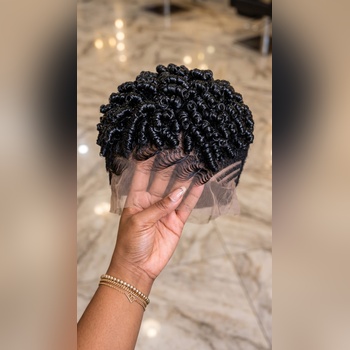
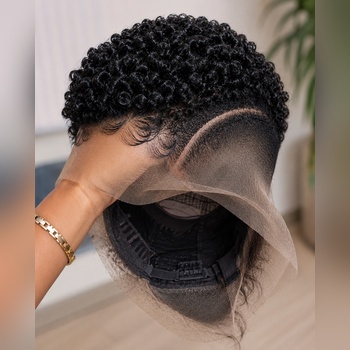
Instagram and TikTok sellers
Search terms such as “light honey curly pixie”, “blonde spiral glueless”, and “pale warm lace front unit” surface accounts that show the edge clearly. Prioritise sellers who post daylight shots of the hairline rather than only warm indoor lighting.
Etsy
Look for short curly lace fronts in light honey or blonde that emphasise lace quality and show the edge in detail. Descriptions that mention fine or HD lace for light colours are more useful than generic claims.
Marketplaces like Amazon, AliExpress, and Temu
These platforms carry light warm short curly units, but lace quality varies sharply. Some use fine mesh that can melt; others use standard lace that remains visible on a pale unit. Check recent reviews that mention the hairline on light shades.
Local beauty supply shops and salons
If a shop stocks light warm short curly units, hold the piece against your skin in daylight and examine the edge. A good unit shows minimal mesh and a graduated density; a weaker one shows a clear lace line.
Vendors and wholesalers direct
Wholesale sources can supply this construction in volume. Request a sample that shows the exact lace grade and edge density on a light tone before placing a larger order.
Regionally (Lagos, Accra, Atlanta, London, South Africa)
These markets produce short curly units in a wide range of light warm tones. Local maker networks often allow in-person inspection of the lace and hairline under real light before purchase.
Vet the seller
Ask for a daylight photograph of the hairline on the light unit, not only a warm indoor shot. Confirm the lace grade and whether the density at the edge is graduated. Check the underside for solid combs and an adjustable strap.
Red flags
Listings that only show the unit under yellow indoor light. Units photographed exclusively from above. Standard beige lace on a pale honey unit. Prices that undercut the market while claiming invisible lace on a light colour.
When you order, send
Your preferred lace grade, confirmation that the unit is a light honey or pale warm tone, and a note that the edge density must be clean enough for a light colour. Clear instructions reduce the chance of receiving a lace that remains visible.
Contact / order inquiries: WhatsApp [WhatsApp: +XX XXX XXX XX XX]
How Much It Costs
Tiered pricing
Human-hair versions with a light honey spiral, fine lace, and a proper glueless system typically range from $190 to $450. The light pigment and the higher lace grade both add cost. Mid-range human units land around $155–310. Basic human or mixed-fibre pieces start near $100–180. Good synthetic versions that hold the coil and include functional hardware usually fall between $70 and $150. Entry-level synthetic can be found from $35 to $80.
What that includes and excludes
The quoted price covers the unit with the coils, lace, combs, and strap already finished. It rarely includes extra bands, additional styling product, or later lace upgrades. Shipping and duty sit outside the base figure.
Shipping and duty
International shipping commonly adds $15–50. Duty and tax vary by country and can add 10–25 % of the declared value. Factor both into the true landed cost.
Ongoing costs
Light honey and pale warm tones fade and turn brassy or dull faster than darker shades, so regular toning is normal. The hardware still needs periodic checking. Budget $50–100 per year in colour care and basic maintenance if the unit is worn several times a week.
First-year total
Unit price + shipping + duty + one year of products. A solid mid-range human light-honey unit often lands between $280 and $560 for the first twelve months.
Cost per wear
At three wears a week the mid-range unit costs roughly $1.80–$3.60 per wear in the first year. After that the major outlay is behind you, provided the colour stays toned and the lace edge remains clean.
What a very low price signals
A dense light-honey spiral with “invisible” lace and solid hardware offered well below market usually means the lace is standard grade that will show on a pale unit or the colour will shift quickly. Extremely low prices almost always mean the edge will remain visible under daylight.
Deposit structure
Custom makers typically request 30–50 % to begin, with the balance due before shipping. Use a payment method that allows dispute if the finished lace or edge does not meet the standard required for a light colour.
Shipping, Delivery, And What To Expect After Ordering
Ready-to-ship units usually leave within a few business days. Custom light-honey units with fine lace and a full glueless system take 2–5 weeks depending on the maker’s queue. Once shipped, most international orders arrive in 7–18 days. On arrival, open the unit under natural daylight and check the hairline first. The lace should disappear as much as possible against the light hair and your skin. If a clear mesh line or sparse edge is visible, contact the seller with clear photographs before any washing or trimming.
Light Colour As A Lace Stress Test
Black and deep brown hair create a dark frame that hides minor lace coarseness and small density gaps. Light honey and pale warm tones remove that frame. The lace is judged against a bright background, so any grid, any thick thread, or any uneven knot becomes more obvious. The same lace that looks acceptable on a black unit can look like a visible film on a light one. Buyers who move from dark units to light ones often discover this only after the unit arrives. The product photograph that shows the edge in clear light is the best protection against that surprise.
Density Graduation Matters More
On a light unit the final centimetre of the hairline must thin gradually. A sudden drop or a row of thicker hairs creates a harsh line that the pale colour cannot disguise. The best light-toned short units keep single fine hairs at the very edge and build density only as they move inward. When you evaluate the unit, look specifically at that graduation under daylight. The soft, irregular edge visible in the product shot is the standard to demand.
Hardware Still Required
Even while the lace and edge are under greater scrutiny, the unit remains short and relatively lightweight. The combs and adjustable strap continue to provide the primary security. A fine lace and clean edge do not compensate for weak hardware. Both the visual melt and the mechanical grip must be present. The underside view in the product photograph allows you to check the hardware at the same time as the lace.
Colour Maintenance On Pale Warm Tones
Light honey and pale blonde-warm coils are among the most maintenance-intensive colours. They fade, pick up brassiness, and can look dull without regular toning. Colour-safe cleansing and a suitable toner become part of the normal routine. The lace and hardware are independent of that colour work: even if the tone shifts slightly, a fine lace and solid combs continue to perform the same function. Separate the colour care from the construction check.
Before You Pay
Does the seller provide a daylight photograph of the hairline on the light unit, not only a warm indoor shot?
Is the lace fine enough to minimise visibility against light hair and skin?
Does the density at the edge graduate cleanly to single fine hairs?
Are the combs metal and firmly stitched, and does the strap adjust usefully?
After the first wash, will the light coils still hold acceptable tone and definition, and has the seller stated what to expect?
Trimming The Lace
Leave the excess lace in place until the unit is on your head, the combs are engaged, and the strap is adjusted. Only then mark and trim the lace to your hairline in daylight so you can see the true melt. Cutting the lace before testing the edge under real light removes the chance to adjust. Trim gradually with sharp lace scissors. Once the lace is removed, the placement is fixed.
Search Terms
light honey curly pixie · pale warm glueless spiral · blonde honey lace front · light tone short curly lace quality · honey blonde glueless unit · fine lace light brown pixie · pale warm edge density · light honey underside combs
Final Thoughts
A light honey short curly unit does not hide construction faults. It reveals them. The same lace and edge density that can pass on a dark unit are put under direct visual stress by the pale colour. If the lace is fine and the density graduates cleanly, the unit can still produce a clean melt. If either is only average, the light tone will make the shortfall obvious under daylight.
Evaluate the hairline in the most demanding light available and treat the colour as a stress test rather than only a style choice. On a pale warm pixie the lace quality is not a background detail. It is the difference between a unit that disappears at the edge and a unit that keeps a visible border.