
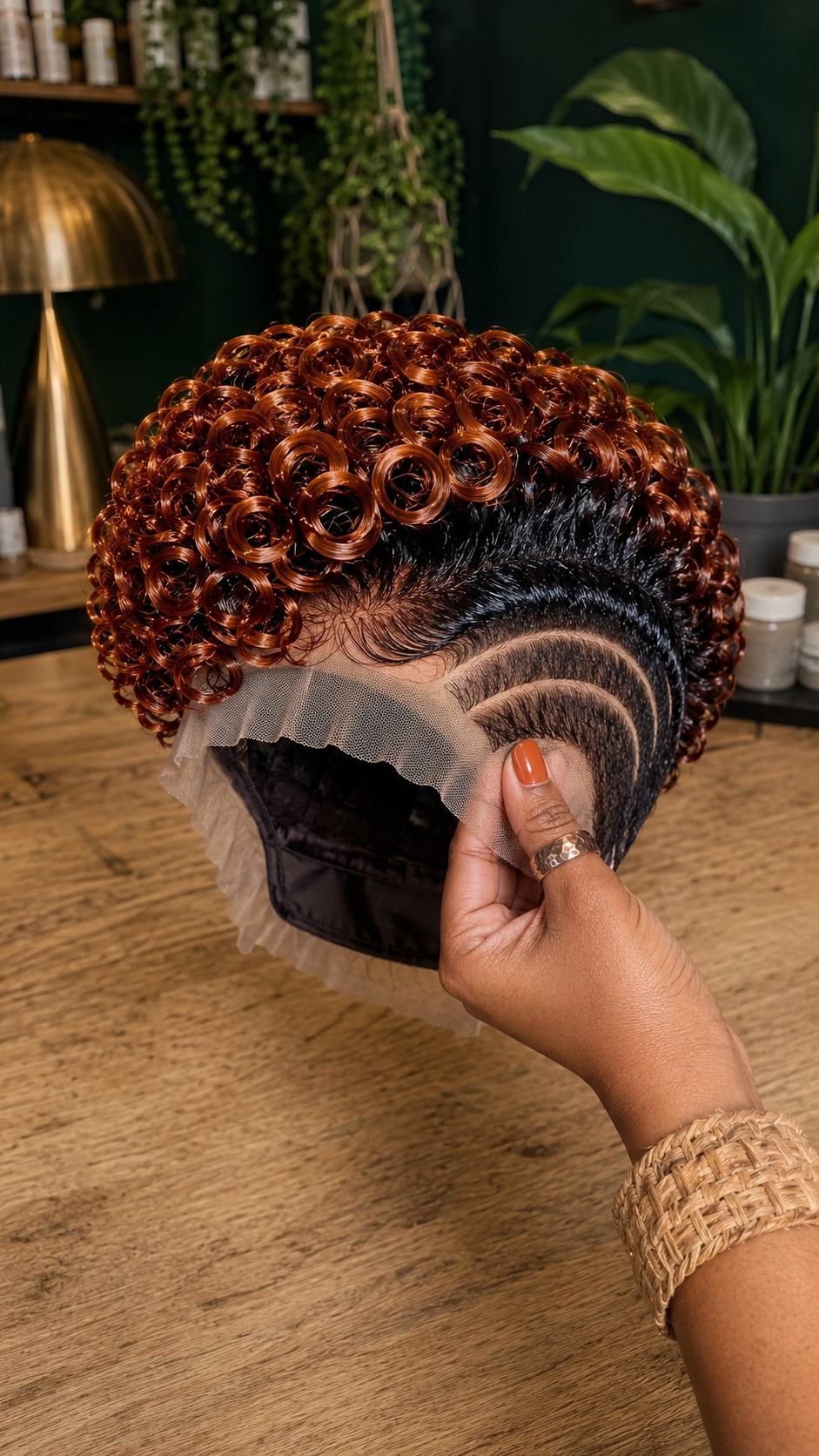
Every one of these copper coils was wound and set by hand. The black side was cut and knotted to stay. This short unit again presents a warm copper-auburn spiral zone against a deep black carved section. The photograph makes both zones equally clear: the coils are uniform, glossy, and tightly wound; the black side carries clean multi-line geometry. The two zones were not made the same way, and they will not age the same way.
The copper coils are a set. Heat, rods, and product created the crisp definition visible in the product shot. That definition is temporary. The black carved side is construction. The lines are knotted or cut into the lace and the hair density is graduated to hold the shape. That geometry is permanent until the hair itself wears out. Treating both zones as if they share the same lifespan is the most common mistake with this design.
Where To Buy This Copper Black Pixie
Custom makers
Makers who control both a tight rod-set coil in a warm tone and a clean carved black side are the strongest source. Ask how the copper coils were set and whether the black lines are knotted with graduated density. Request photographs that show both zones after a simulated wash or at least under different lighting.
Instagram and TikTok sellers
Search terms such as “copper black rod set pixie”, “auburn spiral carved side”, and “two tone set curl unit” surface accounts that show the contrast clearly. Prioritise sellers who post close-ups of the coil definition and the side geometry in the same frame.
Etsy
Look for short curly lace fronts that specify a rod-set or defined coil in the lighter zone and a carved or hard-part construction in the darker zone. Descriptions that separate the two processes are more useful than listings that treat the whole unit as one technique.
Marketplaces like Amazon, AliExpress, and Temu
These platforms carry similar two-tone short curly units. Coil definition and side sharpness vary widely between sellers and even between colour runs. Check recent reviews that mention how the curls looked after the first wash and whether the side lines stayed clean.
Local beauty supply shops and salons
If a shop stocks this style, hold the unit and examine the copper coils and the black side under bright light. A good set shows uniform, springy coils; a good carve shows continuous lines with a clear density drop.
Vendors and wholesalers direct
Wholesale sources can supply this construction in volume. Request a sample that shows both the set quality of the copper and the construction quality of the black side before placing a larger order.
Regionally (Lagos, Accra, Atlanta, London, South Africa)
These markets produce large numbers of short curly units with bold colour and side work. Local maker networks often allow in-person inspection of coil definition and carved geometry before purchase.
Vet the seller
Ask for a photograph that shows the copper coils and the black carved side clearly. Confirm whether the coils are a heat-set style that will relax and whether the black lines are permanent construction. Request any after-wash images if available.
Red flags
Listings that only show the copper coils in perfect definition and hide the black side. Units that claim “permanent curls” on a clearly heat-set rod pattern. Prices that undercut the market while promising both crisp coils and sharp carved lines that never change.
When you order, send
Your preferred balance of copper to black, how defined you want the initial coil set, and confirmation that you understand the copper will relax while the black geometry is meant to stay. Clear expectations reduce disappointment after the first wash.
Contact / order inquiries: WhatsApp [WhatsApp: +XX XXX XXX XX XX]
How Much It Costs
Tiered pricing
Human-hair versions with a controlled copper-auburn rod-set zone and a deep black carved side typically range from $200 to $460. The dual process (set plus carve) adds cost. Mid-range human units land around $165–320. Basic human or mixed-fibre pieces start near $110–185. Good synthetic versions that hold a tight coil and clean side geometry usually fall between $75 and $160. Entry-level synthetic can be found from $40 to $85.
What that includes and excludes
The quoted price covers the unit with both zones finished and the lace left long for trimming. It rarely includes extra bands, additional styling product, or later re-setting of the copper coils. Shipping and duty sit outside the base figure.
Shipping and duty
International shipping commonly adds $15–50. Duty and tax vary by country and can add 10–25 % of the declared value. Factor both into the true landed cost.
Ongoing costs
The copper coils will need periodic re-setting or product refresh to recover definition. The black carved side needs regular cleaning to keep the lines distinct. Budget $55–100 per year in maintenance, product, and occasional professional re-set if the unit is worn several times a week.
First-year total
Unit price + shipping + duty + one year of products and any re-setting. A solid mid-range human unit often lands between $290 and $580 for the first twelve months.
Cost per wear
At three wears a week the mid-range unit costs roughly $1.90–$3.70 per wear in the first year. After that the major outlay is behind you, provided you accept that the copper will require ongoing attention while the black side does not.
What a very low price signals
A dense copper-and-black unit with perfect coil definition and sharp carved lines offered well below market usually means the coils are a temporary set that will collapse quickly or the side work is only surface-cut. Extremely low prices almost always mean one of the two zones will degrade after the first wash.
Deposit structure
Custom makers typically request 30–50 % to begin, with the balance due before shipping. Use a payment method that allows dispute if the finished coil definition or side geometry does not match what you requested.
Shipping, Delivery, And What To Expect After Ordering
Ready-to-ship units usually leave within a few business days. Custom two-tone work with both a rod set and a carved side takes 2–6 weeks depending on the maker’s queue. Once shipped, most international orders arrive in 7–18 days. On arrival, open the unit under natural light and check both zones. The copper coils should be uniform and springy; the black lines should be continuous and clean. If either zone fails that check, contact the seller with clear photographs before any washing or trimming.
Set Definition Versus Permanent Geometry
The copper coils in the product photograph are at their peak. Rods, heat, and product produced the tight, glossy rings. Once the unit is washed, slept in, or exposed to humidity, those coils will relax toward their resting pattern. The resting pattern may still be curly, but it will not be this crisp or this uniform. That is normal for any heat-set or wet-set style. The black carved side does not share that behaviour. The lines are built into the density and the lace. They can collect product or lose a few fine hairs, but the geometry itself does not “relax.” It stays until the hair is worn away or the lace fails.
This difference is the core of the design. One zone is a temporary visual effect. The other is permanent construction. Buyers who expect the copper to remain as tight as the day it arrived will be disappointed. Buyers who treat the copper as a style that can be refreshed and the black side as a fixed feature will get longer satisfaction from the unit.
Why The Contrast Increases Over Time
As the copper coils soften, the visual gap between the two zones grows. The black side remains precise while the copper becomes fuller, less defined, and sometimes slightly frizzier. Some wearers like the evolving contrast. Others find it unbalanced. Knowing that the change is structural rather than a defect helps set the right expectation before purchase.
Re-Setting The Copper Zone
Because the copper is a set, it can usually be refreshed. Heat protectant, rods or flexi-rods, and a controlled set can restore much of the original definition. Each re-set adds a small amount of stress to the hair, especially if the copper was lifted or dyed to reach that tone. The black zone should be protected during any re-set so the carved lines are not flattened or coated with the same product. Separate the care of the two zones and both last longer.
Orientation Still Locked By The Black Side
Even while the copper changes, the black carved side continues to lock the unit’s direction. The geometry tells you which way the unit must sit. Shifting it will place the carved lines in the wrong position relative to the face. The copper may look different over time, but the orientation rule does not.
Before You Pay
Does the seller provide a clear photograph of both the copper coil definition and the black carved side?
Are the copper coils a heat or wet set that will relax, and has the seller stated that openly?
Are the black lines permanent construction with graduated density, or only cut into the surface?
After the first wash, what does the seller say the copper coils will look like?
Are you prepared to re-set the copper periodically while the black side requires only cleaning?
Trimming The Lace
Leave the excess lace in place until the unit is on your head and both zones are positioned where you want them. The carved black side should sit at the angle you prefer before any cutting. Trim gradually with sharp lace scissors. Once the lace is removed, the placement of both the set zone and the permanent geometry is fixed.
Search Terms
copper black rod set pixie · auburn spiral carved side · two tone set vs construction · copper coil permanent black side · warm curl black hard part · rod set copper lace front · defined coil vs carved geometry · copper auburn black two tone unit
Final Thoughts
This unit is built from two different processes. The copper coils are a set that will relax. The black carved side is construction that is meant to stay. The product photograph shows both at their best, but only one of them is permanent. Once the copper softens, the contrast between the zones increases and the black geometry becomes even more dominant.
If you want the crisp copper definition to last, plan for periodic re-setting and accept the maintenance. If you are happy for the copper to evolve into a softer curl while the black side remains precise, the unit will reward that expectation. The only mistake is assuming both zones were made the same way and will age the same way. They were not, and they will not.