
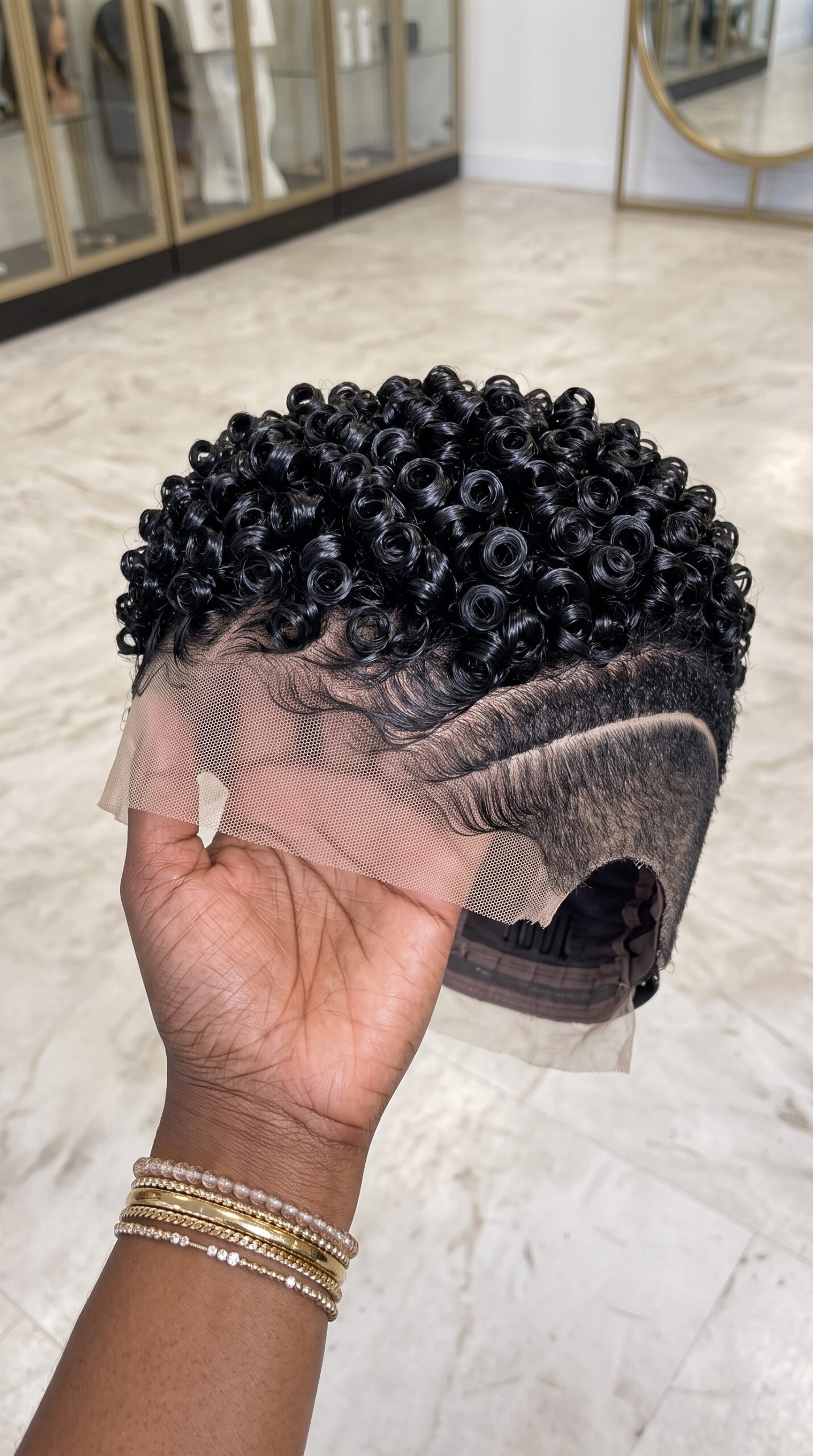
If the side of a short curly unit has no sharp lines, the first thing to judge is how the curls meet the lace. This black spiral pixie is presented with a wide panel of lace still attached and a soft, irregular hairline that follows the natural growth pattern rather than a razor design. The dense, high-shine coils sit right up to the edge. There is no multi-line carve, no hard part, and no geometric fade forcing the unit into one orientation.
That absence is the point. Recent short curly units have leaned heavily on carved sides as the main design feature. This one does the opposite. It keeps the side quiet so the curls and the lace melt can do the work. The result is a more flexible unit that can be parted, shifted, or worn with different face-framing approaches without a permanent side pattern dictating the angle.
Where To Buy This Soft Edge Pixie
Custom makers
Makers who specialise in short curly lace fronts with pre-plucked, natural-looking edges are the most reliable source. Ask specifically for a soft hairline rather than a carved or hard-part design. Request close-ups of the edge from multiple angles so you can see how the coils meet the lace.
Instagram and TikTok sellers
Search terms such as “soft hairline curly pixie”, “natural edge spiral unit”, and “black tight curl lace front” surface accounts that show units without aggressive side carving. Prioritise sellers who post clear photographs of the lace edge under natural light.
Etsy
Filter for short curly lace fronts that emphasise a pre-plucked or baby-hair finish rather than razor designs. Read the description for language about a natural or soft hairline. Avoid listings that only show the top of the curls.
Marketplaces like Amazon, AliExpress, and Temu
These platforms carry dense black spiral units, but the hairline quality varies widely. Some arrive with a clean soft edge; others have a blunt or sparse transition. Check recent reviews that mention the lace and the hairline specifically.
Local beauty supply shops and salons
If a shop stocks short curly lace fronts, hold the unit and examine the edge under bright light. A good soft hairline shows gradual density and individual coils sitting close to the lace without large gaps or obvious machine lines.
Vendors and wholesalers direct
Wholesale sources can supply this construction in volume. Request a sample that shows the exact edge finish before placing a larger order. Confirm that the lace is left long enough for custom trimming.
Regionally (Lagos, Accra, Atlanta, London, South Africa)
These markets produce large numbers of short curly lace fronts. Local maker networks often allow in-person inspection of the hairline quality and lace transparency before purchase.
Vet the seller
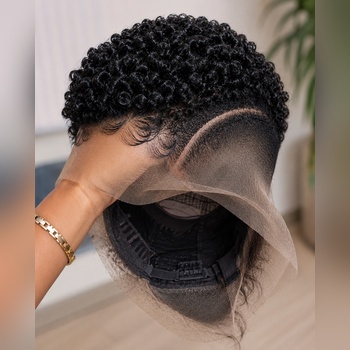
Ask for a straight-on photograph of the hairline and a three-quarter angle that shows how the curls meet the lace. The edge should look irregular and natural rather than perfectly straight or heavily carved. Confirm whether baby hairs are included and whether they match the coil pattern.
Red flags
Listings that never show the lace edge clearly. Units photographed only from above. Descriptions that call every short curly unit “natural hairline” without visual proof. Prices that undercut the market while claiming hand-tied soft edges.
When you order, send
Your preferred density at the hairline, whether you want baby hairs, how much excess lace you need left, and a note that you are looking for a soft edge rather than any carved or hard-part design. Clear instructions reduce the chance of receiving a different style.
Contact / order inquiries: WhatsApp [WhatsApp: +XX XXX XXX XX XX]
How Much It Costs
Tiered pricing
Human-hair versions with dense black spiral curl and a clean soft hairline typically range from $160 to $400. Units with higher-grade lace and carefully pre-plucked edges sit toward the upper end. Mid-range human pieces land around $140–270. Basic human or mixed-fibre units start near $90–160. Good synthetic versions that hold the tight coil and a believable soft edge usually fall between $60 and $130. Entry-level synthetic can be found from $25 to $65.
What that includes and excludes
The quoted price covers the unit with the soft hairline already finished and the lace left long for trimming. It rarely includes extra elastic bands, additional styling product, or later density adjustments. Shipping and duty sit outside the base figure.
Shipping and duty
International shipping commonly adds $15–45. Duty and tax vary by country and can add 10–25 % of the declared value. Factor both into the true landed cost.
Ongoing costs
A soft hairline needs regular gentle cleaning along the edge and occasional light trimming of any baby hairs that become sparse or tangled. Leave-in conditioner and a soft brush are normal. Expect $35–70 per year in maintenance products if the unit is worn several times a week.
First-year total
Unit price + shipping + duty + one year of products. A solid mid-range human soft-edge spiral often lands between $230 and $480 for the first twelve months.
Cost per wear
At three wears a week the mid-range unit costs roughly $1.50–$3.10 per wear in the first year. After that the major outlay is behind you, provided the edge stays clean and the coils do not mat.
What a very low price signals
A dense black spiral with a perfect soft hairline offered well below market usually means the edge is machine-finished or sparsely knotted. Extremely low prices almost always mean the hairline will look thinner or more artificial after the first few washes.
Deposit structure
Custom makers typically request 30–50 % to begin, with the balance due before shipping. Use a payment method that allows dispute if the finished hairline does not match the soft-edge standard you requested.
Shipping, Delivery, And What To Expect After Ordering
Ready-to-ship units usually leave within a few business days. Custom soft-edge work takes 2–5 weeks depending on the maker’s queue. Once shipped, most international orders arrive in 7–18 days. On arrival, open the unit under good light and check the hairline first. The coils should sit close to the lace with a natural irregular edge. The lace itself should be intact and long enough for your preferred trim. If the edge looks blunt, sparse, or heavily carved instead of soft, contact the seller with clear photographs before any washing or cutting.
Soft Edge Versus Carved Side
A carved or hard-part side is a permanent design decision. It locks orientation, multiplies maintenance points, and turns every profile view into a geometry check. A soft hairline does the opposite. It leaves the side quiet so the unit can be adjusted, parted, or worn with different accessories without a fixed pattern fighting the new angle. On a short dense spiral this flexibility matters. The curls already create strong texture and volume. Adding a graphic side design can feel redundant; leaving the edge soft keeps the focus on the coil pattern and the lace melt.
The trade-off is visibility. A soft edge relies more heavily on lace quality and knot work because there is no carved fade to create deliberate skin exposure. If the lace is coarse or the knots are dark, the soft hairline will show it. A well-executed soft edge therefore demands the same attention to lace grade and bleaching as a front hairline, just without the additional labour of multiple carved lines.
How The Curls Meet The Lace
On a unit like this the critical zone is the final centimetre where the spiral coils transition into the lace. Dense, springy curls that sit right up to the edge create a continuous texture. If there is a visible gap, a sudden drop in density, or a row of straight hairs before the coils begin, the hairline looks artificial. The best soft-edge units keep the coil pattern consistent all the way to the lace, with only the finest baby hairs breaking the line for realism. When you evaluate the unit, look specifically at that transition under daylight. The product photograph in this case shows the coils remaining tight and close to the edge, which is the standard to demand.
Excess Lace As A Practical Signal
The wide lace panel left on this unit is not waste in the product photograph. It is a signal that the maker expects the buyer to customise the hairline to their own face shape and preferred wear style. Units that arrive with the lace already cut to a short, fixed shape remove that option. When the lace is left long, you can position the unit, mark the exact line that suits your temples and forehead, and trim once. That single extra step often produces a better melt than a pre-cut edge designed for a generic mannequin head.
Orientation Freedom
Because there is no permanent side design, this unit can be shifted slightly forward, backward, or to either side without a carved pattern ending up in the wrong place. That freedom is useful for wearers who change their parting, wear different earrings, or prefer to adjust the unit according to outfit or face shape on a given day. The cost of that freedom is that the unit does not come with a built-in “signature” side. The identity of the piece rests entirely on the quality of the coils and the cleanliness of the soft edge.
Before You Pay
Does the seller provide a clear photograph of the hairline that shows how the coils meet the lace, not only the top of the curls?
Is the edge soft and irregular, or does it show signs of a hard part or multi-line carve that was not requested?
How much excess lace is left, and is it enough for you to customise the shape to your own hairline?
Do any baby hairs match the tight coil pattern, or do they look like a different texture?
After the first wash, will the density at the edge remain consistent, or does the seller warn that the hairline thins noticeably?
Trimming The Lace
Leave the excess lace in place until the unit is on your head and positioned exactly where you want the hairline to sit. Use a skin-safe marker or the tip of a pin to mark the line that follows your natural hairline and temples. Trim in small stages with sharp lace scissors. Do not cut into the knotted area. Once the lace is removed, the shape is fixed. If you are unsure, have a stylist experienced with short lace units make the first cuts while you watch the edge in a mirror.
Search Terms
soft hairline black spiral pixie · natural edge tight curl unit · black rod set lace front soft · pre plucked spiral pixie · dense coil soft hairline · no hard part curly pixie · excess lace black spiral · baby hair matching coil pixie
Final Thoughts
This unit is defined by what it does not have. There is no multi-line carve, no hard part, and no geometric side design locking it to one orientation. The dense black spirals and the soft, irregular hairline are left to carry the look. That choice produces a more flexible short curly pixie that can be adjusted and worn in different ways without a permanent side pattern dictating the angle.
The quality of the piece therefore rests on two things: how cleanly the coils meet the lace, and how well the lace itself can melt against the skin. If both are strong, the absence of carving becomes an advantage. If either is weak, the unit has nothing else to hide behind. Evaluate the edge with the same seriousness other buyers give to carved designs. On a soft-hairline spiral the edge is the entire side story.