
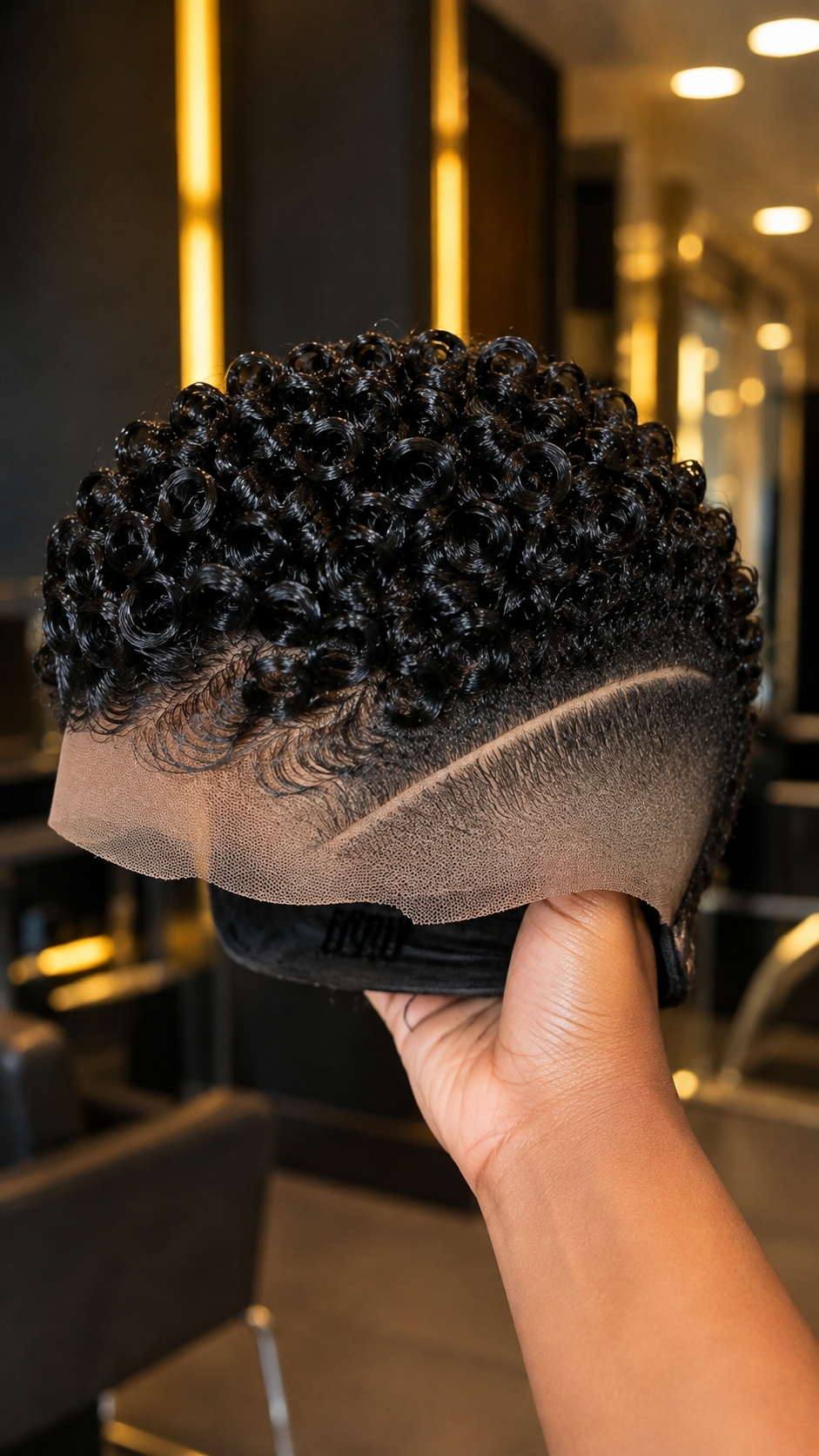
This is a short companion note to a fuller breakdown of set-curl-to-natural-texture pixie units. The unit itself — glossy spiral curls up top melting into a flatter natural texture below — has already been covered in depth elsewhere. What this particular close-up adds, and what earlier photos did not show as clearly, is the front hairline: the swept, laid-down edges worked flat against the lace right where the curl meets the forehead. That single detail is worth a focused look on its own.
Laid Edges Are Styled, Not Built In
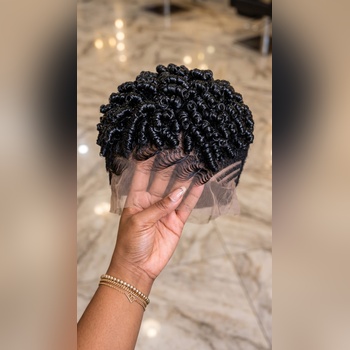
Look at the fine, swept hairs combed flat and curved along the very front of the hairline, just below where the spiral curls begin. These are laid edges — baby-hair-style wisps at the perimeter, smoothed and shaped with product to blend the hard lace boundary into something that reads more like a natural hairline. On this unit they are neatly laid in a soft directional sweep rather than left loose.
The key thing to understand, exactly as with carved lines and set curls, is that laid edges are a styling step, not a permanent feature. They are created fresh with product and a fine brush, and they relax, frizz, or wash out entirely with time, humidity, and cleaning. A unit photographed with beautifully laid edges will not arrive, or stay, that way on its own — you recreate them each time you style.
Why This Detail Decides How Natural The Front Reads
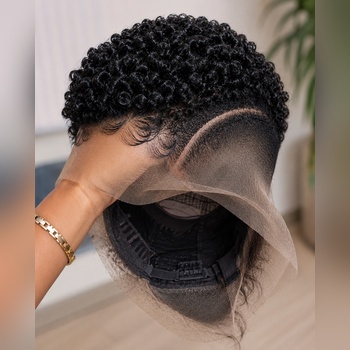
On a curly pixie, the front hairline is where the illusion of a natural head of hair either holds or breaks. The curls above can be flawless, but if the edge where lace meets skin looks hard or abrupt, the whole front gives the unit away. Laid edges exist specifically to soften that transition, which is why sellers style them carefully for photos.
For a buyer, this means two things worth checking. First, ask whether the unit has fine, workable hairs at the perimeter to lay in the first place — some units have a blunt, hair-free lace edge with nothing to sweep, which limits how natural you can make the front look. Second, budget the small ongoing effort: an edge product and a few minutes of combing each time you wear it, since the laid look never survives a wash.
The Wide Exposed Lace In This Shot
This close-up also shows a broad span of bare lace flipped forward, more than earlier photos revealed. That is simply the ear-to-ear lace being held open, not extra material you keep — most of it gets trimmed to your hairline as covered in the main breakdown. It is worth noting only because seeing this much bare lace can look alarming if you do not expect it; it is normal, and it trims down to a natural edge once fitted.
Final Note
Everything else about this unit — the set curl on top, the natural texture below, the split maintenance, the cap and comb construction — is covered in the main article on set-curl-to-natural blends, so this note stays deliberately short. The one addition worth carrying forward is the hairline: laid edges make or break how natural the front looks, they are styled rather than permanent, and a unit needs workable perimeter hairs for you to lay them at all. Check for that before you buy, and plan the few minutes of upkeep after.