
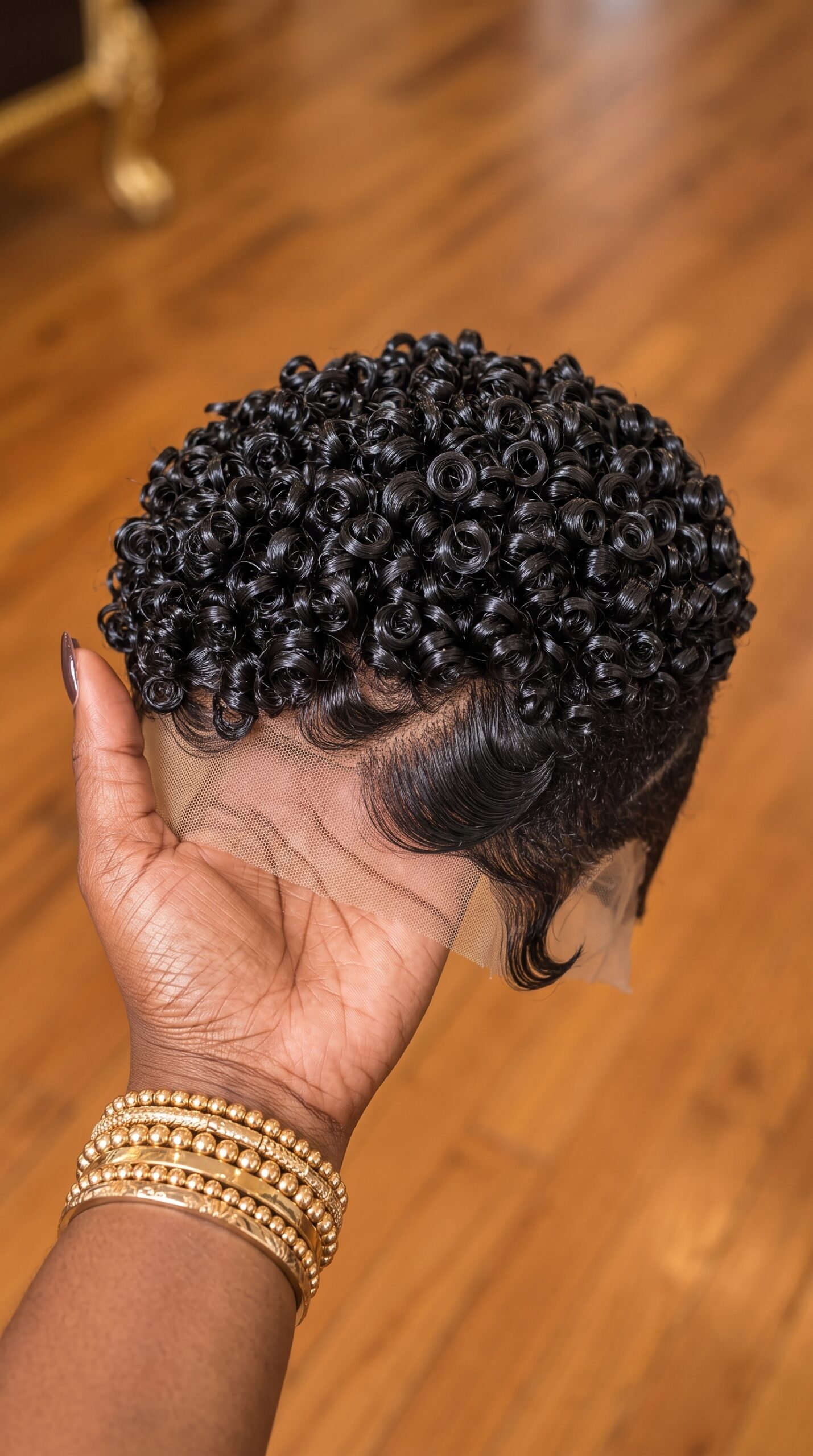
A short curly pixie wig can look beautifully finished before it is ever installed, but one small construction detail can determine how easy the final fitting becomes: the amount of space left between the first row of curls and the front edge of the lace.
On a compact pixie like this one, the crown is filled with glossy black ringlets while the lower frontal area is shaped with flatter sculpted hair. The curls sit close enough to the front to create a full pixie silhouette, but the installer still needs enough visible lace and perimeter space to position, trim, and blend the unit.
If the curls begin too far forward, the front can become crowded and difficult to customize. If they begin too far back, the wig may have an unusually large flat zone between the hairline and the curly crown.
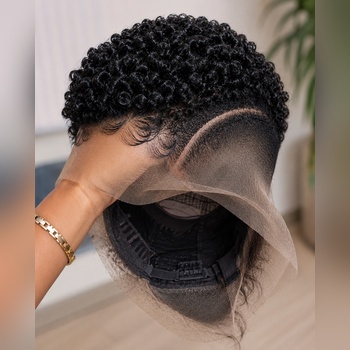
The goal is not one universal measurement. The goal is a balanced front curl setback that leaves enough installation room while keeping the pixie visually compact.
Where To Buy A Short Curly Pixie Wig With A Well-Planned Front
Custom wig makers. Custom makers can usually control where the main ringlet crown begins. Send a side or three-quarter reference and explain whether you want the curls close to the forehead or slightly farther back with more sculpted perimeter hair.
Local wig boutiques. Shopping in person allows you to examine the wig before the lace has been trimmed. Look at the distance between the raw lace edge, the hairline, the sculpted front section, and the first full curls.
Instagram and TikTok wig sellers. Ask for close-up video of the actual frontal before installation. Many social media sellers show the finished curls but not the amount of workable lace underneath them.
Etsy wig makers. Independent makers may offer custom lace, cap size, curl placement, density, and front styling. Send a reference photo rather than simply asking for a “curly pixie.”
Online wig stores. Search for short curly lace wigs, glueless pixie wigs, ringlet pixie wigs, finger-wave pixie wigs, and short human-hair wigs for black women.
Amazon, AliExpress, and Temu. Budget options can be attractive, but inspect customer photos carefully. Factory units can differ in how close the bulk of the curls sits to the front.
Professional wig salons. A stylist may be able to reshape an existing pixie by adjusting the first curls, front waves, and perimeter after the cap has been fitted.
Wholesale suppliers. If you purchase several units, compare the front setback across the batch. A product can look like the same wig from above while having noticeably different frontal proportions from unit to unit.
Order inquiries: WhatsApp [WhatsApp: +XX XXX XXX XX XX]
How Much Does A Short Curly Pixie Wig Cost?
Premium Custom Human Hair: approximately $260–$520+. This category can include higher-grade human hair, custom lace, cap measurements, hand-set curls, sculpted frontal work, smaller knots, and detailed finishing.
Standard Custom Human Hair: approximately $180–$360. These units can provide good human hair with customized styling and reliable construction at a lower price than fully premium work.
Basic Human Hair: approximately $120–$250. The basic structure may be suitable, but additional salon shaping can be necessary to reproduce a specific front profile.
Premium Synthetic: approximately $60–$160. High-quality synthetic fibre can maintain compact ringlets very well, although front customization options can be more limited.
Basic Synthetic: approximately $25–$80. Budget units can reproduce the overall shape but may use heavier lace or more standardized curl placement.
Shipping, customs charges, professional installation, lace work, additional cutting, and curl resetting can increase the final cost.
The Raw Lace Edge Is Not The Hairline
This is the first important distinction.
A new wig may arrive with lace extending noticeably beyond the actual hairs.
That extra lace is working material.
The installer normally positions the wig first and then trims the lace closer to the intended hairline.
Therefore, when evaluating the distance between the curls and the front, measure visually from the actual hairline area rather than from the outermost raw lace edge.
The First Full Curls Should Not Sit Directly On The Lace Edge
Large ringlets placed immediately at the very front can make installation difficult.
The installer needs space to access the lace, see the hairline, and trim the perimeter without accidentally cutting into the main curl structure.
A compact pixie can still appear full while leaving a small styling zone before the main crown begins.
That zone can contain finer hairs, flatter waves, or shorter curls.
A Front Styling Zone Makes The Pixie Easier To Customize
Think of the front as having two jobs.
The lace and perimeter need to create the illusion of the hairline.
The ringlet crown needs to create the volume and character of the haircut.
When those two areas are pushed directly on top of each other, both jobs become harder.
A small transition zone lets the stylist work on the hairline without disturbing the crown.
Too Much Space Can Make The Wig Look Flat
Leaving room at the front is useful, but excessive distance causes another problem.
If the main curls begin far behind the frontal, the wig can develop a broad flat area above the forehead.
This may make the crown appear as though it is sitting too far back on the head.
On a short pixie, even a relatively small change in this distance can significantly alter the silhouette.
The Correct Setback Depends On Curl Size
Large curls project farther forward than compact curls.
That means a larger ringlet may need to begin slightly farther back while still appearing close to the hairline once it bends forward.
Smaller curls can often sit nearer the frontal without covering as much lace.
This is why the construction should be planned according to the final curl pattern rather than using the same front spacing for every pixie style.
Curl Direction Matters As Much As Curl Position
A curl can be physically positioned behind the hairline but still hang forward over the lace.
Another curl placed at almost the same location may point upward and leave the frontal completely visible.
When checking a unit, look at both placement and direction.
The front curls should frame the hairstyle without falling so far forward that the installer cannot work comfortably around the lace.
Lower Front Curls Can Be Shorter Than Crown Curls
One practical way to maintain a compact shape is using slightly shorter curls near the front perimeter.
They visually connect the sculpted hairline with the fuller crown while leaving the main ringlets higher and farther back.
This can prevent the front from appearing too heavy.
Ask the wig maker whether the unit uses graduated curl lengths or one uniform length throughout the crown.
Finger Waves Can Create A Useful Transition
This type of pixie often includes flatter sculpted waves beneath the ringlets.
Those waves help bridge the difference between the lace hairline and the full curly crown.
Instead of moving directly from thin lace-front hairs into large curls, the eye passes through a shaped perimeter section first.
That creates a more deliberate front profile.
The Transition Should Still Look Connected
The front waves and upper curls should not appear like two unrelated hairstyles.
There needs to be visual continuity.
The final wave can move naturally into a smaller curl, and the curl formation can gradually become fuller farther into the crown.
This makes the front look designed rather than divided into separate zones.
Check The Wig From A Low Front Angle
Most product photographs are taken from above because that angle shows the curls attractively.
For front spacing, a lower angle can be more useful.
It reveals whether the ringlets project excessively over the forehead and whether the lace remains accessible underneath them.
Ask for both normal and slightly lower frontal views when ordering custom.
A Side View Reveals The True Setback
From the front, depth is difficult to judge.
A side view shows exactly where the first full curl begins relative to the hairline.
It also shows whether the curl leans forward, upward, or backward.
For a custom pixie, the side profile should be one of the main reference angles.
Do Not Judge The Front While Someone Is Holding The Curls Back
A seller can make the lace look extremely accessible simply by lifting the curls during photography.
Ask to see the unit with the curls resting naturally.
If they immediately fall across most of the frontal, you will have a different installation experience from what a lifted product photo suggests.
A short video is useful because it shows how the curls settle after being released.
The Front Setback Changes Once The Wig Is On A Head
A handheld wig is not stretched in the same way as a worn wig.
Once the cap sits on a head, the frontal and crown take on their intended curvature.
The distance between features can appear slightly different.
This is why handheld construction photos and worn photos should ideally be used together.
Cap Size Can Change The Apparent Front Position
If the cap is too small, it may be pulled backward under tension.
The crown can then appear farther from the forehead than intended.
If the cap is too large, it may slide forward and make the curls crowd the frontal.
Before altering curl placement, confirm that the cap size itself is correct.
Do Not Trim The Lace To Fix Curl Placement
This is an important mistake to avoid.
If the curls appear too far from the edge, cutting more lace does not actually move the curls forward.
You are only changing where the lace ends.
Likewise, leaving extra lace does not correct curls that hang too far forward.
Separate lace trimming from hairstyle structure when diagnosing the problem.
Do Not Cut Into The Hairline To Create More Working Space
If the frontal feels crowded, avoid randomly removing hairs or cutting into the curl base.
You can permanently change the density and shape of a short wig very quickly.
A professional stylist can determine whether selected front curls should be repositioned, shortened, reset, or removed.
Small changes are safer than aggressive cutting.
Pre-Plucking Should Not Create A Huge Empty Zone
Pre-plucking can make the hairline appear less dense.
But excessive plucking combined with a large curl setback can leave too much empty-looking space in front of the crown.
The hairline should transition gradually into the styled section.
Ask to see the exact frontal after any pre-plucking is completed.
The Front Density Should Build Gradually
A believable short wig often uses lower density at the immediate perimeter and increases fullness farther back.
This creates depth.
If the density jumps suddenly from very sparse frontal hairs to extremely heavy curls, the transition can look abrupt.
Good construction distributes that increase over a small but visible zone.
Check Whether The Curl Base Is Visible
If the curls are positioned too far apart near the front, large patches of base may become visible between them.
Some separation is normal.
Large empty zones are different.
Inspect the transition from slightly above and from the side to determine whether the coverage remains balanced.
Gloss Can Make The Curls Appear Closer To The Front
Highly reflective ringlets attract the eye strongly.
Because they are visually dominant, they can appear to occupy more space than they physically do.
This is worth remembering when comparing a heavily styled product photo with an unstyled unit.
Evaluate the actual placement rather than relying entirely on visual impact.
The Front Setback Should Work With The Wearer’s Forehead
Not every wearer has the same frontal proportions.
A curl placement that looks ideal on one person may feel too close or too far back on another.
This is one advantage of custom ordering.
Send the maker a clear reference and discuss whether you prefer a compact forward crown or slightly more open frontal styling.
A High Forehead Does Not Automatically Need Curls Pulled Forward
It can be tempting to use the curls to cover more forehead.
That may work stylistically, but it should be a deliberate choice rather than a construction fix.
The lace hairline should still be positioned correctly.
The crown can then be styled forward if that is the desired look.
A Low Hairline May Need More Restraint
On someone with a naturally lower forehead, heavy front curls can make the wig feel visually crowded.
Keeping the first full ringlets slightly farther back may create better proportion.
This is why copying measurements from another person’s finished wig does not always produce the same result.
Glueless Wigs Benefit From A Clear Front Working Area
A glueless unit needs to sit correctly without depending heavily on adhesive.
The wearer may adjust the frontal, check the lace, and reposition the wig more frequently.
Having enough accessible perimeter space makes those adjustments easier.
If dense curls permanently cover the front, everyday fitting can become unnecessarily awkward.
Ask Whether The Wig Arrives Fully Styled
A factory unit may arrive with curls positioned differently from the product photographs.
The seller may style the sample immediately before photography.
Ask whether your unit will arrive with the front waves and curl setback already prepared.
If not, you may need a stylist to recreate the final arrangement.
Human Hair Allows More Front Adjustment
Human-hair pixies can generally be wet, reset, and reshaped more freely.
If the first few curls sit too far forward, a stylist may be able to redirect them without changing the cap construction.
If they sit too far back, selected curls may sometimes be restyled forward.
This flexibility is useful for buyers who intend to maintain the unit professionally.
Synthetic Curls Can Be More Fixed
Synthetic ringlets may hold their original position extremely well.
That is convenient when you already like the factory arrangement.
It also means major repositioning can be more difficult.
Before buying synthetic, inspect the front profile carefully because you may have less freedom to alter it later.
How To Find A Stylist For This Type Of Pixie
Search for a pixie wig stylist, short curly wig specialist, lace wig customization, finger wave wig stylist, or short human-hair wig salon.
Check the stylist’s portfolio for actual short units.
Send the reference before booking and explain whether your concern is curl placement, frontal spacing, lace trimming, wave shaping, or overall crown position.
Appointments can usually be requested by phone, WhatsApp, Instagram DM, Facebook, or the salon’s booking page.
What To Tell The Wig Maker
For a custom order, explain that you want a compact ringlet crown without the curls crowding the lace.
Ask for enough front styling room for installation while keeping the main curls close enough to preserve the short pixie silhouette.
If you want sculpted waves between the frontal and crown, mention that separately.
Send side and three-quarter references instead of relying only on one frontal photograph.
Before You Pay
- Can you show the exact wig from the side?
- How far behind the hairline do the full ringlets begin?
- Do the front curls naturally fall over the lace?
- Can you show the curls resting without holding them back?
- Is there a sculpted wave section between the hairline and crown?
- Can the first curls be shortened or redirected if necessary?
- Is the unit human hair or synthetic?
- Does it arrive fully styled like the product photo?
- Can you show the frontal before the lace is cut?
- Can I approve the finished front profile before shipping?
Maintaining The Front Shape
The front of a pixie often loses its original structure before the center of the crown does because it receives more handling.
Avoid constantly pulling the first curls forward and backward.
When refreshing human hair, work with small sections and preserve the intended direction.
Use lightweight styling products so the transition area does not become stiff or overloaded.
Store The Wig Without Crushing The Front Curls
If the wig is pressed face-first into a box, the first ringlets may flatten backward or downward.
This changes the apparent setback even though the construction has not moved.
Store the unit with enough room around the frontal and crown.
A properly sized wig stand or mannequin head can help preserve the front profile.
Search Terms
short curly pixie wig · curly pixie wig for black women · glueless curly pixie wig · ringlet pixie lace wig · short human hair curly wig · finger wave pixie wig · black curly pixie wig · lace front short curly wig · compact ringlet pixie wig · short curly wig with waves · pixie wig frontal · custom curly pixie wig
Final Thoughts
The distance between the first full curls and the front hairline is easy to overlook, but it affects both installation and the finished proportions of a short pixie.
Place the curls too close and the frontal becomes crowded. Move them too far back and the wig can develop an oversized flat zone before the crown begins.
A better approach creates a small transition area where the lace, hairline, sculpted perimeter, and compact ringlets can each do their own job.
When ordering online, request a true side view and a video of the curls resting naturally. Make sure the seller is not simply lifting the crown to expose more lace for the photograph.
For custom work, discuss the front profile before construction is finished. On a short pixie, a small difference in curl setback can change the entire relationship between the forehead, frontal, waves, and crown.