
Buying one attractive curly pixie wig is very different from buying six, ten, or fifty units of the same style. A seller may show one perfectly shaped sample, but the real business question is whether the next units will arrive with the same crown height, curl pattern, short-side proportions, hairline placement, and overall silhouette.
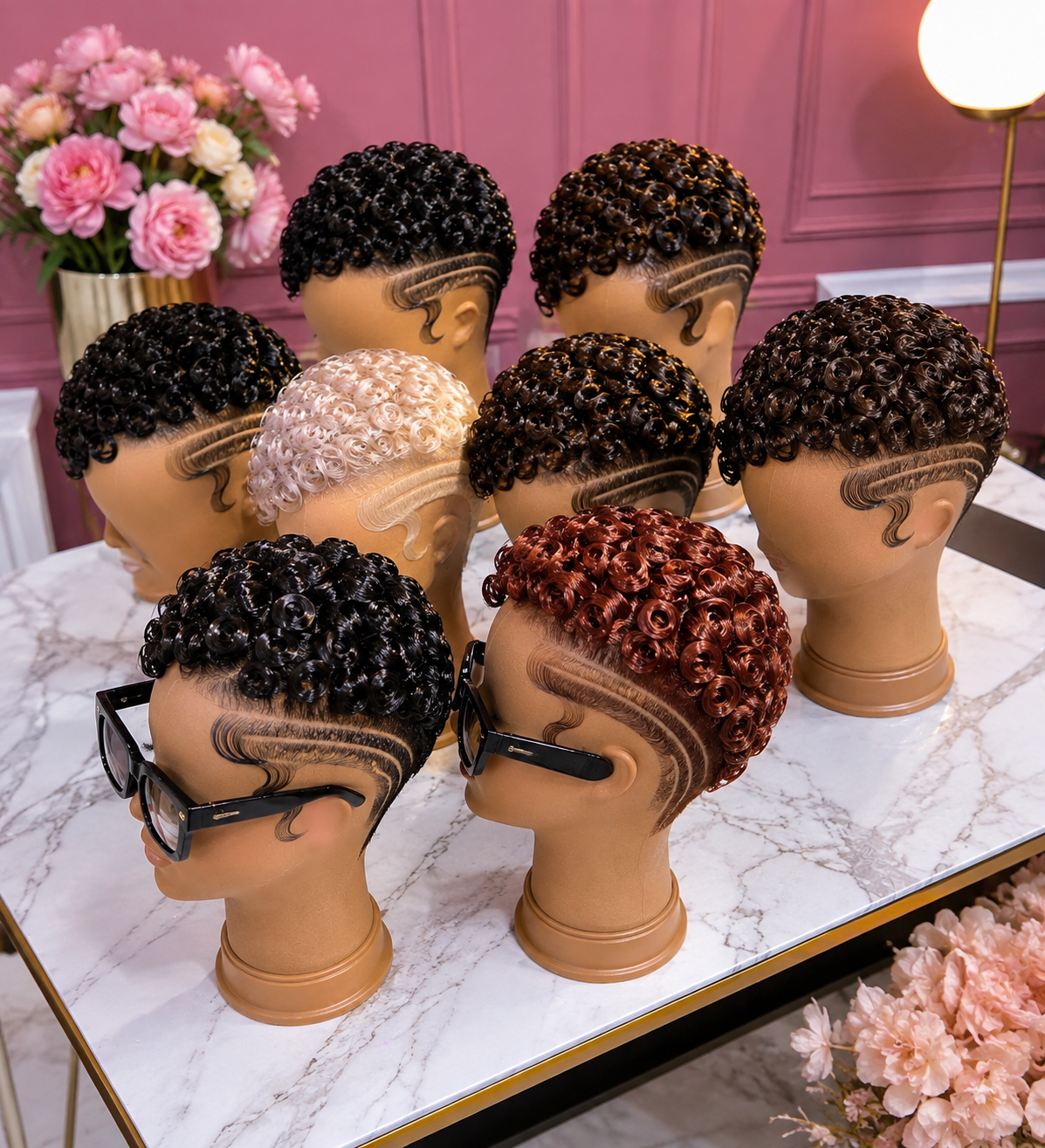
This group of short curly pixie wigs is a useful example because several similar units can be compared side by side. Some are black, some have brown or copper tones, and one uses a much lighter shade. The color changes, but the underlying hairstyle is supposed to remain recognizable.
For a wig business, that consistency matters. Customers who order from the same product listing normally expect the wig they receive to resemble the unit shown in the photographs. If every batch arrives with a different curl height or a noticeably different side cut, the seller may face complaints even when the individual wigs are technically wearable.
Before purchasing several units, learn to evaluate the wig as a repeatable product rather than as one beautiful sample.
Where To Buy Curly Pixie Wigs In Small Or Bulk Quantities
Direct wig manufacturers. Buying directly from a manufacturer can make sense when you need repeated stock. Ask for sample units first and confirm which parts of the pixie are standardized and which are finished manually.
Wholesale wig vendors. Wholesalers can offer lower minimum quantities than some factories. Request photographs of several units from the same batch rather than asking to see only the best sample.
Custom wig makers. Custom makers are useful when quality and detail matter more than large-volume production. If you need repeated units, discuss whether the maker can reproduce the same measurements and styling template consistently.
Local wig suppliers. Buying locally allows you to compare several units physically before paying. Place them next to one another and inspect the crown, sides, back, and inside caps.
Instagram and TikTok sellers. Some social sellers also offer wholesale or reseller packages. Ask for an unfiltered video showing several available units together.
Online marketplaces. Amazon, AliExpress, and Temu can provide ready-made pixie wigs at different price levels. For business purchases, customer photographs are useful for understanding how much the product varies from order to order.
Private-label suppliers. If you want to sell the wigs under your own brand, ask whether the factory can maintain the same construction specifications across repeat orders.
Order inquiries: WhatsApp [WhatsApp: +XX XXX XXX XX XX]
How Much Do Curly Pixie Wigs Cost?
Premium Custom Human Hair: approximately $260–$500+ per unit depending on hair quality, cap construction, lace, custom coloring, curl setting, and hand finishing.
Standard Custom Human Hair: approximately $180–$350 per unit. Small wholesale discounts may be available when several units use the same specifications.
Basic Human Hair: approximately $120–$250. These units may require additional finishing after delivery if you want every piece to match closely.
Premium Synthetic: approximately $60–$160. Synthetic fibre can be useful for repeated products because factory curl patterns and colors may be easier to reproduce consistently.
Basic Synthetic: approximately $25–$80. Lower-cost production may show greater variation in density, cap construction, curl placement, or finishing.
Bulk pricing can differ substantially from single-unit retail pricing. Shipping, customs charges, sample costs, private labeling, packaging, and quality-control services should also be included when calculating your actual landed cost.
Start By Comparing The Overall Silhouette
Do not begin with individual curls.
Place several units at the same angle and compare their overall shape from a normal viewing distance.
Does one crown rise noticeably higher than the others?
Is one wig wider through the sides?
Does another look much flatter at the back?
If the wigs are intended to be the same model, the general silhouette should remain recognizably consistent even when the colors differ.
Crown Height Should Stay Within A Reasonable Range
Small handmade differences are normal.
One wig does not need to match another to the millimeter.
However, a customer should not order a compact pixie and receive a unit with a crown that appears twice as tall as the product photograph.
Ask your supplier how the crown length is controlled during production.
If the final shape depends entirely on manual cutting without a measurement reference, larger variations may occur between workers and batches.
Compare Curl Size Across Several Units
For this type of pixie, curl diameter contributes strongly to the finished look.
If one unit has small ringlets and another has noticeably larger spirals, the wigs can appear like different products even when the hair length is identical.
Inspect several areas of each crown rather than choosing one curl as the reference.
The objective is a similar curl family across the batch, not perfect cloned curls.
Check Curl Coverage At The Front
The front of a pixie is highly visible in customer photographs.
One unit may have curls beginning close to the hairline while another leaves a much larger flat area before the crown starts.
That changes the apparent proportion of the hairstyle.
When comparing samples, line the wigs up from the side and look at where the raised curls begin relative to the frontal area.
Check The Back Of Every Sample
Factories know that product listings usually prioritize the front.
That means the back is sometimes where production differences become most obvious.
Turn every sample around.
Compare crown coverage, taper length, nape finishing, and whether the curls continue evenly toward the rear.
A wig business should never approve a bulk order based only on frontal samples.
The Short Side Needs Its Own Quality Check
The side of this hairstyle contains very short hair and decorative carved lines.
This section requires precision.
If the side length changes significantly from one wig to another, the same crown can appear much heavier or lighter.
Check how much short hair remains between the curls and the lower edge of the cap.
That visible side depth should remain reasonably consistent.
Side Designs Are Often The Least Repeatable Detail
Decorative barber-style lines may be created manually.
That makes them more difficult to reproduce than a basic factory cap.
One worker may make the design wider, another may place it higher, and another may create a different curve.
If you advertise an exact side design, discuss tolerance with the supplier.
If exact repetition is unrealistic, present the design as handmade variation rather than promising every unit will be identical.
Decide Which Details Must Match Exactly
Not every feature needs identical reproduction.
For example, tiny differences in individual curl direction may be acceptable.
But cap size, general crown height, overall curl scale, side length, lace dimensions, and basic design placement may need much tighter control.
Create a specification sheet separating critical measurements from acceptable handmade variation.
This makes quality control much easier.
Colors Should Not Change The Construction
A black unit, copper unit, and blonde unit may naturally look slightly different because color changes how the eye perceives density.
But the underlying haircut should still remain comparable.
Do not accept a completely different crown shape simply because the supplier used another color.
If multiple colorways share one product listing, customers will usually assume they are choosing the same style in different shades.
Light Colors Can Make Density Look Different
Blonde and pale hair often reveal more space between curls than black hair.
That can make a light unit appear less dense even when the actual strand count is similar.
Before asking the supplier to add large amounts of extra hair, determine whether the difference is true density or simply an optical effect caused by color.
Compare the crown from above and look at actual coverage rather than relying only on visual darkness.
Dark Colors Can Hide Small Production Differences
Black ringlets create deep shadows between curls.
Those shadows can disguise small gaps, unequal curl sizes, and minor construction differences.
Lighter colors expose those variations more easily.
For quality-control sampling, consider inspecting at least one lighter color if your collection includes it.
It can reveal issues that are difficult to notice on jet-black units.
Compare Lace Dimensions
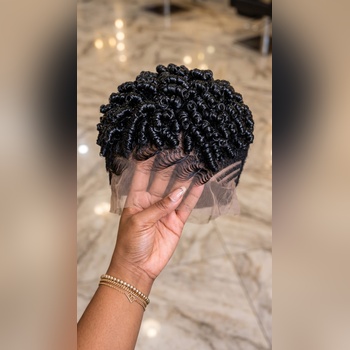
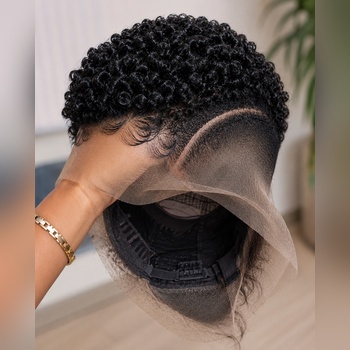
Place several wigs inside out and compare the frontal lace.
The width and depth should correspond with the specifications you approved.
If one unit provides generous workable lace while another is already extremely narrow, customers may have different installation experiences from the same product listing.
Also check whether the temple sections are positioned consistently.
Inspect The Inside Cap
Batch quality control should include construction, not only appearance.
Compare adjustable straps, elastic bands, combs, clips, stitching, seams, and cap material.
Make sure one production run has not quietly switched to cheaper hardware or a different cap.
Customers may notice these changes immediately even if your product photos still show the previous construction.
Check Cap Size With Measurements
Do not rely only on labels such as small, medium, and large.
Measure actual cap circumference on several samples.
A product marked medium should not vary dramatically from unit to unit.
This is particularly important for glueless wigs because fit provides much of the security.
Excessive size variation can create customer complaints that appear to be installation problems but are actually production inconsistencies.
Check Ear And Temple Placement
On a short wig, the side perimeter is visible.
Compare how far the ear area sits from the frontal and whether the short side has similar proportions across the batch.
A unit that is structurally shifted forward or backward may not sit like the product sample even if its circumference is technically correct.
Use The Same Mannequin For Comparison
When performing quality control, changing mannequin heads can introduce another variable.
Different head sizes and shapes change how the same wig appears.
Use the same mannequin or measurement block when comparing multiple units.
This makes crown height, side position, lace placement, and overall silhouette easier to evaluate fairly.
Use The Same Camera Angle Too
Photography can make two identical wigs appear different.
A higher camera angle makes the crown look smaller. A low angle can make it appear taller.
For internal quality-control photographs, keep the camera distance and angle reasonably consistent.
This gives you a more useful visual archive for comparing future batches.
Do Not Approve A Batch From One Perfect Sample
This is one of the most important wholesale rules.
A supplier naturally wants to show the strongest unit available.
That tells you what the factory can produce, but not necessarily what the average production quality will be.
Ask to see several random units from the completed batch.
If possible, request that they be selected from different cartons rather than all being prepared specifically for photography.
Ask For A Group Photograph
A group photo like this is surprisingly useful.
When several wigs are displayed together, differences in crown size, curl density, color, and side proportions become easier to notice.
Request both a group photograph and individual videos.
The group view helps with comparison while the individual view allows closer construction inspection.
Set An Acceptable Variation Range
Hand-finished wigs cannot always be perfectly identical.
The practical goal is defining what level of variation you are willing to sell under one product listing.
You might accept minor curl-direction differences but reject major changes in crown height.
You may accept slightly different carved-line curves but reject missing side details entirely.
Agree on these standards before large production begins.
Create A Golden Sample
Once you receive a unit that represents the exact product you want, keep it as your master reference.
This is often called a golden sample.
Photograph it from the front, both sides, back, top, and inside.
Record measurements including cap size, crown height, curl scale, lace dimensions, and relevant side proportions.
Future production can then be compared with one stable reference rather than depending on memory.
Do Not Sell The Golden Sample
If you intend to reorder the product repeatedly, keep your approved sample.
Once it is sold, you lose the easiest physical reference for future batches.
A photograph helps, but it cannot fully replace holding the original unit beside a new one.
For a growing wig business, a small sample library can become extremely valuable.
Document Color Codes Separately
Record which color was used for each version.
Do not rely only on descriptions such as brown, copper, or blonde.
Where the supplier uses standardized color codes, save those codes.
For custom human-hair coloring, keep the formulation information whenever possible.
This reduces unnecessary color drift during repeat orders.
Check Shine And Styling Product
A heavily styled sample may appear more polished than production units shipped with minimal product.
Ask whether every customer unit arrives fully finished like the listing photo.
If not, make that clear in your own product description.
Otherwise customers may interpret ordinary styling differences as a quality problem.
Human Hair Will Show More Styling Variation
Human-hair ringlets can be reset manually.
This gives stylists flexibility, but it can also create greater visual variation between finished units.
If several workers are setting the curls, make sure they use similar rod sizes, section sizes, product quantities, and drying techniques.
A repeatable styling process is necessary for a repeatable product.
Synthetic Wigs Can Be Easier To Standardize
Factory-set synthetic fibre can provide more predictable curl formation in large quantities.
This is useful when customers expect a very specific ringlet pattern straight out of the package.
However, synthetic production still needs quality control for cap size, hair placement, density, and finishing.
Consistency in one area does not guarantee consistency everywhere.
Perform Random Inspection Before Shipping To Customers
Do not assume a supplier inspection replaces your own.
When stock arrives, open random units from different cartons.
Compare them with your approved sample.
Check styling, cap construction, size, lace, color, and major side details.
Finding a production issue before the stock reaches customers is much cheaper than handling repeated refunds and complaints later.
Take Your Own Product Photos
If possible, photograph the actual stock you are selling.
Supplier images may show an earlier batch or a heavily customized sample.
Your own photos help customers understand what the current inventory looks like.
This is particularly valuable when the product includes handmade curls or side designs that naturally contain small variations.
How To Find A Wholesale Supplier
Search for pixie wig wholesale supplier, short curly wig manufacturer, human hair wig vendor, custom pixie wig factory, or glueless wig wholesaler.
Before placing a large order, request samples and ask about minimum order quantity, production time, repeat-order consistency, private labeling, packaging, replacement policy, and available quality-control procedures.
Communicate through the supplier’s official sales channel, WhatsApp business number, email, verified social account, or ordering platform whenever possible.
Before You Pay For A Bulk Order
- Can you show several units from the same batch together?
- What crown-height variation should I expect?
- Is the curl size produced with a standardized method?
- Are the carved side designs handmade?
- Can the side design vary between units?
- Are the cap measurements checked before shipping?
- Will every color use the same haircut specifications?
- Can you provide inside-cap photos from the production batch?
- Can I approve a golden sample before bulk production?
- Will future repeat orders follow that approved sample?
- What happens if a portion of the batch fails inspection?
- Can you send a random batch video before shipment?
Search Terms
curly pixie wig wholesale · short curly wig supplier · pixie wig manufacturer · curly pixie wigs for black women · wholesale ringlet pixie wigs · human hair pixie wig vendor · glueless pixie wig wholesale · short curly wig bulk order · pixie wig private label · custom pixie wig supplier · curly wig factory · wholesale short human hair wigs
Final Thoughts
A beautiful sample proves that a supplier can make one beautiful wig. A successful wig business needs something more: the ability to receive that quality repeatedly.
When several curly pixies are displayed together, compare the haircut underneath the colors. Look at crown height, curl scale, front coverage, short-side depth, decorative details, cap construction, and lace dimensions.
Decide which variations are acceptable and which would make the unit feel like a different product. Keep an approved golden sample and use it as the physical standard for later orders.
Most importantly, never approve a large production run solely from one carefully styled piece. Ask to see several random units together.
Customers do not purchase your best sample. They purchase whichever unit comes out of the box. Good batch consistency is what makes those two things feel like the same product.