
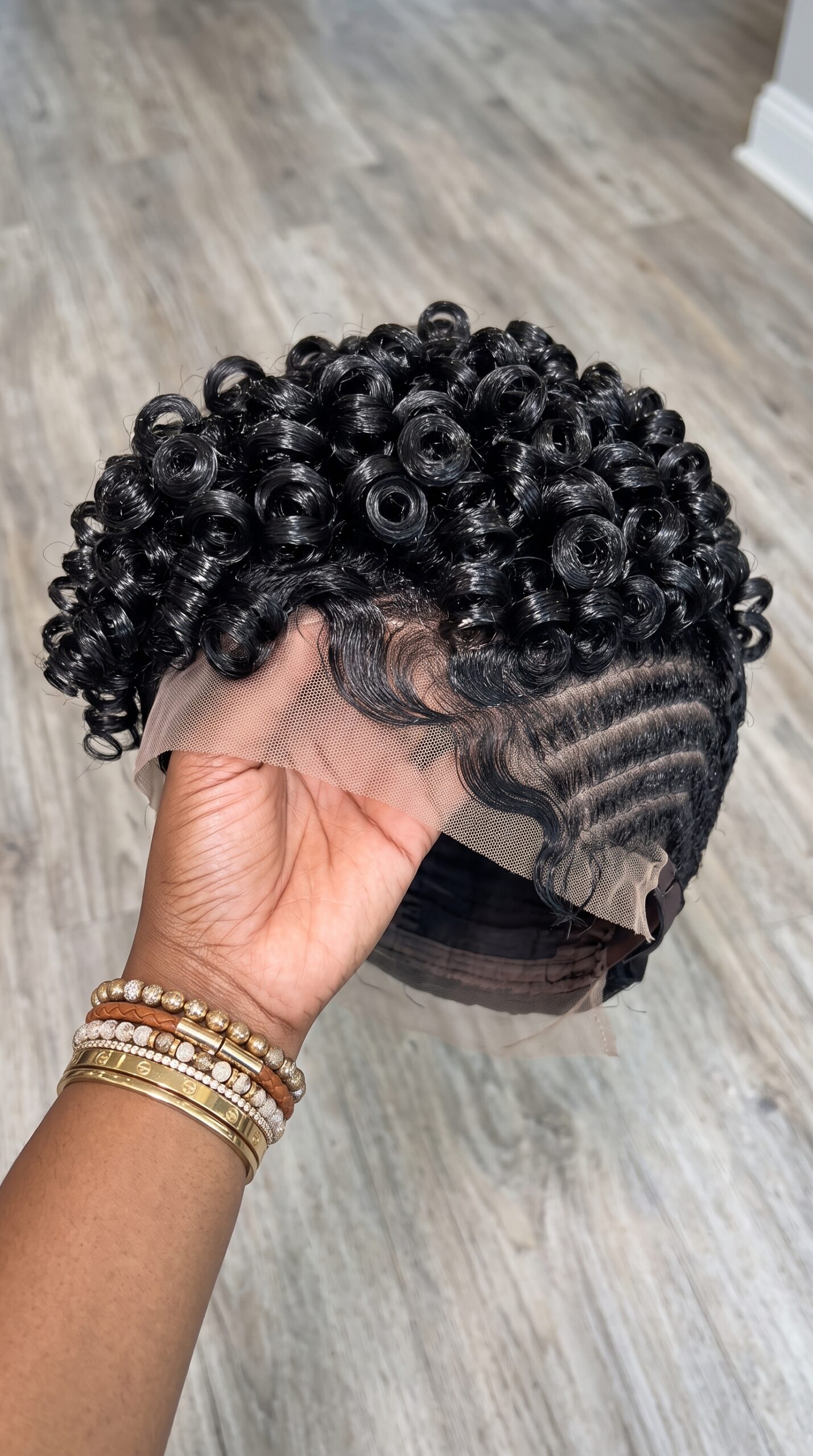
A carved pixie is not judged only by how straight or curved the shaved lines are. The dark hair left between those lines matters just as much. This black curly pixie shows three narrow curved channels running through the short side, with small bands of dark hair separating one line from the next.
Those dark bands keep the design readable. If they become too narrow, several separate shaved lines can visually merge into one large pale section. If they become too wide, the three-line design loses its connection and begins looking like unrelated marks placed across the fade.
That means buyers should look beyond the number of carved lines. The spacing between the lines determines whether the design reads as one intentional pattern.


Where To Buy A Curly Pixie Wig With Precise Carved-Line Spacing
Custom wig makers. Custom ordering is the strongest option when you care about the exact side pattern. Send a close side-profile reference and specify that the dark bands between the carved lines should remain visible rather than being shaved too narrowly.
Instagram and TikTok sellers. Ask for a close side video under normal lighting. Strong flash can make the exposed channels appear wider than they really are because the lighter base reflects more light than the short black hair.
Etsy. Independent makers may allow control over fade height, line count, curvature, spacing, crown length, cap size, and lace construction. Use a photograph instead of requesting only “three shaved lines.”
Amazon, AliExpress, and Temu. Similar listings can use completely different spacing even when they advertise the same carved-side pixie. Customer side photographs are useful for checking whether the pattern remains readable outside the seller’s studio.
Local beauty supply shops and salons. In person, inspect the side from both close range and several feet away. The individual lines should remain distinguishable without requiring you to stand directly beside the wig.
Direct vendors and wholesalers. If you are ordering multiple units for resale, request a group photo of the carved sides. Spacing can vary between handmade units, and large differences may make stock sold under one listing look inconsistent.
Regional wig makers. Sellers in Lagos, Accra, Atlanta, London, and major South African hair markets may call these shaved lines, barber lines, carved lines, razor designs, or hair-tattoo details. A reference image communicates the desired spacing more accurately than terminology.
Vet the seller. Favor sellers who show true side views rather than only high angles. The side profile gives the clearest picture of how much dark hair remains between each carved channel.
Red flags. Be cautious if two lines nearly touch in one section, if the gaps become dramatically wider toward the back, or if the seller cannot reproduce approximately the same spacing on another unit.
When you order, send. Include your cap size, desired line count, side-profile reference, fade height, preferred line width, approximate spacing, and how far toward the back you want the pattern to travel.
Contact / order inquiries: WhatsApp [WhatsApp: +XX XXX XXX XX XX]
How Much It Costs
Premium custom human hair. A short human-hair ringlet pixie with refined lace, hand-shaped crown curls, a carefully graduated fade, and multiple carved lines can commonly range around $240–$470 depending on the hair and construction.
Standard custom human hair. Around $180–$330 can cover many strong units. At this level, inspect whether the side design has been measured and planned rather than improvised after the wig was completed.
Basic human hair. Around $150–$240 may buy a simpler version with a more generic side pattern, heavier cap construction, or less consistent spacing between carved lines.
Good synthetic. Around $60–$150 can provide a convincing carved pixie when the side structure is well manufactured. The preset curls may also require less frequent reshaping.
Basic synthetic. Around $25–$70 is common for budget units. Look carefully at whether the carved effect is created through actual short hair and visible channels rather than an artificial printed or molded appearance.
What the price may exclude. Custom cap sizing, lace tinting, carved-side work, colour, knot work, crown resetting, and professional first fitting may all cost extra.
Shipping and duty. International delivery, customs charges, and local taxes can significantly increase the final cost. Compare the complete delivered price instead of only the listing amount.
Ongoing costs. Human-hair curls may need refreshing while the very short side can require occasional reshaping if longer hairs begin crossing the carved channels.
The Dark Hair Between The Lines Is Part Of The Design
When buyers look at a carved pixie, attention naturally goes toward the pale exposed lines.
But the dark strips between those lines are equally important.
They create separation.
Without enough dark hair between two pale channels, the eye stops identifying two lines and begins seeing one wider gap.
The negative and positive spaces have to work together.
Three Lines Need Two Strong Interior Bands
With three parallel shaved lines, there are two important strips of short hair sitting between them.
Those bands need enough thickness to remain visible throughout the curve.
If either band collapses into an extremely thin section, the pattern becomes uneven.
One half may still look like three lines while another section appears to contain only two.
This is why spacing must be checked along the entire design rather than at one point.
Very Narrow Spacing Can Make Lines Merge
Imagine two shaved channels separated by only a tiny amount of black hair.
At extremely close range, you may still see the dark divider.
Move several feet away and it can disappear visually.
The two channels then merge into one larger light area.
That completely changes the design even though the barber technically created two separate lines.
Very Wide Spacing Can Break The Pattern Apart
The opposite extreme causes a different problem.
If large sections of fade sit between the lines, the eye may stop grouping them together.
Instead of one three-line motif, you see three unrelated curves.
A successful pattern needs enough spacing to distinguish each line while keeping them close enough to behave like one visual family.
Spacing Should Follow The Curve
These lines are not straight. They travel around the side of the head in a curved path.
That makes consistent spacing harder than it appears.
The inner line travels along a different radius from the outer line. If the maker simply copies the same hand motion without accounting for the curve, the gap can narrow or widen unexpectedly.
The stronger result keeps the bands visually balanced as the pattern bends around the head.
The Front Of The Pattern And Back Of The Pattern May Need Slightly Different Gaps
The side of the head changes shape as it moves toward the rear.
A tiny spacing adjustment can therefore be necessary to keep the design visually proportional.
This does not mean the lines should obviously spread apart.
It means perfect mathematical spacing is less important than consistent visual spacing once the curved cap is worn.
Line Width And Line Spacing Work Together
A narrow carved line can tolerate a smaller gap because enough dark hair still remains between channels.
Make the carved lines wider and the same gap suddenly feels much smaller.
This is why spacing should never be chosen independently from line thickness.
Three very bold channels need stronger dark separators than three extremely fine ones.
The Fade Density Changes How Wide The Gaps Appear
The short hair between the lines is not a completely solid black surface.
Its density determines how dark each separating band appears.
A dense short section creates stronger contrast and makes even relatively narrow spacing easy to identify.
A very sparse fade reveals more scalp-like tone between individual hairs, so the dark bands can visually shrink even when their physical width is unchanged.
Jet Black Makes Small Spacing Differences More Obvious
This unit uses highly reflective black hair.
That creates strong contrast against the lighter carved channels.
As a result, the borders of each line are easier to identify.
This is useful for inspection but unforgiving for workmanship. A small wobble or inconsistent gap can become more visible on jet black than on a softer low-contrast colour.
High Shine Can Exaggerate The Pattern
Glossy black hair reflects light strongly while the exposed carved lines reflect differently.
Under flash, those differences can make the pattern look sharper and the spacing more dramatic.
That is why a neutral-light video is valuable.
You want to know how the side design reads in everyday conditions, not only under a direct salon light.
The Pattern Should Remain Readable From Normal Distance
A carved design is generally intended to be seen as part of the haircut.
If the individual channels are visible only in a macro close-up, the spacing may be too subtle for the look you expect.
Step back mentally from the listing photograph.
Ask whether you can still identify the three-line motif when the entire head is visible.
The Crown Can Change How The Spacing Feels
The upper section of this wig is packed with large glossy ringlets.
That creates substantial visual detail above the carved side.
A very intricate side pattern with extremely tight spacing may compete with the crown.
Slightly clearer gaps allow the side to remain readable without turning the entire wig into one crowded collection of details.
Crown Overhang Can Hide The Upper Gap First
When lower ringlets begin dropping over the fade, they typically cover the upper carved line before the lower ones.
That also hides the first dark band between lines.
The remaining visible pattern may suddenly look as though its spacing is inconsistent.
Before assuming the side was badly carved, move the crown curl back into position and reassess.
The Pattern Needs Enough Fade Around It
Three parallel lines require physical room.
If the fade panel is very narrow, the maker may be forced to compress the lines together.
That creates tight spacing simply because there is nowhere else for the design to go.
If you want several clearly separated lines, the fade height needs to support that amount of detail.
More Lines Do Not Automatically Mean A Better Design
It can be tempting to request four or five channels instead of three because the design sounds more elaborate.
But every added line consumes space.
Either the pattern becomes taller, the individual channels become thinner, or the gaps between them shrink.
Three well-proportioned lines can look much stronger than five compressed ones.
Spacing Influences Whether The Design Feels Bold Or Subtle
Closer lines visually combine into a stronger single graphic area.
Wider spacing allows each line to breathe and makes the overall pattern feel lighter.
So even with the same line count, you can change the character of the side simply by adjusting the gaps.
This gives custom buyers another specification beyond “bold” or “subtle.”
A Seller Should Show The Pattern Without Hair Covering It
Ask for one side photograph with the crown resting normally and another with the nearest curls gently moved upward.
The first tells you what the design looks like during ordinary wear.
The second lets you inspect the entire carved pattern and spacing.
You need both views because a beautiful line hidden under curls is still invisible in daily wear.
Cap Stretch Can Slightly Change Visual Spacing
A handheld wig is not under the same tension as a cap worn on a head.
When the cap stretches, curved sections of the short side may spread slightly.
The physical haircut has not changed, but the visible gaps between lines may appear marginally wider.
This is another reason correctly sized worn photos are more informative than hand-held photos alone.
A Wrong Cap Size Can Distort The Pattern
If the cap is too small, excessive tension may pull the side design farther around the head.
If the cap is too large, wrinkles or loose areas can alter how the carved lines sit.
The line spacing may then look inconsistent even if the unit was originally carved correctly.
Always judge the design after confirming fit.
Do Not Try To Correct Spacing By Re-Carving Immediately
If one gap appears narrower, first identify why.
Is a longer hair crossing the channel?
Is the cap stretched unevenly?
Is a curl hiding part of the upper line?
Is styling product darkening the exposed area?
Re-carving removes material permanently. Confirm that the design itself is the problem before changing it.
Human Hair Gives Some Correction Options
With a human-hair construction, a skilled wig stylist may sometimes refine a line or remove a few hairs to improve visibility.
But correction has limits.
Once too much hair has been removed between two channels, rebuilding that dark separating band is difficult.
It is safer for a maker to begin conservatively than to carve overly wide lines from the start.
Synthetic Units Need Accurate Factory Geometry
Preset synthetic pixies can hold their side design consistently with little maintenance.
That is useful when you want the same pattern repeatedly.
However, major corrections may be harder because the short fibre and cap construction are less forgiving.
Inspect the spacing carefully before altering or cutting a synthetic unit.
Batch Consistency Matters For Sellers
If you sell several units under one product listing, carved-line spacing should be part of your quality control.
One unit with broad gaps and another with tightly compressed lines may technically share the same three-line design, but customers will perceive them differently.
Ask your vendor for a group side photo before accepting a large batch.
Before You Pay
- Can you show a direct side photo where all three carved lines are visible?
- Do the dark bands between the lines stay approximately consistent through the full curve?
- Can I request slightly wider or narrower spacing on a custom unit?
- Will the spacing change noticeably once the cap is stretched onto the correct head size?
- Can you show another finished unit using the same three-line side pattern?
Trimming The Lace
Position the wig correctly before trimming any frontal lace. Cap placement affects where the carved design sits relative to the temple and ear.
Check that the pattern sits at the intended angle and that the gaps between the lines look balanced while the cap is under normal wearing tension.
Then trim the frontal gradually without using the side design as a guide for shifting the whole unit.
If the carved lines appear misplaced, solve the fit or construction issue first. Do not rotate the wig simply to make the pattern photograph better.
Search Terms
three line carved pixie wig · shaved line curly pixie wig · parallel line pixie wig design · black ringlet carved pixie wig · barber line lace pixie wig · shaved side curly wig · triple line pixie wig · carved fade curly pixie wig
Final Thoughts
The three carved lines on this black curly pixie work because the dark hair between them remains visible. Those small separating bands prevent the channels from merging into one large shaved area and keep the pattern readable as one coordinated design.
The ideal spacing is not simply “close” or “wide.” It depends on line thickness, fade density, available side height, crown placement, and how bold you want the finished pattern to appear.
When ordering, show the seller the spacing you want rather than mentioning only the number of lines. Three lines with tight gaps and three lines with generous gaps can create completely different side profiles.
On a carved pixie, the hair that remains between the lines is doing just as much design work as the hair that was removed.