
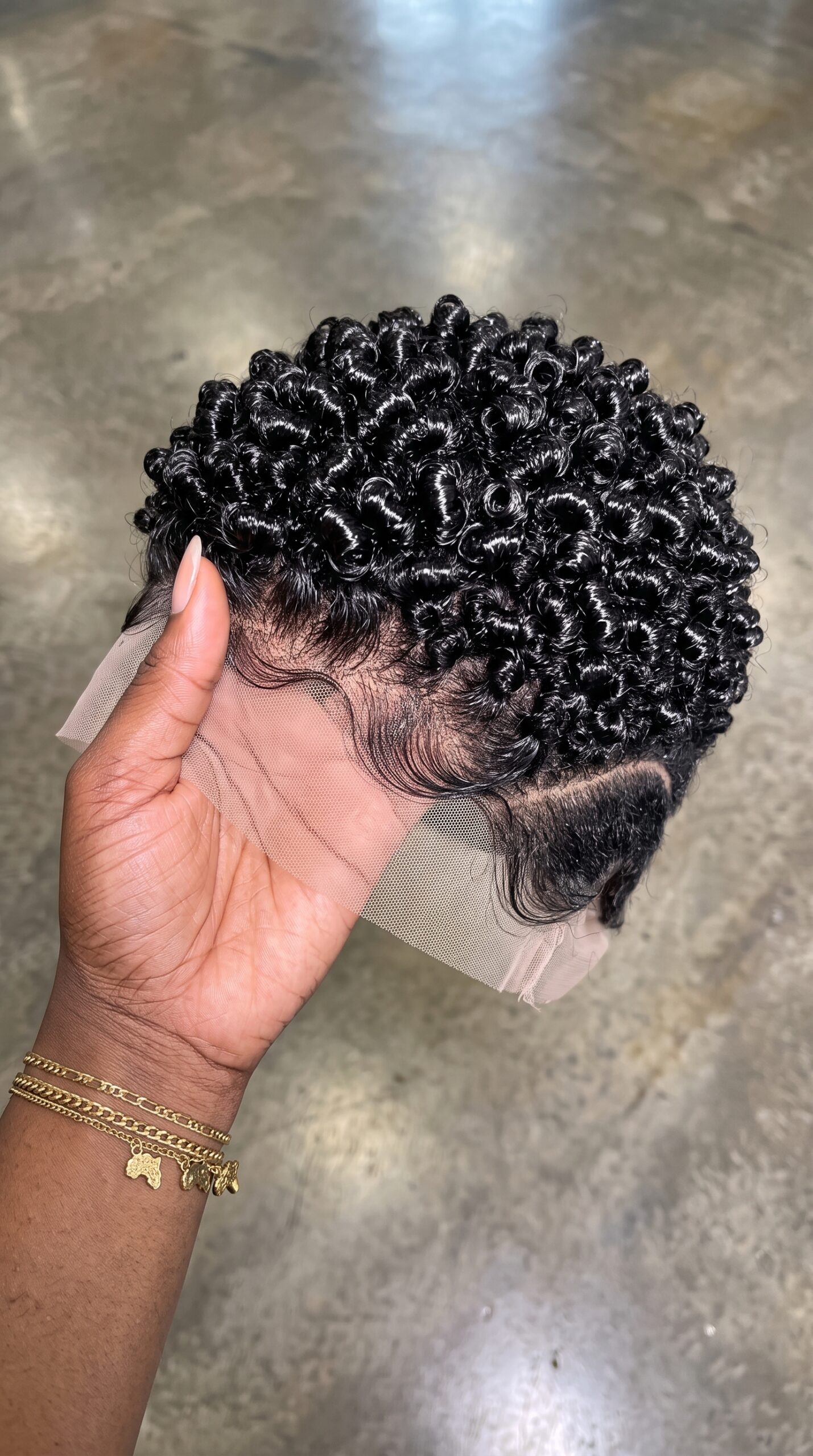
Two curly pixie wigs can have the same density, the same curl size, the same black colour, and almost the same hair length yet still look completely different. One of the reasons is surprisingly small: the direction in which the individual ringlets face.
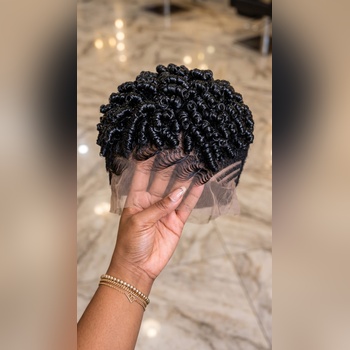
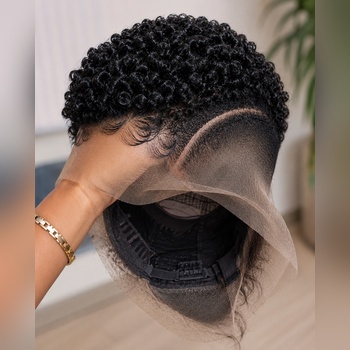
On this jet-black pixie, the crown is filled with compact cylindrical curls. Some curl openings point upward, some face slightly forward, and others turn sideways as the hairstyle travels around the head. That directional variation creates movement without changing the basic ringlet pattern.
This is different from simply asking whether the curls are tight or loose. The curl axis determines how each ringlet occupies space and how the entire crown flows when viewed from different angles. A good seller or wig maker should be able to explain whether the curls are intentionally directed or simply set randomly across the cap.
Where To Buy A Curly Pixie Wig With Controlled Ringlet Direction
Custom wig makers. Custom work is usually the strongest option if you want the crown to follow a particular direction. Send front, side, and top references showing how the ringlets should face instead of sending only one beauty photo.
Instagram and TikTok sellers. Ask for a slow rotation video. A still image can hide ringlets that point awkwardly backward or sideways. Rotation shows whether the curl orientation remains coherent through the entire crown.
Etsy. Independent makers may allow more control over curl size, crown height, root direction, ringlet orientation, cap size, and lace construction. Explain whether you prefer an organized sculpted crown or a more irregular natural-looking arrangement.
Amazon, AliExpress, and Temu. Similar-looking pixies may use very different factory sets. Look at customer videos rather than relying only on listing photos because packing can also alter the direction of individual curls.
Local beauty supply stores and salons. Seeing the unit in person gives you an easy test. Rotate the wig slowly and watch the curl openings. You should not suddenly find one section where nearly every ringlet points in an unrelated direction.
Direct vendors and wholesalers. Ask whether the curls are rod-set, molded, heat-set synthetic, or individually shaped after construction. The setting method affects how reliably the direction can be reproduced across several units.
Vet the seller. Look for front, side, top, and rear-three-quarter views. A strong unit should remain visually balanced even when the camera moves away from its best angle.
Red flags. Be cautious if the seller repeatedly photographs only one side, if sections appear crushed in opposite directions, or if the crown looks organized only after someone manually rearranges every curl for the camera.
When you order, send. Include your cap size, preferred curl size, crown height, frontal styling preference, and a reference showing how organized or varied you want the ringlet directions to appear.
Contact / order inquiries: WhatsApp [WhatsApp: +XX XXX XXX XX XX]
How Much It Costs
Premium custom human hair. A carefully shaped human-hair ringlet pixie with refined lace, individually controlled crown curls, and detailed perimeter work can commonly range around $240–$460 depending on the hair and amount of hand styling.
Standard custom human hair. Around $180–$320 can cover many strong short units. At this price level, ask whether the crown will be reset and checked from several angles before shipping.
Basic human hair. Around $150–$240 may buy a simpler unit with a more generic rod set and less control over exactly where individual curls face.
Good synthetic. Around $60–$150 can work very well for directional ringlets because quality synthetic fibre can preserve factory-set orientation for a long time.
Basic synthetic. Around $25–$70 is common for budget units. Check whether the curls face intentionally or simply point wherever they settled after molding and packaging.
What the price may exclude. Custom cap sizing, lace tinting, knot work, detailed edge styling, crown resetting, and professional first fitting may all cost extra.
Shipping and duty. International delivery, customs fees, and local taxes can significantly increase the final cost, so compare the complete delivered amount rather than only the listed unit price.
Ongoing costs. Human-hair ringlets may require mousse, setting product, and occasional directional resetting. Synthetic curls usually preserve their original axis longer but may be harder to alter later.
Curl Shape And Curl Direction Are Two Different Things
A ringlet can maintain exactly the same cylindrical shape while facing a completely different direction.
Imagine holding a small spring. Point the opening toward the ceiling and it occupies space one way. Turn it sideways and the spring itself has not changed, but its visual relationship with everything around it has.
That is essentially what happens on a ringlet pixie.
The curl pattern describes the spring. The orientation describes where the spring points.
Upward-Facing Ringlets Create More Open Crown Space
When a curl opening faces upward, you can often see more of the circular interior from above.
This makes the ringlet pattern very easy to recognize and creates a highly sculpted top view.
Too many perfectly upward-facing curls, however, can begin looking mechanically arranged. The crown may resemble rows of identical tubes rather than naturally styled hair.
A little directional variation usually prevents that effect.
Forward-Facing Ringlets Add Weight Toward The Hairline
Curls directed toward the forehead visually move the crown forward.
Even if they are not physically longer, they can make the front feel fuller because their openings and outer curves become more visible from a front-facing camera angle.
This can be useful when you want a strong curly frame near the face.
If too many curls point forward, however, the crown can begin feeling front-heavy.
Side-Facing Ringlets Make The Crown Look Wider
A curl turned toward the side occupies more lateral visual space.
Place several of these around the temple and upper side and the hairstyle begins appearing broader.
Turn the same curls upward or slightly backward and the silhouette becomes narrower without removing any hair.
This is why curl orientation affects perceived head width independently from density.
The Best Crown Usually Uses More Than One Direction
A realistic sculpted crown does not need every ringlet facing exactly the same way.
Variation can make the hairstyle feel more dimensional.
The strongest approach often uses a dominant direction with controlled exceptions. For example, the upper crown may mostly point upward while curls near the front lean forward and curls near the sides gradually turn outward.
This creates a directional map rather than random placement.
Random Direction And Intentional Variation Are Not The Same
Intentional variation still creates a readable flow.
Neighbouring curls respond to the shape of the head and the area of the haircut in which they sit.
Random orientation feels different. One curl points forward, the next straight backward, another sideways, and no larger relationship appears between them.
The crown may still be technically curly, but it loses visual organization.
The Top View Is The Best Direction Test
If you want to understand curl orientation quickly, ask the seller for a direct overhead photograph.
From above, you can see dozens of ringlet openings simultaneously.
That lets you judge whether they create an intentional flow or look randomly scattered.
A side photograph may show only the outer walls of several curls and hide their actual orientation.
The Side View Shows Whether The Crown Becomes Front-Heavy Or Back-Heavy
A good side profile tells you how the directional map affects the silhouette.
If most ringlets lean forward, volume begins concentrating near the forehead.
If most travel backward, the crown can look elongated toward the rear.
If curls point outward across the entire crown, the style becomes rounder.
That means direction is one of the tools used to shape a pixie without changing its length.
Curl Orientation Can Change The Visibility Of The Hairline
Ringlets near the frontal deserve special attention.
If they are directed forward and downward, they can cover part of the lace and soften the hairline.
If they point upward, more of the frontal becomes exposed.
The underlying lace construction has not changed, but the styling changes how much of it the viewer sees.
This is why sellers should show the frontal both with the curls resting normally and gently moved away.
Orientation Can Change The Visibility Of A Short Side Too
The same principle applies around the faded or short side.
Lower crown curls directed downward can cover more of the short panel.
Curls turned upward or toward the crown expose more of it.
Before cutting a lower curl because it seems too long, check its direction first. Sometimes the issue is orientation rather than length.
Root Direction And Ringlet Direction Are Related But Not Identical
The hair leaves the cap in one direction and then forms a curl that may rotate into another.
A backward-directed root can eventually create a ringlet whose opening faces sideways.
That means judging only the root does not tell you exactly how the final curl will present itself.
On a highly sculpted pixie, both parts of the geometry matter.
Shine Makes Curl Direction Easier To Read
This jet-black unit has a very glossy finish.
Light reflects along the outer walls of the cylindrical ringlets, making their curves and openings extremely visible.
That can help you inspect orientation in a photograph.
It can also exaggerate how organized the set appears, especially under flash.
Ask for normal-light video to see whether the directional pattern remains clear without extreme reflections.
Dense Crowns Need Better Directional Control
The more curls you place into a compact crown, the more opportunities there are for neighbouring ringlets to interfere with one another.
If two openings face directly into each other, they may compress or overlap.
If several curls point into the same narrow area, that section can become crowded while another part of the crown develops a gap.
Directional planning therefore becomes more important as density increases.
Orientation Can Create The Illusion Of Uneven Density
This is an important buying trap.
Suppose one area contains curls whose openings face the camera while another contains curls turned away.
The first area may appear fuller because you see more circular structures and reflected surfaces.
The second may look sparse even if the actual number of hairs is similar.
Before concluding that a wig has uneven density, rotate it and see whether the apparent difference changes.
Shipping Can Disturb Curl Direction Without Destroying The Curl
A compressed package can push individual ringlets sideways.
When the wig arrives, some curls may still be perfectly formed but facing the wrong direction.
This is often easier to correct than a curl that has completely lost its shape.
Give the unit time to recover, then gently redirect compressed ringlets before deciding that the seller sent a different style.
The First Wash Is The Real Test On Human Hair
Human-hair ringlets may retain their basic curl pattern after washing while losing the carefully arranged orientation created in the seller’s salon.
That is normal for a manually sculpted set.
The challenge is recreating not only the curl but also where each major section faces.
Photograph the top, front, and sides before the first wash if you want to reproduce the original crown accurately.
Reset Sections, Not Random Individual Hairs
When rebuilding the crown, work in zones.
Decide how the front should travel, how the center crown should sit, and how the side ringlets should turn.
Then shape individual curls within those zones.
If you style every ringlet independently without considering its neighbours, the finished crown can become directionally chaotic even though each curl looks beautiful by itself.
Too Much Gel Can Freeze The Wrong Direction
Strong product can hold a ringlet almost anywhere.
That is useful only when it is holding the curl where you actually want it.
If a curl has been compressed sideways and you add heavy gel before redirecting it, you may simply preserve the packing damage.
Set direction first, then use only the amount of product needed to maintain it.
Human Hair Gives More Directional Flexibility
Human hair lets you alter the orientation of the crown more easily.
You can make the front more forward-facing, turn the sides upward, or create a more backward-moving silhouette during a later reset.
The tradeoff is that the original arrangement may need to be rebuilt after washing.
Flexibility and maintenance come together.
Synthetic Fibre Can Preserve The Original Axis Longer
Quality synthetic ringlets can maintain a factory-set direction for many wears.
This can be ideal if you want the wig to look almost the same every time with minimal styling.
But preset synthetic orientation can also be stubborn.
If you dislike the way several curls face, changing them may require controlled heat, and only if the fibre is designed to tolerate it.
Do Not Trim A Curl Only Because It Points The Wrong Way
A wrongly directed ringlet can appear longer than its neighbours simply because it is hanging toward the side or front.
Before cutting it, redirect it into the intended crown flow.
You may discover that its actual length is perfectly matched.
Cutting first can create a genuine length problem where none existed.
Direction Should Still Look Good After Gentle Movement
A wearable pixie cannot depend on every curl remaining frozen to one exact millimeter.
Ask the seller to rotate or lightly move the unit.
The ringlets may shift slightly, but the overall directional map should remain recognizable.
If the crown immediately collapses into random orientation after minimal movement, the set may depend too heavily on precise photography arrangement.
Before You Pay
- Can you show the crown directly from above so I can see which directions the ringlet openings face?
- Is the curl orientation intentionally mapped across the front, crown, and sides?
- What happens to the directional set after the first full wash?
- Can human-hair ringlets be redirected later without cutting them?
- Can you show the wig rotating so I can check whether the crown stays balanced from every angle?
Trimming The Lace
Position the wig correctly before trimming the lace and before judging the curl direction around the front.
A slightly rotated cap changes how the entire crown appears to flow. Curls that were meant to frame the temple may suddenly sit too far forward, while another section appears to travel backward.
Align the center, temples, ear area, and nape first. Once the cap is correctly positioned, judge the ringlet orientation and trim the excess lace gradually.
If a few curls face the wrong direction, restyle those curls. Do not rotate the whole wig to make the crown pattern work.
Search Terms
black ringlet pixie wig · sculpted ringlet direction pixie wig · curly pixie wig crown orientation · cylindrical curl pixie wig · jet black short curly lace wig · directional ringlet pixie wig · short spiral curl wig · ringlet crown lace pixie wig
Final Thoughts
The ringlets on a sculpted pixie are not simply circles of hair. Each one has an orientation, and those small directional choices combine to create the larger crown shape.
Turn more curls upward and the crown feels open and sculpted. Turn them forward and the front becomes fuller. Direct them sideways and the silhouette grows wider. Mix those directions intelligently and the style gains movement without losing organization.
That is why curl size alone cannot describe a ringlet pixie. The diameter tells you the shape of the curl. The direction tells you how that shape participates in the haircut.
When buying a unit like this, inspect the crown from above and from the side. You are not only checking whether every curl is formed. You are checking whether those curls know where they are going.