
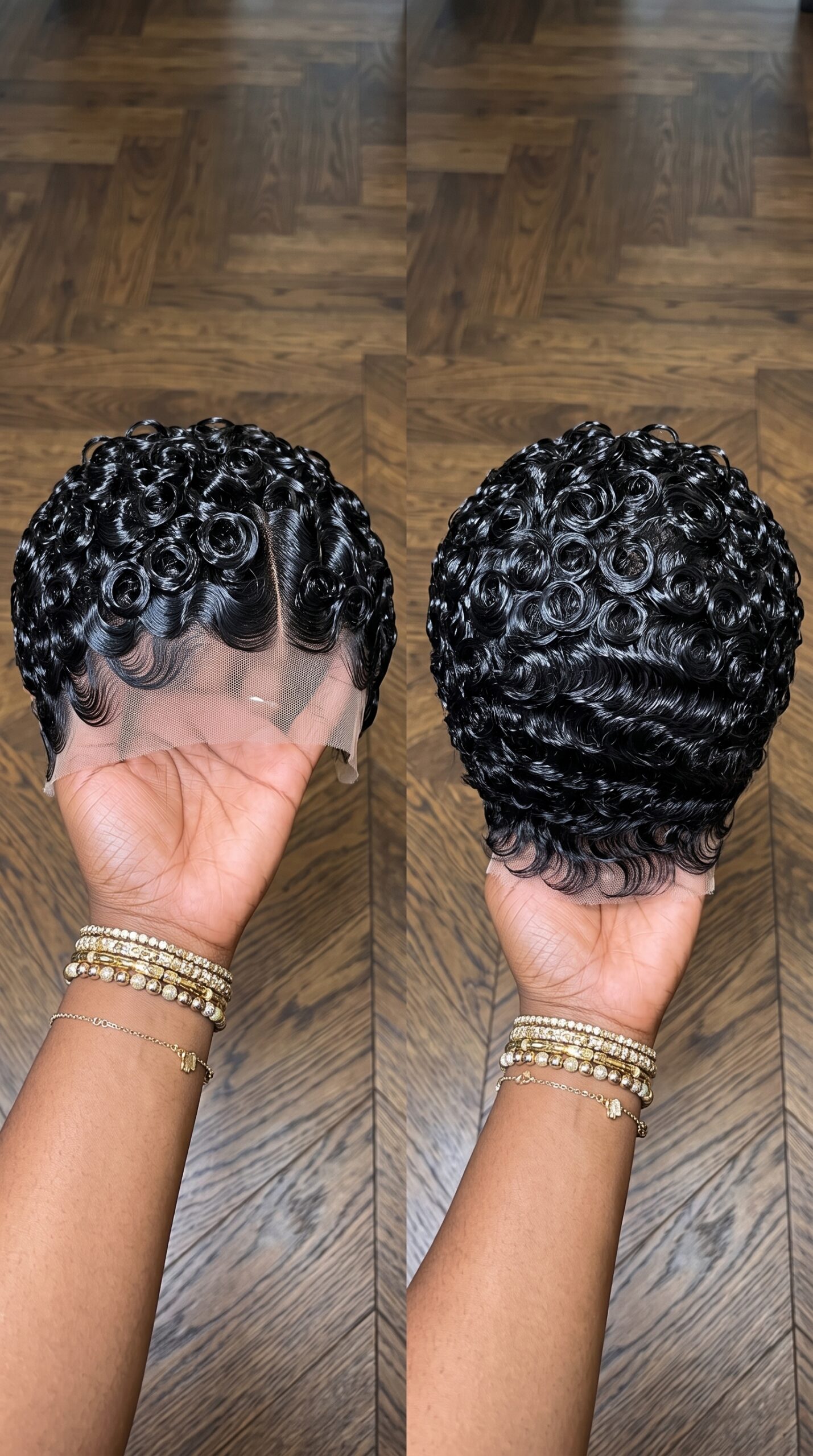
Turn this black pixie wig around and the hairstyle changes more than most buyers expect. From the front, the crown is built with rounded sculpted loops, large ringlet openings, and carefully laid face-framing sections. From the back, those circular curls give way to flatter horizontal waves that travel across the lower crown and toward the nape.
That does not automatically mean the wig is inconsistent. In fact, using different curl geometries in different zones can be exactly what allows a very short unit to keep the right shape from every angle. The front needs detail and lift. The back needs coverage, direction, and a clean descent toward the nape.
The important buying question is therefore not whether every curl matches. It is whether the front loops, crown curls, back waves, and nape finish transition into one another intentionally.
Where To Buy A Pixie Wig With Good Front-To-Back Texture Mapping
Custom wig makers. A custom maker is usually the best option when you want a specific front and back pattern. Send both views of your reference. If you send only the front, the maker may reproduce the face-framing curls beautifully while using a completely different back construction.
Instagram and TikTok sellers. Ask for one continuous video starting at the front and rotating toward the back. That allows you to watch the curl pattern change rather than judging two disconnected photographs.
Etsy. Independent makers may give you more control over crown curl size, back-wave direction, nape length, lace construction, and cap sizing. Ask whether the back is styled separately from the front rather than assuming one uniform curl set covers the whole unit.
Marketplaces like Amazon, AliExpress, and Temu. Product listings often prioritize front views. Search customer reviews specifically for back photographs. A wig can resemble the listing perfectly from the front while the rear uses much looser or less organized hair.
Local beauty supply shops and salons. Local buying gives you the simplest test. Put the unit on a mannequin and slowly rotate it. The texture should change gradually around the crown rather than suddenly switching at one obvious line.
Vendors and wholesalers direct. Ask for front, crown, back, and nape photos of the exact style. If you are buying multiple units, confirm that the rear pattern is included in the approved specification rather than only the front styling.
Regionally. Wig makers in Lagos, Accra, Atlanta, London, and major South African hair markets may use different terms for sculpted loops, molded waves, finger curls, and back-wave sets. Photos are more reliable than terminology when several textures appear on one short unit.
Vet the seller. Favor sellers who show the back voluntarily. A short wig has nowhere to hide a weak rear section, so sellers confident in their work should be comfortable revealing it.
Red flags. Be cautious if every photo shows only the front, if the back becomes dramatically flatter without an intentional transition, if the nape contains random long strands, or if the rear pattern appears much rougher than the crown.
When you order, send. Provide your cap size, front curl reference, back texture reference, preferred nape length, colour, and whether you want the rear to remain wavy, curly, or tightly molded.
Contact / order inquiries: WhatsApp [WhatsApp: +XX XXX XXX XX XX]
How Much It Costs
Premium custom human hair. A carefully styled short human-hair pixie with a sculpted loop front, coordinated crown, directional back waves, lace construction, and detailed perimeter work can commonly range from around $240–$460 depending on the hair and styling labour.
Standard custom human hair. Around $180–$320 can cover many strong short units. At this level, pay attention to whether the back received the same amount of finishing attention as the front.
Basic human hair. Around $150–$240 may buy a simpler version with attractive front curls but less refined rear shaping, heavier lace, or a more generic nape.
Good synthetic. Around $60–$150 can work very well for zoned styling because synthetic fibre can preserve different preset patterns in different parts of the unit.
Basic synthetic. Around $25–$70 is common for budget pieces. Inspect whether the rear waves look deliberately set or simply flattened during manufacturing and packaging.
What the price may exclude. Custom cap sizing, lace tinting, knot work, front-loop styling, rear-wave setting, nape reshaping, and professional fitting may all cost extra.
Shipping and duty. International shipping, customs charges, and local taxes can raise the final cost considerably. Compare the delivered total rather than only the wig price.
Ongoing costs. A multi-pattern pixie may require different refreshing techniques across the crown and rear. The front loops may need individual reshaping while the lower back benefits from a flatter molded reset.
First-year total. Include curl products, setting foam, lace care, possible professional resetting, and any nape maintenance required after repeated washing.
Cost per wear. A slightly more expensive wig with a properly finished back can provide better value than a cheaper unit you only feel comfortable wearing when nobody sees you from behind.
What a very low price may signal. It may mean styling labour was concentrated almost entirely on the visible front while the rear was finished quickly with a generic curl or wave pattern.
Deposit structure. Custom makers commonly request around 30–50% upfront and the remaining balance before shipping. Keep both the front and back reference images with your written order.
Shipping, Delivery, And What To Expect After Ordering
When the wig arrives, inspect it before trimming the lace. Start with the front and identify the dominant curl pattern. Then rotate the unit slowly toward the crown and back.
Watch where the circular loops begin becoming flatter waves. A good transition should feel gradual enough that you do not immediately see a hard boundary separating “front hair” from “back hair.”
Finally inspect the nape. The rear texture should continue into a deliberate ending rather than leaving long stray hair hanging beneath the intended short silhouette.
The Front And Back Have Different Jobs
This is the central reason a pixie does not necessarily need one curl pattern everywhere.
The front of the wig interacts with the face. It needs hairline detail, framing, visible curl openings, and enough height to create character.
The back has another job. It needs to follow the round shape of the head, maintain coverage, avoid excessive bulk, and finish neatly at the nape.
Trying to force exactly the same large circular curls onto every part of the unit can sometimes make the back too bulky.
Using flatter waves in the rear can solve that problem without reducing the quality of the design.
Large Front Loops Create Detail Where People Look First
The front view of this wig contains several large sculpted loops with clearly visible circular openings.
Those loops catch the eye immediately because they create highlights, shadow, and three-dimensional depth close to the face.
That kind of curl works well in the front because the viewer has space to appreciate each individual shape.
If the same large loops were packed tightly across the lower back, however, they could create unnecessary thickness near the nape.
Texture zoning lets the maker place the most decorative curl shape where it delivers the most visual value.
The Back Waves Control Bulk
Turn the wig around and the lower crown becomes much flatter.
Instead of large circular openings, you see horizontal wave ridges travelling across the back.
That flatter geometry keeps the hair close to the cap.
It allows the rear silhouette to follow the skull rather than expanding outward like a round ball of curls.
For short wigs, controlling rear bulk is especially important because even a small amount of extra thickness can change the entire haircut.
Texture Zoning Can Make A Pixie Look More Like A Real Haircut
Real short haircuts rarely behave identically on every part of the head.
Hair at the front may be longer and styled upward. Hair around the crown may curl more freely. Hair closer to the nape may be cut shorter and brushed flatter.
A wig that reproduces those functional differences can therefore look more haircut-like than one that applies one factory curl pattern over the entire cap.
Consistency does not always mean sameness.
Sometimes realism comes from controlled variation.
The Transition Zone Is More Important Than Either Pattern Alone
You can have beautiful front loops and beautiful rear waves and still end up with a poor wig if the two sections do not connect correctly.
The transition usually happens around the upper and mid crown.
There, the circular curls should begin elongating, leaning, or flattening as they move toward the back.
If one row is made of full ringlets and the next row suddenly becomes completely flat waves, the change may look mechanical.
The strongest units contain intermediate shapes that visually bridge the two textures.
Look For A Change In Curl Geometry, Not A Change In Hair Quality
A flatter back does not automatically mean the seller used worse hair there.
This is an important distinction.
The same hair can look extremely different depending on whether it has been rolled into a circular loop or molded into a low wave.
Judge the fibre itself separately from the set.
If the back hair feels equally healthy, glossy, and intact but is simply styled flatter, you may be seeing intentional design rather than cost cutting.
But Sellers Can Also Hide Lower-Quality Hair In The Back
The opposite possibility exists too.
Because product photos focus heavily on the front, some inexpensive units may use the best-looking sections where the camera sees them most clearly while the back receives rougher or less refined hair.
That is why close inspection still matters.
Look for excessive frizz, broken ends, inconsistent shine, and rough texture in the rear rather than assuming every difference is intentional styling.
Zoning should change the pattern, not the quality standard.
The Back Pattern Affects How Round The Head Looks
Horizontal waves emphasize the curvature of the head differently from circular curls.
Because the ridges travel across the rear, the eye follows the rounded contour from one side toward the other.
That can make the back appear compact and smoothly shaped.
Large individual curls would create more separate points of volume and potentially make the same head shape look wider or more textured.
The rear pattern therefore affects silhouette as much as texture.
The Direction Of The Back Waves Matters
Rear waves should not be arranged randomly.
They usually need to follow the shape of the head and descend toward the nape.
If some sections travel upward while others cut diagonally across them with no visual logic, the rear can appear messy even when every individual wave is technically well formed.
Look for an organized flow.
The back should feel like a continuation of the haircut rather than a decorative panel placed onto the cap.
The Nape Needs Its Own Texture Decision
The very bottom of the back introduces a third styling zone.
It cannot carry the same amount of hair as the crown without creating bulk along the neck.
On this kind of pixie, the nape often uses smaller curls, short swoops, or a compact molded finish.
That creates a gradual decrease in scale: larger curls above, flatter waves through the back, then shorter finishing pieces at the perimeter.
This hierarchy helps the wig look intentionally tapered.
A Front-Only Reference Is Not Enough For A Custom Order
This is one of the biggest practical lessons from a front-and-back image like this.
If you show a wig maker only the left photograph, you have specified the front style but left the entire rear open to interpretation.
The maker may give you curls at the back, straight short hair, a molded wave, or something else entirely.
That does not necessarily mean the maker ignored your request. You never specified the missing half.
For a custom pixie, provide both front and back references whenever the rear matters to you.
Two Views Help You Judge Whether The Wig Is Actually Short
A pixie can look very short from the front while hiding extra length behind the crown.
The back view reveals whether the unit truly maintains a compact perimeter.
In this image, the rear hair remains close enough to the head that the unit still reads as a genuine short style.
If long strands were hanging beneath the lower waves, the front could still photograph beautifully while the overall haircut felt wrong in real wear.
Rear Coverage Should Be Full Without Becoming Dense
The back has another difficult balance.
Too little hair and the cap becomes visible between the wave rows.
Too much hair and the rear becomes thick and helmet-like.
The flatter wave set helps solve this by spreading hairs across a wider horizontal area without forcing them to project outward.
This is another example of how styling geometry can substitute for unnecessary density.
Black Hair Makes Rear Pattern Consistency Harder To Judge
Solid black hair absorbs visual detail, especially under low light.
Individual back waves can merge into one dark mass much more easily than blonde, copper, or highlighted hair.
That means strong lighting is important when inspecting the rear of a black unit.
Look for reflected ridges rather than only judging whether the back appears glossy.
If every row disappears completely unless photographed with flash, the pattern may not be as defined as the listing suggests.
Shine Can Reveal The Back-Wave Geometry
Gloss is particularly useful on molded waves because each ridge catches light along a long continuous curve.
The highlights reveal the direction of the styling.
But extreme shine can also exaggerate definition in photographs.
A seller may use oil or serum to make every rear ridge pop under flash.
Ask for a normal-light video if you want to know how visible the pattern remains during everyday wear.
The First Wash Tests Whether Both Zones Are Re-creatable
Human-hair loop curls and molded rear waves may both soften significantly after washing.
But they usually require different techniques to rebuild.
The front may need individual curl shaping around fingers or rollers.
The back may need mousse, comb direction, and molding closer to the cap.
That means washing one wig can create two restyling jobs.
Before the first wash, photograph both views carefully.
Do Not Refresh The Whole Wig With One Technique
If you treat the rear waves like front ringlets, you can accidentally make the back too bulky.
If you flatten the front the same way you mold the back, you can erase the dimensional loop pattern that gives the style its character.
Work according to zone.
Refresh front loops individually where necessary.
Preserve crown transitions.
Keep the rear wave structure flatter and more directional.
The wig is one hairstyle, but it does not require one maintenance motion everywhere.
The Front Can Be Looser Than The Back Without Looking Inconsistent
Buyers sometimes assume a high-quality wig must have the same curl tightness throughout.
That rule works for some uniform curly styles, but not every sculpted pixie.
Here, curl tightness changes according to function.
The front needs dimensional loops. The lower back needs controlled waves.
As long as the transition is deliberate, the difference strengthens the design rather than weakening it.
Look At The Crown From Above To Understand The Connection
Front and back views show the endpoints.
A top or upper three-quarter view shows the bridge between them.
If you are buying this kind of unit, ask for that third angle as well.
You want to see how the top ringlets reorganize themselves as they move toward the rear wave rows.
That crown view often tells you whether the style was designed as one complete unit or finished separately at the front and back.
Check Both Sides Of The Rear
Back photographs can still hide asymmetry.
One side may contain beautifully aligned waves while the opposite side becomes crowded or flat.
Look at the rear three-quarter views from left and right when possible.
The wave direction should wrap around the head coherently rather than working only at the center back.
Storage Can Flatten The Front And Back Differently
A multi-pattern pixie should not be compressed flat in a bag for long periods.
The front loops can collapse and lose their openings, while the rear waves may survive reasonably well because they already sit close to the cap.
That means poor storage can gradually make the wig more rear-heavy in appearance: the back keeps its shape while the front loses height.
Store the unit on a form or mannequin whenever practical so each zone keeps its intended geometry.
Before You Pay
- Can you show the exact same unit from the front and directly from the back?
- Are the rear waves intentionally different from the front loops, or does the curl pattern simply become weaker toward the back?
- Can you show the crown from above so I can see how the two patterns transition into one another?
- What happens to the front loops and rear waves after the first full wash?
- Can you explain how to refresh the back without turning it into the same large curls used at the front?
Trimming The Lace
Inspect both the front and back before cutting the lace.
Place the wig in its natural wearing position and confirm that the front loops sit correctly while the rear waves reach the nape at the intended height.
Do not rotate the cap to improve one view at the expense of the other.
Once the entire front-to-back silhouette aligns correctly, trim the excess lace gradually.
If the front only looks right when the back sits too high or too low, solve the cap-position or construction issue before making the lace cut permanent.
Search Terms
front and back curly pixie wig · sculpted loop pixie wig back view · black pixie wig rear waves · curly pixie wig texture zoning · front loop back wave pixie wig · short lace pixie wig back view · molded wave back pixie wig · black sculpted pixie front back
Final Thoughts
The front and back of a short pixie wig do not have to repeat one identical curl pattern. They have different jobs. Large loops can create dimensional detail around the front and crown, while flatter directional waves help the rear stay compact and follow the shape of the head.
What matters is the connection between those zones. The best units do not feel like one hairstyle in front and another hairstyle in back. The curl geometry changes gradually while the overall silhouette remains coherent.
When ordering a sculpted pixie, show the seller both sides of the idea. The front photograph tells them how you want to meet the world. The back photograph tells them whether the haircut is actually finished.