
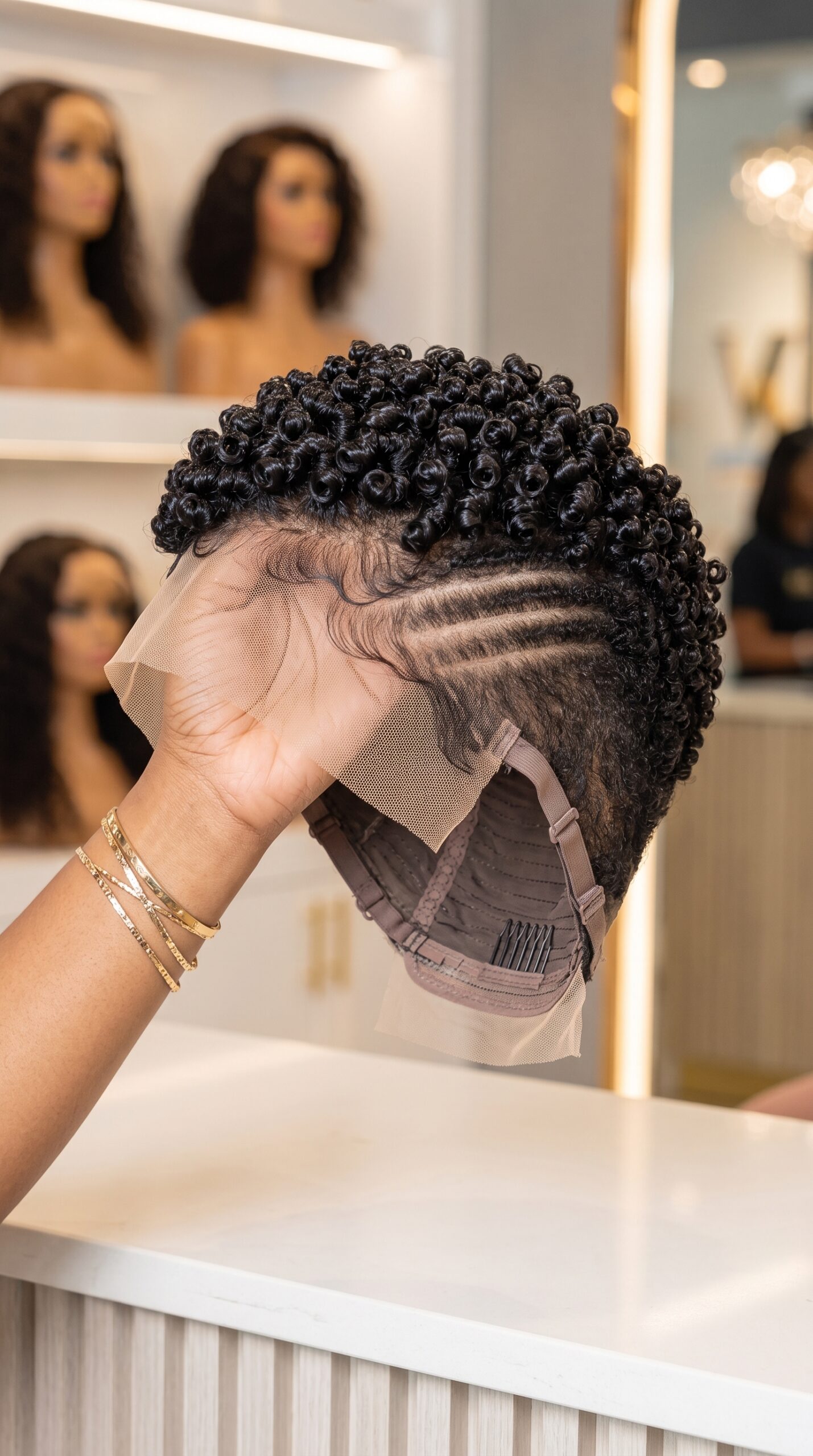
Two adjustable straps can make a short wig feel secure, but where those straps are attached matters almost as much as how tightly they are pulled. On this jet-black curly pixie, the inside of the cap is unusually visible, including the elastic adjusters, lower comb, lace front, and the short tapered side construction.
That makes this unit useful for a buying question most listings never answer: where does the strap tension actually travel when you tighten the wig? A well-placed strap should stabilize the cap without dragging the temples backward, lifting the nape, narrowing the lace front, or distorting the side perimeter. A badly placed strap can make a correctly sized wig behave like the wrong size.
Where To Buy A Curly Pixie Wig With A Good Adjustable Cap
Custom wig makers. Ask the maker to show the cap from the inside before ordering. Do not only ask whether the wig has adjustable straps. Ask where the straps are sewn, whether both sides are symmetrical, and whether tightening them changes the front-lace shape.
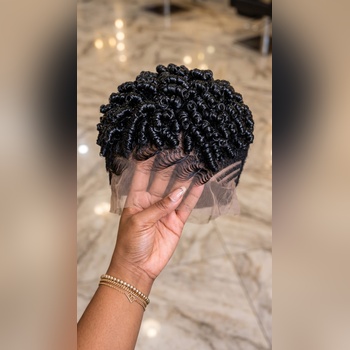
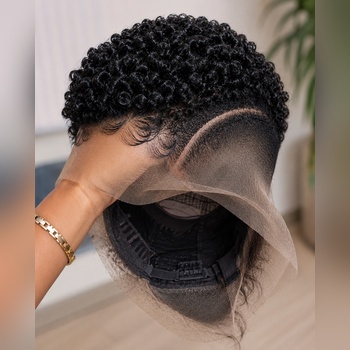
Instagram and TikTok sellers. Short pixie wigs are frequently demonstrated after they have already been styled and secured. Ask for a short video of the cap before installation. The seller should tighten and loosen the straps while showing what happens to the lace and side panels.
Etsy. Independent makers may provide more cap customization than mass-market sellers. If the listing allows custom sizing, ask whether strap position is adjusted for small, average, or large caps rather than using the same anchor points on every unit.
Marketplaces like Amazon, AliExpress, and Temu. Compare customer photographs of the inside cap. Promotional images often focus on curls and the hairline, while buyer photographs may reveal whether the straps are positioned evenly and whether the elastic appears strong enough for repeated wear.
Local beauty supply shops and salons. A local shop gives you the chance to inspect the strap path physically. Hold the wig open, lightly tension both adjusters, and watch whether the lace front stays in the same shape or begins to pull inward.
Vendors and wholesalers direct. Ask for the cap specification, not simply “glueless.” Useful details include cap circumference, strap type, anchor position, comb placement, lace dimensions, and whether the elastic can be replaced if it stretches out.
Regionally. Wig makers in Lagos, Accra, Atlanta, London, and major South African hair markets commonly work with short lace units, but cap construction varies widely. Use close-up photographs when discussing the strap position because terminology is not standardized.
Vet the seller. A seller who willingly shows the underside, seams, strap anchors, lace edges, and combs gives you far more useful information than one who only sends polished front-facing photos.
Red flags. Be cautious if one strap appears higher than the other, the anchor stitching looks loose, the elastic is extremely thin, the straps pull directly against fragile lace, or the seller recommends tightening the wig as much as possible to make it fit.
When you order, send. Provide your head circumference, preferred cap size, whether you wear the wig glueless, and whether you want a snug or relaxed fit. A strap should fine-tune the fit, not compensate for a cap that is fundamentally too large.
Contact / order inquiries: WhatsApp [WhatsApp: +XX XXX XXX XX XX]
How Much It Costs
Premium human hair. A high-quality black human-hair curly pixie can commonly fall around $250–$430 when the price includes good lace, refined ventilation, a strong cap, quality elastic, secure combs, and careful finishing.
Standard human hair. Around $180–$300 can buy a very usable short human-hair unit. At this level, inspect the cap mechanics closely because two wigs with similar curls can differ greatly in how comfortably and evenly they secure.
Basic human hair. Roughly $150–$220 may buy a simpler unit with more machine construction, basic elastic, heavier lace, or fewer customized cap details. That does not automatically make it poor value if the fit is correct.
Good synthetic. Around $60–$150 can provide an attractive preset curly pixie. The synthetic fibre may hold the curl easily, but the cap still needs to distribute tension properly.
Basic synthetic. Around $25–$70 is common for budget units. At this level, inexpensive elastic and simple anchor stitching are more likely, so inspect them before relying on the wig for frequent wear.
What the price includes. Ask whether custom cap sizing, replacement straps, lace tinting, bleached knots, hairline work, and professional fitting are included or charged separately.
Shipping and duty. International shipping, customs charges, and local taxes can change the real cost substantially. Compare the delivered total rather than only the product price.
Ongoing costs. Elastic eventually loses strength. Replacement elastic is inexpensive, but repairing badly positioned or torn anchor points may require a wig maker because those areas are part of the cap structure.
First-year total. Include curl products, washing products, potential lace maintenance, strap replacement, and professional adjustment when comparing two units.
Cost per wear. A $250 wig worn 80 times costs just over $3 per wear before maintenance. A cheaper wig that becomes uncomfortable or unstable after a few wears can become worse value despite its lower purchase price.
What a very low price may signal. Low pricing can reflect simpler elastic, generic cap sizing, basic stitching, less refined lace, or a construction that expects the wearer to solve fit problems by overtightening the straps.
Deposit structure. Custom makers may request about 30–50% upfront with the balance due before shipping. Keep all cap measurements and construction requests in writing and use a payment method with a dispute process.
Shipping, Delivery, And What To Expect After Ordering
When the wig arrives, do not immediately tighten the straps to their shortest setting. First place the unit on a wig stand or your head with the straps relaxed. Check whether the cap size already sits reasonably close to where it should.
Then shorten the elastic gradually and equally. Watch the front lace, temples, sideburn area, and nape while you do it. If one part of the wig starts moving dramatically before the cap feels secure, the tension may not be distributing evenly.
Photograph the underside before altering or trimming anything. If the strap stitching is uneven or damaged, you want evidence while the unit is still eligible for a return or remake.
Strap Position Determines The Direction Of Pull
An adjustable strap does not simply make a wig “smaller.” It applies force between two anchor points.
That distinction matters. If the anchors sit low and evenly around the back of the cap, tightening the elastic can pull the cap inward around the circumference. If they are positioned too high, too far forward, or unevenly, the force may travel toward the temples instead.
On a short pixie, that can become visible immediately because the perimeter is exposed. The lace may begin to curve unnaturally, one side can sit higher, or the sideburn area can pull backward.
The best test is simple: tighten the straps while watching the wig rather than only feeling the tightness. A good adjustment should make the unit more stable without visibly redesigning its shape.
Symmetrical Anchors Matter More Than Buyers Think
The two strap anchors should work as a pair. If the left attachment point sits noticeably higher or farther forward than the right, equal strap settings may still produce unequal tension.
That can rotate a short wig slightly on the head. The change may be small, but a pixie exposes small errors because the hairline, carved side detail, temple area, and nape all have fixed visual positions.
A long wig can hide slight cap rotation under several inches of hair. A short carved pixie cannot. A few millimeters of movement can make the side design look misplaced.
When examining an inside-cap photograph, compare the two anchor locations rather than only checking that two straps exist.
Overtightening Can Create A Fake Fit
One of the most common mistakes with adjustable wigs is using the strap to solve a cap-size problem.
If an average cap is genuinely too large, pulling the elastic to its shortest setting may make the wig feel tighter. But that does not mean the base now fits correctly. Excess cap material still exists. It may bunch at the back, wrinkle under the curls, lift near the ears, or push tension into the lace front.
A properly sized cap should already be close to your circumference. The strap should provide a small amount of adjustment and security.
If the only way a wig feels secure is by making the elastic uncomfortably tight, the problem may be the cap size rather than the strap strength.
Tension Can Change The Hairline Without You Noticing
Very thin lace is flexible. That flexibility helps it conform to the skin, but it also means tension can change its geometry.
If a strap pulls strongly backward, the front can become slightly narrower. The temple sections may stretch, the lace may wrinkle, or baby hairs that were styled in a soft curve may suddenly point in a different direction.
That can create a confusing situation where the buyer blames the hairline customization even though the real cause is cap tension.
Always inspect the hairline once with the straps relaxed and again after securing them. The basic shape should remain consistent.
The Carved Side Makes Uneven Tension Easier To See
This particular pixie has another useful visual clue: the side contains several parallel carved lines.
Those lines function almost like a level indicator. If the cap rotates or pulls unevenly, the design may no longer sit where the wearer expects it relative to the temple and ear.
The carved design itself is not the new buying issue here. The important point is that a fixed geometric side pattern makes cap movement easier to notice than a plain curly side would.
If you are buying a wig with a carved, shaved, braided, or otherwise directional side design, cap stability becomes even more important because the decoration cannot simply be moved later.
Replaceable Elastic Is Better For Long-Term Ownership
Elastic does not stay equally strong forever. Repeated stretching, body heat, washing, product residue, and storage can gradually reduce recovery.
Ask whether the adjustable strap can be replaced without dismantling a major part of the cap. A replaceable elastic component can extend the usable life of an otherwise good wig.
Also inspect how the anchor is stitched. The elastic may cost very little, but rebuilding a torn attachment point in fragile cap material is more complicated.
For frequent wear, construction that allows simple maintenance is more valuable than a strap that merely feels very tight on day one.
Before You Pay
- Can you show both adjustable-strap anchor points in one clear inside-cap photo?
- Are the left and right anchors positioned symmetrically on the cap?
- Can you tighten the straps on video and show whether the front lace changes shape?
- Is the elastic replaceable if it stretches after repeated wear?
- What cap size should I order before relying on the straps for adjustment?
Trimming The Lace
Set the cap tension before making the final lace cut. The wig should be sitting in its normal wearing position, with the straps adjusted to a comfortable setting rather than pulled excessively tight.
Trim the lace gradually around the natural hairline and avoid cutting into ventilated hairs. Recheck both temples after the first small section is trimmed because uneven tension may only become obvious once the lace begins to follow the face.
If tightening the cap noticeably changes where the hairline sits, solve the fit problem before removing more lace. Once too much lace is cut away, correcting the alignment becomes much harder.
Search Terms
adjustable strap curly pixie wig · glueless pixie wig strap placement · curly lace wig elastic anchor · short pixie wig cap tension · black ringlet wig adjustable cap · lace front pixie strap position · carved side curly glueless wig · secure short curly pixie cap
Final Thoughts
The adjustable straps visible inside this jet-black curly pixie are not just accessories attached to the back of the cap. Their position determines the direction in which the cap tightens, and that direction can affect the lace front, temples, side perimeter, nape, and even the alignment of a carved design.
Do not judge a glueless wig by how tight the elastic can become. Judge it by whether the correct cap size stays stable with moderate, evenly distributed tension. The best strap system is the one you almost forget is working because it secures the unit without changing the shape the wig was built to have.